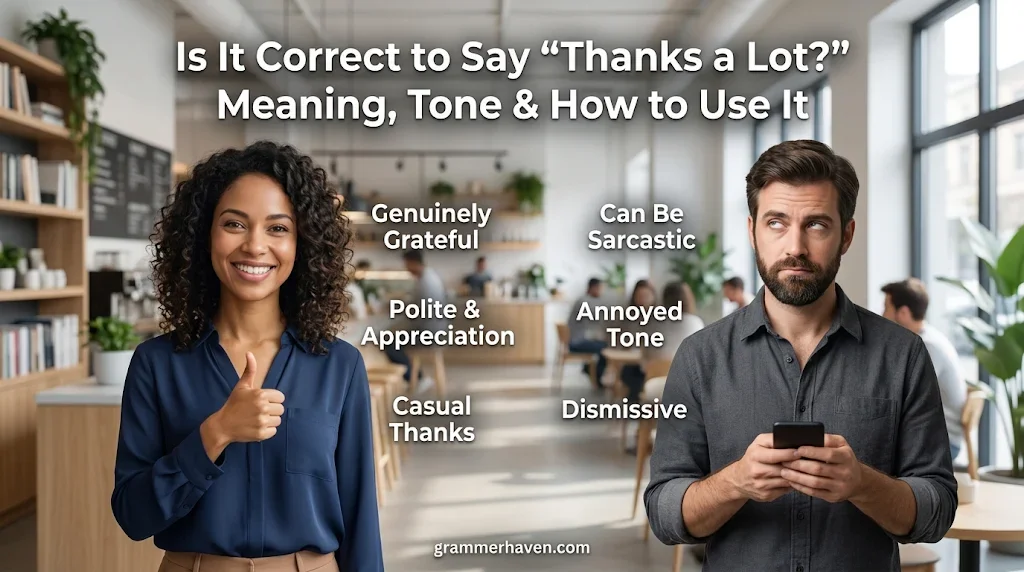
The phrase Is It Correct to Say “Thanks a Lot?” Meaning, Tone explains how Thanks a Lot expresses gratitude with context, tone, and etiquette. In English etiquette and everyday language use, Thanks a Lot is a common phrase used to express gratitude after receiving a favor or kind gesture. These simple words carry different meaning depending on the audience, situation, and context. The right way to use this phrase depends on understanding its history, usage, and the nuances of the English language. Many people feel hesitation because the phrase can sound straightforward, heartfelt, and genuine, but the wrong tone or emphasis may cause the listener to think it sounds sarcastic or rude.
The phrase feels natural when used while saying thank you in daily conversations or emails after a positive emotional response. A warm voice, proper sentence structure, and clear wording create a polite expression of appreciation, acknowledgment, and courtesy. In formal language and professional contexts, alternatives like thank you or thank may sound more suitable, while informal language often accepts Thanks a Lot in personal situations. Learning English grammar, English phrases, idioms, and rich expressions helps you understand the correct decision for appropriate usage.
What “Thanks a Lot” Actually Means in English
When you say thanks a lot, you are intensifying gratitude. The phrase breaks down like this:
- Thanks = basic gratitude
- A lot = intensifier meaning “greatly” or “deeply”
So literally, it means:
“I appreciate this very much.”
That’s the clean, grammatical meaning.
However, English doesn’t stop at literal meaning. It adds emotional shading. Think of it like music. The same notes can sound like a happy tune or a sad one depending on how you play them.
So while the structure is correct, the interpretation depends on:
- Voice tone
- Relationship between speakers
- Situation (good or bad outcome)
- Written vs spoken communication
In short, grammar says yes. Social meaning says “it depends.”
Is “Thanks a Lot” Grammatically Correct?
Yes, “thanks a lot” is grammatically correct English.
It follows a standard intensifier pattern:
noun + intensifier
Here are similar correct structures:
- Thanks very much
- Thanks a lot
- Thanks so much
- Thanks a ton
Linguistically, English often uses intensifiers to amplify emotion. This is common in informal speech patterns.
Quick Grammar Insight
| Phrase | Structure Type | Correct? | Formality |
| Thanks | Base noun phrase | Yes | Neutral |
| Thanks a lot | Intensified noun phrase | Yes | Informal |
| Thanks very much | Adverbial intensifier | Yes | Neutral-formal |
| I appreciate it greatly | Verb phrase intensifier | Yes | Formal |
So if your question is purely grammatical, the answer is simple: it is absolutely correct English.
But grammar is only half the story.
Why “Thanks a Lot” Can Sound Polite or Sarcastic
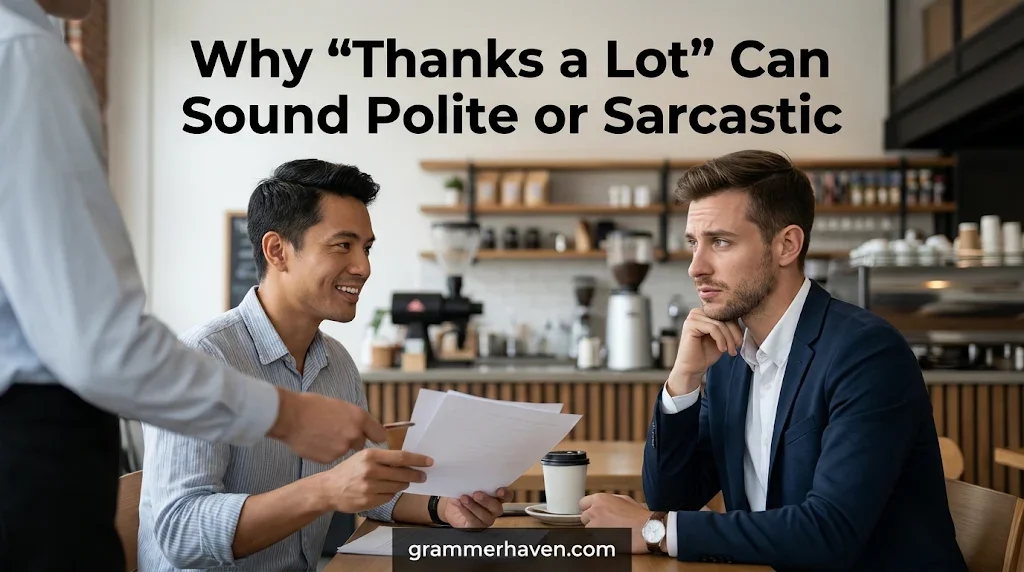
Here’s where things get interesting. The phrase is emotionally flexible. It behaves like a chameleon.
In spoken English, tone carries meaning. In written English, punctuation and context take over.
Let’s look at both sides.
When “Thanks a Lot” Sounds Genuine
In friendly, relaxed situations, it works perfectly as sincere gratitude.
You’ll often hear it in:
- Casual conversations
- Friendly texting
- Informal workplace chats
- Everyday interactions
Example:
- “You helped me fix my laptop. Thanks a lot!”
- “Thanks a lot for picking me up today.”
In these cases, the phrase feels warm and natural. It adds emotional weight compared to a simple “thanks.”
When “Thanks a Lot” Sounds Sarcastic
Now flip the context. Imagine something goes wrong.
Suddenly, the same phrase changes meaning completely.
Example:
- “You deleted my file… thanks a lot.”
- “Oh great, you locked me out. Thanks a lot.”
Here, “a lot” doesn’t express gratitude. It exaggerates frustration.
It becomes shorthand for:
“You really messed this up.”
This dual meaning is why learners often feel confused.
Why Tone Changes Everything
Linguists often explain this using pragmatics, which studies meaning beyond grammar.
The phrase itself is neutral. But humans interpret:
- Emotion in voice
- Speed of speech
- Facial expressions
- Relationship history
- Situation outcome
Even in text, people infer tone using:
- Periods (.)
- Exclamation marks (!)
- Timing of message
- Prior conversation context
So the phrase becomes a blank canvas. You paint the meaning.
Real-Life Scenarios: Polite vs Sarcastic Use
Let’s make it practical so you can feel the difference.
Scenario Table
| Situation | Phrase Used | Likely Meaning |
| Friend helps you carry groceries | “Thanks a lot!” | Genuine gratitude |
| Coworker misses deadline causing delay | “Thanks a lot…” | Sarcasm / frustration |
| Someone gives you a gift | “Thanks a lot!” | Warm appreciation |
| Someone gives wrong directions | “Oh, thanks a lot.” | Irritation |
Notice how the same words shift meaning entirely.
That’s English in real life: flexible and emotional.
When “Thanks a Lot” Feels Polite and Natural
Let’s zoom in on positive usage.
You’ll typically use “thanks a lot” when:
- You want to sound warm but casual
- You’re speaking to friends or peers
- You want to emphasize appreciation
Natural Examples
- “Thanks a lot for helping me move. I couldn’t have done it without you.”
- “Thanks a lot, that advice really helped.”
- “Thanks a lot for the ride home.”
In these cases, the phrase feels personal. It’s slightly stronger than “thanks” but not overly formal.
Think of it like a friendly tap on the shoulder instead of a formal handshake.
When “Thanks a Lot” Becomes Sarcastic or Rude
Now let’s look at the tricky side.
This phrase often turns sarcastic when:
- Something goes wrong
- The speaker is disappointed
- There is blame involved
- Emotions are high
Example Dialogues
Example 1: Broken expectation
- A: “I accidentally submitted the wrong file.”
- B: “Thanks a lot. Now I have to redo everything.”
Example 2: Mistake causing inconvenience
- A: “I forgot to send the email.”
- B: “Oh, thanks a lot.”
In both cases, the phrase carries frustration, not gratitude.
Why it sounds harsh
Because “a lot” amplifies emotion. When paired with negative situations, it amplifies anger instead of appreciation.
It’s like turning up the volume on frustration.
Cultural and Regional Differences in Interpretation

English is not one-size-fits-all. Different regions interpret tone differently.
General patterns:
- American English: More tolerant of casual sarcasm in speech
- British English: Often relies heavily on tone and understatement
- Texting culture globally: More prone to misinterpretation
In professional environments, especially in international communication, “thanks a lot” can sometimes feel risky because written tone is harder to read.
That’s why many professionals avoid it in emails.
Better Alternatives to “Thanks a Lot”
Sometimes clarity matters more than expression. Choosing the right phrase avoids misunderstanding.
Here’s a practical breakdown:
Neutral Alternatives
Use these when you want safe, clear communication:
- Thanks
- Thank you
- Many thanks
These are simple and almost impossible to misread.
Warm and Friendly Alternatives
Use these when you want to sound human and appreciative:
- Thanks so much
- I really appreciate it
- That means a lot, thank you
These feel more emotionally stable than “thanks a lot.”
Professional Alternatives
In workplace or formal writing, choose clarity:
- Thank you for your assistance
- I appreciate your help
- Many thanks for your support
These reduce ambiguity and maintain professionalism.
Comparison Table
| Phrase | Emotional Tone | Risk of Misunderstanding |
| Thanks | Neutral | Very low |
| Thanks a lot | Depends on context | Medium to high |
| Thanks so much | Warm | Low |
| I appreciate it | Sincere | Very low |
| Thank you very much | Formal | Very low |
When You Should Avoid Saying “Thanks a Lot”
Even though it is grammatically correct, some situations make it risky.
Avoid it when:
- Writing formal emails
- Communicating with clients
- Dealing with sensitive topics
- Reporting problems or complaints
- Professional conflict situations
Why? Because written communication lacks tone clarity.
A simple phrase like “thanks a lot” can unintentionally sound passive-aggressive.
Case Study: Miscommunication in Workplace Emails
Let’s look at a real-world communication pattern.
Situation
A project manager misses a deadline, affecting a team rollout.
Email response options:
Option A:
Thanks a lot for the delay.
- Interpretation: Passive-aggressive
- Risk: High tension
Option B:
Thank you for the update. Let’s adjust the timeline.
- Interpretation: Professional and calm
- Risk: Low
Same situation. Completely different impact.
This is why professionals often avoid ambiguous phrases like “thanks a lot” in writing.
Psychological Reason Behind the Confusion
Human brains are wired to detect emotion quickly.
When people read “thanks a lot,” they subconsciously ask:
- Is this positive or negative?
- What tone should I assume?
- Is there hidden frustration?
Because of this ambiguity, the brain sometimes defaults to caution.
That’s why misinterpretation happens so easily.
See also: The Latter: Definition, Meaning and Examples
FAQs:
1. Is “Thanks a Lot” grammatically correct?
Yes, Thanks a Lot is grammatically correct. It is a common English expression used to show appreciation or gratitude. The phrase works best when the speaker uses a friendly and sincere tone.
2. Can “Thanks a Lot” sound sarcastic?
Yes, Thanks a Lot can sometimes sound sarcastic depending on the situation and voice tone. For example, someone may say it after a mistake or inconvenience to express annoyance instead of gratitude.
3. Is “Thanks a Lot” formal or informal?
Thanks a Lot is generally considered more informal. In professional or formal situations, phrases like Thank you very much, I appreciate your help, or I am grateful for your support may sound more appropriate.
4. What is the difference between “Thanks” and “Thanks a Lot”?
Thanks is a simple way to show appreciation, while Thanks a Lot adds more emphasis. It usually expresses stronger gratitude, but the meaning can change based on the speaker’s tone and context.
5. What are some alternatives to “Thanks a Lot”?
Some alternatives include Thank you so much, I really appreciate it, I am very grateful, Many thanks, and I truly appreciate your kindness. These expressions can fit different levels of formality and situations.
Conclusion:
Is It Correct to Say “Thanks a Lot?” Meaning, Tone depends on the situation, relationship, and the way you say it. The phrase is perfectly correct and commonly used to show gratitude, especially in casual conversations, personal interactions, and friendly situations. However, your tone, context, and choice of words decide whether it sounds warm, genuine, or sarcastic. By understanding English etiquette, social norms, and proper usage, you can use Thanks a Lot confidently while making your message clear and respectful.
Latest Post:
- Result In or Result To: Which Is Correct? (With Examples)
- A Dime a Dozen: Meaning, Definition, Origin and Real-Life Usage
- Hooplehead Definition, Meaning, Usage and Examples
- Whole vs Hole: What’s the Difference?
- Acumen vs Acuity vs Acuteness: What’s the Difference?