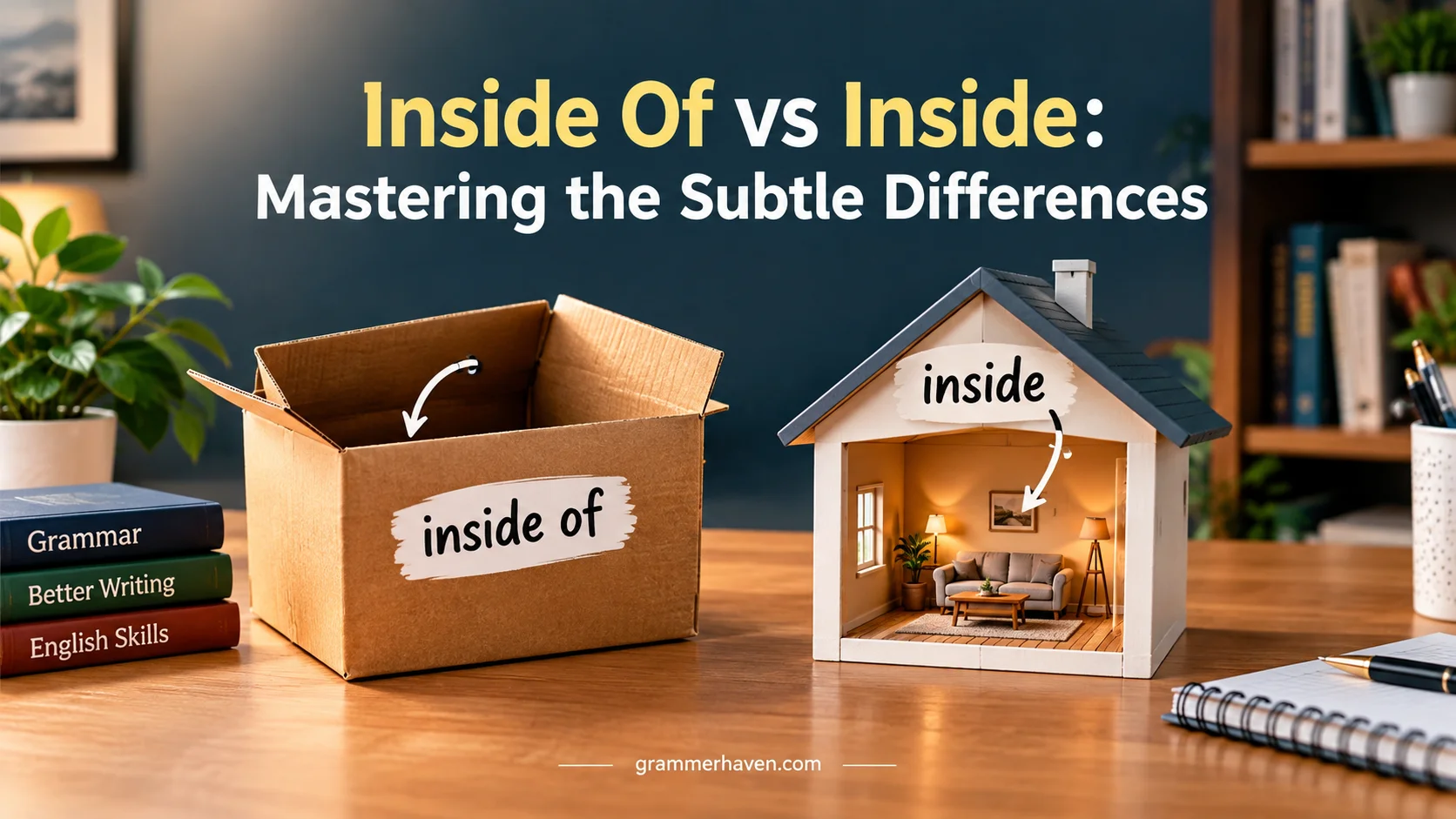
Inside Of vs Inside: Mastering the Subtle Differences helps English learners understand usage, meaning, context, and grammar rules clearly today. Mastering the English language requires noticing small details that create a big difference in communication. Many English learners become confused because Inside and Inside of appear similar at first glance, but their usage and meaning can vary significantly. Inside usually describes an interior, location, or place, while Inside of often adds emphasis when describing the interior of something such as a house or box. These phrases are commonly debated and sometimes misused, which makes understanding their subtle differences, grammar rules, and practical applications important for better word choice.
The key to sounding like a native speaker is knowing when and how to use each phrase correctly. In modern English, these 2 phrases have different purposes in sentences, and a comparison of their context, tone, and terminology improves sentence structure. For example, sentence examples show that “inside” focuses on location meaning, while “inside of” can highlight emphasis meaning. Through learning, practicing, and real conversations, learners can improve fluency, accuracy, and communication skills while learning to write and speak more confidently.
Using the right tool for the job also applies to language learning because choosing the correct expression improves clarity. Handling these small details prevents confused situations and helps people communicate in a more clear, simple, and direct way. When discussing a time frame or period, such as five minutes or 5 minutes, understanding a time expression becomes easier with practice. Feeling the language, reviewing examples, and understanding how Inside is used Inside another sentence can build stronger conversational English skills. The explanation becomes more effective when learners focus on specific purpose, practice, and everyday conversations and writing.
Inside Of vs Inside: Quick Answer You Can Use Immediately
If you don’t have time to dig deep, here’s the core idea:
- Inside = cleaner, more formal, and preferred in writing
- Inside of = more casual, conversational, and common in speech
That’s it.
Think of it like dressing for different occasions:
- “Inside” is your clean, fitted outfit for work or school
- “Inside of” is your relaxed, everyday home outfit
Both are correct. But one looks more polished depending on the situation.
Inside Of vs Inside: What’s Actually Happening in Grammar?
To really understand Inside Of vs Inside, you need to see how each functions in a sentence. The difference isn’t about meaning. It’s about structure and tone.
Inside as a Preposition
The word inside works as a straightforward preposition. It directly shows location without extra words.
It is:
- Short
- Efficient
- Grammatically standard
Examples:
- The laptop is inside the bag.
- She stayed inside the house during the storm.
- The files are inside the folder.
In each case, “inside” does the job cleanly without needing support words.
Inside of as a Prepositional Phrase
Now compare that with inside of. Here, “of” gets added for rhythm or emphasis, especially in spoken English.
It feels:
- Softer
- More conversational
- Slightly redundant in formal writing
Examples:
- The laptop is inside of the bag.
- She stayed inside of the house during the storm.
- The files are inside of the folder.
Same meaning. Just more wordy.
Key Insight You Should Remember
There is no difference in meaning between the two.
However:
- “Inside” = preferred in writing
- “Inside of” = more natural in speech
That small shift matters more than most people realize.
Inside Of vs Inside: When You Should Use “Inside”
If you want your writing to sound sharp, clean, and professional, inside should be your default choice.
Use “Inside” in these situations:
- Academic writing
- Business communication
- Professional emails
- Articles and blog posts
- Technical explanations
Examples of correct usage:
- The contract is inside the folder.
- Please remain inside the building during the inspection.
- The solution is hidden inside the system.
Why “Inside” Works Better
Writers prefer “inside” for one simple reason: clarity wins.
Shorter words:
- Improve readability
- Reduce clutter
- Speed up comprehension
Imagine reading a long report filled with unnecessary words. It slows you down. “Inside” avoids that problem entirely.
Real-world tip
Editors often remove “of” in professional writing unless it adds tone or rhythm. That’s why published books, newspapers, and formal documents lean heavily toward “inside.”
Inside Of vs Inside: When “Inside of” Feels Natural
Even though “inside of” is less formal, it still has a place in English. In fact, native speakers use it quite often in casual speech.
Use “inside of” when:
- Speaking casually
- Writing dialogue in stories
- Emphasizing tone or emotion
- Mimicking natural speech patterns
Examples in real-life conversation:
- He’s still inside of the office.
- I left my phone inside of the car.
- She said she was inside of the room the whole time.
These sound natural in speech. They feel relaxed and unfiltered.
Why people still use it
English speech tends to be rhythm-driven. Sometimes “inside of” simply feels better when speaking quickly.
It adds:
- Flow
- Emphasis
- A conversational tone
So even though it’s not necessary, it sticks around in everyday language.
Inside Of vs Inside: Side-by-Side Comparison Table
Let’s break it down visually so you can see the difference instantly.
| Context | Better Choice | Example |
| Academic writing | Inside | The data is inside the report. |
| Business email | Inside | Please check inside the attachment. |
| Casual speech | Inside of | It’s inside of the drawer. |
| Fiction dialogue | Inside of | He said he was inside of the house. |
| Technical writing | Inside | The file is inside the system. |
This pattern is consistent across English usage.
Inside Of vs Inside: Common Mistakes People Make

Even fluent speakers slip up when using Inside Of vs Inside. The mistakes usually come from overthinking or copying spoken habits into writing.
Mistake: Overusing “inside of” in formal writing
This makes writing feel longer and less sharp.
❌ Incorrect:
- The documents are inside of the folder attached to the email.
✔ Better:
- The documents are inside the folder attached to the email.
Mistake: Thinking they mean different things
Some learners assume “inside of” adds emphasis or changes meaning. It doesn’t.
Both mean:
located within something
Mistake: Mixing tone in one paragraph
This creates inconsistency.
❌ Example:
- The files are inside of the system and inside the database.
✔ Better:
- The files are inside the system and the database.
Mistake: Using “inside of” to sound more advanced
Ironically, it does the opposite. It makes writing feel less refined, not more.
Why “Inside” Dominates in Professional English
If you look at modern writing standards, inside clearly dominates.
Here’s why professionals prefer it:
1. It reduces wordiness
Every extra word slows the reader slightly.
2. It improves readability
Shorter sentences are easier to process.
3. Style guides prefer it
Most editorial guidelines favor concise language.
4. It matches global English standards
Across:
- Academic writing
- Journalism
- Technical documentation
“Inside” is the default choice.
Simple analogy
Think of writing like a highway.
“Inside of” is the same road but with extra traffic slowing things down.
Inside Of vs Inside: Regional and Spoken English Differences
English changes depending on where and how people use it.
American English
- “Inside of” appears frequently in casual speech
- “Inside” dominates formal writing
Example:
- He’s inside of the house (spoken)
- He is inside the house (written)
British English
- “Inside” is strongly preferred in most contexts
- “Inside of” is less common overall
Speech vs Writing
| Medium | Preference |
| Speech | Inside of (common) |
| Writing | Inside (preferred) |
Inside Of vs Inside: A Simple Rule You Can Always Follow

Here’s the easiest rule you can remember:
If you’re writing something important, use “inside.”
If you’re speaking or writing casually, “inside of” is fine.
That one rule solves 95% of confusion.
Inside Of vs Inside: Practice Examples
Now let’s test your understanding. Choose the best option.
Fill in the blanks
- The keys are ___ the drawer.
- She stayed ___ the house during the rain.
- The documents are ___ the folder.
- He said he was ___ the office all day.
- The answer lies ___ the text.
Answers
- inside
- inside / inside of (both work, context decides tone)
- inside
- inside / inside of (speech vs writing)
- inside
Inside Of vs Inside: Case Study in Real Writing
Let’s look at a practical example to see how this plays out.
Scenario: A student writing an essay
The student writes:
The experiment materials were placed inside of the laboratory cabinet, and the samples were kept inside of sealed containers.
A teacher reviews it and revises it:
The experiment materials were placed inside the laboratory cabinet, and the samples were kept inside sealed containers.
What changed and why it matters
- Removed unnecessary “of” phrases
- Improved academic tone
- Made sentences tighter and more professional
- Reduced word count without losing meaning
Result
The revised version:
- Reads faster
- Feels more formal
- Looks publication-ready
That’s the real impact of choosing “inside” correctly.
See also: “In the Morning” or “On the Morning”? A Complete Guide Explains
FAQs:
1. What is the main difference between Inside and Inside of?
Inside usually refers to the position or location of something, while Inside of often emphasizes the interior part of an object, place, or area. In many situations, both can have similar meanings, but the tone and emphasis may change.
2. Is “Inside of” grammatically correct?
Yes, Inside of is grammatically correct. It is commonly used in everyday speech, especially when someone wants to emphasize the inner part of something. However, in many cases, Inside sounds more natural and concise.
3. Can I use Inside instead of Inside of in every sentence?
Not always. Although they are sometimes interchangeable, the best choice depends on the context and intended meaning. For example, “The book is inside the bag” sounds more natural than “The book is inside of the bag” in standard usage.
4. Why do English learners confuse Inside and Inside of?
English learners often get confused because both phrases describe something being within another place or object. The difference is subtle and depends on usage, emphasis, and how native speakers structure sentences.
5. Which phrase is more common in modern English: Inside or Inside of?
Inside is generally more common in modern English because it is shorter, direct, and widely used in both speaking and writing. Inside of is still accepted but is often used when the speaker wants to highlight the interior of something.
Conclusion:
Understanding Inside Of vs Inside: Mastering the Subtle Differences helps you communicate with better accuracy and confidence. While both phrases can describe something located within a place, Inside is usually the more common choice for showing location, while Inside of often adds extra emphasis or focuses on the interior of something. By paying attention to context, meaning, and sentence structure, you can choose the right expression naturally. With regular practice, examples, and real conversations, these small grammar details become easier to understand and use correctly.