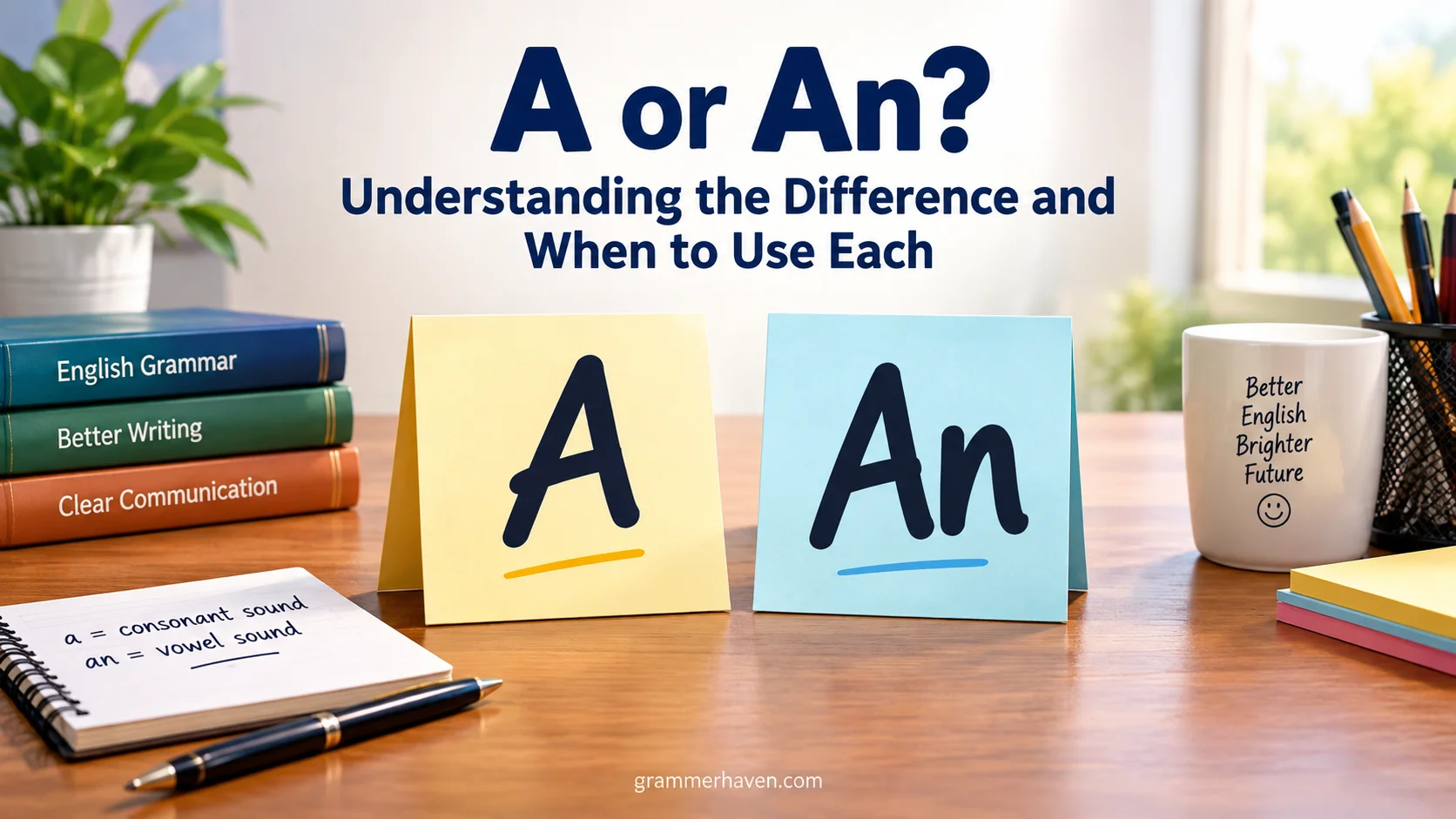
Choosing A or An depends on the first sound: use a before a consonant sound and an before a vowel sound in English. A and an are two different forms of the same indefinite article. They appear before a singular noun, adjective, or noun phrases. The spelling of the word doesn’t decide the article. A football, a driver’s license, a European country, and a university president use a because their opening sound is a consonant sound. An apple uses an because it begins with a vowel sound. The vowel letter may be e, u, or y, but pronunciation controls the choice.
Pronunciation matters when a consonant letter has a vowel sound. In an hour, the h is silent, so the word begins with a vowel sound. An irritated driver and an accurate weather report also begin with vowel sounds. A university uses a because u has the yoo sound. European follows the same pattern. A menu can use a when it follows a consonant sound. I’ve seen learners focus on the letter instead of the sound, which creates avoidable errors. The simple rule is to listen to the first sound before choosing a or an.
Initialisms follow their spoken letter name, not their written letter. An MBA degree uses an because MBA is pronounced with M, whose name begins with the em sound. An FBI agent follows the same pattern because the spoken name of F begins with a vowel sound. A university uses a because its opening sound is yoo. This rule works in emails, essays, reports, conversations, and resumes. It also applies to academic writing and everyday English, where listening to the opening sound makes choosing the correct article easier.
Quick Answer: A or An?
Use a before a consonant sound and an before a vowel sound.
| Use | When | Examples |
| A | Before a consonant sound | a book, a car, a house |
| An | Before a vowel sound | an apple, an idea, an umbrella |
| A | Before a “you” sound | a university, a uniform |
| An | Before a silent H | an hour, an honest person |
| A | Before a “w” sound | a one-time offer |
| An | Before a vowel sound in an abbreviation | an FBI agent, an MBA |
The most important rule is simple:
Choose “a” or “an” according to pronunciation, not the first letter.
Merriam-Webster, Cambridge Dictionary, and the British Council all explain the distinction in terms of the sound that follows the article.
What Are A and An?
A and an are indefinite articles. They normally appear before singular countable nouns when you’re talking about one person, animal, object, or thing without identifying a particular one.
For example:
- I saw a dog outside.
- She bought an umbrella.
- He wants a new laptop.
- We found an interesting book.
The listener doesn’t necessarily know which dog, umbrella, laptop, or book you’re talking about. You’re introducing the noun as one item among others.
Compare these two sentences:
- I saw a dog in the park.
- I saw the dog in the park.
The first sentence introduces a nonspecific dog. The second suggests that both people know which dog the speaker means. That’s the basic difference between the indefinite articles a/an and the definite article the.
Why Are There Two Forms?
A and an perform the same grammatical job. The difference exists because English speakers naturally adjust pronunciation for smoother speech.
Consider these phrases:
- a book
- an apple
Try saying them aloud. The extra n in an creates a natural bridge before a vowel sound.
English does this because speech has rhythm. A phrase such as an apple flows more easily than forcing the consonant sound in a directly against the vowel beginning of apple.
The Main Rule: A Before Consonant Sounds, An Before Vowel Sounds
This is the rule worth remembering above everything else.
Use A Before a Consonant Sound
Use a when the next word begins with a consonant sound.
Examples include:
- a dog
- a teacher
- a computer
- a house
- a movie
- a problem
- a restaurant
- a large apartment
Notice that the rule concerns pronunciation.
For instance, a house works because the house begins with a clearly pronounced /h/ sound.
Use An Before a Vowel Sound
Use an when the next word begins with a vowel sound.
Examples include:
- an apple
- an elephant
- an idea
- an office
- an umbrella
- an expensive car
- an interesting story
The British Council gives the same sound-based rule and specifically uses examples such as a university and an hour to demonstrate why spelling can mislead you.
Why Spelling Can Mislead You
Here’s where many grammar mistakes begin.
You may have learned that vowels are A, E, I, O, U. From there, it’s tempting to assume that every word beginning with one of those letters needs an.
That shortcut doesn’t work.
Likewise, assuming that every word beginning with a consonant letter requires a creates mistakes.
The reason is straightforward: letters represent sounds, and English spelling doesn’t always match pronunciation perfectly.
Look at these examples:
| Word | First letter | Opening sound | Correct phrase |
| university | U | “yoo” | a university |
| European | E | “yoo” | a European |
| one-time | O | “w” | a one-time offer |
| hour | H | vowel sound | an hour |
| honest | H | vowel sound | an honest answer |
| apple | A | vowel sound | an apple |
This is why a university is correct while an university isn’t standard US English. The first sound in university is the consonant-like /y/ sound.
On the other hand, an hour is correct because hour starts with a vowel sound after the silent h.
When to Use A
A Before Ordinary Consonant Sounds
The easiest cases involve words that clearly begin with consonant sounds.
Examples:
- a cat
- a table
- a phone
- a student
- a teacher
- a garden
- a river
- a question
You don’t need to overthink these. Say the word naturally, listen to its opening sound, and choose a.
A Before a Pronounced H
Words such as house, hotel, hospital, and hero begin with a pronounced h sound.
Therefore:
- a house
- a hotel
- a hospital
- a hero
- a human
- a history book
The written letter h isn’t the deciding factor. The pronunciation is.
That distinction becomes important when you compare a hotel with an hour. Both words start with h on the page, but their sounds differ.
A or An Before U?
The letter U creates some of the most common mistakes.
Sometimes u begins with a vowel sound. Sometimes it begins with a “you” sound.
When it sounds like “you,” use a.
Examples:
- a university
- a uniform
- a user
- a useful tool
- a unique opportunity
- a union
- a European vacation
Why?
Because university begins with a sound like “yoo-niversity.” The opening /y/ sound acts as a consonant sound for article selection. Cambridge specifically lists a university, a united group, and a one-year-old child as examples of vowel letters producing consonant sounds.
Now compare those with words in which u produces a true vowel sound:
- an umbrella
- an uncle
- an unusual event
- an urgent request
So don’t memorize “U means an.” That’s too crude.
Instead, ask:
How does the word sound when you say it?
A or An Before EU Words?
Words beginning with eu often follow the same “you” pattern.
For example:
- a European
- a European country
- a euphemism
- a eulogy
- a Eurasian species
The opening sound resembles “you,” so a is normally appropriate.
This is another case where the written vowel doesn’t automatically require an.
When to Use An
An Before Ordinary Vowel Sounds
Use an before words that genuinely begin with vowel sounds.
Examples:
- an apple
- an orange
- an elephant
- an engineer
- an idea
- an office
- an umbrella
- an answer
These are the straightforward cases.
An Before Words With Silent H
Now things get more interesting.
Some English words begin with the letter h, but speakers don’t pronounce that h. The word therefore starts with a vowel sound.
Common examples include:
- an hour
- an honest person
- an honor
- an heir
- an honorable decision
Consider an hour.
You don’t pronounce it “h-hour.” You pronounce it roughly like “our.” Because the first audible sound is a vowel sound, an hour is correct.
The same principle explains an honest answer. The h doesn’t produce the opening consonant sound.
A or An With H Words: The Important Distinction

A useful way to remember H words is to divide them into two groups.
| Pronunciation | Article | Examples |
| H is pronounced | A | a house, a hotel, a hospital |
| H is silent | An | an hour, an honest person, an heir |
This distinction is more reliable than memorizing lists.
If you hear the h sound, choose a.
If the word begins with a vowel sound because the h is silent, choose an.
What About “A Historic” vs. “An Historic”?
This one deserves special attention because you may encounter both forms.
In contemporary US English, a historic event is the natural choice when the h is pronounced.
For example:
- a historic decision
- a historic moment
- a historic building
However, an historic also appears, particularly in older writing and in varieties where the initial h may be weak or absent. Merriam-Webster notes that historic is among the words for which both forms can occur and connects the choice to pronunciation.
For modern US English, a historic is generally the safer everyday choice when you pronounce the h.
A or An Before Adjectives
Here’s another detail that trips people up.
The article agrees with the first sound immediately after it, not necessarily the noun at the end of the phrase.
Compare:
- a car
- an expensive car
- a useful car
- an unusual car
- a European car
- an old European car
In an expensive car, the article doesn’t care that the car begins with a consonant sound. The next word is expensive, which begins with a vowel sound.
So the structure works like this:
article → first spoken sound → rest of noun phrase
The University of Nevada, Reno also explains that a/an works with singular count nouns and that the sound of the word following the article determines the form.
A or An With Abbreviations, Initialisms, and Acronyms
Abbreviations create some wonderfully strange-looking examples.
Consider:
- an FBI agent
- an MBA
- an MRI scan
- an HR manager
At first glance, these may seem backward. FBI begins with the letter F, which is written as a consonant.
But say the letters aloud:
FBI → “eff-bee-eye”
The first spoken sound is a vowel sound: “eff.”
Therefore:
an FBI agent is correct.
The same principle applies to MBA, pronounced “em-bee-ay,” and MRI, pronounced “em-ar-eye.” Merriam-Webster specifically explains that article choice with initialisms depends on how the letters are pronounced aloud.
Compare These Examples
| Expression | Spoken beginning | Correct |
| FBI agent | “eff” | an FBI agent |
| MBA program | “em” | an MBA program |
| MRI scan | “em” | an MRI scan |
| HR manager | “aitch” | an HR manager |
| URL | “you” | a URL |
| USB drive | “you” | a USB drive |
| CIA agent | “see” | a CIA agent |
The printed letter isn’t what matters. The spoken letter name is.
A or An Before Numbers
Numbers can follow the same pronunciation rule.
For example:
- an 8-year-old child
- an 11-year-old student
- an 18-month-old baby
- a one-time payment
- a 100-year-old building
Why is it an 8-year-old?
Because 8 is read as eight, which begins with a vowel sound.
Why is it a one-time payment?
Because one begins with a w sound when pronounced.
This same logic applies to numbers written as words.
| Number | Spoken form | Correct article |
| 8 | eight | an 8-year-old |
| 11 | eleven | an 11-page report |
| 18 | eighteen | an 18-minute delay |
| 100 | one hundred | a 100-page book |
| 1 | one | a one-hour meeting |
The University of Nevada, Reno notes that the sound-based principle applies to words and numbers that begin with vowel sounds.
A or An With Professions and Occupations
English commonly uses a/an when you identify someone’s profession, occupation, or role.
Examples:
- She is a doctor.
- He is an engineer.
- She became a teacher.
- He’s an architect.
- She works as an editor.
- He’s a university professor.
The choice still depends on pronunciation.
You say:
- a doctor
- an engineer
- an architect
- a lawyer
- an analyst
A common mistake is to leave the article out:
- She is a doctor. ❌
- She is a doctor. ✅
When a singular countable profession follows in this kind of identification, the indefinite article is normally needed.
When You Shouldn’t Use A or An
Knowing when not to use an article is just as important as knowing which one to choose.
Plural Nouns
You don’t normally put a or an before a plural noun.
Incorrect:
- a books
- an apples
- a cars
Correct:
- books
- apples
- cars
The reason is structural. A/an refers to one singular item, while plural nouns refer to more than one.
Uncountable Nouns
You also don’t normally use a/an directly before an uncountable noun.
Common examples include:
- advice
- information
- furniture
- water
- rice
- traffic
- equipment
So these are incorrect in standard English:
- an advice ❌
- an information ❌
- a furniture ❌
- an equipment ❌
Instead, you can use a suitable counting expression:
- a piece of advice
- a piece of information
- a piece of furniture
- a piece of equipment
- a bottle of water
The writing center at Texas A&M University explains that the indefinite article is used with count nouns rather than noncount nouns.
Common A or An Mistakes
These mistakes often happen because writers look at spelling instead of pronunciation.
| Incorrect | Correct | Reason |
| an university | a university | “University” starts with a “you” sound |
| a hour | an hour | The H is silent |
| an European | a European | “European” starts with a “you” sound |
| a apple | an apple | “Apple” starts with a vowel sound |
| an house | a house | The H is pronounced |
| a honest person | an honest person | The H is silent |
| an useful tool | a useful tool | “Useful” begins with a “you” sound |
| a umbrella | an umbrella | “Umbrella” begins with a vowel sound |
| a FBI agent | an FBI agent | “FBI” begins with “eff” |
| an URL | a URL | “URL” begins with a “you” sound |
The pattern becomes obvious once you stop treating letters as the deciding factor.
A or An: Common Myths
Myth: Use An Before Every Vowel Letter
Not quite.
You use an before a vowel sound, not simply a vowel letter.
That’s why:
- a university ✅
- a European ✅
- a uniform ✅
Myth: Use A Before Every Consonant Letter
That fails too.
Consider:
- an hour ✅
- an honest answer ✅
- an heir ✅
The letter h appears in all three words, but it doesn’t create the opening consonant sound.
Myth: The Noun Determines the Article
The noun isn’t always the word that matters.
Compare:
- a car
- an expensive car
- a useful car
- an old car
The article responds to the first sound immediately after it.
Myth: A and An Have Different Meanings
They don’t.
A and an are two forms of the same indefinite article. The difference exists because English pronunciation favors one form before consonant sounds and the other before vowel sounds.
A or An: A Simple Three-Step Method
When you’re unsure, don’t guess. Use this quick process.
Identify the noun phrase
Ask whether you’re talking about a singular countable noun.
For example:
- a book
- an idea
- a university
- an unusual situation
Ignore the spelling for a moment
Say the next word aloud.
Don’t stare at the first letter. Listen.
Choose the article
If the word starts with a consonant sound, use a.
If it starts with a vowel sound, use an.
For example:
university → “yoo-niversity” → consonant sound → a university
hour → “our” → vowel sound → an hour
one → “wun” → consonant sound → a one-time offer
apple → “apple” → vowel sound → an apple
This method works far better than memorizing hundreds of individual words.
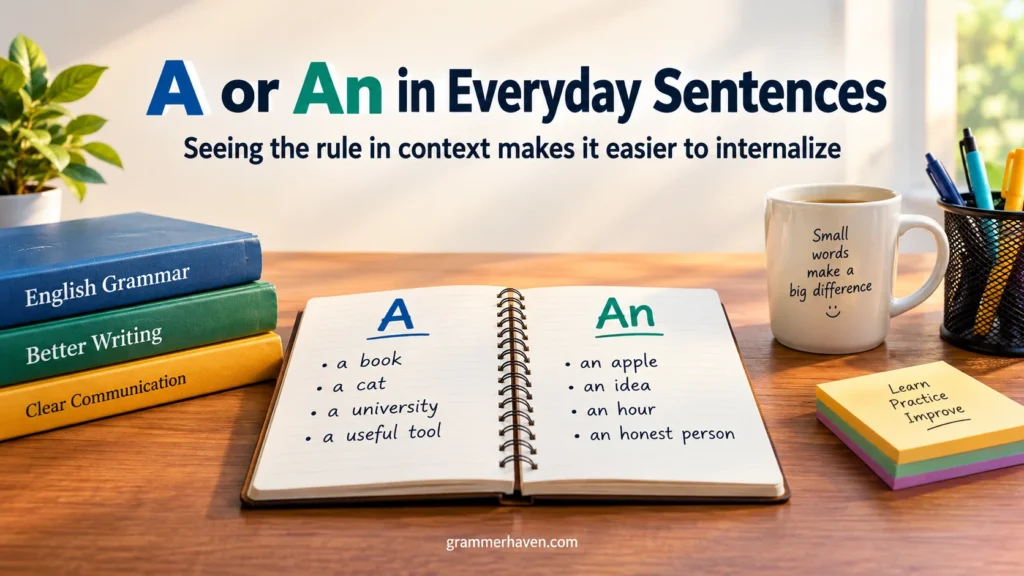
A or An in Everyday Sentences Seeing the rule in context makes it easier to internalize.
Everyday English
- I need a pen.
- She bought an umbrella.
- We saw a bird in the yard.
- He waited for an hour.
- She found an interesting recipe.
Work and Business
- We need a new strategy.
- She scheduled an interview.
- He prepared a report.
- They hired an experienced manager.
- We received an updated proposal.
Academic Writing
- The researcher developed a hypothesis.
- The study identified an unusual pattern.
- She wrote a literature review.
- The team conducted an experiment.
Technology
- He created a URL.
- She bought an SSD.
- We need a USB drive.
- He applied for an IT position.
- They hired an AI specialist.
A or An in American English
For US English, the safest practical rule remains pronunciation.
Most American speakers pronounce the h in words such as historic, so a historic event is the natural choice.
You’ll also hear a hotel, a hospital, and a history book because the initial h is pronounced.
Meanwhile, words such as hour, honest, and honor normally take an because their opening h is silent.
Pronunciation can vary across English-speaking communities, which explains why some expressions appear with different articles in different sources. Merriam-Webster specifically identifies historic as a word where pronunciation can affect whether writers choose a or an.
For standard contemporary US English, follow the pronunciation you actually use.
A vs. An: The Most Useful Comparison Table
| Situation | Use A | Use An |
| Consonant sound | a book | — |
| Vowel sound | — | an apple |
| Pronounced H | a hotel | — |
| Silent H | — | an hour |
| “You” sound | a university | — |
| Vowel U sound | — | an umbrella |
| “W” sound | a one-time offer | — |
| Vowel-sounding initialism | — | an FBI agent |
| “You”-sounding initialism | a URL | — |
| Vowel-sounding number | — | an 8-year-old |
| “W”-sounding number | a one-year-old | — |
Keep this table handy if you frequently write in English. It covers most of the cases that cause confusion.
A or An: Practice Quiz
Choose a or an in each sentence.
- She waited for ___ hour.
- He attends ___ university.
- We bought ___ umbrella.
- She’s ___ honest employee.
- He works for ___ FBI contractor.
- They made ___ unusual decision.
- I need ___ USB cable.
- She earned ___ MBA.
- He received ___ one-time offer.
- We visited ___ historic building.
- She wants to become ___ engineer.
- He stayed at ___ hotel.
- They hired ___ HR manager.
- She adopted ___ dog.
- He wrote ___ interesting article.
Answers
- an hour
- a university
- an umbrella
- an honest employee
- an FBI contractor
- an unusual decision
- a USB cable
- an MBA
- a one-time offer
- a historic building
- an engineer
- a hotel
- an HR manager
- a dog
- an interesting article
The trickiest answers are the ones where spelling and pronunciation disagree. Those are precisely the examples worth practicing.
A or An: Real-World Case Study
Imagine you’re writing a sentence for a business report:
The company hired an university graduate with experience in cybersecurity.
Something feels slightly off.
The problem is an university.
Say university aloud:
“yoo-niversity.”
That opening “yoo” sound is consonant-like. The corrected sentence is:
The company hired a university graduate with experience in cybersecurity.
Now change the sentence:
The company hired an experienced university graduate.
This time, an is correct because the next word is experienced. The adjective begins with a vowel sound.
That’s an important lesson: the article follows the first sound of the immediate word, not the main noun buried later in the phrase.
A or An: Final Rule to Remember
If you remember only one thing, remember this:
A goes before a consonant sound. An goes before a vowel sound.
Don’t let the first letter fool you.
That’s why you write:
- a university
- a European
- a uniform
- a one-time offer
- a URL
- an apple
- an umbrella
- an hour
- an honest person
- an FBI agent
- an MBA
The fastest way to make the right choice is to say the next word aloud. If the opening sound is a consonant, choose a. If it’s a vowel, choose an.
Once you start listening instead of simply looking at spelling, the whole a or an question becomes far less mysterious. What first seems like a pile of exceptions turns into one consistent pronunciation rule.
See also: Better Then or Than: Which Is Correct? A Complete Guide
FAQs:
Is it a or an before a vowel?
Use an before a vowel sound.
Examples include an apple, an idea, and an umbrella.
However, a vowel letter doesn’t automatically mean you need an. For example, a university is correct because university begins with a “you” sound.
Is it a university or an university?
The correct form is a university.
University begins with a /y/ sound, similar to the beginning of you. Therefore, it starts with a consonant sound for article purposes.
Is it a hour or an hour?
The correct form is an hour.
The h in hour is silent, so the word begins with a vowel sound.
Is it a European or an European?
The standard form is a European.
European begins with a “you” sound, which functions as a consonant sound.
Is it a honest person or an honest person?
The correct form is an honest person.
The h in honest is silent, so the word begins with a vowel sound.
Is it a historic or an historic?
In contemporary US English, a historic is generally the natural choice when the h is pronounced.
An historic also appears in some varieties and older usage. The choice can depend on pronunciation and style.
Is it a MBA or an MBA?
Use an MBA.
MBA is pronounced “em-bee-ay,” so its first spoken sound is a vowel sound.
Is it a URL or an URL?
Use a URL when you pronounce URL as “you-are-el.”
The initial “you” sound is consonant-like, so a URL follows the standard sound-based rule.
Can you use a or an with plural nouns?
No. A/an normally introduces a singular countable noun.
You say:
- a book
- an apple
- books
- apples
You don’t say a books or an apples.
Can you use a or an with uncountable nouns?
Not directly in the usual sense.
You wouldn’t normally write an information or a furniture. Instead, use a counting expression such as a piece of information or a piece of furniture.
Does a or an depend on spelling or pronunciation?
Pronunciation is the key.
Use a before a consonant sound and an before a vowel sound. This explains pairs such as a university/an umbrella and a hotel/an hour.
Conclusion
Choosing between a and an is mainly about pronunciation, not spelling. Use a before a consonant sound and an before a vowel sound. That’s why you write a university but an hour, and a European country but an MBA degree. Once you focus on the first sound of the next word, the rule becomes much easier to apply in everyday English, academic writing, and normal conversations.