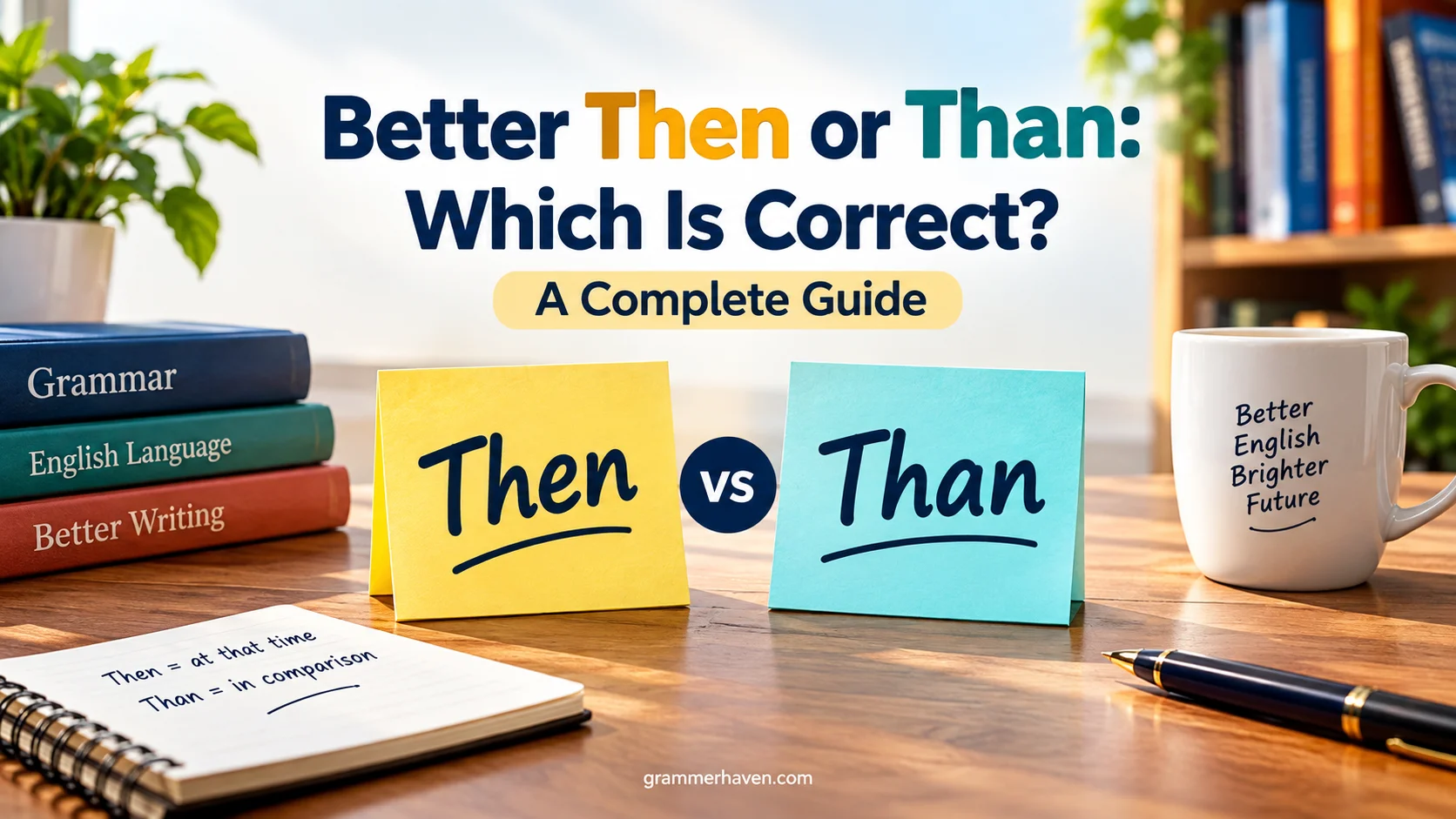
Better Then or Than is a common English grammar confusion involving words with different meanings, usage and roles in comparison sentences. Than belongs to comparison, while Then shows time, sequence, order, or a result. Learners often mix these words in writing and speech because they sound almost identical. The phrase Better Then is incorrect for a comparative sentence. She is better than him makes a clear comparison. We went home then ate dinner shows the order of actions. This simple rule makes the distinction straightforward: use Than for comparison and Then for time or sequence.
Correct usage of these two words can reduce grammatical errors and enhance clarity in professional communication, formal writing, academic work, and everyday speech. A useful method is to compare the purpose of each word with its role in the sentence. Than connects a comparative form to a person or thing. Then connects one event to another. In my experience, this distinction becomes easier with practice and attention to the word’s particular role. The correct choice depends on what you are expressing: comparisons, time, sequence, or results. Regular practice can improve accuracy, quality, and consistency in writing and speaking.
The focus keyword Better Then or Than points to a distinction that learners can master through simple practice. Choosing Than makes sense when you compare a good thing with something better. Choosing Then makes sense when you describe what happens next. A new laptop may play things better than an old one. You can describe what you did then to show the order of events. Keeping the words separate prevents them from being interchanged, strengthens understanding, and supports improving English skills across different contexts. Mastering this straightforward pattern helps you use each word correctly, clearly, and effectively.
Quick Answer: Better Then or Than?
“Better than” is correct when you’re making a comparison.
Use than after better when you compare people, objects, actions, ideas, situations, or results.
This option is better than the other one.
Use then when it means “at that time,” “next,” “after that,” or “in that case.”
Life was better then.
So, the simplest rule is:
Than compare. Then relates to time, order, or consequence.
| Phrase | Correct? | Typical meaning | Example |
| better than | ✅ Yes | Makes a comparison | This book is better than that one. |
| better then | ⚠️ Context-dependent | Refers to a particular time or sequence | Things were better then. |
The important point is that “better then” isn’t automatically wrong. It can be grammatically correct when then has its normal meaning. However, if you’re comparing two things, than is the word you need.
What Does “Better Than” Mean?
Better than means that one person, thing, action, or situation has a higher quality, standard, degree, or level than another.
The word better is the comparative form of good. It can also function as the comparative form of well when describing how an action is performed. Cambridge Dictionary defines better as something of a higher standard or something more suitable, pleasing, or effective than another option.
Consider this sentence:
This restaurant is better than the one across the street.
Here, better identifies the difference in quality. Than introduces the second restaurant in the comparison.
The structure looks like this:
First option + better + than + second option
For example:
- This phone is better than my previous phone.
- Sarah is better than me at chess.
- This method works better than the old one.
- The second explanation was better than the first.
- Today’s weather is better than yesterday’s.
In each sentence, than connect the two sides of the comparison.
Why “Better” Naturally Takes “Than”
Better is already comparative. It tells you that one thing has a higher degree of a quality than something else.
That’s why these combinations are so common:
- better than
- worse than
- faster than
- slower than
- easier than
- harder than
- more useful than
- less expensive than
English uses than to introduce the second part of a comparison. Cambridge’s grammar guidance specifically notes that than follows comparative adjectives and adverbs when the second person or thing is mentioned.
What Does “Then” Mean?
While than handles comparisons, then has a completely different role.
Then commonly refers to time, sequence, or consequence. Cambridge Dictionary identifies several uses, including “at that time,” “next,” and “in that case.”
That’s why these sentences work:
I lived there then.
Finish your work, then call me.
If you’re ready, then we can leave.
None of these sentences compares two things.
Then Means “At That Time”
The word then can point to a particular period in the past or future.
For example:
- I was much younger then.
- We didn’t have smartphones then.
- Things were different then.
- I’ll be busy then.
- Where were you then?
In these sentences, then = at that time.
That’s also why “Things were better then” is perfectly correct.
Here, better doesn’t introduce a comparison with a noun immediately afterward. Instead, then tells you when things were better.
Then Means “Next” or “After That”
Then can also describe the order in which events happen.
For example:
- First, wash the vegetables. Then cut them.
- Finish the report, then send it.
- We had dinner and then watched a movie.
- Turn left at the intersection, then continue for two miles.
Think of then as a signpost on a timeline.
First → then → afterward
That’s a completely different job from than.
Then Can Show a Result
You can also use then to express a consequence, particularly in if…then constructions.
For example:
If you study consistently, then you’ll improve.
If the store is closed, then we’ll come back tomorrow.
Here, then means something close to “in that case” or “as a result.”
Why Do People Confuse “Then” and “Than”?
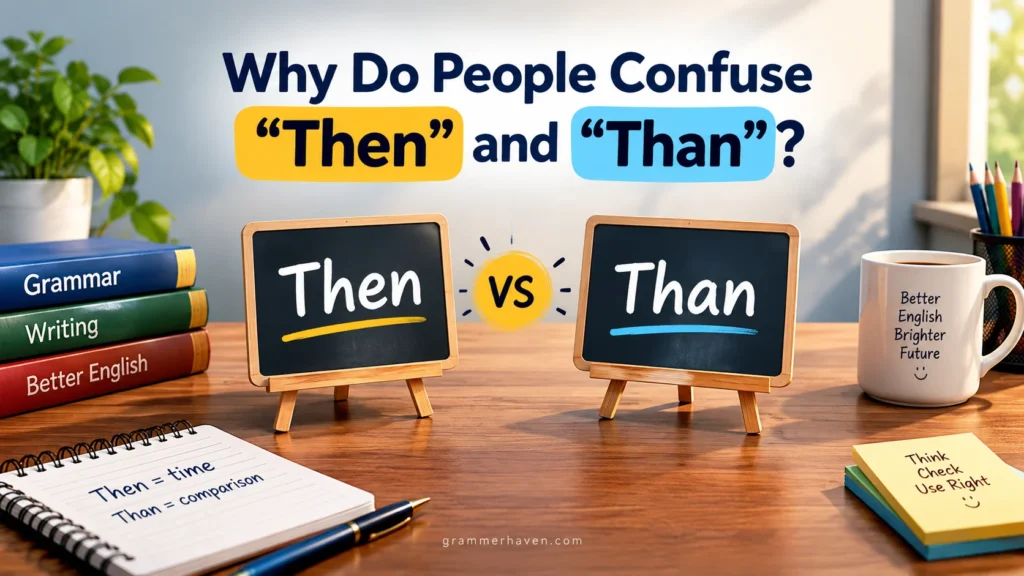
The confusion is understandable because then and than are visually similar and usually have very similar pronunciations.
When you speak quickly, the distinction can almost disappear.
Writing exposes the difference.
That’s where the problem starts.
Both words are real English words. Spell-checking software may therefore fail to flag the mistake because “then” isn’t misspelled when you accidentally use it instead of than. The problem is grammatical rather than orthographic.
Compare these:
❌ This car is better then that one.
✅ This car is better than that one.
The first sentence contains a correctly spelled word in the wrong grammatical role.
It’s similar to writing “their” when you mean “there.” The word itself isn’t nonsense. It simply doesn’t belong in that particular sentence.
Better Than vs. Better Then: The Main Difference
The easiest way to understand the distinction is to focus on what the sentence is doing.
| Word | Main function | Ask yourself | Example |
| than | Comparison | Am I comparing something? | This is better than that. |
| then | Time | Am I referring to a time? | Things were better then. |
| then | Sequence | Am I describing what happens next? | Eat first, then leave. |
| then | Result | Am I saying “in that case”? | If you’re ready, then let’s go. |
There’s a useful shortcut here:
If the sentence measures one thing against another, choose “than.”
If the word tells you when something happened or what happens next, choose then.
When “Better Then” Can Actually Be Correct
This is where the distinction gets more interesting.
Many grammar explanations say “better than” is correct and stop there. That’s useful, but incomplete.
The combination “better then” can be grammatically correct when then means “at that time.”
Consider:
Things were better then.
This sentence is completely correct.
It means:
Things were better at that time.
Now look at another example:
Life was better then than it is now.
This sentence contains both words, and each performs a different job.
- then = at that time
- than = introduces the comparison
That’s an excellent example because it shows that you don’t choose between then and than based on the word better alone.
You choose based on meaning and grammatical function.
Case Study: “Things Were Better Then”
Imagine someone discussing life in their hometown 20 years ago.
They might say:
Things were better then.
The speaker isn’t explicitly comparing things with another noun after better. Instead, then points back to a period in the past.
Now imagine the speaker continues:
Things were better then than they are today.
Suddenly, both words appear.
The sentence makes two separate grammatical moves:
Things were better then → refers to a past time.
than they are today → makes a comparison between past and present.
That distinction is subtle, but it’s important.
Examples of “Better Than” in Everyday English
You’ll encounter better than constantly because comparisons are everywhere.
Comparing People
Maya is better than Jake at tennis.
This compares their ability.
Another example:
He is better than me at solving puzzles.
In more formal writing, you may see:
He is better than I am at solving puzzles.
Both constructions occur in English. Cambridge notes that than + object pronoun such as me is common, while more formal constructions can use a subject pronoun followed by a verb.
Comparing Things
This camera is better than my old one.
The sentence compares two cameras.
Comparing Ideas
A clear explanation is better than a complicated one.
Here, the comparison concerns two approaches rather than physical objects.
Comparing Situations
Working remotely is better than commuting for some employees.
The sentence compares two working arrangements.
Comparing Results
The final results were better than expected.
This is a particularly common structure. English frequently shortens the second part of a comparison when its meaning remains clear.
Common Mistakes With “Better Then” and “Better Than”
Even though the rule is simple, several mistakes appear frequently.
Mistake: Using “Then” for a Comparison
❌ This phone is better then that one.
The sentence compares two phones.
Therefore, use than:
✅ This phone is better than that one.
Mistake: Using “Than” for Sequence
❌ We ate dinner than went home.
There’s no comparison here.
The sentence describes two events in sequence:
✅ We ate dinner then went home.
Mistake: Assuming “Better Then” Is Always Wrong
❌ Things were better then.
This isn’t wrong.
Here, then means at that time.
The correct interpretation is:
Things were better at that time.
Mistake: Choosing by Sound Alone
Because then and than sound similar, listening isn’t always enough.
Instead, look at the sentence’s purpose.
Ask:
Is this word comparing something?
If yes, choose than.
How to Remember Then vs. Than
A good memory trick doesn’t need to be complicated.
Than = Comparison
Connect than with comparison.
Better than
Faster than
Stronger than
More expensive than
Less complicated than
Whenever you see a comparative form, check whether than introduces the second side.
Then = Time or Sequence
Think of then as belonging to a timeline.
First → then → afterward
For example:
First, finish your homework. Then, play video games.
Or use the time test:
Things were better then.
Can you replace then with “at that time”?
Yes.
That confirms the meaning.
The Two-Question Test
When you’re stuck, ask two quick questions:
Question 1: Am I comparing two things?
- Yes → than
Question 2: Am I talking about time, sequence, or a result?
- Yes → then
This simple test handles most everyday cases.
Better Than in Different Types of Comparisons
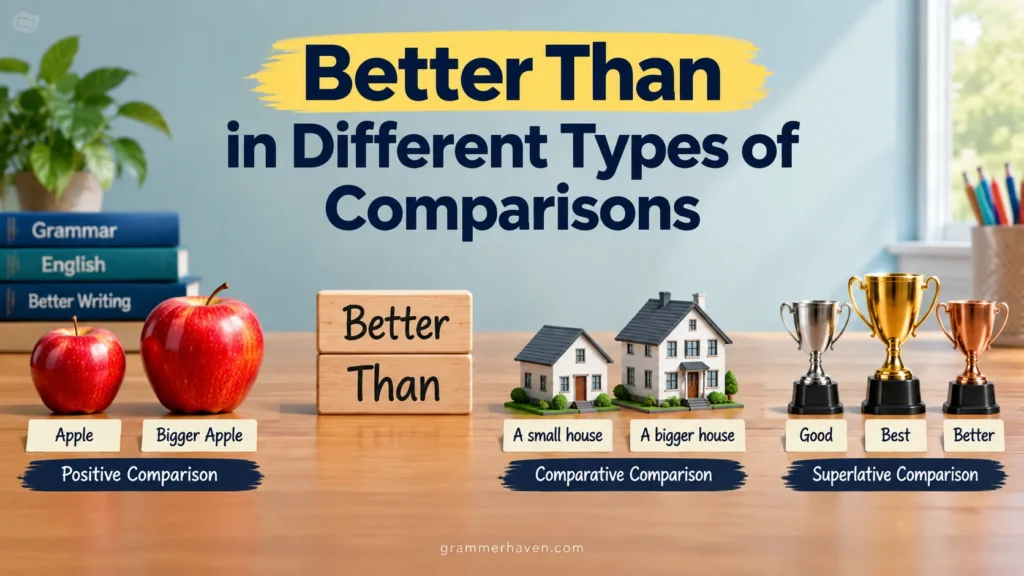
The phrase isn’t limited to simple noun-to-noun comparisons.
Better Than + Noun
This laptop is better than the older model.
Better Than + Pronoun
She is better than him at tennis.
Better Than + Clause
The result was better than I expected.
Better Than + Adverbial Comparison
She performed better than I did.
Better Than + Implied Comparison
The weather is better than before.
English often leaves part of the second comparison unstated because readers can understand the missing information from context. Cambridge describes this as a common feature of comparison clauses, including reduced clauses and ellipsis.
Better Than vs. Other Comparative Expressions
Once you understand better than, you’ll notice the same pattern throughout English.
| Comparative | Example |
| better than | This plan is better than the old one. |
| worse than | The traffic is worse than yesterday. |
| faster than | This computer runs faster than mine. |
| easier than | The test was easier than expected. |
| harder than | This job is harder than I thought. |
| more useful than | The guide is more useful than the previous version. |
| less expensive than | This model is less expensive than that one. |
| more interesting than | The book was more interesting than the movie. |
The grammatical pattern remains remarkably consistent:
Comparative + than + second side of comparison
That’s why mastering than here helps you with dozens of other sentences.
“Better Than” vs. “Rather Than”
Don’t confuse better than with rather than.
They can appear in similar sentences, but they express different relationships.
Better than makes a comparison:
Walking is better than driving in heavy traffic.
Rather than expresses preference or an alternative:
I’d rather walk than drive in heavy traffic.
The first sentence evaluates two options.
The second tells you which option you prefer.
That distinction matters because both constructions can appear around choices.
A Simple Grammar Diagram
The difference can be visualized like this:
THAN
Thing A → comparison → Thing B
This laptop → is better than → my old laptop.
THEN
Event A → sequence/time → Event B
Finish your work → then → go home.
Or:
Past time → then
Things were better → then.
Once you see the two words as performing different jobs, the spelling becomes much easier to remember.
Practice: Choose “Then” or “Than”
Test yourself before checking the answers.
- This book is better ___ the movie.
- We ate dinner and ___ watched television.
- Things were better ___.
- She runs faster ___ her brother.
- Finish this task, ___ start the next one.
- This solution is more practical ___ the old one.
- I was much younger ___.
- The new version works better ___ the previous version.
Answers
- than — The sentence compares the book with the movie.
- then — It describes the next event.
- then — It refers to a particular past time.
- than — It compares running speeds.
- then — It shows the sequence.
- than — It compares two solutions.
- then — It means “at that time.”
- than — It compares two versions.
The pattern is consistent once you focus on meaning rather than pronunciation.
See also: Hone In or Home In: Which Phrase Is Correct?
FAQs:
Is “better than” correct?
Yes. Better than is the standard form when you compare one thing with another.
This option is better than the first one.
Better is comparative, and than introduces the second part of the comparison.
Is “better then” ever correct?
Yes. Better then can be correct when then means “at that time.”
Things were better then.
It can also appear naturally when both words have separate functions:
Things were better then than they are now.
Why is “better than” correct?
Because better is a comparative form, and English commonly uses than to introduce the second element of a comparison.
Should you say “better than me” or “better then me”?
Use:
better than me
For example:
She is better than me at tennis.
Then would be incorrect because the sentence compares two people.
Is “better than before” correct?
Yes.
The new version is better than before.
Here, than introduces a comparison with the earlier state or condition.
Is “better then” grammatically wrong?
Not necessarily.
It depends on what then means.
Things were better then. ✅
Here, then means at that time.
But:
This car is better then that car. ❌
Here, the sentence needs than because it compares two cars.
What’s the easiest way to remember “then” and “than”?
Remember this:
Than = comparison.
Then = time or sequence.
If you’re comparing, reach for than.
If you’re talking about what happened at that time or what happens next, choose then.
Conclusion:
Understanding Better Then or Than becomes easier when you remember the purpose of each word. Use Than for comparisons, such as saying one thing is better than another. Use Then for time, sequence, or the next action. This simple distinction can improve your grammar, writing, and communication while helping you avoid common errors. With regular practice and careful attention to context, you can use both words correctly and confidently.