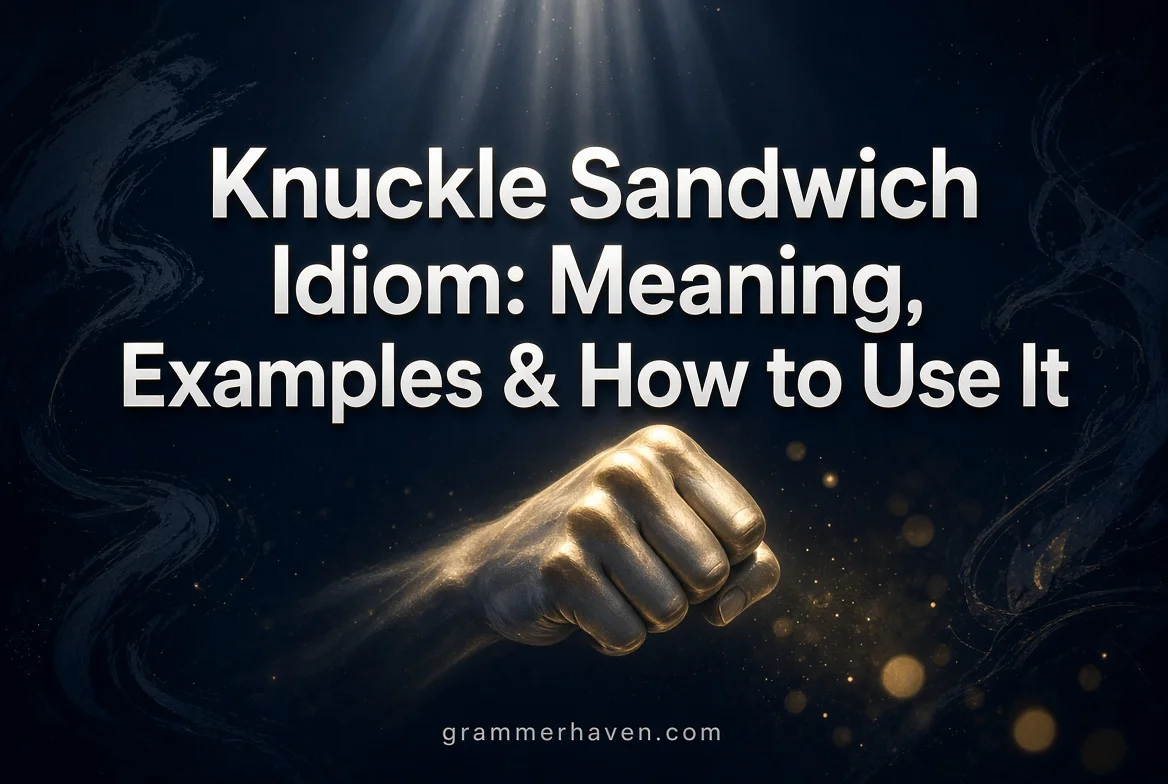
The Knuckle Sandwich Idiom is a funny phrase in informal English and slang that describes a punch with a clenched fist, not a real sandwich or meal. Literally, knuckle sandwich sounds like a strange deli item for lunch on a diner menu, but its literal meaning has nothing to do with food or a real sandwich you can eat. This colorful expression describes a punch involving a clenched fist aimed at the mouth or face. The unusual difference between the words and their actual meaning makes this English expression fun, creative, and unusual.
Informal language uses knuckle sandwich jokingly as a warning or offer to hit another person. The speaker can sound angry, funny, or light-hearted, based on the tone, relationship, setting, and context. An example appears in movies, TV shows, and cartoons, where characters use the phrase during playful conversation with friends. A genuinely threatening speaker can use the same words differently. You can understand this slang by listening to how it sounds and noticing what comes before and comes after the phrase.
The playful aspects of the phrase make it popular in movies and casual speech. Its rough aspects mean you should use it carefully. It isn’t polite to seriously threaten someone with a knuckle sandwich, even when the expression sounds humorous. The phrase can sound harmless when delivered in a playful order of words, especially among friends, but it can still mean a fist may hit someone’s face. Good understanding requires recognizing whether the expression is jokingly playful or genuinely threatening. Use it in casual situations where everyone understands the intended fun and situation.
Quick Answer
A knuckle sandwich is an informal idiom for a punch with a clenched fist, particularly a punch to someone’s mouth or face. Oxford defines it as a hard hit in the mouth made with a fist, while American dictionaries describe it as a punch in the mouth.
For example:
“Keep insulting him and you’ll get a knuckle sandwich.”
Here, knuckle sandwich means a punch. The expression creates a humorous image by pretending that someone’s fist is a sandwich being “served” to another person’s face.
The phrase is best suited to casual conversation, jokes, fictional dialogue, and informal storytelling. Because it refers to physical violence, you should avoid using it casually with strangers or in professional situations where someone could interpret it as a real threat.
What Does “Knuckle Sandwich” Mean?
The knuckle sandwich idiom means a punch delivered with a closed fist. The target is traditionally the mouth or face, although people sometimes use the expression more loosely for a punch in general.
Both Oxford and American Heritage classify the expression as slang. Collins likewise defines it as an informal expression meaning a punch in the mouth.
In simple terms:
Knuckle sandwich = punch with a fist
The phrase usually appears as a noun phrase. Common constructions include:
- give someone a knuckle sandwich
- get a knuckle sandwich
- serve someone a knuckle sandwich
- threaten someone with a knuckle sandwich
For example, if someone says, “He gave the bully a knuckle sandwich,” the speaker means that he punched the bully.
Simple Definition of Knuckle Sandwich
A knuckle sandwich is a slang expression meaning a punch in the mouth or face with a clenched fist.
The expression isn’t normally literal. It uses a humorous food metaphor to describe physical violence.
Is “Knuckle Sandwich” Literal or Figurative?
It’s figurative when used as an idiom.
A literal sandwich contains food between pieces of bread. A “knuckle sandwich” doesn’t involve bread, cheese, meat, or anything else from a kitchen. Instead, knuckle points to the striking part of a closed fist while sandwich creates the image of that fist being “served” to someone’s mouth.
That absurd comparison is part of the phrase’s appeal.
Knuckle Sandwich Meaning in Different Contexts
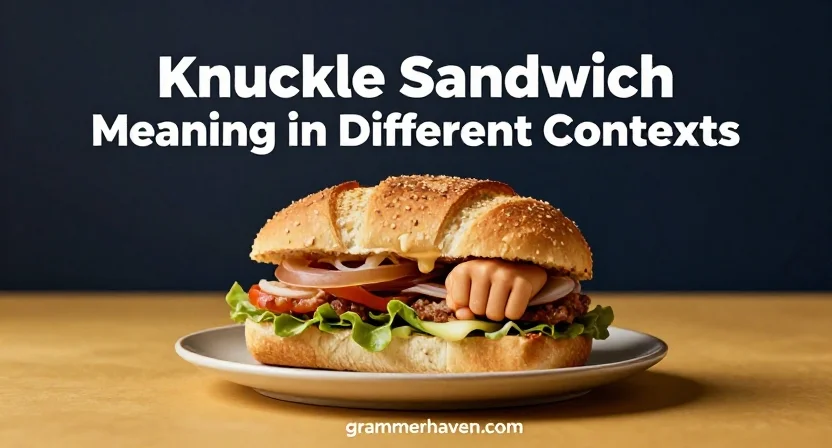
The meaning stays basically the same, but the tone can change dramatically.
| Context | What it usually means | Typical tone |
| Argument | A threat to punch someone | Aggressive |
| Friendly teasing | A joking threat | Playful |
| Fictional dialogue | A punch or threat of one | Dramatic or humorous |
| Storytelling | Someone being punched | Informal |
| Comedy | Exaggerated physical threat | Humorous |
As a Threat
The phrase can work as a direct warning.
“Say that again and you’ll get a knuckle sandwich.”
In this sentence, the speaker is threatening to punch the other person. Whether the threat is serious depends on the circumstances.
If two close friends say it while joking around, the expression might produce a laugh. During a heated confrontation, however, the same words could sound hostile.
As a Joke
English speakers often use violent expressions humorously without intending actual violence.
Imagine someone stealing the last slice of pizza from a friend:
“You ate my slice? You’re getting a knuckle sandwich.”
The speaker probably isn’t announcing a genuine plan to fight. The exaggerated threat adds comic effect.
That’s why tone and relationship matter. A grin between friends sends a very different message from an angry statement during an argument.
In Movies, TV Shows, and Fiction
The expression works particularly well in dialogue because it immediately establishes an informal, tough, or exaggerated voice.
A character who says “I’m going to punch you” sounds direct. A character who says “I’ll serve you a knuckle sandwich” sounds more theatrical.
Writers can therefore use the phrase to give dialogue a comic, old-fashioned, tough-guy, or cartoonish flavor.
When Describing an Actual Punch
You can also use the expression after a punch has happened.
“The boxer gave his opponent a knuckle sandwich.”
Here, the speaker isn’t necessarily making a threat. The sentence describes the physical action in a humorous or colorful way.
Knuckle Sandwich Examples
Here are several natural examples that show how the expression works:
- “Keep messing with me and you’ll get a knuckle sandwich.”
- “He threatened to give me a knuckle sandwich.”
- “The movie’s hero served the villain a knuckle sandwich.”
- “One more insult and you’re getting a knuckle sandwich.”
- “The character joked about giving his rival a knuckle sandwich.”
- “Nobody wanted to start a fight, so the threat of a knuckle sandwich was mostly comic.”
- “He got a knuckle sandwich after picking a fight at the bar.”
Notice how the expression remains recognizable even when the surrounding verbs change.
How to Use “Knuckle Sandwich” in a Sentence
The phrase behaves like a noun. Most natural examples place it after verbs such as give, get, serve, receive, or threaten.
“Give Someone a Knuckle Sandwich”
This construction means to punch someone.
“He said he’d give the bully a knuckle sandwich.”
The phrase give someone makes the punch sound like something being handed over. That’s where the food metaphor becomes especially obvious.
“Get a Knuckle Sandwich”
This construction focuses on the person receiving the punch.
“Keep pushing him and you might get a knuckle sandwich.”
Here, get means receive or suffer the punch.
“Serve Someone a Knuckle Sandwich”
This version pushes the food metaphor even further.
“The hero threatened to serve the villain a knuckle sandwich.”
The wording often sounds more humorous or theatrical than the plain verb punch.
Is “Knuckle Sandwich” a Threat?
It can be.
The phrase commonly appears in threats involving physical violence. However, it doesn’t automatically indicate that the speaker intends to attack someone.
Consider these two examples:
“Keep touching my stuff and you’ll get a knuckle sandwich.”
“Careful, buddy. You’re asking for a knuckle sandwich!”
The first could sound genuinely hostile. The second might be playful banter between friends.
The surrounding situation determines the meaning.
Because the expression can describe violence, it’s wise to avoid using it with someone who may not understand your humor. A phrase that sounds harmless to one person can sound intimidating to another.
Is “Knuckle Sandwich” Offensive?
The expression isn’t generally considered profanity. It doesn’t contain a swear word or an inherently vulgar term.
However, its meaning involves physical violence, which can make it inappropriate in certain situations.
For example, using it with a coworker during a disagreement could make a joke sound like a threat. Using it in a formal email would also sound bizarre and unprofessional.
So the issue isn’t usually profanity. It’s register and implied aggression.
Is “Knuckle Sandwich” Slang?
Yes. Major dictionaries identify it as slang or informal language. Oxford labels the expression “slang,” while Dictionary.com and American Heritage give it a slang classification as well.
It’s also an idiomatic expression because its intended meaning isn’t derived from the ordinary meanings of the two words.
Think of the distinction this way:
- Knuckle is an ordinary noun.
- Sandwich is an ordinary noun.
- Knuckle sandwich is an established slang expression.
- Its idiomatic meaning is a punch.
Calling it simply “slang” isn’t wrong. Calling it an informal slang idiom gives a more complete picture.
Origin and History of the “Knuckle Sandwich” Idiom
The history of knuckle sandwich is more interesting than a simple “it started in the 1970s” explanation suggests.
Several modern dictionaries list the expression’s first recorded period as 1970–75. Dictionary.com and Collins both give that range.
However, historical research has identified substantially earlier printed examples.
One documented example appeared in the San Francisco Chronicle on August 19, 1940. A photograph caption used “knuckle sandwich” while describing a baseball-related fight. Historical research also identifies later American examples from the 1940s and 1950s.
That distinction is important.
A dictionary’s first recorded date doesn’t necessarily mean nobody used the expression before that date. It can mean that earlier printed evidence had not yet been identified or incorporated into that dictionary’s evidence base.
When Did People Start Saying “Knuckle Sandwich”?
The safest answer is that the expression was definitely in printed American use by 1940, while some modern dictionary entries date its recorded history to 1970–75.
There is also evidence from a 1957 comedy play, Anniversary Waltz, in which a character uses the expression while threatening another person.
So the documented timeline looks roughly like this:
| Period | Evidence |
| 1940 | Printed American example in the San Francisco Chronicle |
| 1942 | American newspaper usage connected with football |
| 1957 | Expression appears in Anniversary Waltz |
| 1963 | British newspaper evidence uses it for punches |
| 1970s | Dictionaries and other sources record the expression more broadly |
The evidence suggests that the phrase was circulating well before some modern dictionary entries indicate.
Why Is a Punch Called a “Knuckle Sandwich”?
The metaphor is fairly easy to picture.
A closed fist brings the knuckles toward someone’s mouth. The person’s mouth becomes the place where the imaginary “sandwich” is being received.
The expression essentially turns a punch into a ridiculous food order.
That contrast creates humor. Violence sounds less stark when it gets wrapped in an absurd culinary metaphor.
Historical sources describe the phrase in much the same way. The image involves the knuckles being delivered into the recipient’s mouth as though that person were “eating” a sandwich.
Why Does “Knuckle Sandwich” Mean a Punch?
The metaphor works through three simple ideas:
- Knuckle represents the striking part of a closed fist.
- Sandwich creates a familiar food image.
- Give or serve turns the punch into something supposedly being offered to another person.
That’s why the phrase is memorable.
Compare these two statements:
“I’ll punch you.”
“I’ll give you a knuckle sandwich.”
The first is blunt. The second is more colorful because it disguises the threat behind a ridiculous food metaphor.
This kind of wordplay appears frequently in slang. Speakers often make expressions more memorable by replacing direct descriptions with vivid images.
Knuckle Sandwich vs. Similar Expressions
Not every informal expression involving a punch means exactly the same thing.
| Expression | Meaning | Tone |
| Knuckle sandwich | A punch, especially to the mouth | Humorous, informal |
| Throw a punch | Attempt to punch someone | Neutral/informal |
| Take a swing | Attempt to hit someone | Informal |
| Cold-cock | Hit someone suddenly or unexpectedly | Informal |
| Knock someone out | Cause someone to lose consciousness | Stronger |
| Throw hands | Fight physically | Modern informal slang |
Knuckle Sandwich vs. “Throw a Punch”
Throw a punch is more direct and neutral.
“He threw a punch during the argument.”
The sentence simply describes an attempted punch. Knuckle sandwich, by comparison, adds humor and personality.
Knuckle Sandwich vs. “Take a Swing”
Take a swing generally means to attempt to hit someone.
“He took a swing at the other player.”
It doesn’t necessarily tell you whether the punch connected.
A knuckle sandwich, however, usually refers to the punch itself or a threatened punch.
Knuckle Sandwich vs. “Cold-Cock”
Cold-cock generally describes hitting someone suddenly or unexpectedly.
That makes it more specific than knuckle sandwich. The latter doesn’t necessarily imply surprise.
Synonyms for “Knuckle Sandwich”
If you need a simpler expression, choose an alternative based on tone.
Neutral Alternatives
- Punch
- Hit
- Blow
- Fist strike
Informal Alternatives
- Throw a punch
- Take a swing
- Wallop
- Sock someone
Humorous Alternatives
- Knuckle sandwich
- Serve up a knuckle sandwich
- Get a taste of my fist
These expressions aren’t perfect substitutes in every sentence. Punch is the clearest option when you want accuracy without humor.
When Should You Use “Knuckle Sandwich”?
The expression works best in informal settings where its colorful tone fits naturally.
Good situations include:
- Casual conversations
- Friendly teasing
- Comedy
- Fictional dialogue
- Informal storytelling
- Humorous writing
- Describing exaggerated tough-guy behavior
For example, a comedy character might say:
“Touch my sandwich again and I’ll give you a knuckle sandwich.”
The joke works because the word sandwich appears twice with completely different meanings.
When Should You Avoid “Knuckle Sandwich”?
You should generally avoid the expression in formal or sensitive settings.
Avoid it in:
- Business emails
- Academic writing
- Job applications
- Professional reports
- Customer-service communication
- Serious workplace disputes
- Conversations where a threat could be misunderstood
If you simply mean punch, say punch.
Clear language beats clever language when the situation is serious.
Common Mistakes When Using “Knuckle Sandwich”
Taking the Phrase Literally
A knuckle sandwich isn’t normally food. The phrase is an idiom for a punch.
Using It in Formal Writing
The expression is slang. It can make formal writing sound childish, theatrical, or overly casual.
Assuming It’s Always a Joke
Not necessarily. Someone can use the phrase as a genuine threat.
Treating It as a Food Expression
The sandwich imagery is only the metaphor. The actual meaning concerns physical violence.
Assuming It Means Every Type of Attack
The phrase specifically centers on a punch with a fist. It isn’t a general term for every kind of physical assault.
“Knuckle Sandwich” in Pop Culture and Fiction
The phrase has qualities that make it attractive to writers.
First, it’s visual. Readers can immediately imagine what it means. Second, it’s rhythmic and memorable. Third, it combines violence with an ordinary food image.
That combination creates a comic contradiction.
A tough character saying “I’ll punch you” sounds serious. The same character saying “I’ll serve you a knuckle sandwich” sounds more theatrical. Depending on the scene, that can make the character seem funny, exaggerated, old-fashioned, or deliberately intimidating.
Historical examples also show the expression moving through entertainment and public writing. A 1957 comedy play uses the phrase, while later British and Australian examples demonstrate how the expression traveled beyond American English.
Is “Knuckle Sandwich” Still Common Today?
The expression remains recognizable in modern English, particularly in American English and informal or humorous contexts.
It’s not the kind of phrase most people would use in every ordinary conversation. Instead, it tends to appear when someone wants to sound playful, exaggerated, theatrical, or deliberately tough.
Modern dictionaries still list it as an established expression. Oxford identifies it as slang, American Heritage defines it as a punch in the mouth, and Collins continues to list both American slang and British informal usage.
Its continued survival makes sense. The image is simple and memorable. A fist becomes a “sandwich,” and suddenly a punch has a comic disguise.
Knuckle Sandwich at a Glance
| Question | Answer |
| Meaning | A punch with a clenched fist |
| Typical target | Mouth or face |
| Type | Slang idiom |
| Register | Informal |
| Literal meaning | Not normally literal |
| Common use | Jokes, threats, fiction, casual speech |
| Can it be serious? | Yes |
| Formal writing? | Usually avoid it |
| Historical evidence | Printed American use is documented by 1940 |
| Simple synonym | Punch |
When you hear someone offer another person a “knuckle sandwich,” don’t start looking for bread. In idiomatic English, they’re talking about a fist, not food.
See also: It’s vs. Its: Meaning, Difference, Rules, and Examples
FAQs:
What does the idiom “knuckle sandwich” mean?
The knuckle sandwich idiom means a punch delivered with a clenched fist, especially a punch to someone’s mouth or face. It is an informal slang expression.
Why is a punch called a knuckle sandwich?
The phrase creates a humorous metaphor in which someone’s knuckles act like a sandwich being delivered to another person’s mouth. The absurd food comparison makes the expression memorable. Historical sources describe essentially this same image.
Is “knuckle sandwich” a slang term?
Yes. Major English dictionaries classify knuckle sandwich as slang or informal language.
Is “knuckle sandwich” a threat?
It can be a threat. A speaker may use it to warn someone that they intend to punch them. However, friends can also use the expression jokingly, so context and tone matter.
Can “knuckle sandwich” be used in formal writing?
Generally, no. Knuckle sandwich is informal slang. In formal writing, punch or hit is usually clearer and more appropriate.
Conclusion:
The knuckle sandwich idiom is a colorful and humorous way to describe a punch, usually one aimed at the mouth or face. Its unusual wording comes from the playful image of serving someone a “sandwich” made from knuckles. Although the phrase can sound funny, it can also express a genuine threat when used during an argument.
Because knuckle sandwich is informal slang, it works best in casual conversations, jokes, fictional dialogue, and storytelling. It isn’t a good choice for professional or formal writing. When you understand its meaning, tone, and context, you’ll know exactly when this quirky idiom fits—and when a simple word like “punch” would be the better choice.