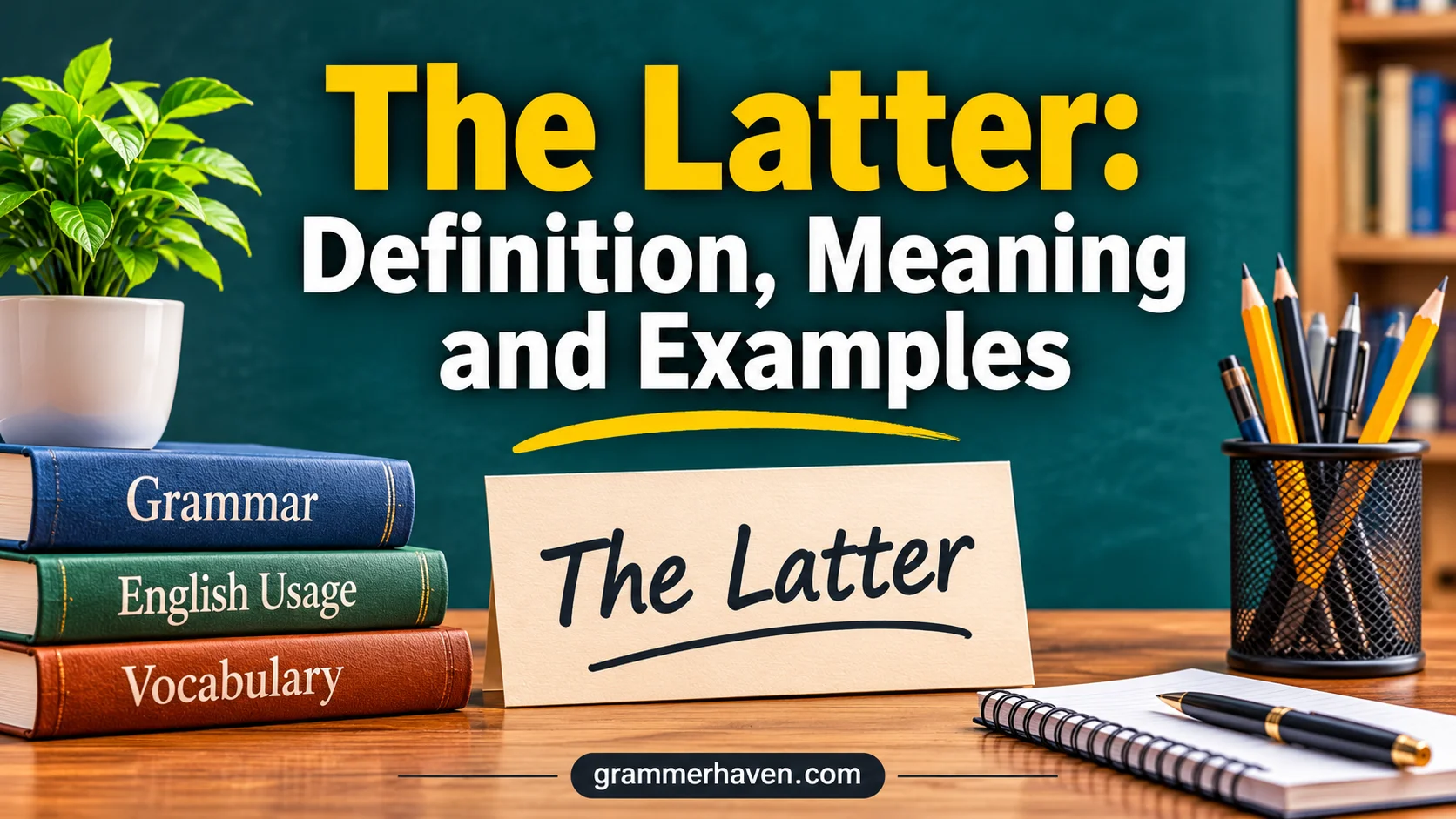
Learn the topic The Latter – Definition, Meaning, and Examples to understand how this term helps English learners use words clearly in sentences. The latter is a common and sometimes confusing term because people often mixed its exact meaning and usage with other choices. This article will explain the definition and show what this essential word and phrase means. The latter refers to the second choice of two things or people already mentioned. It is helpful when you prefer coffee over tea, because you can respond by choosing the latter and avoid repeating the last mentioned item in a conversation. This makes discussions smoother, clearer, and more straightforward by pointing directly to recently discussed options.
The latter works as a grammatical tool for comparisons and helps create clear and precise sentences. The former identifies the first thing mentioned, while the latter identifies the second. For examples, if two dogs are discussed, a golden retriever and a poodle, the former may be energetic while the latter is quiet. In formal usage, someone may choose between studying law and medicine and select the latter. In a historical context, Albert Einstein and Nikola Tesla were brilliant inventors, but the latter is often celebrated for his contributions to alternating current.
Following the common usage rules makes this term easier to understand. The latter is strictly used for only two items when discussing exactly two things or groups. If you are listing three or more choices, use the last or final one instead. The latter can work as a pronoun or adjective, and the article the must stay with it through matching agreement. Practice in business, daily life, and academics improves understanding, while a quiz can help you master the topic and avoid confused word pairs.
What Does “The Latter” Mean in English Grammar?
The phrase “the latter” refers to the second of two things that were mentioned earlier.
That’s the key rule. Simple, strict, and non-negotiable.
If you mention two items, ideas, or people, the second one is called the latter.
Here’s the structure in action:
- First item → the former
- Second item → the latter
Simple definition of The Latter
“The latter refers to the second of two previously mentioned things.”
That’s it. No hidden meaning. No exceptions for casual use.
Important limitation
You can ONLY use “the latter” when:
- Exactly two items are mentioned
- Both items are already clear in the sentence or context
If you list three or more things, “the latter” becomes incorrect.
The Latter vs The Former: The Core Relationship
To fully understand The Latter – Definition, Meaning, and Examples, you must understand its partner: the former.
These two words always work as a pair.
Basic rule
- Former = first item
- Latter = second item
Comparison Table
| Term | Meaning | Position | Example |
| Former | First of two mentioned items | First | Tea and coffee → tea |
| Latter | Second of two mentioned items | Second | Tea and coffee → coffee |
Example in real usage
“I had to choose between working in Dubai or staying in Karachi. I chose the latter.”
Here:
- Dubai = former
- Karachi = latter
The sentence avoids repetition and sounds cleaner.
Why We Use “The Latter” in Writing
Writers use “the latter” for one main reason: clarity without repetition.
Instead of repeating words, you refer back smoothly.
Compare these two sentences
❌ Repetitive:
“I like apples and oranges. I prefer oranges over apples.”
✅ Clean and natural:
“I like apples and oranges. I prefer the latter.”
The second version feels tighter and more professional.
Key benefits
- Reduces repetition
- Improves flow
- Makes writing more elegant
- Works well in formal contexts
Grammar Role of The Latter
“The latter” works like a pronoun substitute.
It replaces the second item in a pair after both items are already known.
How it functions in a sentence
Think of it as a pointer:
- It points backward in the sentence
- It refers to something already introduced
- It avoids restating the noun
Sentence structure pattern
You typically see it like this:
Mention Item A and Item B → then refer to “the latter”
Example breakdown
“I considered marketing and finance. The latter offered better career growth.”
- Marketing = first item
- Finance = second item
- “The latter” = finance
The Latter vs The Former: Deep Comparison
Let’s go deeper because many learners still mix these up.
Mental model
Imagine two doors:
- Door 1 = Former
- Door 2 = Latter
You always pick from left to right in order.
Expanded comparison table
| Feature | The Former | The Latter |
| Position | First item | Second item |
| Usage limit | Two items only | Two items only |
| Function | Refers back | Refers back |
| Common mistake risk | Medium | High |
| Replacement role | Avoid repetition | Avoid repetition |
Real-Life Examples of The Latter
Let’s make this practical. Here are examples from everyday life, school, and work.
Everyday conversation examples
- “I had tea and coffee. I preferred the latter.”
- “She watched a movie and a documentary. The latter was more interesting.”
- “We visited Lahore and Islamabad. The latter felt more peaceful.”
Academic examples
- “The study compared qualitative and quantitative research. The latter produced measurable results.”
- “Students learned algebra and geometry. The latter required more visualization skills.”
Business examples
- “The company focused on expansion and cost reduction. The latter improved profitability.”
- “We tested manual and automated systems. The latter reduced errors significantly.”
Common Mistakes People Make with The Latter
Even fluent English speakers misuse this phrase.
Let’s break down the most common errors.
Mistake 1: Using it with more than two items
❌ Incorrect:
“I like tea, coffee, and juice. I prefer the latter.”
Why it’s wrong:
There are three items. “The latter” becomes unclear.
Mistake 2: Confusing it with “later”
❌ Incorrect:
“I will call you the latter.”
Correct version:
“I will call you later.”
These two words are unrelated:
- Latter = position in a pair
- Later = time
Mistake 3: Unclear reference
❌ Incorrect:
“He bought a phone and a laptop. The latter is expensive.”
This works grammatically, but it becomes confusing if context is missing.
Mistake 4: Overusing it in casual speech
People sometimes force it into conversations where simple repetition is clearer.
Better to say:
“I prefer coffee over tea” instead of always using “the latter.”
How to Remember The Latter Easily
You don’t need complicated tricks. Just use simple memory anchors.
Memory trick 1: Alphabet rule
- F comes before L
- Former comes first
- Latter comes last (of two)
Memory trick 2: Position logic
Think:
First = Former
Last (of two) = Latter
Memory trick 3: Visual image
Picture two boxes:
- Box A (former)
- Box B (latter)
You always refer to Box B when you say “the latter.”
When You Should NOT Use The Latter
This is where many learners slip.
Avoid “the latter” when:
- You mention more than two items
- The reference is unclear
- Simplicity improves readability
- You write for a broad audience that may misinterpret it
Better alternatives
Instead of forcing “the latter,” use:
- The second option
- The final choice
- The one mentioned last
- Repeating the noun if clarity matters
The Latter in Formal vs Casual Writing

Let’s see how tone changes usage.
Formal writing
Writers prefer “the latter” in:
- Academic essays
- Reports
- Legal documents
- Business communication
Example:
“The committee reviewed two proposals. The latter was approved due to cost efficiency.”
Casual speech
People often avoid it in everyday conversation.
They prefer:
- “I chose coffee over tea”
- “I liked the second one more”
Why?
Because clarity matters more than elegance in speech.
Case Study: Misuse of The Latter in Real Writing
Let’s look at a realistic scenario.
Scenario
A student writes:
“I studied history, geography, and economics. The latter was difficult.”
Problem
The reader cannot clearly identify which subject is “the latter.”
Fix
Option 1:
“I studied history and geography. The latter was difficult.”
Option 2:
“I studied history, geography, and economics. Economics was difficult.”
Lesson
Clarity always beats stylistic shortcuts.
Practice Section: Test Your Understanding
Try identifying “the latter” in these sentences.
Example 1
“I had burgers and pizza. I preferred the latter.”
Answer: Pizza
Example 2
“She chose medicine and engineering. The latter suited her skills better.”
Answer: Engineering
Example 3
“They discussed online learning and classroom learning. The latter offers more structure.”
Answer: Classroom learning
See also: Dead in the Water Meaning: Definition, Origin, Usage and Real-Life Applications
FAQs:
1. What does “the latter” mean?
The latter refers to the second of two people, things, or options that have already been mentioned. It helps avoid repeating the same noun and makes sentences shorter and clearer.
2. What is the difference between “the former” and “the latter”?
The former refers to the first item mentioned, while the latter refers to the second item. For example, in “I like tea and coffee, but I prefer the latter,” the latter means coffee.
3. Can “the latter” be used for more than two items?
No, the latter should only be used when discussing exactly two items, people, or groups. If you mention three or more options, use words like the last or the final one instead.
4. Is “the latter” a noun or an adjective?
The latter can work as both a pronoun and an adjective depending on the sentence. It always appears with the article the and points back to the second mentioned option.
5. Why is learning “the latter” important in English?
Learning the latter improves your sentence clarity and helps you avoid repetition. It is especially useful in formal writing, conversations, business, and academic discussions where precise language matters.
Conclusion:
Understanding The Latter – Definition, Meaning, and Examples helps you make your English writing and speaking more accurate. This term is a simple but powerful grammatical tool that replaces repeated words and makes sentences smoother. Remember that the latter always points to the second of two previously mentioned things or people, while the former refers to the first. By practicing its correct usage in conversations, business, academics, and daily writing, you can avoid confusion and communicate more clearly.
Latest Post:
- Result In or Result To: Which Is Correct? (With Examples)
- A Dime a Dozen: Meaning, Definition, Origin and Real-Life Usage
- Hooplehead Definition, Meaning, Usage and Examples
- Whole vs Hole: What’s the Difference?
- Acumen vs Acuity vs Acuteness: What’s the Difference?