The Dead in the Water Meaning: Definition, Origin, Usage explains a phrase about failure, stopped progress, and lost direction in daily communication. The phrase describes something stopped, failing, or without a chance of succeeding. Its origin connects to a ship or boats floating without power or direction, unable to move forward. In daily conversation, this idiom appears in politics, business, and sports when plans, projects, ideas, or a product launch become stuck. English learners can understand how to communicate clearly, improve grammar, and avoid misinterpretation through this expression that creates a vivid mental picture and makes a message more impactful, precise, and easy for the reader to resonate with.
I had a similar experience during summer kayaking with a friend. It was my first time, and I was excited to check the kayaks before entering the lake. Halfway through the trip, I noticed leaks, and my kayak started sinking as water kept filling it. I shouted for help and was sure enough that no matter how hard we paddled, we were going nowhere. We were waiting for help to arrive, and that moment illustrates how this phrase can describe difficult situations. The article helps uncover how people use this term and know exactly when it fits in the next conversation.
In practical terms, calling a plan, project, or effort dead in the water means it is not progressing and is unlikely to reach success. The phrase works in both literal and metaphorical ways, from a damaged kayak to a struggling business that is losing traction. These real-world applications show how language, communication, and expression combine with imagery, context, and engagement.
Dead in the Water Meaning Explained (Simple Definition + Deep Insight)
At its core, the phrase “dead in the water meaning” refers to something that has stopped moving forward and is unlikely to recover.
Simple definition
If something is dead in the water, it means:
- It has completely failed or stalled
- It cannot move forward anymore
- It has lost momentum, support, or functionality
Deeper meaning
But the phrase carries more weight than just “stopped.”
It often implies:
- There was hope before, but it’s now gone
- Recovery is unlikely without major change
Think of it like a car that suddenly runs out of fuel in the middle of a desert. It’s not just slow. It’s stuck. And help is uncertain.
Literal vs Figurative Meaning of Dead in the Water
The phrase works on two levels:
Literal meaning (nautical origin)
- A ship without wind or engine power
- It becomes motionless at sea
- It cannot steer or move forward
Figurative meaning (modern usage)
- A project without funding
- A business idea without support
- A plan that has lost momentum
| Type | Meaning | Example |
| Literal | Ship stuck at sea with no movement | A sailing ship with no wind |
| Figurative | Something that has failed or stalled | A startup with no investors |
The figurative meaning is what you’ll hear almost everywhere today.
Origin of Dead in the Water (Where the Phrase Comes From)
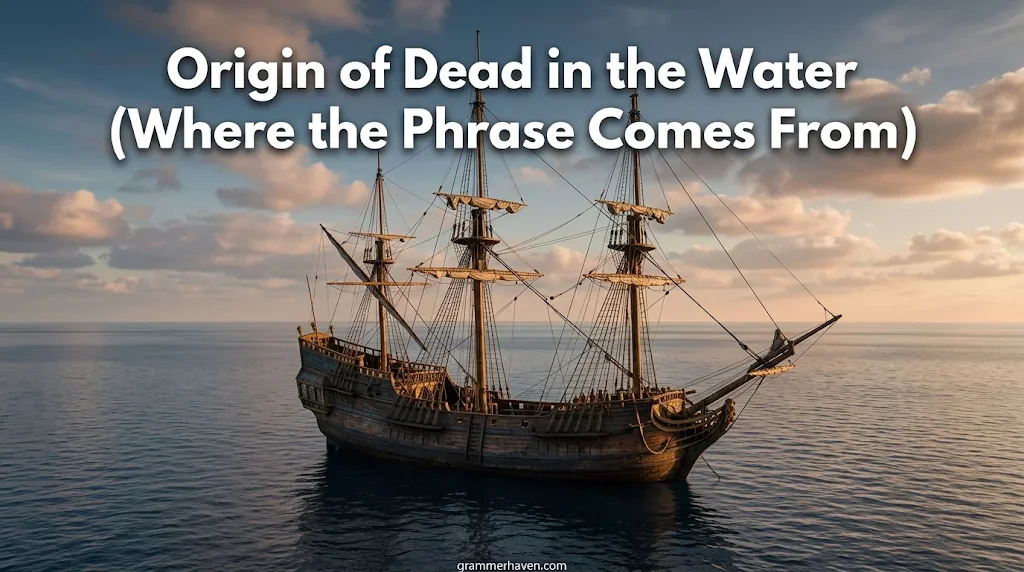
To understand the phrase properly, you need to go back to maritime life.
Nautical background
Before modern engines, ships depended entirely on wind. If the wind disappeared:
- The sails went slack
- The ship stopped moving
- The crew had no control over direction
In that moment, the ship was literally “dead in the water.”
No movement. No progress.
That physical reality turned into a powerful metaphor in English.
How the phrase evolved into modern English
Over time, sailors and traders began using the phrase outside the ocean.
Eventually:
- Business leaders used it for failing deals
- Journalists used it for stalled policies
- Everyday speakers adopted it for life situations
Today, most people using the phrase have never seen a sailing ship—but they still understand the feeling instantly.
That’s the power of good idioms. They survive even after their original context disappears.
How “Dead in the Water” Is Used Today (Real Contexts Explained)
The phrase is extremely flexible. You’ll hear it in business meetings, news headlines, political debates, and casual conversations.
Let’s break it down.
Dead in the Water in Business and Projects
In business, the phrase usually signals failure or cancellation.
Common situations include:
- A startup losing investors
- A product failing before launch
- A project losing leadership support
Example:
“The app update is dead in the water after the development team shut down.”
What it really means:
- No funding
- No development
- No future release
In corporate language, this phrase is often used when people want to avoid saying “failed” directly. It softens the blow slightly but still communicates finality.
Dead in the Water in Politics
Politics is full of shifting momentum, so the phrase appears often.
You’ll hear it when:
- A bill loses support
- A campaign collapses
- A policy fails before approval
Example:
“After the scandal, the candidate’s campaign is dead in the water.”
Interpretation:
- Public trust is gone
- Funding dries up
- Winning becomes unlikely
In political reporting, this phrase adds drama without being overly technical.
Dead in the Water in Technology
Tech moves fast, but not every idea survives.
A product becomes dead in the water when:
- Users don’t adopt it
- Competitors dominate the market
- Development stops
Example:
“Without user engagement, the platform is dead in the water.”
Think of apps that launch with excitement but quickly disappear from app stores. That’s the exact scenario.
Dead in the Water in Personal Life
This is where the phrase becomes more emotional.
It can describe:
- Travel plans falling apart
- Relationships losing direction
- Personal goals collapsing
Example:
“My plans to move abroad are dead in the water after visa rejection.”
Here, the phrase carries disappointment and finality.
Real-Life Examples of Dead in the Water (Case Study Style)
Sometimes the best way to understand an idiom is through stories. Let’s look at realistic scenarios.
Case Study 1: The Startup That Lost Its Momentum
A small tech startup launches a food delivery app.
At first:
- Investors show interest
- Early downloads look promising
- The team expands quickly
Then problems begin:
- Customer retention drops
- Marketing costs rise
- Investors pull out
Within months, the founder says:
“The project is dead in the water.”
Nothing moves forward anymore. Development stops. Staff leaves.
This is a textbook example of the phrase in business.
Case Study 2: The Political Campaign Collapse
A local candidate starts a strong election campaign.
Early signs:
- Large rallies
- Positive media coverage
- Strong donor support
But then:
- A corruption allegation emerges
- Media tone shifts
- Public trust declines
Soon after:
“The campaign is dead in the water.”
Momentum disappears completely.
Case Study 3: The Travel Plan That Fell Apart
A group of friends plans a dream vacation.
Then reality hits:
- Flight prices increase
- Visa delays occur
- One person backs out
Eventually:
“Our trip is dead in the water.”
No rescheduling. No workaround. Just cancellation.
Synonyms and Similar Expressions for Dead in the Water
English offers many ways to express similar ideas. However, each carries slightly different tone.
| Expression | Meaning | Tone |
| At a standstill | No movement or progress | Neutral |
| Going nowhere | No progress expected | Informal |
| Off track | Lost direction | Mild |
| Fizzled out | Slowly failed | Casual |
| Finished before it started | Early failure | Strong emphasis |
Key insight:
“Dead in the water” feels more final than most alternatives. It suggests recovery is unlikely.
Common Mistakes When Using Dead in the Water
People often misuse this phrase without realizing it.
Mistake 1: Using it for temporary delays
Wrong:
“My meeting is delayed, so it’s dead in the water.”
Correct:
- A delay is temporary
- “Dead in the water” means permanent failure
Mistake 2: Using it too casually
Wrong:
“My coffee is late. It’s dead in the water.”
This weakens the meaning and sounds unnatural.
Mistake 3: Confusing literal and figurative meaning
Some think it refers to something physically underwater or sinking. It doesn’t.
When You Should Use Dead in the Water (and When You Shouldn’t)
Use it when:
- A project has officially failed
- There is no funding or support
- Progress has completely stopped
- Recovery is unlikely
Avoid it when:
- Something is just delayed
- A situation still has options
- You need formal or legal wording
- The issue is minor or temporary
Tone and Emotional Weight of Dead in the Water
This phrase carries emotional weight.
It often feels:
- Final
- Slightly dramatic
- Frustrating
- Defeated
In conversations, it can signal closure.
However, it’s not always negative. Sometimes people use it to simply acknowledge reality without emotional exaggeration.
Why “Dead in the Water” Still Matters in Modern English
Even though its origin is centuries old, the phrase remains powerful.
Here’s why it survives:
1. It paints a strong mental image
You can instantly imagine a motionless ship.
2. It communicates failure quickly
No long explanation needed.
3. It works in many contexts
Business, politics, tech, and daily life all use it.
4. It feels natural in conversation
It’s short, punchy, and expressive.
Quick Memory Trick to Remember Dead in the Water Meaning
Here’s a simple way to lock it in your memory:
Imagine this scene:
- A boat floats in the ocean
- No wind fills the sails
- No engine runs
- It just sits there, stuck
Now ask yourself:
Can it move forward?
No. That’s exactly what “dead in the water” means in real life.
See also: Wreckless or Reckless: What’s the Difference?
FAQs:
1. What does “dead in the water” mean?
“Dead in the water” means that something has stopped making progress and is unlikely to succeed. It can describe a failing plan, project, idea, or situation that has lost momentum.
2. Where did the phrase “dead in the water” originate?
The phrase comes from a literal situation involving boats or ships that are floating without movement because they lack power, direction, or the ability to continue traveling.
3. How is “dead in the water” used in business?
In business, “dead in the water” describes projects, products, or strategies that are stuck, losing traction, or unlikely to achieve their goals due to problems or obstacles.
4. Can “dead in the water” be used in everyday conversations?
Yes, people use this idiom in everyday conversations to describe anything that has stopped progressing, such as a difficult plan, failed effort, or an idea that cannot move forward.
5. Is “dead in the water” a literal or metaphorical phrase?
“Dead in the water” can be both literal and metaphorical. Literally, it refers to a boat or kayak unable to move. Metaphorically, it describes a person, plan, or project that has lost progress.
Conclusion:
Understanding Dead in the Water Meaning: Definition, Origin, Usage helps you recognize how this powerful idiom describes situations where progress has stopped and success seems unlikely. Whether used in business, politics, sports, or everyday conversations, the phrase creates a clear image of something unable to move forward, like a ship without power or a kayak struggling in the water. By learning its meaning, origin, and proper usage, you can communicate more accurately, avoid confusion, and use this expression confidently in real-world situations.
Latest Post:
- Result In or Result To: Which Is Correct? (With Examples)
- A Dime a Dozen: Meaning, Definition, Origin and Real-Life Usage
- Hooplehead Definition, Meaning, Usage and Examples
- Whole vs Hole: What’s the Difference?
- Acumen vs Acuity vs Acuteness: What’s the Difference?