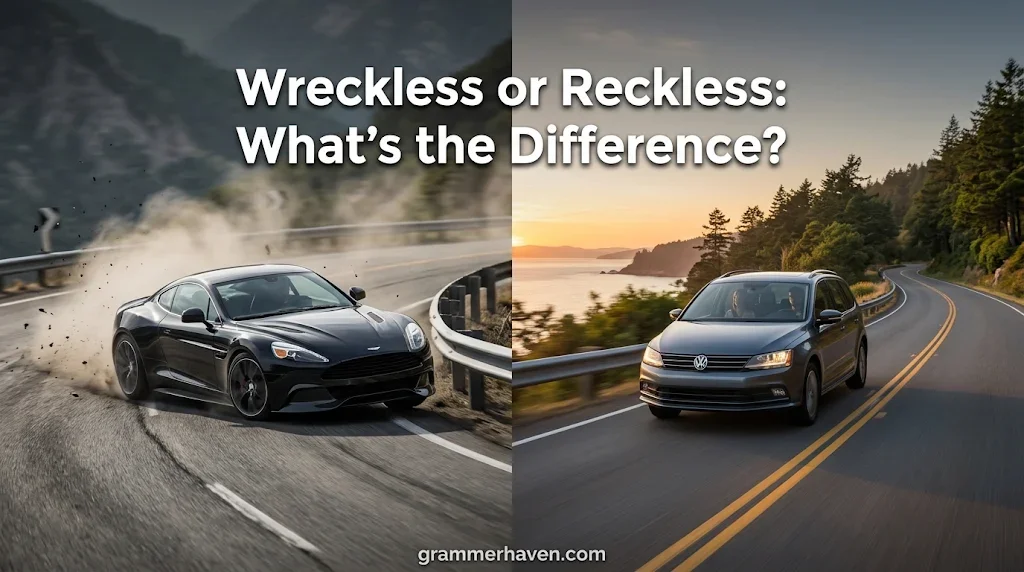
Wreckless or Reckless: What’s the Difference? explains why spelling confusion happens when similar words create mistakes in English writing. Having a solid grasp of the English language helps you notice why some words that sound the same can bring confidence or create uncertainty. These tricky twins are often seen as culprits in spelling mistakes because they appear to operate in everyday language. By looking at their meaning, usage, and straight definitions, you can start diving deep into this piece and understand the real difference.
The main reason for this spelling confusion is their similar pronunciation, which makes these two terms commonly mistaken as homophones. However, reckless is the correct term because it describes acting without care or without thinking about possible results. Wreckless is usually incorrect because it has not followed the evolution from deviant error to accepted convention. The long and sometimes nonlinear process of language change continues for many words, but this spelling remains outside standard vocabulary, grammar, and proper communication.
Many learners carefully check a page before they choose the right spelling, and this is where understanding the implied meaning matters. Wreckless may seem to suggest something connected to a wreck, but that is not what you intend to say when describing careless behavior. The latter category shows why this adjective choice matters. To discover the better choice, follow the rules, understand the possible spellings, and remember this interesting twist: only one form is widely recognized in accepted English.
Wreckless or Reckless Meaning Explained in Simple English
Before comparing spelling, you need to understand meaning. Because once you truly grasp the meaning of reckless, the confusion starts to disappear.
What “Reckless” Actually Means
The word reckless describes behavior that shows:
- No concern for danger
- Poor judgment
- Ignoring consequences
- Acting too fast without thinking
In simple terms, it means:
Doing something risky without caring what might happen next.
Everyday Examples of Reckless Behavior
You see recklessness everywhere in daily life:
- A driver speeding through traffic lights
- A person spending all savings on impulse
- Someone jumping into a decision without reading the risks
- A biker performing stunts on busy roads
None of these actions are “careful.” They are driven by impulse, not thought.
A Quick Emotional Picture
Think of someone standing on the edge of a roof, laughing, stepping closer to the edge for fun. That feeling of “this could go wrong but I don’t care right now” is recklessness in action.
Why “Wreckless” Looks Correct but Isn’t
This is where things get interesting. Because “wreckless” feels logical.
You see the word wreck, and your brain instantly connects it with destruction, accidents, and crashes. So naturally, you assume:
“Wreckless must mean without wrecks.”
That logic seems clean. But English doesn’t always follow clean logic.
The Problem With “Wreckless”
Here’s the reality:
- It is not listed in standard dictionaries
- It has no official linguistic origin
- It is considered a spelling error in academic and professional writing
Even though it looks meaningful, it is not a valid English word.
Why People Keep Using It Anyway
There are three main reasons:
- Phonetic confusion: “reckless” and “wreckless” sound almost identical
- Association with “wreck”: people link meaning instead of origin
- Internet repetition: once a mistake spreads online, it multiplies quickly
So the mistake survives not because it is correct, but because it feels correct.
Wreckless or Reckless Word Origin: The Real Story
To fully understand why “wreckless” is wrong, you need to go back in time.
The word reckless does NOT come from “wreck.”
Instead, it comes from an old English root: “reck.”
What “Reck” Means
In Old English, reck meant:
- To care
- To pay attention
- To think about something
So if someone was “reckless,” it literally meant:
“without care” or “without thought”
Breaking It Down Clearly
Let’s simplify it:
- reck = care or thought
- -less = without
So:
reck + less = without care
That’s it. No wrecks involved. No crashes.
Why This Matters
Once you know this origin, the confusion disappears. The word has always been about thoughtlessness, not damage.
Wreckless or Reckless Side-by-Side Comparison
Let’s make this crystal clear.
| Feature | Reckless | Wreckless |
| Status | Correct English word | Incorrect spelling |
| Meaning | Careless, risky, impulsive | No official meaning |
| Origin | Old English “reck” (care/thought) | No linguistic origin |
| Usage | Formal and informal writing | Common typo |
| Dictionary presence | Yes | No |
If you remember nothing else, remember this table.
Why “Wreckless” Spreads So Easily Online
You might wonder: if it’s wrong, why do so many people use it?
The internet explains a lot.
1. Typing Errors on Mobile Devices
Phones often autocorrect based on partial guesses. If someone types quickly, “wreckless” appears naturally.
2. Mishearing in Conversations
When spoken quickly, “reckless” can sound like it has a “w” sound in casual speech.
3. Social Media Reinforcement
Once a spelling mistake appears in viral posts, others copy it without checking.
4. Logic-Based Guessing
People assume English words follow strict logic. So they “fix” it into something that makes sense visually.
But English is not always logical. It is historical.
How to Remember the Correct Word Easily
Let’s make this practical so you never hesitate again.
Memory Trick #1: The “No Care” Rule
Think of it like this:
Reckless = no care, no thought
If there is no thinking involved, it is reckless.
Memory Trick #2: Remove the “Wreck” Idea
Ask yourself:
- Does the word come from “wreck” meaning crash?
- Or from “reck” meaning thought?
The answer is always reck.
Memory Trick #3: The Shortcut Sentence
Repeat this:
“If it’s about wrecks, it’s not about spelling.”
Common Real-Life Uses of “Reckless”
This word appears in many real situations. Let’s explore how it works in context.
Driving and Traffic
- Reckless driving is one of the most common legal terms worldwide.
- It refers to ignoring road safety rules and endangering others.
Example:
“The court fined him for reckless driving after he ignored multiple traffic signals.”
Financial Decisions
People often act recklessly with money:
- Gambling without limits
- Spending without budgeting
- Investing without research
Example:
“His reckless spending left him with no savings in three months.”
Personal Behavior
Recklessness can also be emotional:
- Making decisions during anger
- Acting without thinking in relationships
- Taking risks without considering consequences
Example:
“Her reckless decision to quit her job surprised everyone.”
Case Study: How One Misspelling Went Viral Online
A small but interesting example comes from online forums and comment sections.
The Situation
A viral post on social media used the phrase:
“That was a wreckless move.”
At first, thousands of users didn’t notice the error.
What Happened Next
- Some users copied the spelling
- Others argued it was correct slang
- A debate formed around “wreckless vs reckless”
The Outcome
Eventually, language educators and dictionaries clarified the mistake. But the incorrect version still appears in casual online writing today.
Lesson Learned
Once misinformation spreads online, it can stick even when it’s wrong. That’s why understanding basics matters more than ever.
Related Words People Confuse With Reckless
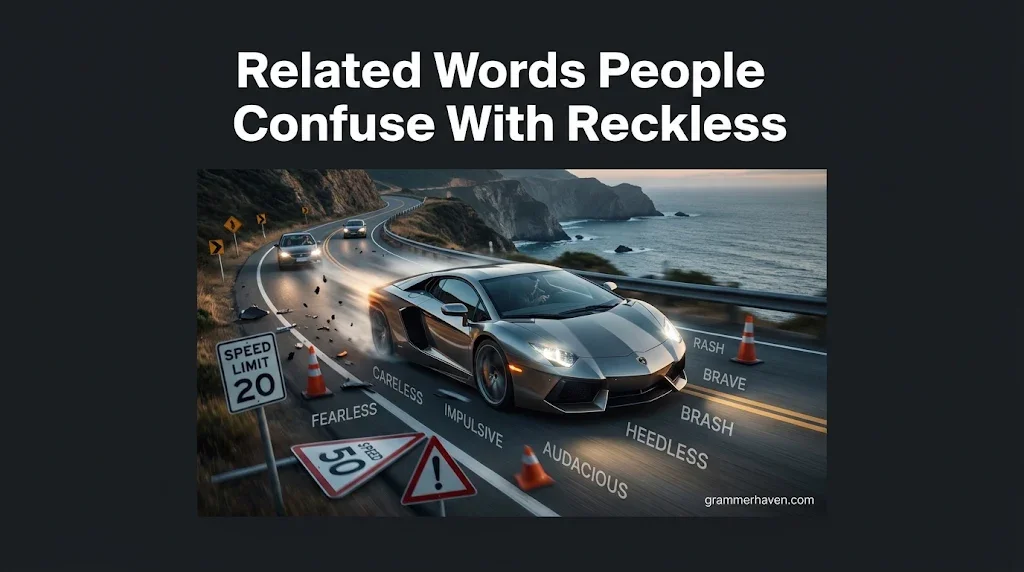
English has several near-synonyms that create confusion.
Careless
- Lacks attention or caution
- Often accidental, not intentional
Rash
- Quick decision without thinking
- Usually emotional
Impulsive
- Acting on sudden feelings
Risky
- Involves danger, but not always careless
Thoughtless
- Shows lack of consideration for others
Each word has a slightly different shade of meaning, but reckless usually implies stronger danger and disregard.
Grammar Rules for “Reckless”
Let’s keep this simple and practical.
Part of Speech
- “Reckless” is an adjective
Common Sentence Patterns
You will usually see it like this:
- Reckless + noun
- reckless behavior
- reckless driving
Collocations You Should Know
These phrases appear often in real writing:
- Reckless abandon
- Reckless decision
- Reckless action
- Reckless disregard
Wreckless or Reckless in Modern Writing and SEO Mistakes
This confusion also shows up in search engines.
People often search:
- “wreckless driving meaning”
- “wreckless vs reckless spelling”
- “is wreckless a word”
Search engines still return results for these queries because enough users make the mistake.
Important Insight
Google doesn’t decide correctness. It reflects usage.
So even incorrect spellings can appear in search trends if enough people type them.
See also: Uphill Battle Idiom Definition: Meaning, Usage, Origin & Real-Life Examples
FAQs:
1. Is Wreckless a correct word in English?
No, Wreckless is generally considered an incorrect spelling. The accepted and widely used word is reckless, which describes careless or risky behavior.
2. What does reckless mean?
Reckless means acting without thinking about the possible results or dangers. A reckless person may ignore safety, rules, or consequences.
3. Why do people confuse Wreckless and reckless?
People confuse these words because they have a similar pronunciation and look almost identical in spelling. The connection between “wreck” and “wreckless” can also make the incorrect form seem reasonable.
4. Can Wreckless ever be used in writing?
In standard English writing, Wreckless should be avoided. It may appear as a creative term, brand name, or intentional wordplay, but it is not the correct replacement for reckless.
5. How can I remember the difference between Wreckless and reckless?
Remember that reckless comes from the idea of lacking care or caution. If you are describing dangerous, careless, or thoughtless actions, the correct choice is always reckless.
Conclusion:
Understanding Wreckless or Reckless: What’s the Difference? helps you avoid a common spelling mistake in English. While Wreckless may look logical because it seems connected to the word “wreck,” it is not the standard spelling used in modern English. Reckless is the correct adjective for describing someone who acts without care, caution, or thought about consequences. By improving your vocabulary and understanding word evolution, you can make better choices in your writing and communication.
Latest Post:
- Result In or Result To: Which Is Correct? (With Examples)
- A Dime a Dozen: Meaning, Definition, Origin and Real-Life Usage
- Hooplehead Definition, Meaning, Usage and Examples
- Whole vs Hole: What’s the Difference?
- Acumen vs Acuity vs Acuteness: What’s the Difference?