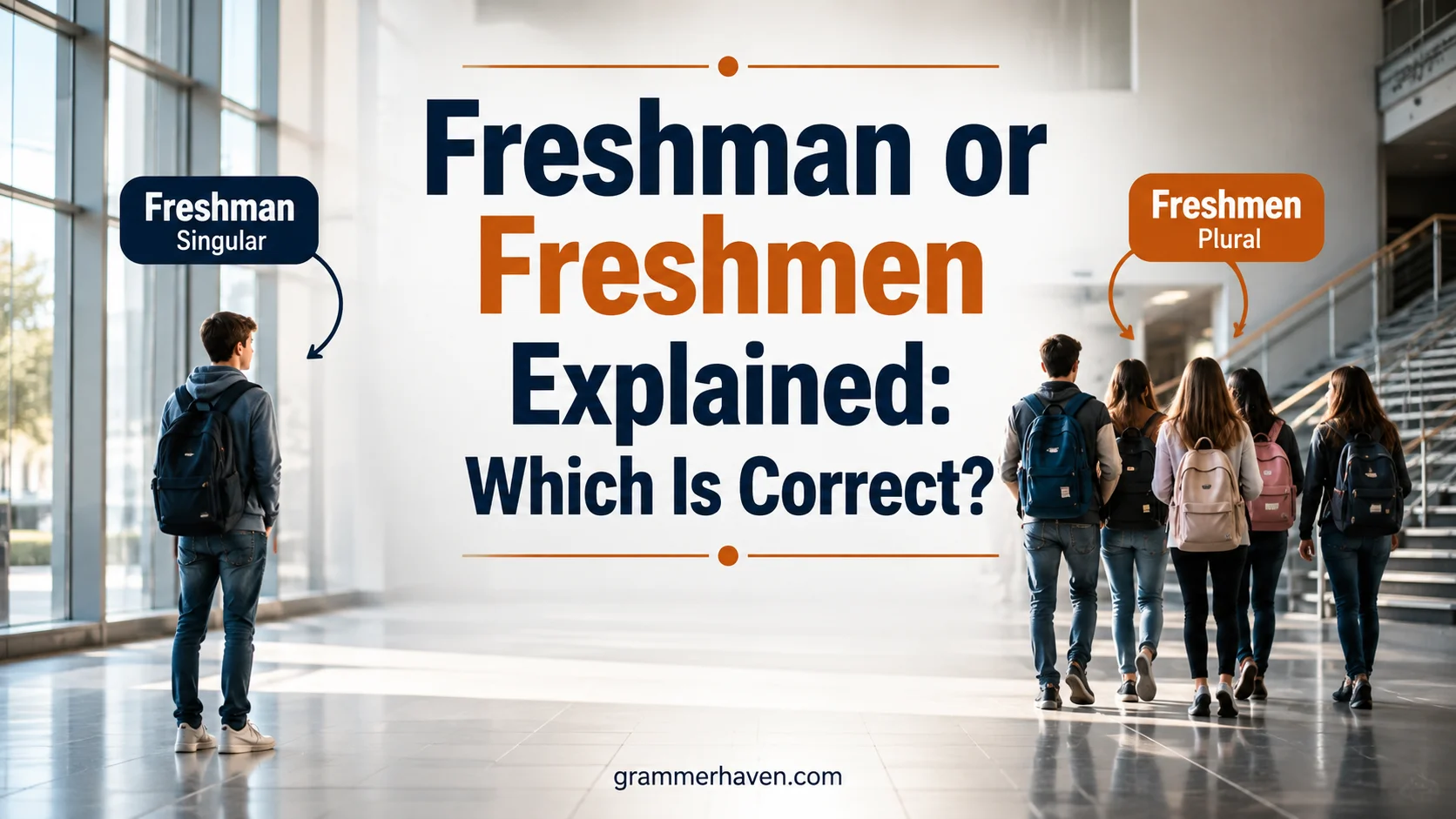
Freshman or Freshmen Explained: Which Is Correct? helps you understand the difference between these two English words with ease.
A Freshman is the singular noun that refers to one student who has entered the first year of high school, college, a university, or a university program, while Freshmen is the plural form for more than one student. Although the two words are often spoken aloud and may look almost the same when spelled, they have different meaning, usage, and terminology. In my editing experience, many learners confuse them at first, but when you compare each word in context, it becomes much easier to tell apart the correct choice. You’ll often see these terms used in education, an academic year, a group, an event, or when talking about first-year students, also called first-years.
In English grammar, Freshman is an irregular noun with an irregular plural. Instead of adding -s or adding -es, the plural form changes by changing a to e, just as man becomes men. This rule is part of grammar, plural nouns, noun forms, word formation, inflection, morphology, and grammatical number, making it valuable for building your language and vocabulary. Trusted sources such as Dictionary.com and Thesaurus.com describe this rule clearly.
Today, some people object to applying Freshman to all male persons and other students because of the -man ending. As a result, alternative forms such as first-year students, first-years, fire fighter, handyperson, chairperson, or simply chair are commonly used. Freshman can also work as an adjective, while Freshmen is only the plural noun.
Freshman or Freshmen: Quick Difference Explained
Before diving deeper, here is the simplest way to understand the difference:
| Word | Meaning | Example |
| Freshman | One first-year student | “Sarah is a freshman at college.” |
| Freshmen | More than one first-year student | “The freshmen attended orientation.” |
Think of it like this:
- Freshman = one person
- Freshmen = a group of people
A freshman is one student starting their first year. Freshmen are several students starting their first year.
What Does Freshman Mean?
The word freshman refers to a student who is in their first year of education at a particular level.
In the United States, people commonly use freshman for:
- A first-year high school student
- A first-year college student
- A first-year university student
- A first-year member of a group or organization
For example:
- “My brother is a freshman in high school.”
- “Emily became a freshman at the University of Texas.”
- “The freshman athlete joined the basketball team.”
The word does not describe age. Instead, it describes a student’s position in their academic journey.
A 14-year-old ninth grader and a 40-year-old person starting college could both be called freshmen.
Freshman Meaning in School and College
The meaning of freshman depends slightly on the educational setting.
Freshman in High School
In most American high schools, a freshman is a student in ninth grade.
The typical US high school structure looks like this:
| Grade Level | Student Name |
| 9th grade | Freshman |
| 10th grade | Sophomore |
| 11th grade | Junior |
| 12th grade | Senior |
Example:
“Jake is a freshman because he just started ninth grade.”
Freshman year often represents a major transition. Students move from middle school into a larger environment with new teachers, harder classes, and more independence.
Freshman in College
At colleges and universities, a freshman is a student in their first year of undergraduate study.
Example:
“Maria is a freshman studying computer science.”
College freshman year usually involves:
- Adjusting to independent learning
- Choosing academic interests
- Meeting new people
- Managing schedules
- Exploring campus activities
Many universities provide special programs to help freshmen adapt, such as:
- Orientation programs
- First-year seminars
- Academic advising
- Student mentoring
What Does Freshmen Mean?
Freshmen is the plural form of freshman.
You use it when you are talking about two or more first-year students.
Examples:
✅ Correct:
- “The freshmen moved into their dorm rooms.”
- “Thousands of freshmen started classes this semester.”
- “The university welcomed new freshmen.”
❌ Incorrect:
- “The freshman moved into their dorm rooms.”
(This suggests one student unless freshman is being used as an adjective.)
❌ Incorrect:
- “The freshmans started school.”
English does not add -s to make this word plural. Instead, it follows an older spelling pattern.
Freshman vs Freshmen: The Main Grammar Rule
The main rule is simple:
Use Freshman for One Person
When you mean a single student, use freshman.
Examples:
- “I am a freshman at college.”
- “My sister is a freshman.”
- “The freshman won the award.”
You can often recognize singular usage because words like these appear before it:
- a
- one
- each
- every
- this
- that
Examples:
- “A freshman joined the club.”
- “Every freshman must complete orientation.”
Use Freshmen for Multiple People
When you mean several first-year students, use freshmen.
Examples:
- “Many freshmen struggle with their first semester.”
- “The freshmen attended a campus event.”
- “Five freshmen received scholarships.”
Words that often signal plural usage include:
- many
- several
- hundreds
- thousands
- all
- those
- these
Examples:
- “Many freshmen live on campus.”
- “These freshmen are preparing for exams.”
Why Is the Plural of Freshman Freshmen?
A common question is:
Why isn’t the plural form “freshmans”?
The answer comes from English language history.
The word freshman follows an older pattern found in some words ending in -man.
Similar examples include:
| Singular | Plural |
| Man | Men |
| Woman | Women |
| Freshman | Freshmen |
| Policeman | Policemen |
| Fireman | Firemen |
These words change internally instead of simply adding -s.
However, not every word ending in “man” follows this rule.
Examples:
| Singular | Plural |
| Human | Humans |
| German | Germans |
| Roman | Romans |
| Chairman | Chairmen (traditional usage) |
English can be unpredictable because it developed from many languages over centuries.
Is Freshman Gender Neutral?
The word freshman contains the word “man,” which sometimes makes people question whether it applies to all genders.
Today, freshman is widely used as a gender-neutral term in American English.
Examples:
- “She is a freshman at Yale.”
- “He is a freshman studying engineering.”
- “They are a freshman at the university.”
The word describes academic year, not gender.
However, some schools and organizations prefer the term first-year student because it sounds more inclusive and modern.
For example:
Traditional:
“Freshman orientation begins Monday.”
Alternative:
“First-year student orientation begins Monday.”
Both expressions communicate the same idea.
Freshman or First-Year Student: Which One Should You Use?
Both terms are correct, but they have slightly different tones.
| Term | Style | Common Use |
| Freshman | Casual and traditional | Everyday conversation |
| First-year student | Formal and inclusive | University documents |
You might say:
“My cousin is a freshman.”
in normal conversation.
However, a university website might write:
“All first-year students must complete academic advising.”
The choice depends on the audience.
Freshman, Sophomore, Junior, and Senior Explained
The American education system uses four common labels for student years.
| Year | Term | Meaning |
| First year | Freshman | New student |
| Second year | Sophomore | Student in year two |
| Third year | Junior | Student in year three |
| Fourth year | Senior | Student in final year |
Example:
A four-year college student might experience:
Year 1:
“I am a freshman studying biology.”
Year 2:
“I became a sophomore and started advanced courses.”
Year 3:
“As a junior, I began researching career options.”
Year 4:
“As a senior, I prepared for graduation.”
Freshman as an Adjective: Why It Sometimes Stays Singular
One confusing part about freshman vs freshmen happens when the word describes another noun.
When freshman acts as an adjective, it usually stays singular.
Examples:
✅ Correct:
- Freshman year
- Freshman class
- Freshman orientation
- Freshman dormitory
- Freshman athletes
❌ Incorrect:
- Freshmen year
- Freshmen class
- Freshmen orientation
Why?
Because English adjectives usually do not change based on number.
For example:
- A small car
- Small cars
The word “small” stays the same.
The same idea applies here:
- A freshman class
- Two freshman classes
Freshman or Freshmen in Sports
Sports create another area where people often get confused.
A single first-year athlete is a:
Freshman player
A group of first-year athletes are:
Freshmen players
Examples:
Singular:
“The freshman quarterback scored the winning touchdown.”
Plural:
“The freshmen on the team practiced together.”
However, when used as an adjective, the word remains singular:
- Freshman football team
- Freshman basketball league
- Freshman athletes
Common Mistakes With Freshman and Freshmen
Mistake: Saying “I am a freshmen”
This is one of the most common errors.
Incorrect:
“I am a freshmen at college.”
Correct:
“I am a freshman at college.”
Why?
Because “I” refers to one person.
Mistake: Saying “The freshman arrived”
If you mean a group, this is incorrect.
Incorrect:
“The freshman attended the meeting.”
Correct:
“The freshmen attended the meeting.”
Mistake: Adding “s” to Make Freshmans
English learners sometimes assume every plural needs “s.”
Incorrect:
“The freshmans joined the program.”
Correct:
“The freshmen joined the program.”
Mistake: Using Freshmen as an Adjective
Incorrect:
“Freshmen students attended orientation.”
Correct:
“Freshman students attended orientation.”
The noun “students” already shows that it is plural.
Real-Life Examples of Freshman vs Freshmen
Understanding examples makes the difference easier to remember.
Example One: Talking About One Student
“David is a freshman at Ohio State University.”
Meaning:
David is one first-year student.
Example Two: Talking About a Group
“The freshmen attended their first campus event.”
Meaning:
Many first-year students attended.
Example Three: Using Freshman as a Description
“The freshman class has 800 students.”
Meaning:
The class belongs to first-year students.
Freshman vs Freshmen Quick Test
Choose the correct word:
Question 1:
My sister is a college ______.
Answer:
✅ Freshman
Question 2:
Thousands of ______ started university this year.
Answer:
✅ Freshmen
Question 3:
The ______ orientation program begins tomorrow.
Answer:
✅ Freshman
Question 4:
The school welcomed new ______.
Answer:
✅ Freshmen
Easy Memory Trick for Freshman or Freshmen
Here is a simple way to remember:
Freshman = One
Think:
“One freshman walks into the classroom.”
See also: Referred or Refered: Which Spelling Is Correct?
Freshmen = Many
Think:
“Many freshmen walk into the classroom.”
Another trick:
The word men inside freshmen can remind you that it refers to multiple people.
Remember:
- One → freshman
- More than one → freshmen
FAQs:
1. Is Freshman or Freshmen correct?
Both are correct, but they have different meanings. Freshman is the singular form for one first-year student, while Freshmen is the plural form for two or more first-year students.
2. Why is the plural of Freshman written as Freshmen?
Freshman is an irregular noun.
3. Can Freshman be used as an adjective?
Yes. Freshman can describe something related to first-year students, such as freshman orientation or a freshman course. Freshmen is only used as a plural noun.
4. Are there gender-neutral alternatives to Freshman?
Yes. Many schools and universities now use terms like first-year student or first-year students because they are gender-neutral and inclusive.
5. How can I remember when to use Freshman and Freshmen?
Think of man and men. If you’re talking about one student, use Freshman. If you’re talking about multiple students, use Freshmen.
Conclusion:
Understanding the difference between Freshman and Freshmen is easier than it first appears. Freshman refers to one first-year student, while Freshmen refers to more than one. Since Freshman is an irregular noun, its plural follows the same pattern as man and men rather than adding -s. Whether you’re writing about high school, college, or university life, choosing the correct form will make your English more accurate and professional.