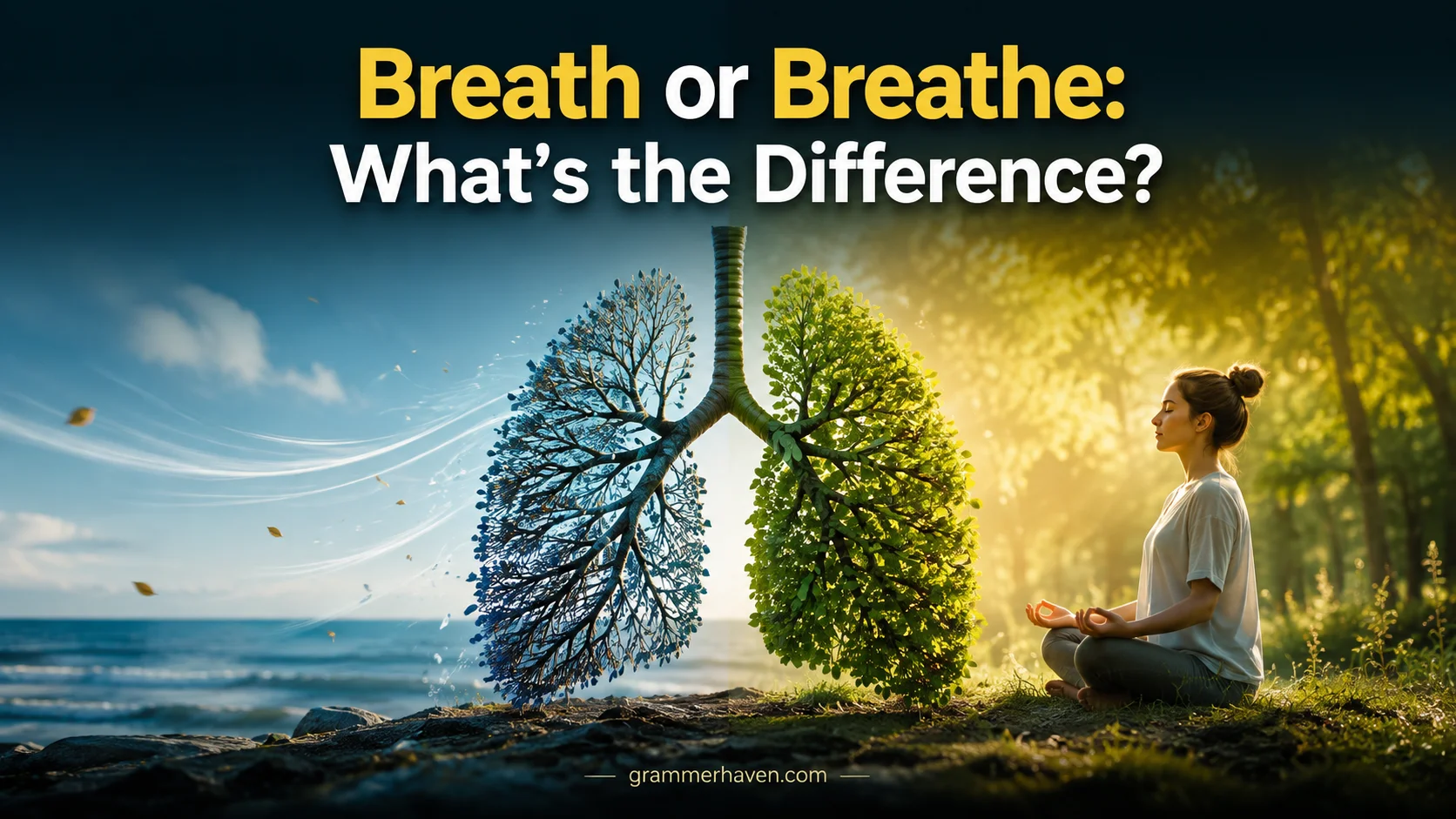
Breath or Breathe can cause confusion because these English words sound similar, but their meanings, uses, and grammatical usage differ. Breathe is a verb for drawing air into your lungs, inhaling air, exhaling it, or expelling it again; breath is a noun for the air brought in and exhaled during breathing. The word meaning and proper usage become easier to understand when you remember this difference.
The spelling difference comes from the letter e at the end of breathe. This single letter changes the pronunciation difference and separates the noun form from the verb form. In English language basics, breath has a shorter sound, while breathe has a longer sound. Their word pronunciation, word ending, spelling, and context help show which form fits.
These similar-sounding words also matter in semantics, grammar, and everyday use. Both appear in common idioms and non-literal senses, creating related meanings beyond physical breathing. Remembering 2, or two, grammatical roles makes the rule clear: breathe describes the action, while breath names the thing.
The Short Answer: Breath vs. Breathe
If you only remember one thing from this article, make it this table.
| Word | Part of Speech | Meaning | Pronunciation | Example |
| Breath | Noun | The air you inhale or exhale or one complete inhalation | breth | Take a deep breath. |
| Breathe | Verb | To inhale and exhale air | breeth | Try to breathe slowly. |
Think of it this way:
- Breath = the thing
- Breathe = the action
That’s the entire difference.
Everything else builds from this rule.
What Does “Breath” Mean?
The word breath is always a noun.
A noun names a person, place, thing, or idea. In this case, breath refers to the air moving into or out of your lungs or to a single act of breathing.
For example:
- Take one deep breath.
- Her breath smelled like peppermint.
- His breath became slower after the workout.
Notice something?
You can usually place words like:
- a
- the
- your
- my
- one
before breath because it names something.
Examples:
- a breath
- your breath
- my breath
- every breath
- one breath
That wouldn’t work with breathe, because verbs don’t function that way.
Common Meanings of Breath
Depending on context, breath can refer to:
| Meaning | Example |
| Air from the lungs | I could see my breath on the cold morning. |
| One inhalation | Take a deep breath. |
| Breathing ability | He was short of breath after climbing stairs. |
| Life itself | She took her last breath peacefully. |
Examples of Breath in Everyday Life
You’ll encounter breath almost everywhere.
During exercise:
The runner paused to catch his breath.
During public speaking:
Take a deep breath before walking onto the stage.
In cold weather:
You could see everyone’s breath in the freezing air.
At the doctor’s office:
The physician listened to her breath with a stethoscope.
What Does “Breathe” Mean?
Unlike breath, breathe is always a verb.
A verb describes an action.
In this case, the action is inhaling and exhaling air.
Examples include:
- Breathe slowly.
- Try to breathe through your nose.
- He couldn’t breathe after laughing so hard.
- Remember to breathe during your workout.
Notice that breathe often follows helping verbs such as:
- can
- could
- should
- must
- will
- would
- may
Examples:
- Can you breathe?
- You should breathe deeply.
- I couldn’t breathe.
- We must breathe clean air.
Examples of Breathe in Daily Conversation
During yoga:
Breathe deeply and relax your shoulders.
During swimming lessons:
Learn to breathe on every third stroke.
At the hospital:
The patient began to breathe normally again.
While hiking:
Stop for a minute and breathe slowly.
Breath vs. Breathe: The Main Difference
The easiest way to remember the difference is to think about grammar first.
| Breath | Breathe |
| Noun | Verb |
| A thing | An action |
| Air or one inhalation | The act of inhaling and exhaling |
| One syllable | One syllable with a long “ee” sound |
| Used with articles like “a” or “the” | Used after helping verbs or as an action |
Here is another comparison.
| Incorrect | Correct |
| I can’t breath. | I can’t breathe. |
| Take a deep breathe. | Take a deep breath. |
| She lost her breathe. | She lost her breath. |
| Remember your breathe. | Remember your breath. |
The extra “e” changes more than spelling. It changes the word’s role in the sentence.
How to Remember the Difference Between Breath and Breathe
English contains many word pairs that follow a similar pattern.
| Noun | Verb |
| Bath | Bathe |
| Cloth | Clothe |
| Wreath | Wreathe |
| Breath | Breathe |
Notice the pattern?
The noun ends without e.
The verb ends with e.
Once you recognize this pattern, remembering breath and breathe becomes much easier.
Memory Trick One
Ask yourself:
Can I physically do it?
If the answer is yes, use breathe.
Examples:
- breathe
- bathe
- clothe
These are actions.
Memory Trick Two
If you’re referring to something you possess, use breath.
Examples:
- my breath
- your breath
- his breath
- her breath
You can’t possess an action.
Pronunciation Guide
Many learners spell these words incorrectly because they sound similar.
Here’s the difference.
| Word | Sounds Like |
| Breath | Death |
| Breathe | Seethe |
The ending sound changes.
Breath
- Ends with the soft th sound.
Breathe
- Ends with the voiced th sound followed by a long ee.
Say them aloud:
- breath
- breathe
The pronunciation difference becomes much more obvious.
Breath vs. Breathe in Sentences
Seeing both words together helps reinforce the distinction.
Exercise
Take a deep breath before you breathe into the microphone.
Public Speaking
Take a slow breath before beginning your presentation.
Remember to breathe naturally while speaking.
Running
She stopped to catch her breath.
Once she recovered, she continued to breathe steadily.
Swimming
Every swimmer needs good breath control.
Learning to breathe correctly improves endurance.
Meditation
Each breath should feel relaxed.
Continue to breathe slowly throughout the session.
Healthcare
The doctor listened to his breath.
The patient struggled to breathe.
Common Mistakes People Make
Many errors happen because people choose the wrong part of speech.
Here are some examples.
| Incorrect | Correct |
| I can’t breath. | I can’t breathe. |
| Take a breathe. | Take a breath. |
| She lost her breathe. | She lost her breath. |
| Breath deeply. | Breathe deeply. |
| He forgot to breath. | He forgot to breathe. |
| Hold your breathe. | Hold your breath. |
| I need a breathe. | I need a breath. |
| We couldn’t breath underwater. | We couldn’t breathe underwater. |
| Every breathe counts. | Every breath counts. |
| Breath through your nose. | Breathe through your nose. |
A quick grammar check usually catches these mistakes.
Common Expressions Using “Breath”
English includes dozens of idioms with breath.
Here are the most common ones.
| Expression | Meaning | Example |
| Catch your breath | Recover after exertion | I needed a minute to catch my breath. |
| Hold your breath | Stop breathing briefly | Hold your breath underwater. |
| Out of breath | Breathing heavily | He was out of breath after running. |
| Save your breath | Stop wasting your effort | Save your breath. He won’t change his mind. |
| Under your breath | Quietly | She apologized under her breath. |
| Take my breath away | Amazed | The mountain view took my breath away. |
| Breath of fresh air | Refreshing change | The new manager was a breath of fresh air. |
| Last breath | Final moment of life | He remained hopeful until his last breath. |
These expressions appear regularly in books, films, speeches, and everyday conversation.
Can “Breath” Ever Be a Verb?
In modern English, the answer is no.
Breath functions only as a noun.
Whenever you need the action, choose breathe instead.
Examples:
❌ I breath every day.
✅ I breathe every day.
This rule has remained consistent in modern English grammar.
Can “Breathe” Ever Be a Noun?
No.
Breathe always functions as a verb.
Whenever you need a noun, use breath.
Examples:
❌ Take one deep breathe.
✅ Take one deep breath.
There are no common exceptions.
A Grammar Rule You Can Always Trust
When choosing between breath and breathe, ask one question.
Is it a thing?
Use breath.
Examples:
- one breath
- my breath
- every breath
- deep breath
Is it an action?
Use breathe.
Examples:
- breathe deeply
- breathe slowly
- breathe easier
- breathe normally
This simple test works almost every time.
Quick Practice Quiz
Choose the correct word.
Questions
- Take a deep ______ before answering.
- It’s difficult to ______ during allergy season.
- Hold your ______ underwater.
- Remember to ______ slowly during yoga.
- She finally caught her ______ after the race.
- I couldn’t ______ because of the smoke.
Answers
- breath
- breathe
- breath
- breathe
- breath
- breathe
If you answered all six correctly, you’ve mastered the difference.
Real-World Case Study: Why This Mistake Matters
Imagine two emergency signs in a hospital.
Sign One
If you cannot breath, seek immediate medical help.
Sign Two
If you cannot breathe, seek immediate medical help.
Only the second sentence is grammatically correct.
While most readers would understand the intended meaning, mistakes like this can reduce credibility. In professional writing, healthcare materials, educational resources, and workplace documents, using the correct form helps maintain clarity and trust.
The same principle applies to resumes, emails, websites, and academic papers. Small grammar errors may seem minor, yet they can leave a lasting impression on readers.
Quick Reference Cheat Sheet
| If You Mean… | Correct Word |
| Air from your lungs | Breath |
| One inhalation | Breath |
| The action of inhaling | Breathe |
| To inhale and exhale | Breathe |
| Take a deep ___ | Breath |
| Can’t ___ | Breathe |
| Hold your ___ | Breath |
| Learn to ___ | Breathe |
Bookmark this table if you frequently mix up the two words.
See also: Donor or Donar: Which Spelling Is Correct?
FAQs:
1. What is the difference between breath and breathe?
Breath is a noun, while breathe is a verb. Breath refers to the air you take in or release. Breathe describes the action of taking air in and letting it out.
2. Is breathe a verb?
Yes. Breathe is a verb that means to take air into your lungs and release it.
3. Is breath a noun?
Yes. Breath is a noun that refers to the air taken into or released from your lungs.
4. How do you remember the difference?
A simple trick is to remember that breathe has an extra e and refers to an action. Breath refers to the air itself.
5. How do you pronounce breath?
Breath has a short vowel sound, similar to the sound in “death.”
6. How do you pronounce breathe?
Breathe has a long vowel sound, similar to the sound in “these.”
7. Is “take a breathe” correct?
No. The correct phrase is “take a breath.” Since breath is a noun, it fits after “take a.”
8. Is “I need to breath” correct?
No. The correct sentence is “I need to breathe.” Since the sentence describes an action, you need the verb breathe.
9. Can breath and breathe be used in idioms?
Yes. Both words appear in common English expressions, such as “catch your breath” and “breathe new life into something.”
10. Which one should I use: breath or breathe?
Use breathe when you’re talking about the action of taking in and releasing air. Use breath when you’re talking about the air itself.
Conclusion:
Breath and breathe may look and sound similar, but they have different grammatical roles. Breath is a noun, while breathe is a verb. Remembering this simple difference can help you avoid common spelling and grammar mistakes.