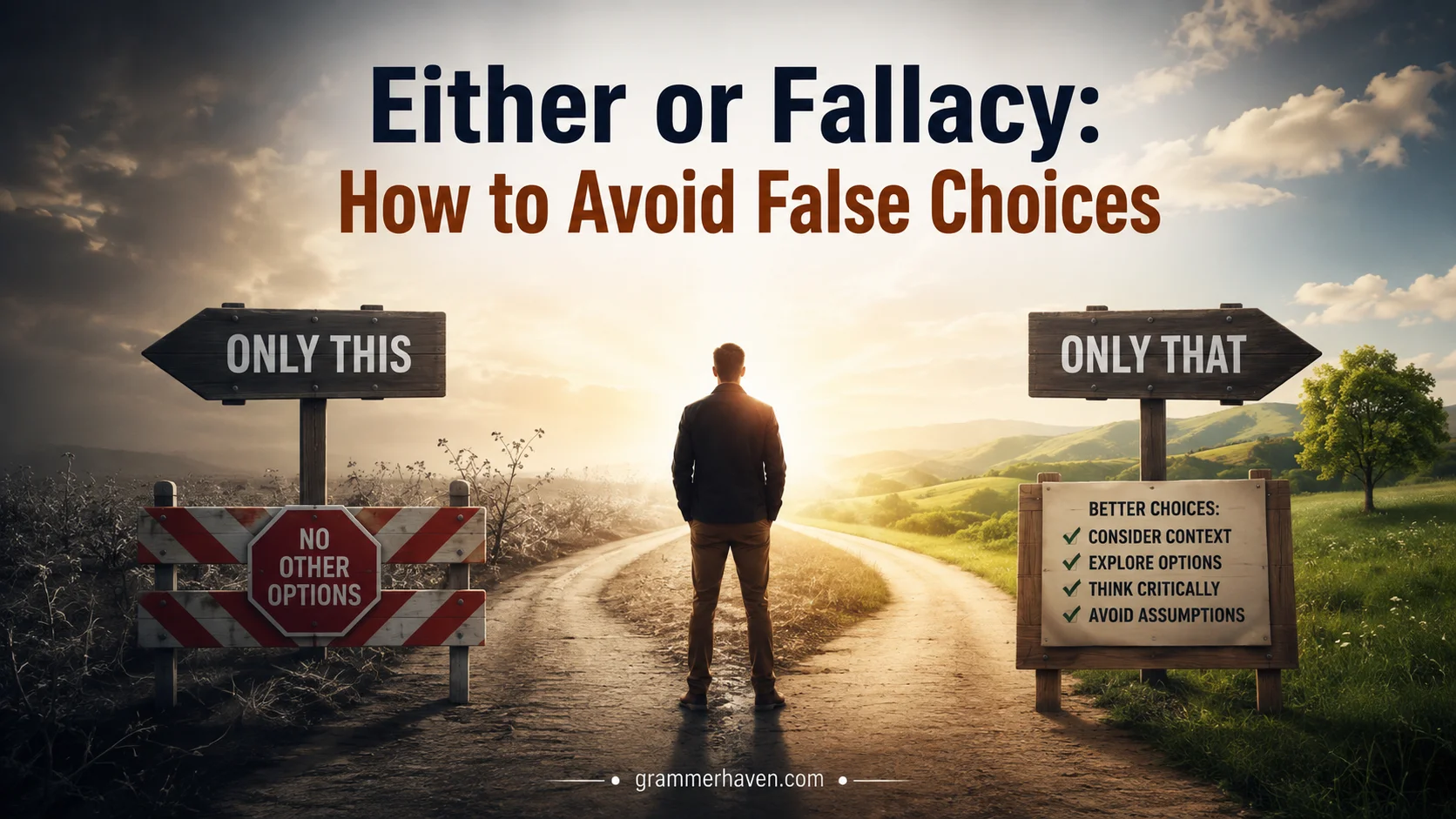
Either or Fallacy is a fallacy and logical error in logic and reasoning that limits real possibilities to only two options.
The false dilemma oversimplifies complex situations through flawed reasoning, presenting two outcomes as the only choices and creating an oversimplification. This assumption involves ignoring alternatives, the middle ground, other possibilities, and other ways within a dilemma. A specific policy may involve welfare and the community, yet a claim that a person must support it or be against support for the community creates a false choice. Real social issues, political issues, complex social issues, and complex political issues contain multiple ways to support the community. Black or white thinking is rarely the case, since mutually exclusive options and two extremes may ignore the actual complexity of an issue and make the decision harder to assess.
This error in reasoning appears in formal writing, English usage, everyday contexts, business communication, project management, online booking, calendar scheduling, and other professional settings. A project can succeed or fail, yet complex scenarios may include partial results, revisions, delays, or changed goals. Meetings, broadcasting, time management, and calendar workflows can also involve several outcomes. Grammar, consistency guidelines, US and UK style preferences, distinctions, and clarity matter in speech, text, presentations, written content, and spoken formats. Recognizing this common trap supports nuanced thinking, professional consistency, written formats, scheduling efficiency, and stronger arguments.
What Is the Either or Fallacy?
The Either or Fallacy is a logical error where an argument incorrectly reduces a complex situation into two opposing choices.
The basic structure looks like this:
Either A is true, or B is true.
A is not true.
Therefore, B must be true.
The problem is that another option, C, D, or even several other possibilities, may exist.
A real-world example:
“Either we increase taxes, or society will collapse.”
This argument assumes only two outcomes exist. In reality, governments may consider many alternatives, such as:
- Reducing unnecessary spending
- Changing tax structures
- Improving economic growth
- Adjusting policies gradually
- Combining multiple approaches
The fallacy appears because the speaker removes other possibilities from the conversation.
Other Names for the Either or Fallacy
The Either or Fallacy appears under several names. These terms usually describe the same reasoning mistake.
| Term | Meaning |
| Either or Fallacy | Presenting only two choices when more exist |
| False Dilemma | Creating a misleading two-option situation |
| False Dichotomy | Dividing an issue into two incorrect extremes |
| Black-and-White Thinking | Seeing situations as only one extreme or another |
| Bifurcation Fallacy | Splitting a complex issue into two limited categories |
Although the names differ, the central issue remains the same: unnecessary restriction of choices.
How the Either or Fallacy Works
The Either or Fallacy works by narrowing a discussion before the evidence has been fully examined.
A person using this fallacy often skips important questions:
- Are there other possible solutions?
- Are the two options actually opposites?
- Does choosing one option automatically eliminate all others?
- Is the situation more complicated than it appears?
By removing alternatives, the argument becomes easier to defend.
A complicated debate might involve ten possible solutions. Turning it into a two-choice argument makes the issue appear simpler than it really is.
The Structure of an Either or Fallacy Argument
Most examples follow a similar pattern:
Step One: Present Two Options
The speaker creates two possibilities.
“Either you work constantly, or you will never succeed.”
Step Two: Make One Option Negative
Usually, one choice is made undesirable.
“Nobody wants to fail.”
Step Three: Force Acceptance of the Remaining Option
The listener feels pressured to accept the first choice.
“Therefore, you must sacrifice all your free time.”
The hidden assumption is that success requires only one specific path.
However, many successful people achieve goals through different methods, including:
- Better planning
- Developing skills
- Building relationships
- Improving efficiency
- Creating sustainable habits
Common Examples of the Either or Fallacy
Example: Education
Statement:
“Either you go to college, or you cannot have a successful career.”
Why it is flawed:
Higher education can help many people, but it is not the only route to success.
Other paths include:
- Trade schools
- Entrepreneurship
- Apprenticeships
- Professional certifications
- Self-directed learning
The argument ignores these alternatives.
Example: Politics
Statement:
“Either you agree with my political views, or you hate your country.”
Why it is flawed:
People can care deeply about a country while holding different political opinions.
A healthy society includes:
- Different viewpoints
- Debate
- Compromise
- Policy disagreements
Disagreement does not automatically mean opposition or hostility.
Example: Health and Lifestyle
Statement:
“Either you follow this strict diet, or you do not care about your health.”
Why it is flawed:
Health improvement can involve many approaches:
- Balanced nutrition
- Regular exercise
- Better sleep
- Medical guidance
- Sustainable lifestyle changes
One method is not automatically the only responsible choice.
Example: Workplace Decisions
Statement:
“Either employees work overtime regularly, or the company will fail.”
Why it is flawed:
Businesses have multiple ways to improve performance:
- Better processes
- Automation
- Training
- Hiring additional staff
- Reducing waste
Long hours may be one option, but it is not the only option.
Why People Use the Either or Fallacy
People use false dilemmas for several reasons.
To Make Arguments Simpler
Complex issues require careful analysis. A two-option argument feels easier to understand.
For example:
Climate policy involves science, economics, technology, and politics. Reducing the conversation to:
“Either protect the environment, or protect the economy”
ignores the possibility that societies can pursue both goals together.
To Persuade Others Quickly
False dilemmas create pressure.
When someone says:
“Either you support this decision, or you are against progress”
They make disagreements appear unreasonable.
This emotional pressure can influence people before they examine the actual evidence.
To Avoid Discussing Alternatives
Sometimes people use this fallacy because alternative solutions weaken their position.
If several options exist, their preferred solution may no longer appear necessary.
Either or Fallacy vs Genuine Choices
Not every either/or statement is a fallacy.
Some situations truly involve two options.
For example:
“Either the light switch is on, or it is off.”
This is a legitimate two-option situation because the switch has only two states.
The difference comes down to whether additional realistic possibilities exist.
| Statement | Fallacy? | Reason |
| “The light is either on or off.” | No | Only two states exist |
| “Either you agree with me or you are my enemy.” | Yes | Many positions exist |
| “The file is either saved or deleted.” | Usually no | Digital systems often use two states |
| “Either we use this solution or nothing will work.” | Usually yes | Other solutions may exist |
How to Identify the Either or Fallacy
You can spot this fallacy by asking a few questions.
Does the Argument Present Only Two Options?
Look for words like:
- Either
- Or
- Only
- Must choose
- No alternative
- The only way
These words do not automatically indicate a fallacy, but they can signal a restricted choice.
Are the Options Really Opposites?
Sometimes arguments create fake opposites.
Example:
“Either you care about profits, or you care about employees.”
A company can care about both.
The two goals do not necessarily cancel each other out.
Are Important Alternatives Missing?
Ask:
“What other options exist?”
If you can easily identify reasonable alternatives, the argument may contain a false dilemma.
The Psychology Behind False Choices
The human brain often prefers simple answers.
Researchers call this tendency cognitive ease. People usually process information faster when it appears organized and straightforward.
A complicated issue might require research and careful thinking. A two-choice statement feels easier.
For example:
“This person is either a hero or a villain.”
Real people are usually more complicated. Someone can make good decisions in one area and poor decisions in another.
This tendency toward simplified categories can make false dilemmas persuasive.
Real-World Case Studies of the Either or Fallacy
Case Study: The “Technology Will Replace Humans” Argument
A common argument says:
“Either we stop technological progress, or machines will take all human jobs.”
This creates a false choice.
The reality includes many possibilities:
- Technology may replace some tasks.
- New industries may appear.
- Workers may need new skills.
- Humans and machines may collaborate.
History shows that major technological changes often eliminate some jobs while creating others.
Case Study: Remote Work Debate
During debates about workplace policies, people sometimes argue:
“Either employees work from the office full-time, or productivity disappears.”
This ignores other possibilities:
- Hybrid schedules
- Flexible hours
- Team-based approaches
- Different arrangements for different roles
The best solution often depends on the organization, employees, and type of work.
How to Avoid Using the Either or Fallacy
Avoiding this fallacy requires more careful thinking.
Consider Multiple Possibilities
Before making a conclusion, ask:
- What alternatives exist?
- Can these options be combined?
- Is there a middle solution?
Use More Accurate Language
Instead of saying:
“Either we do this, or nothing improves.”
Try:
“This approach may help, but we should compare it with other solutions.”
The second statement leaves room for better reasoning.
Separate Preferences From Facts
Someone may prefer one option without claiming it is the only option.
Example:
Weak argument:
“Either you choose this strategy, or you are making a mistake.”
Better argument:
“I think this strategy works best because of these reasons.”
How to Respond When Someone Uses the Either or Fallacy
When you notice a false dilemma, avoid simply saying:
“That is a fallacy.”
Instead, expand the conversation.
Try responses like:
- “Are those really the only two options?”
- “Could there be another approach?”
- “What about a combination of both ideas?”
- “Why does choosing one mean rejecting everything else?”
These questions encourage deeper discussion.
The Difference Between the Either or Fallacy and Other Logical Fallacies
The Either or Fallacy often appears alongside other reasoning mistakes.
| Fallacy | How It Differs |
| Slippery Slope | Claims one action will lead to extreme consequences |
| Straw Man | Misrepresents someone’s argument |
| Ad Hominem | Attacks the person instead of the argument |
| Appeal to Fear | Uses fear to persuade |
| Either or Fallacy | Reduces choices to only two options |
Understanding these differences helps you analyze arguments more accurately.
See also: Breath or Breathe: What’s the Difference?
FAQs:
1. What is the Either or Fallacy?
The Either or Fallacy is a logical error that presents only two choices when more options or possibilities exist.
2. Is the Either or Fallacy the same as a false dilemma?
Yes. False dilemma and Either or Fallacy describe the same basic reasoning error.
3. What is an example of the Either or Fallacy?
“Either you support this policy, or you don’t care about the community” is an example because it ignores other possible views.
4. Why is the Either or Fallacy problematic?
It oversimplifies complex situations and can make people believe they must choose between two extremes.
5. Does every either-or statement contain a fallacy?
No. Some situations genuinely have only two possible choices. The fallacy occurs when realistic alternatives exist but are ignored.
6. How can I identify an Either or Fallacy?
Ask whether the argument gives only two options when other reasonable choices, outcomes, or a middle ground exist.
7. Can the Either or Fallacy appear in everyday speech?
Yes. You may encounter it in conversations, social issues, political discussions, business communication, and online discussions.
8. Can the Either or Fallacy appear in formal writing?
Yes. It can appear in essays, reports, presentations, professional documents, and other forms of written content.
9. How can I avoid the Either or Fallacy?
Look for additional possibilities and alternatives before treating two choices as mutually exclusive.
10. What is another name for the Either or Fallacy?
The most common alternative name is false dilemma, also called a false dichotomy.
Conclusion:
The Either or Fallacy creates a false dilemma by reducing a situation to two choices when other possibilities may exist. Recognizing this logical error helps you examine arguments more carefully, consider alternatives, and avoid oversimplifying complex issues. Whether you encounter it in everyday conversations, professional settings, or formal writing, looking beyond two extremes can lead to clearer and more balanced reasoning.