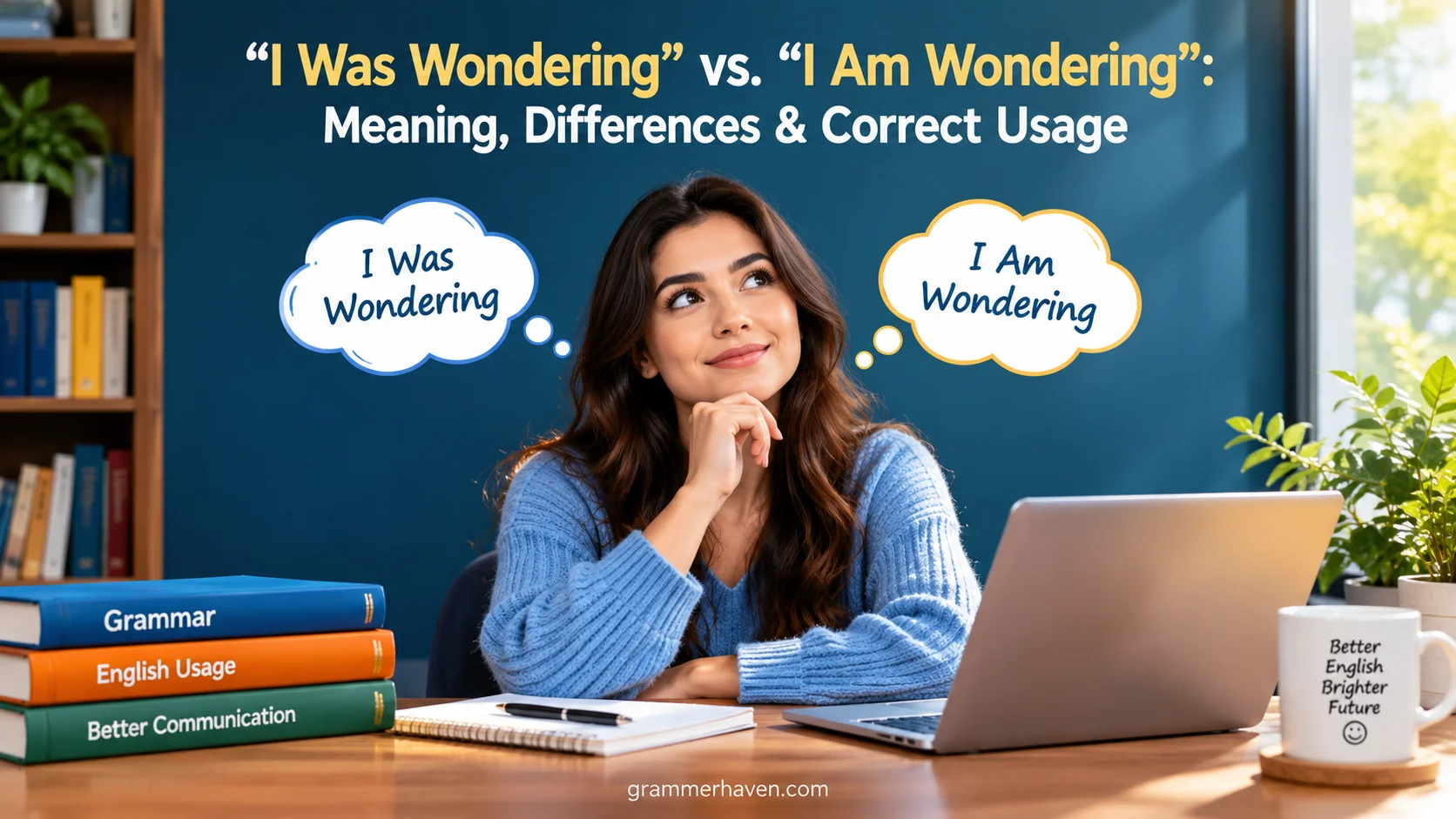
“I Was Wondering” vs. “I Am Wondering” explains how verb tense, emphasis, and tone affect polite requests, questions, and everyday English communication.
Both expressions are grammatically correct, but they serve different purposes. “I was wondering” often introduces a polite request or indirect question. “I am wondering” highlights a present thought or current uncertainty. These expressions help you sound natural, polite, and confident in spoken English, written English, professional emails, text messages, and workplace discussions.
For example, “I was wondering if you could help me with this report” makes a request to a coworker sound softer and more respectful. Its past-tense form and sentence structure support polite language, indirect requests, and effective request phrasing. “I am wondering whether this report needs another revision” expresses a thought about a present situation. This present-tense expression suits discussions about report revisions, questions, and uncertainty. Understanding the context, auxiliary verb, verb forms, sentence meaning, and conversational tone helps you choose the appropriate expression for formal and informal communication.
Quick Answer: “I Was Wondering” vs. “I Am Wondering”
“I was wondering” uses the past progressive tense and often makes a request sound softer or less direct. Although the verb is in the past tense, the expression can introduce a request about the present or future.
“I am wondering” uses the present progressive tense and emphasizes a thought, question, or uncertainty you’re experiencing now.
| Feature | I was wondering | I am wondering |
| Verb tense | Past progressive | Present progressive |
| Main purpose | Often introduces a polite request | Often describes current thinking |
| Tone | Usually softer and more indirect | More direct about your current thoughts |
| Common context | Requests, favors, professional emails | Decisions, uncertainty, ongoing questions |
| Example | I was wondering if you could call me. | I am wondering whether I should call her. |
Both expressions are correct English. The best choice depends on what you want to communicate.
What Does “I Was Wondering” Mean?
“I was wondering” means that you had a question, wanted to know something, or were considering something. In everyday English, however, people frequently use this expression to introduce a present-day request politely.
For example:
- “I was wondering if you could explain this question.”
- “I was wondering whether you had received my email.”
- “I was wondering if we could reschedule our meeting.”
In these examples, the speaker doesn’t necessarily describe a thought that happened entirely in the past. Instead, the expression makes the question feel less demanding.
Compare “Can you send me the report?” with “I was wondering if you could send me the report.” Both communicate a similar request, but the second sounds more tentative and considerate.
This difference matters in professional communication, especially when you’re contacting someone who is busy, asking for a favor, or discussing a sensitive issue.
Grammar Structure of “I Was Wondering”
The expression follows this structure:
Subject + was + verb ending in -ing
- Subject: I
- Past form of be: was
- Present participle: wondering
Together, these words form the past progressive tense, which commonly describes an action or state in progress at a particular time in the past.
For example:
- “I was wondering about your suggestion yesterday.”
- “I was wondering why the office closed early.”
In these sentences, the speaker may genuinely refer to an earlier thought. However, when used to introduce a request, “I was wondering” often functions as a conventional politeness strategy.
Consider this example:
“I was wondering if you could review my application.”
The speaker may be asking for help right now, even though the phrase uses a past-tense verb. The past form creates conversational distance rather than necessarily locating the entire request in the past.
This is why you shouldn’t automatically assume that “I was wondering” refers only to something that happened before the present moment.
When to Use “I Was Wondering”
Use “I was wondering” when you want to ask a question without sounding overly demanding. It works particularly well when you need someone’s time, assistance, permission, or information.
Asking for help
“I was wondering if you could help me understand this assignment.”
This wording politely invites assistance instead of sounding like a command.
Requesting information
“I was wondering whether you had any updates about the project.”
This expression works well when you want information but don’t want to pressure the other person.
Asking permission
“I was wondering if I could leave a little early today.”
The phrase makes the request sound considerate while leaving room for the other person to respond.
Making a suggestion
“I was wondering if we could try a different approach.”
This wording can help you suggest a change without dismissing someone else’s ideas.
Following up professionally
“I was wondering if you had a chance to review the document I sent.”
This is a useful way to follow up without sounding impatient, although the rest of the message should remain clear and respectful.
Examples of “I Was Wondering” in Sentences
Here are several natural examples from everyday and professional situations.
- “I was wondering if you could recommend a good English dictionary.”
- “I was wondering whether the meeting had been moved to Friday.”
- “I was wondering if you would be available for a quick call.”
- “I was wondering whether you had spoken to the manager.”
- “I was wondering if I could borrow your notes.”
- “I was wondering if there’s another way to solve this problem.”
Notice that the expression can introduce questions about different time frames. The context and the clause that follows determine the intended meaning.
For instance, “I was wondering if you are available tomorrow” asks about future availability. The phrase remains natural because the speaker is making a present-day inquiry politely.
What Does “I Am Wondering” Mean?
“I am wondering” means that you’re thinking about something, trying to understand a situation, or considering a question at the present moment. It highlights your current thought process rather than simply introducing a request.
For example, imagine you’re deciding whether to accept a new job. You might say, “I am wondering whether this position is right for me.” The sentence tells someone that you’re actively considering your options.
You can also use this expression when investigating a problem or seeking an explanation. It works naturally in conversations with friends, colleagues, and other people who are helping you find an answer.
Grammar Structure of “I Am Wondering”
The expression follows this structure:
Subject + am + verb ending in -ing
In this construction:
- I is the subject.
- Am is the present-tense form of the verb be.
- Wondering is the present participle of wonder.
Together, these words form the present progressive tense, also called the present continuous tense.
This tense often describes an action or process that’s happening around the present moment.
Consider these examples:
- “I am wondering why the internet keeps disconnecting.”
- “I am wondering whether we should leave earlier.”
- “I am wondering how she solved the problem.”
Each sentence emphasizes an unresolved question or an ongoing thought.
In everyday conversation, you will usually hear the contraction “I’m wondering” rather than “I am wondering.” Both forms are correct. The full form can sound more deliberate or emphatic, while the contraction often feels more relaxed.
When to Use “I Am Wondering”
Use “I am wondering” when you want to describe something you’re currently considering or trying to understand.
When making a decision
“I am wondering whether I should enroll in another course.”
This sentence shows that you’re weighing your options and haven’t reached a final decision.
When seeking an explanation
“I am wondering why the delivery hasn’t arrived yet.”
You’re expressing a current question about an unresolved situation.
When discussing a problem
“I am wondering whether the new software is causing this error.”
The phrase helps explain your thinking while you investigate a possible cause.
When considering future plans
“I am wondering if we should book our tickets today.”
You’re discussing a choice that needs attention now.
When asking for clarification
“I am wondering what you meant by your last comment.”
This sentence communicates that you’re still trying to understand something.
Examples of “I Am Wondering” in Sentences
Here are six examples that demonstrate how the expression works in different situations.
- “I am wondering whether I made the right decision.”
- “I am wondering why the manager hasn’t responded.”
- “I am wondering if the restaurant will be open tonight.”
- “I am wondering how we can improve these results.”
- “I am wondering whether this plan will work.”
- “I am wondering what everyone thinks about the proposal.”
These examples focus on present curiosity, uncertainty, or consideration. However, “I am wondering” can also introduce a question directed at another person.
For example, “I am wondering if you could explain the final step” is grammatically correct. Depending on the context, though, “I was wondering if you could explain the final step” may sound more natural as a polite request.
The distinction isn’t about one expression being correct and the other being incorrect. It’s about how each expression presents the speaker’s intention.
“I Was Wondering” vs. “I Am Wondering”: Key Differences
The most useful way to understand these expressions is to compare their grammar, meaning, and tone in real situations.
Both expressions contain the verb wondering. The difference lies in the form of the verb be and the effect that choice can have on a conversation.
Difference in Verb Tense
“I was wondering” uses the past progressive tense, while “I am wondering” uses the present progressive tense.
The past progressive commonly describes an ongoing situation in the past. The present progressive commonly describes an ongoing process around the present moment.
However, English speakers also use past-tense forms to soften requests. This means the grammatical tense doesn’t always tell you when the speaker wants something to happen.
| Example | Grammatical form | Likely meaning |
| I was wondering about your suggestion yesterday. | Past progressive | A thought in the past |
| I was wondering if you could help me. | Past progressive | A polite request now |
| I am wondering what to do next. | Present progressive | A current thought |
| I am wondering whether she is available. | Present progressive | A current question |
The surrounding words and the conversation determine the intended meaning.
Difference in Meaning and Emphasis
The two expressions can communicate similar ideas, but they emphasize different aspects of the situation.
“I was wondering” often presents a question indirectly. It can make a request sound less forceful by framing it as something the speaker had been considering.
“I am wondering” emphasizes the speaker’s current curiosity or uncertainty. It draws attention to a question that remains unresolved.
Consider this pair:
- “I was wondering if you could review my essay.”
- “I am wondering whether my essay needs another revision.”
The first sentence asks someone to perform an action. The second describes the speaker’s current concern.
Of course, these aren’t fixed rules. You can use either expression in several contexts, but this distinction helps you choose more naturally.
Difference in Politeness and Tone
Politeness depends on more than tense. Your relationship with the listener, the size of the request, and the situation all matter.
Still, “I was wondering” often sounds softer when you ask someone for assistance.
Compare these sentences:
- Direct: “Can you explain this to me?”
- Polite: “I was wondering if you could explain this to me.”
- Present-focused: “I am wondering how this works.”
The first asks for help directly. The second softens the request. The third focuses on the speaker’s current question.
Neither directness nor indirectness is automatically better. A brief, direct question may work best with a close friend or colleague. A more indirect expression may suit a formal email or an unfamiliar person.
Side-by-Side Examples of “I Was Wondering” and “I Am Wondering”
The following examples show how a small grammatical change can influence the message.
| Situation | I was wondering | I am wondering |
| Work | I was wondering if you could review this file. | I am wondering whether this file needs more work. |
| Education | I was wondering if you could explain question four. | I am wondering why question four has two answers. |
| Travel | I was wondering if you had booked the tickets. | I am wondering whether we should book the tickets today. |
| Personal decisions | I was wondering if you could give me some advice. | I am wondering which option would suit me best. |
| Scheduling | I was wondering if we could meet on Friday. | I am wondering whether Friday would be convenient. |
Notice that the first column usually seeks cooperation or information from another person. The second often emphasizes the speaker’s active thinking.
Is “I Was Wondering” More Polite Than “I Am Wondering”?
Yes, “I was wondering” often sounds more polite when introducing a request. However, that doesn’t mean “I am wondering” is rude or inappropriate.
English speakers frequently soften requests through indirect wording. Rather than immediately asking someone to do something, they introduce the request as a thought or question.
For example:
“Send me the updated document.”
This is clear, but it sounds like an instruction.
“I was wondering if you could send me the updated document.”
This version gives the listener more conversational space and sounds less demanding.
Research on requests in English-language emails has also examined past-tense forms such as “I was wondering” as a way to reduce directness. You can explore this topic in research on polite request strategies in emails.
Using “I Was Wondering” in Professional Emails
When writing to a manager, client, professor, or colleague, this expression can help you sound considerate.
Here are three practical examples.
Requesting a project update
Hi Alex,
I was wondering if you had any updates on the project timeline. Please let me know when you have a chance.
Thanks!
Asking for a meeting
Hello Morgan,
I was wondering if we could schedule a brief meeting to discuss the proposal. Would Thursday afternoon work for you?
Best regards,
Requesting feedback
Hi Taylor,
I was wondering if you could review the attached draft and share your feedback. I’d appreciate any suggestions you have.
Thank you!
Each message states the request clearly without sounding overly demanding. The expression works best when you follow it with a specific question or action.
Using Both Expressions in Everyday Conversation
In casual conversations, either expression can sound natural.
Suppose you’re talking to a friend about a weekend trip.
You might say, “I was wondering if you wanted to come with us.” This is a gentle invitation.
However, you might say, “I am wondering whether we should leave early.” Here, you’re sharing a thought about the trip.
The difference is subtle but useful. Choose “I was wondering” to soften a request and “I am wondering” to emphasize current thinking.
How “Could” and “Can” Affect Politeness
The words that follow wondering also influence the tone.
Compare:
- “I was wondering if you can help me.”
- “I was wondering if you could help me.”
Both sentences are grammatically acceptable. However, “could” often sounds more tentative and polite because it frames the request less directly.
You can also use would in suitable contexts:
“I was wondering if you would be willing to review my application.”
This wording is especially useful when asking someone to consider a request that requires time or effort.
Don’t add extra softening phrases automatically, though. Too many can make a simple message unnecessarily hesitant.
Can You Use “I Was Wondering” for Something Happening Now?
Yes. This is one of the most important points to remember.
Although “I was wondering” contains a past-tense verb, speakers commonly use it to introduce present-day questions and requests.
For example:
“I was wondering if you are available tomorrow.”
The speaker is asking about tomorrow’s availability. The request itself happens now, even though the opening expression uses the past progressive.
Similarly:
“I was wondering if you could help me with this assignment.”
The speaker usually wants help in the present or near future. The past-tense form softens the request rather than placing the entire situation in the past.
Compare that with:
“I was wondering why the lights went out last night.”
Here, the speaker may genuinely be referring to a thought about a past event.
The key is to distinguish grammatical tense from the intended time reference. Look at the complete sentence instead of interpreting “was” in isolation.
“I Was Wondering,” “I Am Wondering,” and “I Wonder” Compared
Another expression worth understanding is “I wonder.” It shares a similar meaning with the other two phrases, but its grammatical structure differs.
“I wonder” uses the simple present tense. It often expresses curiosity, speculation, or reflection without emphasizing an ongoing thought process.
| Expression | Grammar | Typical use | Example |
| I was wondering | Past progressive | Polite requests or past thoughts | I was wondering if you could call me. |
| I am wondering | Present progressive | Current thinking or uncertainty | I am wondering what to do next. |
| I wonder | Simple present | Curiosity or reflection | I wonder why the train is late. |
When to Use “I Wonder”
Use “I wonder” when expressing curiosity about something.
For example:
- “I wonder where she went.”
- “I wonder why the store is closed.”
- “I wonder whether this plan will work.”
The expression doesn’t necessarily ask the listener to do anything. It can simply communicate a thought.
You can also use “I wonder if you could help me” as a polite request. Therefore, the distinction isn’t absolute. Context still matters.
When to Use “I Am Wondering” Instead of “I Wonder”
Use “I am wondering” when you want to emphasize an active process of thinking or considering.
For example:
- “I wonder whether I should apply.” This expresses curiosity or uncertainty.
- “I am wondering whether I should apply.” This emphasizes that you’re considering the decision now.
Both sentences are natural. The present progressive simply gives more emphasis to the ongoing thought.
For additional examples, see this English grammar discussion comparing the three expressions.
Common Mistakes to Avoid
Even advanced English learners sometimes confuse these expressions. Fortunately, a few simple guidelines can help you avoid the most common problems.
Assuming “I Was Wondering” Always Refers to the Past
The word was often marks past time, but not every past-tense expression refers exclusively to a past situation.
For example:
- “I was wondering if you could give me a ride.”
- “I was wondering whether you had time to talk.”
Both can introduce present-day requests.
Don’t change the tense simply because you’re asking the question now. The past form can serve a purpose beyond describing time.
Thinking “I Am Wondering” Is Grammatically Incorrect
“I am wondering” is a correct present progressive construction.
You can use it to describe current curiosity, uncertainty, or consideration.
For example:
“I am wondering why my application hasn’t received a response.”
The sentence is grammatically correct and natural. It would be misleading to say that the expression is wrong simply because “I was wondering” is more common in many polite requests.
Overusing Indirect Language
Although indirect wording can sound polite, excessive hesitation may make your message less clear.
For example:
“I was just wondering if perhaps you might possibly have time to review the document.”
This sentence contains several softening expressions. Unless the situation calls for unusual caution, a simpler version works better:
“I was wondering if you could review the document.”
Politeness doesn’t require a long sentence. A clear request with a respectful tone is usually enough.
Confusing Direct Questions With Indirect Questions
When you use wonder to introduce an indirect question, the clause usually follows statement word order.
Incorrect: “I wonder where is John.”
Correct: “I wonder where John is.”
Incorrect: “I am wondering what does she want.”
Correct: “I am wondering what she wants.”
The same rule applies after “I was wondering.”
- Correct: “I was wondering where the office is.”
- Incorrect: “I was wondering where is the office.”
Remember that an indirect question doesn’t use the usual word order of a direct question.
See also: Complaint vs. Complain: Meaning, Differences, Grammar and Examples
FAQs:
Is “I Was Wondering” Grammatically Correct?
Yes. “I was wondering” is grammatically correct and uses the past progressive tense. It can describe a thought from the past or introduce a polite request in the present. For example, “I was wondering if you could help me” is a natural way to ask for assistance.
Is “I Am Wondering” Grammatically Correct?
Yes. “I am wondering” uses the present progressive tense and describes a thought, question, or uncertainty you’re experiencing now. For example, “I am wondering whether I should accept the offer” emphasizes that you’re currently considering a decision.
Which Expression Is Better for a Professional Email?
“I was wondering” is often the better choice when asking for information, requesting assistance, or arranging a meeting. It usually sounds softer than a direct request. However, “I am wondering” works well when explaining a current concern or asking about an unresolved issue.
Can “I Was Wondering” Refer to the Present?
Yes. English speakers often use the past progressive form to soften requests that concern the present or future. For example, “I was wondering if you are free tomorrow” asks about future availability. The tense of the opening expression doesn’t mean the entire situation happened in the past.
What Is the Difference Between “I Wonder” and “I Am Wondering”?
“I wonder” usually expresses general curiosity or reflection, while “I am wondering” emphasizes an ongoing thought. For example, “I wonder why she left” expresses curiosity. “I am wondering why she left” places more emphasis on your current attempt to understand the situation.
Conclusion:
Understanding “I was wondering” vs. “I am wondering” helps you communicate more naturally in everyday conversations and professional settings. Use “I was wondering” when making polite requests or asking for information without sounding too direct. Choose “I am wondering” when expressing a thought, question, or uncertainty you’re experiencing right now. Both expressions are grammatically correct, but their tone and purpose can differ depending on the context. Once you understand these differences, you’ll find it easier to choose the right phrase for emails, workplace discussions, and casual conversations.