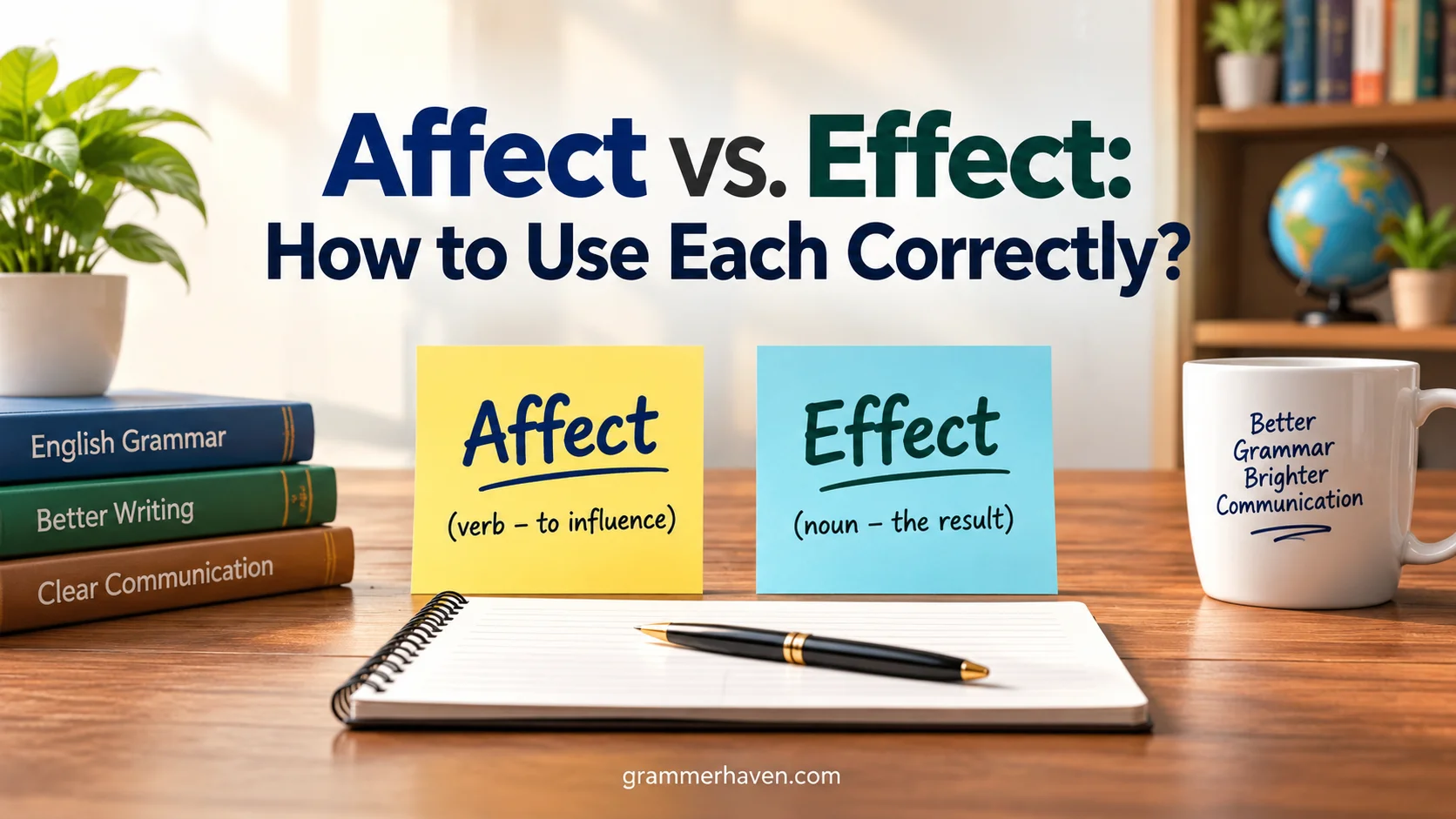
Affect vs. Effect can confuse native speakers because English grammar uses each word differently in everyday writing and in common sentences. The main distinction is that affect is a verb, while effect is a noun. Affect means to influence something, while an effect means the result of that influence. This grammar rule helps you choose the correct words when wondering about the difference. The weather affected sales, while the weather had an effect on sales.
Effect as a verb can mean bring about or accomplish something, and its function depends on the context. Affect as a specialized noun appears in psychology and describes observable emotional expression. The Modern Language Association discusses standard English language usage, while this familiar rule remains useful for everyday writing. The meaning becomes clearer when you examine each sentence and its purpose. A spelling quirk should not replace understanding the real distinction between these terms.
Quick Answer: Affect vs. Effect
The easiest way to remember affect vs. effect is this:
- Affect usually means to influence or change something. It’s usually a verb.
- Effect usually means the result or consequence of something. It’s usually a noun.
- Effect can also be a verb meaning “to bring about” or “accomplish.”
- Affect can be a noun in psychology, where it describes observable emotional expression.
Compare these examples
Lack of sleep can affect your concentration.
Here, affect means “influence.”
Lack of sleep can have a negative effect on your concentration.
Here, effect means “result.”
The difference becomes much easier when you stop memorizing the spelling and focus on the meaning and grammatical role.
| Word | Most common use | Meaning | Example |
| Affect | Verb | Influence or change | Stress can affect your sleep. |
| Effect | Noun | Result or consequence | Stress can have an effect on sleep. |
| Effect | Verb | Bring about or accomplish | The reforms effected major changes. |
| Affect | Noun | Observable emotional expression | The patient displayed a flat affect. |
The first two uses account for most everyday situations. The final two matter when you’re dealing with formal writing, psychology, law, policy, or other specialized contexts.
What Does Affect Mean?
Affect as a Verb
Affect most commonly means to influence, change, or have an impact on something or someone.
For example:
- Lack of sleep can affect your memory.
- Rising prices affect household budgets.
- Loud music can affect your ability to concentrate.
- The storm affected thousands of residents.
- Your decision could affect the entire project.
Notice something important about these sentences. The word affect describes an action or influence.
Something does something to something else.
That’s why affect usually functions as a verb.
A useful substitute is influence. If you can replace affect with influence without changing the basic meaning, you’re probably using affect correctly.
Social media can affect how people communicate.
You could rewrite that as:
Social media can influence how people communicate.
The sentence still works. That’s a strong clue.
Affect Means Influence, Not Result
This distinction is the heart of the affect vs. effect problem.
Consider:
The heat affected the crops.
The heat influenced or changed the crops.
Now compare:
The heat had a serious effect on the crops.
The effect is the result produced by the heat.
Think of affect as the force acting on something and effect as what comes out the other side.
What Does Effect Mean?
Effect as a Noun
Effect most commonly means a result, consequence, outcome, or change produced by something.
Examples include:
- The medicine had a noticeable effect.
- The policy had little effect on sales.
- The storm caused serious effects across the region.
- Exercise can have positive effects on your health.
- The decision had an unexpected effect on the company.
A simple replacement test works well here.
If you can replace effect with result, outcome, or consequence, you’re probably dealing with the noun effect.
The decision had a major effect on the business.
Becomes:
The decision had a major impact on the business.
Or:
The decision had a major result for the business.
The exact wording changes slightly, but the underlying idea remains the same.
Common Expressions With Effect
You’ll encounter effect in many familiar expressions:
- cause and effect
- side effect
- adverse effect
- positive effect
- negative effect
- long-term effect
- take effect
- come into effect
- in effect
- with immediate effect
- to little effect
For example:
The new medication may cause several side effects.
The law will take effect next month.
The warning had little effect on consumer behavior.
Notice that none of these phrases use affect.
That’s because they’re talking about results, consequences, or outcomes.
Affect vs. Effect: The Core Grammar Rule
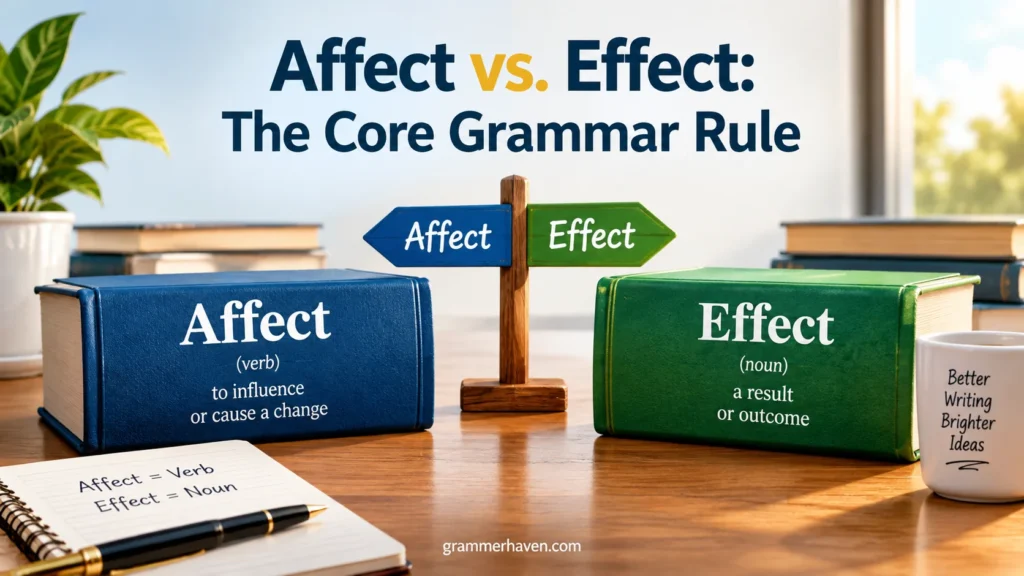
Here’s the practical distinction worth remembering:
Affect usually describes an influence. Effect usually names the result.
Consider this simple chain:
Cause → Influence → Result
For example:
Lack of sleep → affects → concentration → produces an effect → poorer performance
Or in a complete sentence:
Lack of sleep affects concentration and can have a negative effect on performance.
Both words can appear in the same sentence because they perform different jobs.
Affect = Action or Influence
Use affect when something influences or changes another thing.
Stress affects your mood.
Weather conditions affect travel plans.
Advertising affects consumer behavior.
Effect = Result
Use effect when you’re talking about what happened because of something else.
Stress has an effect on your mood.
Weather conditions had an effect on travel plans.
Advertising has an effect on consumer behavior.
The difference isn’t about one word being “better.” They’re simply doing different grammatical jobs.
Affect vs. Effect Examples Side by Side
Seeing the words together often makes the distinction click.
| Sentence | Correct word | Why? |
| The weather will ___ our plans. | affect | It will influence our plans. |
| The weather had a major ___ on our plans. | effect | The word means result. |
| Stress can ___ your memory. | affect | Stress can influence memory. |
| Stress can have a negative ___ on memory. | effect | The word names the result. |
| The medicine ___ her appetite. | affected | The medicine influenced her appetite. |
| The medicine had an unusual ___. | effect | The word means result. |
| The new rule may ___ thousands of workers. | affect | The rule will influence workers. |
| The rule produced several unexpected ___. | effects | The word means consequences. |
Use Both Words in One Sentence
Here’s a particularly useful example:
The storm affected the town, and its effects lasted for weeks.
The storm affected the town because it changed conditions there.
Its effects were the consequences that remained afterward.
Another example:
The policy affected hiring and had a noticeable effect on employment.
The policy influenced hiring. The resulting change in employment was its effect.
The Big Exception: Effect as a Verb
This is where the basic grammar rule needs an upgrade.
Effect can function as a verb.
When it does, it means to bring about, accomplish, produce, or cause something to happen. The MLA Style Center specifically distinguishes this meaning from affect, which generally means to influence something that already exists.
Consider:
The new policy effected major changes.
Here, effected doesn’t mean “influenced.”
It means the policy brought about the changes.
That’s a subtle but important difference.
Affect vs. Effect as Verbs
| Verb | Meaning | Example |
| Affect | Influence or change | The policy affected employee morale. |
| Effect | Bring about or accomplish | The policy effected major reforms. |
Compare the meanings:
The new rules affected employee behavior.
The rules influenced behavior.
The new rules effected significant reforms.
The rules brought about the reforms.
The distinction may feel hair-splitting at first. It isn’t. The two verbs describe different relationships between an action and its outcome.
Affected vs. Effected
The past-tense forms create another common stumbling block.
Affected Means Influenced
Affected usually means influenced, changed, or emotionally impacted.
Examples:
The storm affected several communities.
The news deeply affected her.
Higher prices affected customer demand.
You can usually substitute influenced for affected.
Effected Means Brought About
Effected means brought about, accomplished, or caused to happen.
Examples:
The reforms effected significant improvements.
The agreement effected a peaceful resolution.
The new leadership effected major organizational changes.
In ordinary conversation, affected appears far more often. Effected tends to appear in formal, professional, legal, academic, or policy-oriented writing.
That doesn’t make effected fancy decoration. It has a specific meaning.
Affecting vs. Effecting
The same distinction applies to the -ing forms.
Affecting
Affecting means influencing or changing.
Rising costs are affecting small businesses.
The costs are influencing those businesses.
Effecting
Effecting means bringing something about or accomplishing it.
The organization is effecting major reforms.
The organization is actively bringing those reforms into existence.
Again, effecting is less common in everyday English. Still, you’ll see it in formal writing where precision matters.
The Other Exception: Affect as a Noun
Here’s another reason the simple “Affect is a verb, effect is a noun” rule isn’t enough.
Affect can function as a noun, especially in psychology and clinical writing.
In this specialized sense, affect refers to observable emotional expression. That can include facial expressions, gestures, posture, voice, and other outward signs of emotion. The MLA Style Center notes this specialized noun usage explicitly.
For example:
The patient displayed a flat affect.
The clinician observed a change in the patient’s affect.
Here, affect doesn’t mean influence.
It’s describing how emotion appears outwardly.
Affect vs. Effect in Psychology
These two words can have very different meanings in psychological contexts:
- Affect = observable emotional expression
- Effect = a result or consequence
For example:
The treatment had an unexpected effect on the patient’s behavior.
But:
The patient displayed a restricted affect.
The first sentence describes a result. The second describes emotional expression.
That’s why context matters so much.
Affect Can Also Mean “Pretend”
There’s another legitimate meaning of affect that rarely appears in beginner grammar explanations.
As a verb, affect can mean to deliberately adopt or put on a particular appearance, manner, attitude, or behavior.
For example:
He affected a British accent.
She affected an air of confidence.
He affected indifference despite his obvious concern.
This meaning differs from the more familiar affect = influence.
The surrounding sentence usually makes the intended meaning clear.
Affect Change vs. Effect Change
The phrase “affect change” causes considerable confusion because both words can appear as verbs.
The key question is what you mean.
Affect Change
Affect change means influence change or influence the outcome of a change.
For example:
Public pressure can affect change in government policy.
The idea centers on influencing an existing process or outcome.
Effect Change
Effect change means bring about or create change.
For example:
The organization hopes to effect change through education.
Here, the organization intends to produce the change.
The MLA Style Center gives a useful distinction: to affect something is to influence it, while to effect something is to bring it into existence or accomplish it.
That distinction becomes especially useful in formal writing.
How to Remember Affect vs. Effect

Memory tricks can help, but they shouldn’t replace understanding.
Think A = Affect = Action
Affect usually describes an action or influence.
Stress affects sleep.
Something is doing something to something else.
Think E = Effect = End Result
Effect usually names the result.
Stress has an effect on sleep.
The effect is what results from the cause.
Try the “Influence” Test
If influence fits, use affect.
The weather will affect our plans.
→ The weather will influence our plans.
Try the “Result” Test
If result fits, use effect.
The decision had a major effect on sales.
→ The decision had a major result for sales.
These substitutions aren’t perfect in every specialized context, but they work remarkably well for ordinary writing.
A Simple Step-by-Step Test
When you aren’t sure whether to use affect or effect, don’t guess.
Identify the grammatical role
Ask whether the blank needs a noun or verb.
The change will ___ sales.
You need a verb.
The change had a major ___ on sales.
You need a noun.
Ask what the word means
If the verb means influence, choose affect.
If the verb means bring about, effect may be correct.
Try a replacement
Use:
- influence → likely affect
- result → likely effect
- bring about → likely effect
Check the entire sentence
Don’t make your decision based on the two words alone.
English grammar works through context. The surrounding words often reveal the intended meaning.
Common Affect vs. Effect Mistakes
“It had a big affect.”
Usually incorrect.
Write:
It had a big effect.
The word describes a result.
“It will effect me.”
Usually incorrect.
Write:
It will affect me.
The meaning is “influence me.”
“The medicine had a side affect.”
Incorrect.
Write:
The medicine had a side effect.
A side effect is a result produced by a medication.
“The law will effect thousands of people.”
Usually incorrect when you mean the law will influence people.
Write:
The law will affect thousands of people.
However, effect can be correct when it means “bring about”:
The law will effect major changes.
“Take affect”
Incorrect.
The standard expression is:
take effect
For example:
The new policy will take effect next Monday.
Affect vs. Effect in Different Contexts
The easiest way to master these words is to see how they behave in real situations.
Business
Higher interest rates can affect borrowing decisions.
Higher interest rates can have a significant effect on borrowing.
The first sentence focuses on influence. The second focuses on the resulting consequence.
Education
Stress can affect academic performance.
Chronic stress can have a negative effect on academic performance.
Both sentences communicate nearly the same idea. Their grammatical structures differ.
Health
Lack of sleep can affect your immune system.
Lack of sleep can have several negative effects on your health.
Again, affect describes the influence while effects names the consequences.
Science
Temperature affects reaction rates.
Temperature has a measurable effect on reaction rates.
Scientific writing often uses both words because researchers distinguish between causes, influences, and observed outcomes.
Government and Public Policy
The new legislation could affect small businesses.
The legislation could effect significant regulatory changes.
The distinction becomes especially useful here because policy writers often need to separate influencing existing conditions from creating new conditions.
A Practical Case Study
Imagine a company introduces a four-day workweek.
The policy itself can affect employee behavior.
Some employees may become more productive. Others may struggle with compressed schedules.
Those outcomes are the effects of the policy.
A company report might therefore say:
The four-day workweek affected employee scheduling and had a measurable effect on productivity.
If management then introduces a new system that creates a different organizational structure, the report might say:
The new leadership effected major operational changes.
Each word carries a distinct meaning.
The first describes influence. The second describes results. The third describes bringing something about.
Quick Reference: Affect vs. Effect
| If you mean… | Use |
| Influence | Affect |
| Change something | Affect |
| Have an influence on | Affect |
| Result | Effect |
| Consequence | Effect |
| Outcome | Effect |
| Impact as a noun | Effect |
| Bring about | Effect |
| Accomplish | Effect |
| Observable emotional expression | Affect |
Affect vs. Effect in Common Phrases
Take Effect
Correct:
The new regulations will take effect next month.
Here, effect means the result or operation of something becoming active.
Cause and Effect
Correct:
The lesson explains the relationship between cause and effect.
You’re discussing a cause and the result it produces.
Side Effect
Correct:
Drowsiness is a common side effect of the medication.
A side effect is an additional result.
Adverse Effect
Correct:
The treatment may have an adverse effect.
Again, you’re talking about a result.
In Effect
Correct:
The rule remains in effect.
This expression means the rule remains active or operative.
Affect vs. Effect Practice Quiz
Choose affect, effect, affected, or effected.
- The weather may ___ our travel plans.
- The storm had a major ___ on transportation.
- Lack of sleep can ___ your concentration.
- The medication produced several unexpected ___.
- The new policy ___ employee morale.
- The reforms ___ significant changes.
- The law will ___ next month.
- The treatment had little ___.
- The patient’s flat ___ concerned the clinician.
- The organization hopes to ___ meaningful change.
Answers
- affect — The weather will influence the plans.
- effect — The word means result.
- affect — Lack of sleep can influence concentration.
- effects — These are results produced by the medication.
- affected — The policy influenced employee morale.
- effected — The reforms brought about changes.
- take effect — This is the standard expression.
- effect — The word means result.
- affect — Here, affect is the specialized psychological noun.
- effect — The organization wants to bring about change.
The Easiest Way to Get Affect vs. Effect Right
For everyday English, remember this:
Affect = influence. Effect = result.
Then remember the two major exceptions:
Effect = bring about when used as a verb.
Affect = observable emotional expression when used as a specialized noun.
A quick mental test can save you from most mistakes:
Can you replace the word with “influence”?
If yes, choose affect.
Can you replace it with “result”?
If yes, choose effect.
Can you replace it with “bring about”?
If yes, effect may be the right verb.
Final Comparison
| Word | Part of speech | Meaning | Example |
| Affect | Verb | Influence or change | Noise can affect concentration. |
| Effect | Noun | Result or consequence | Noise can have an effect on concentration. |
| Effect | Verb | Bring about or accomplish | The reform effected major changes. |
| Affect | Noun | Observable emotional expression | The patient showed a flat affect. |
The simplest rule handles most sentences, but understanding the exceptions makes your writing much more precise.
Affect describes what something does to something else. Effect usually describes what happens as a result. Once you start looking for that relationship rather than relying on spelling alone, the distinction becomes far less slippery.
See also: Lie Down vs. Lay Down: Which Is Correct?
FAQs:
Is affect or effect correct?
Both are correct. The choice depends on the meaning and grammatical role of the word.
In ordinary usage, affect usually means “influence” and functions as a verb. Effect usually means “result” and functions as a noun.
Is affect usually a verb?
Yes. In everyday English, affect most commonly functions as a verb meaning to influence or change.
The news affected her decision.
Is effect usually a noun?
Yes. Effect most commonly functions as a noun meaning result, consequence, or outcome.
The news had a strong effect on her decision.
Can effect be a verb?
Yes.
As a verb, effect means to bring about, accomplish, or produce something.
The reforms effected major changes.
This use is less common in casual conversation but remains standard English.
Can affect be a noun?
Yes. In psychology and clinical writing, affect refers to observable emotional expression.
The patient displayed a flat affect.
Is it “affected by” or “effected by”?
Usually affected by.
The economy was affected by rising interest rates.
Here, the meaning is “influenced by.”
Effected by is possible in specialized contexts when the meaning is “brought about by,” but that construction is much less common.
Is it “take affect” or “take effect”?
The correct expression is take effect.
The new rule will take effect on January 1.
Is it “side affect” or “side effect”?
The correct expression is side effect.
Headaches are a possible side effect.
Is it “affect change” or “effect change”?
Both can be grammatical, but they don’t mean exactly the same thing.
Affect change means influence change.
Effect change means bring about change.
That distinction becomes particularly important in formal writing.
Conclusion:
Understanding Affect vs. Effect becomes easier when you remember their usual roles. Affect is generally a verb meaning to influence, while effect is usually a noun meaning the result of that influence. Checking the context and function of the word in a sentence can help you choose the correct form. With regular writing practice, this common English grammar confusion becomes much easier to avoid.