Awhile or A While: Understanding the Difference? gets easier when you see how both forms relate to time but serve different roles in English. Language is a wondrous field rich in subtleties, yet these words can become an easy trap because people often mix up awhile and a while, which almost sound the same. The thing to remember is that they’re used distinctly for different purposes in writing and speech. Misusing them can cause confusion and embarrassing moments in conversations, so this gives you a chance to dispel the fog around these terms.
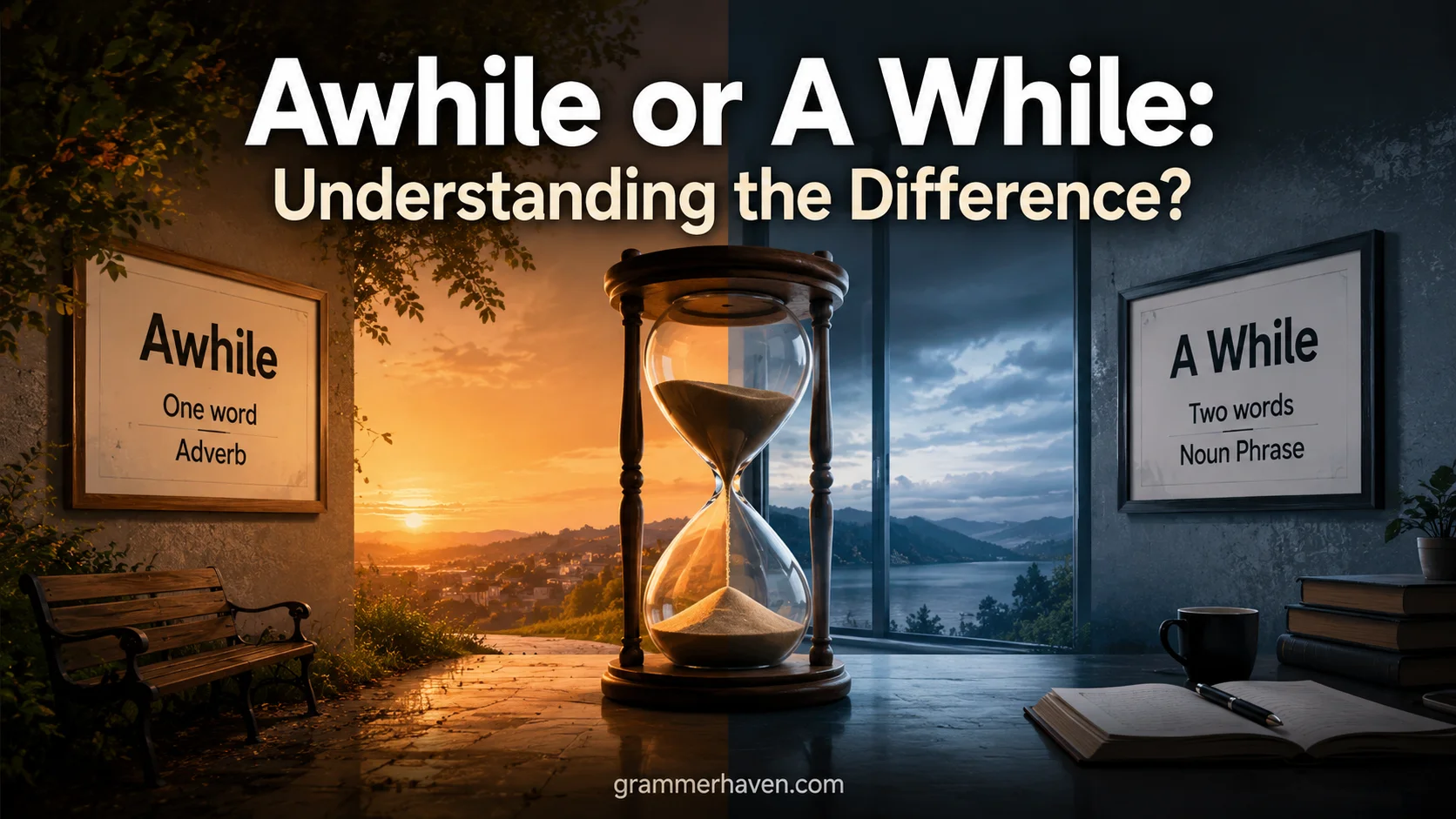
Awhile and a while refer to time, but their forms and uses differ. Awhile works as an adverb, with the meaning for a while, while a while is a noun phrase referring to a period of time. The simplest rule is to use a while after a preposition, such as for, in, or after. By contrast, awhile can stand alone. Both choices become easier when you understand the context, phrase, and whether you need an adverb or noun.
When you dive into the definitions, the key differences become easier to master. This aspect of English may seem confusing, but the distinction becomes clearer once you see how each sentence works. All you need to do is notice whether you’re referring to a period of time or describing an action. This simple distinction helps you write effortlessly, avoid the common trap, and stop treating these similar-looking forms as interchangeable.
Awhile or A While: Quick Difference Explained
Before exploring the details, here is the simplest explanation:
| Word/Phrase | Meaning | Grammar Role | Example |
| Awhile | For some time | Adverb | Sit awhile and relax. |
| A while | A period of time | Noun phrase | I haven’t seen you for a while. |
Think of it this way:
- Awhile describes an action.
- A while describes a length of time.
Compare these sentences:
She stayed awhile.
Here, “awhile” tells us how long she stayed.
Now look at:
She stayed for a while.
Here, “a while” acts as the object of the preposition “for.”
Both sentences communicate a similar idea, but the grammar structure changes.
What Does Awhile Mean?
Awhile is a single word that functions as an adverb.
An adverb modifies a verb. It tells you more about an action, such as:
- how something happens
- when something happens
- where something happens
- how long something happens
In the case of awhile, it explains duration.
It means:
for a short time or for some time
Examples:
- Please stay awhile.
- He rested awhile after work.
- We talked awhile before leaving.
- Sit awhile and enjoy the view.
In each example, awhile modifies the action.
Let’s break one sentence down:
She waited awhile.
- Subject: She
- Verb: waited
- Adverb: awhile
“Awhile” answers the question:
How long did she wait?
Answer:
She waited for some time.
How to Recognize When to Use Awhile
The easiest way to identify awhile is to use a substitution test.
Replace awhile with:
- for some time
- for a short time
If the sentence still sounds natural, awhile is probably correct.
Examples
Original:
Stay awhile.
Replacement:
Stay for some time.
The meaning works.
Correct:
Stay awhile. ✅
Original:
Think awhile before answering.
Replacement:
Think for some time before answering.
The sentence still makes sense.
Correct:
Think awhile before answering. ✅
Common Sentences Using Awhile
Here are everyday examples where awhile works naturally:
| Sentence | Why It Works |
| Wait awhile before opening the door. | “Awhile” describes the waiting action. |
| She sat awhile near the window. | It explains how long she sat. |
| Let’s talk awhile. | It modifies the verb “talk.” |
| He worked awhile before taking a break. | It describes the duration of working. |
What Does A While Mean?
A while is a two-word phrase that functions as a noun phrase.
It refers to:
a period of time
The word “while” acts as a noun meaning a length or amount of time.
Examples:
- I haven’t visited my hometown for a while.
- It took a while to finish the project.
- We waited a while before the movie started.
- After a while, everyone became quiet.
Unlike awhile, “a while” does not directly modify a verb.
Instead, it represents a thing: a period of time.
Understanding the Grammar Behind A While
The phrase a while contains two parts:
| Word | Function |
| A | Article |
| While | Noun meaning a period of time |
Similar examples include:
- a moment
- a minute
- a week
- a year
You can replace “a while” with another noun.
Example:
I waited for a while.
You could also say:
I waited for a minute.
or:
I waited for an hour.
The structure stays the same.
How to Recognize When to Use A While
A helpful trick is to look for prepositions.
The phrase a while commonly appears after words like:
- for
- after
- in
- within
Examples:
For a while
I lived in California for a while.
Meaning:
I lived in California for a period of time.
After a while
After a while, the baby stopped crying.
Meaning:
After some time passed, the baby stopped crying.
In a while
I’ll call you in a while.
Meaning:
I’ll call you after some time.
Awhile vs A While: The Main Grammar Difference
The biggest difference comes down to function.
Awhile = Adverb
It modifies a verb.
Example:
They stayed awhile.
Meaning:
They stayed for some time.
Structure:
Subject + Verb + Awhile
A While = Noun Phrase
It represents a period of time.
Example:
They stayed for a while.
Meaning:
They stayed for a period of time.
Structure:
Subject + Verb + Preposition + A While
A Simple Comparison Table: Awhile vs A While
| Feature | Awhile | A While |
| Number of words | One | Two |
| Grammar type | Adverb | Noun phrase |
| Meaning | For some time | A period of time |
| Describes | An action | A duration |
| Usually follows | A verb | A preposition |
| Example | Wait awhile | Wait for a while |
The “For” Rule: The Easiest Way to Remember
One of the most useful rules for awhile or a while is this:
If you use “for,” choose “a while.”
Correct:
I stayed for a while. ✅
Incorrect:
I stayed for awhile. ❌
Why?
Because the preposition for needs a noun phrase afterward.
Think about similar sentences:
- for a minute
- for an hour
- for a week
- for a while
You wouldn’t say:
- for minute
- for hour
- for week
The same idea applies to a while.
Why People Confuse Awhile and A While
The confusion happens because English often changes word forms over time.
Many words began as separate words but eventually became one word when they developed a different grammatical purpose.
Examples:
| Two Words | One Word |
| every day | everyday |
| all ready | already |
| some time | sometime |
| a while | awhile |
However, these changes do not mean the meanings are always identical.
English keeps many small differences that affect how words work.
A tiny space can carry a big grammatical job.
When Both Awhile and A While Can Be Correct
Sometimes both forms work because English allows different sentence structures.
Consider:
I waited awhile.
and
I waited for a while.
Both sentences are correct.
They communicate almost the same idea.
However, the grammar differs:
I waited awhile.
“Awhile” acts as an adverb.
It modifies “waited.”
I waited for a while.
“A while” acts as a noun phrase.
It follows the preposition “for.”
Think of them like two roads leading to the same destination.
The meaning is similar, but the path is different.
Common Mistakes With Awhile and A While
Mistake: Writing “For Awhile”
One of the most common errors is adding for before awhile.
Incorrect:
I haven’t seen him for awhile.
Correct:
I haven’t seen him for a while.
Why?
Because “for” needs a noun phrase.
Examples:
- for a moment
- for a long time
- for a while
Not:
- for awhile
Mistake: Using A While Everywhere
Some writers avoid awhile completely and use a while in every sentence.
Example:
Sit a while and relax.
This sentence can work in some contexts, but sit awhile is the more direct construction when “a while” acts as an adverb.
Correct:
Sit awhile and relax.
Mistake: Confusing “A While Ago” With “Awhile Ago”
This mistake appears frequently.
Correct:
I met her a while ago. ✅
Incorrect:
I met her awhile ago. ❌
Why?
Because “ago” needs a time expression.
Examples:
- a day ago
- a month ago
- a year ago
- a while ago
Read also: Tomatoes or Tomatos: Which Spelling Is Correct?
FAQs:
1. Is “awhile” one word?
Yes. Awhile is one word and works as an adverb meaning for a while.
2. When should you use “a while”?
Use a while when you need a noun phrase that refers to a period of time, especially after a preposition.
3. Is “stay awhile” correct?
Yes. Stay awhile is correct because awhile functions as an adverb describing how long you should stay.
4. Is “for awhile” correct?
In standard American English, for a while is preferred because for is a preposition followed by the noun phrase a while.
5. What is the easiest way to remember the difference?
Remember this simple rule: awhile means for a while, while a while names a period of time. If a preposition comes before it, a while is usually the right choice.
Conclusion:
Knowing the difference between awhile and a while can make your writing clearer and more precise. Use awhile as an adverb when you mean for a while, such as “Please stay awhile.” Use a while as a noun phrase when you mean a period of time, especially after a preposition: “Please stay for a while.” Once you recognize their grammatical roles, this commonly confusing pair becomes much easier to use correctly.