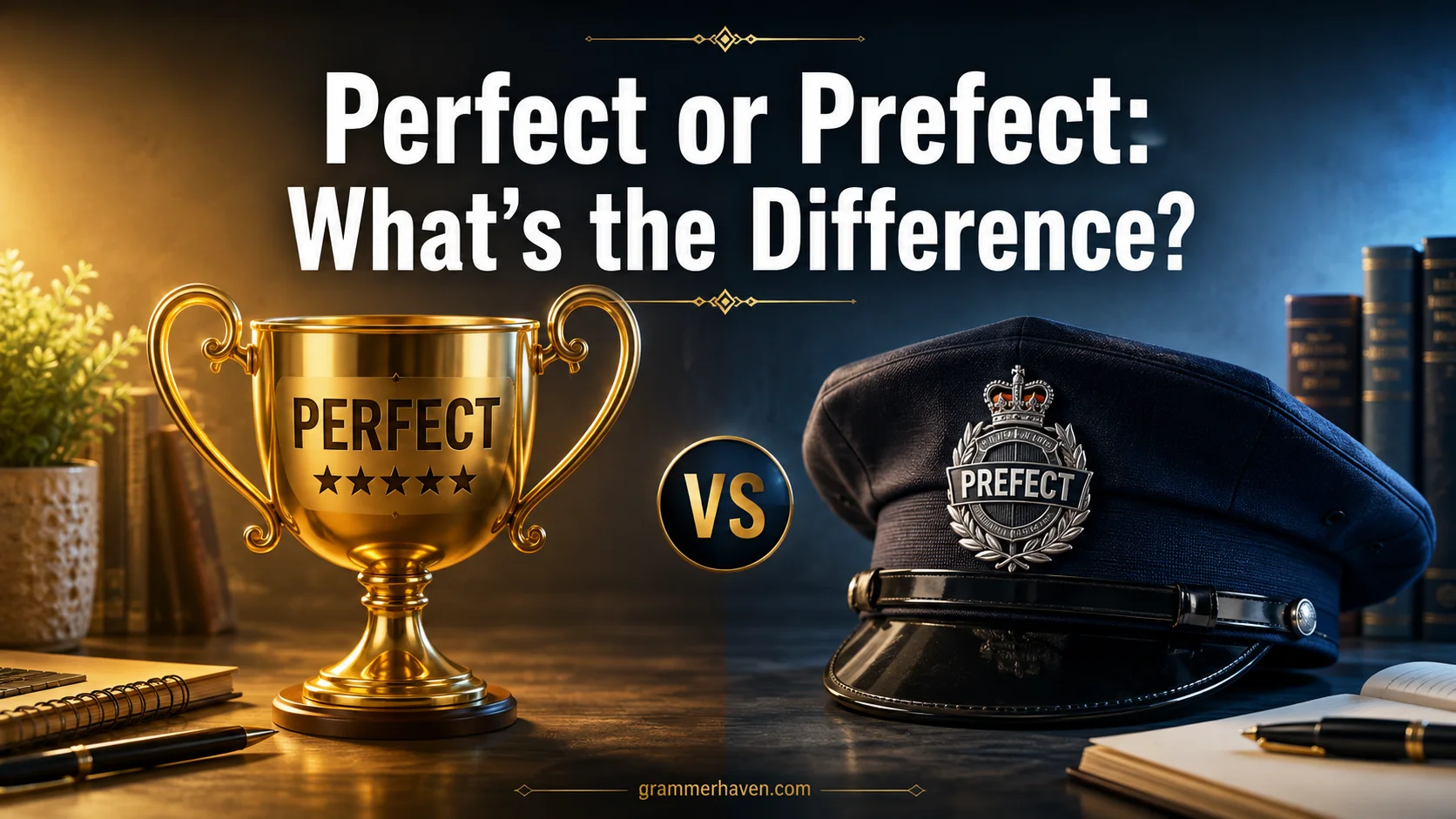
Perfect or Prefect: What’s the Difference? explains the difference in meaning, spelling, pronunciation, and usage between these similar-looking words. Perfect is an adjective that describes someone or something without imperfections or defects. It can refer to an ideal condition, flawless performance, or error-free outcome. Prefect, on the other hand, is a noun and title for an appointed leader or official, especially in a school, who may help maintain discipline, order, and handle certain responsibilities. Although the two words look almost identical, their meanings and usage are completely different.
The small letter changes between Perfect and Prefect often cause common mistakes, especially when writers, students, and learners focus on their similar spelling and pronunciation. Perfect is pronounced “pree-fect,” while Prefect rhymes with “defect.” Using the correct word matters in an essay, email, or casual message because the wrong choice can make your writing unclear. Regular practice, examples, and exercises can improve your accuracy, clarity, and confidence, helping you avoid errors when choosing between these two terms.
Prefect also has a broader historical and official context. Prefects existed in ancient Rome and later appeared in different countries and systems, including civil, military, religious, and governance settings. Depending on the country or region, a prefect may have responsibilities similar to a governor or another official. Understanding this comparison makes it easier to identify whether you mean the quality described by Perfect or the specific role represented by Prefect.
Perfect vs Prefect: Quick Difference Explained
Before exploring the details, here’s the simplest way to remember the difference:
| Word | Meaning | Part of Speech | Example |
| Perfect | Complete, flawless, ideal, or excellent | Adjective, verb, noun (grammar term) | “She gave a perfect answer.” |
| Prefect | A student leader or appointed official | Noun | “The prefect helped organize the school event.” |
The easiest memory trick:
Perfect has an “r” because perfection is rare. Prefect has no “r” because it refers to a role or person.
Although the words look similar, they belong to different worlds.
Perfect focuses on quality.
Prefect focuses on responsibility.
What Does Perfect Mean?
The word perfect describes something that reaches a high standard or has no noticeable flaws. It often means something is complete, accurate, suitable, or exactly what someone needs.
You use perfect when talking about:
- Quality
- Results
- Appearance
- Timing
- Accuracy
- Completion
For example:
“This is the perfect time to start learning English.”
Here, perfect does not mean something magical or impossible. It means the timing is exactly right.
Another example:
“The chef prepared a perfect meal.”
This means the meal had excellent taste, quality, and presentation.
Perfect as an Adjective
The most common use of perfect is as an adjective.
An adjective describes a noun, and perfect describes something that meets an ideal standard.
Examples:
- She found the perfect dress for the wedding.
- The weather was perfect for hiking.
- He gave a perfect explanation.
- That solution is perfect for this problem.
In everyday conversations, people often use perfect to show approval.
Example:
“Can you send the report by Friday?”
“Perfect! I’ll send it tomorrow.”
Here, perfect means “excellent” or “that works well.”
What Does Perfect Mean in Different Contexts?
The meaning of perfect changes slightly depending on where you use it.
Perfect in Everyday English
In normal conversation, perfect usually means something is very good or exactly suitable.
Examples:
- “That restaurant is perfect for a family dinner.”
- “Your timing is perfect.”
- “This jacket fits perfectly.”
Notice that people often use perfect even when something is not literally flawless.
A person might say:
“That movie was perfect.”
They usually mean they loved it. They don’t necessarily mean every single detail was objectively flawless.
Perfect in Education
Students often use perfect when discussing accuracy.
Examples:
- “She got a perfect score on the exam.”
- “He answered every question perfectly.”
A perfect score means someone achieved all available points.
For example:
| Test Score | Meaning |
| 100% | Perfect score |
| 90% | Excellent score |
| 70% | Good score |
| 50% | Average score |
Perfect in Sports
Sports commentators frequently use the word perfect to describe exceptional performance.
Examples:
- “The goalkeeper made a perfect save.”
- “The athlete had perfect timing.”
- “The team completed a perfect season.”
A perfect season usually means a team won every game without losing.
Perfect in Business
Companies use perfect to describe ideal outcomes, products, or solutions.
Examples:
- “This software is perfect for small businesses.”
- “We found the perfect candidate for the position.”
- “The company achieved perfect customer satisfaction.”
However, businesses often use the word carefully because perfection is difficult to measure.
Perfect as a Verb
Although less common, perfect can also function as a verb.
When used as a verb, it means:
To improve something until it becomes highly skilled or complete.
Examples:
- She practiced daily to perfect her piano skills.
- The engineer perfected the design after several tests.
- He spent years perfecting his cooking technique.
Here, perfect means improving something through effort.
A useful comparison:
| Sentence | Meaning |
| She created a perfect design. | The design is already excellent. |
| She perfected the design. | She improved the design until it became excellent. |
Perfect in English Grammar: Perfect Tenses
The word perfect also appears in grammar.
Many English learners recognize phrases like:
- Present perfect
- Past perfect
- Future perfect
These forms describe actions connected to different points in time.
Present Perfect Tense
The present perfect connects a past action with the present.
Structure:
Have/has + past participle
Examples:
- I have finished my homework.
- She has visited London.
- They have completed the project.
The action happened before now, but the exact time may not matter.
Compare:
Simple past:
I visited Paris in 2024.
The time is specific.
Present perfect:
I have visited Paris.
The experience matters more than the exact date.
Past Perfect Tense
The past perfect shows that one action happened before another past action.
Structure:
Had + past participle
Example:
She had finished dinner before the guests arrived.
Two actions happened:
- She finished dinner.
- Guests arrived.
The past perfect shows which action happened first.
Future Perfect Tense
The future perfect describes something that will be completed before a future point.
Structure:
Will have + past participle
Example:
I will have completed the course by next month.
The action will finish before a specific future time.
What Does Prefect Mean?
Unlike perfect, the word prefect refers to a person who holds a specific position or responsibility.
A prefect is usually:
- A student leader in a school
- An official appointed to manage an area
- Someone with authority over a particular group
The word has nothing to do with being flawless or excellent.
Prefect in Schools
The most common modern use of prefect appears in schools.
A school prefect is a student chosen to help maintain discipline, represent students, and support teachers.
Typical prefect responsibilities include:
- Helping younger students
- Monitoring behavior
- Assisting during school events
- Representing the student body
- Supporting teachers and administrators
For example:
“Ahmed became the head prefect after being selected by the teachers.”
This means Ahmed received a leadership role.
It does not mean Ahmed became perfect.
What Is a Head Prefect?
A head prefect is usually the highest-ranking student prefect.
The role may include:
- Leading other prefects
- Communicating with school leaders
- Representing students at official events
- Helping organize school activities
Different schools use different systems. Some schools have:
- Head prefect
- Deputy head prefect
- Class prefects
- House prefects
Prefect Around the World
The meaning of prefect changes depending on the country.
United Kingdom
Many British schools use prefect systems.
A prefect may help teachers and support school traditions.
Example:
“The senior prefects welcomed new students during orientation.”
Pakistan and South Asia
Many schools use prefect systems influenced by British education traditions.
Students may become:
- Class prefects
- House prefects
- Head prefects
These roles often reward leadership, discipline, and responsibility.
France
In France, a prefect has a completely different meaning.
A préfet is a government representative who manages administrative areas.
The role involves:
- Representing the national government
- Managing regional administration
- Coordinating public services
Read also: Awhile or A While: Understanding the Difference?
Perfect vs Prefect: Complete Comparison Table
| Feature | Perfect | Prefect |
| Meaning | Without flaws, complete, ideal | A leader or official |
| Main use | Describing something | Naming a role |
| Word type | Adjective, verb, grammar term | Noun |
| Common context | Daily conversation | Schools and government |
| Example | “The answer is perfect.” | “She is the school prefect.” |
| Letter difference | Contains “r” | Does not contain “r” |
FAQs:
1. What is the difference between Perfect and Prefect?
Perfect describes something flawless or without defects, while Prefect refers to an appointed leader or official, especially in a school.
2. Is Perfect an adjective or a noun?
Perfect is mainly an adjective. It describes something that has no faults, such as “a perfect score” or “a perfect day.”
3. What does Prefect mean?
A Prefect is an appointed official or leader with specific responsibilities. In schools, a prefect often helps maintain discipline and order.
4. How do you pronounce Perfect and Prefect?
Perfect is usually pronounced “PER-fekt,” while Prefect is pronounced “PREE-fekt” in common English usage.
5. How can you remember the difference between Perfect and Prefect?
Think of Perfect as describing quality, while Prefect describes a person or position with authority or responsibility.
Conclusion:
Perfect and Prefect may look and sound similar, but they have completely different meanings and uses. Perfect describes something flawless or without defects, while Prefect refers to a specific person, leader, or official. Remembering this simple difference will help you choose the correct word and avoid common spelling and usage errors in your writing.