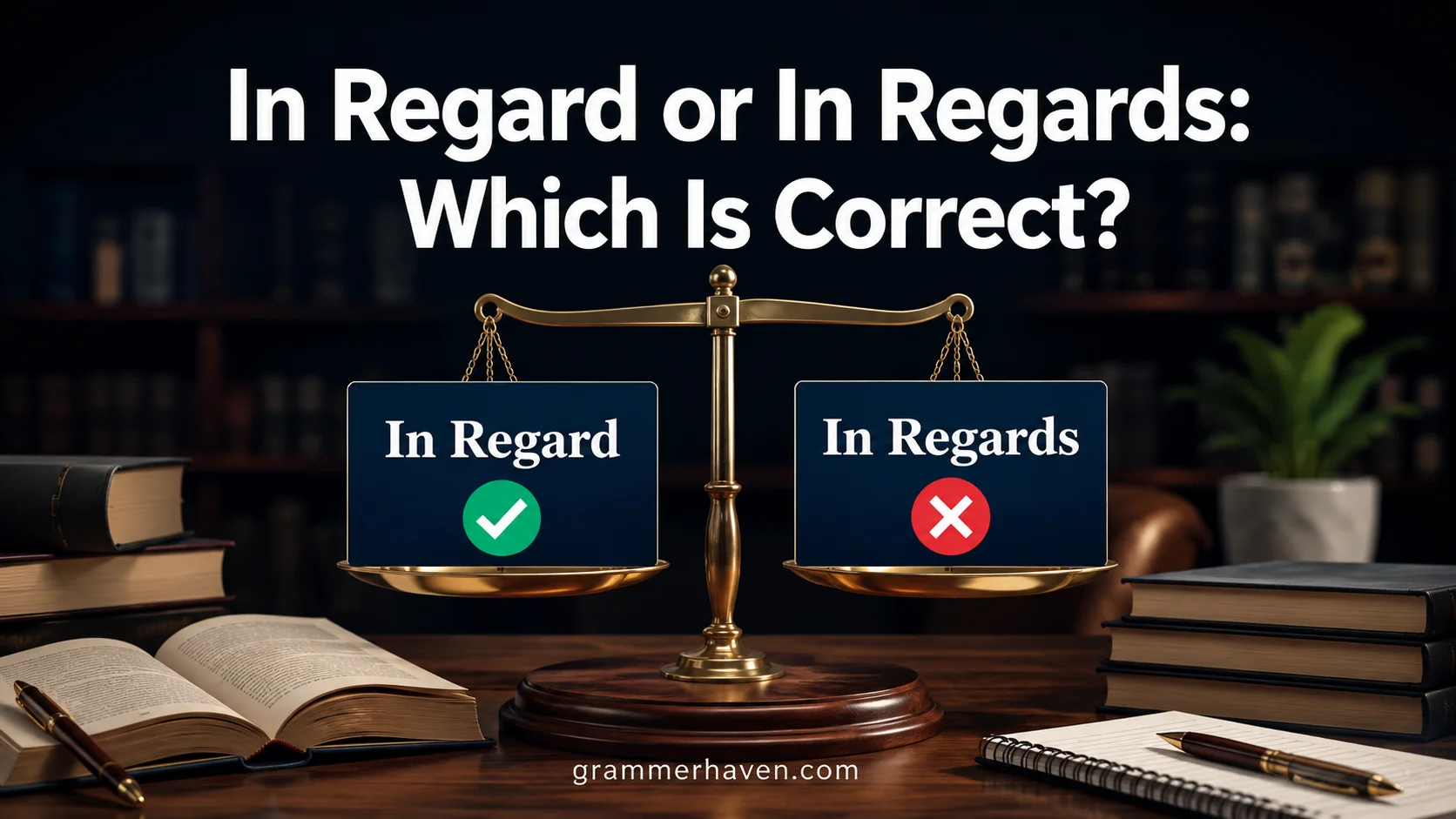
In Regard or In Regards is a common grammar question, with in regard to as the correct expression for formal writing and professional communication.
Use in regard to for a specific subject, specific aspect, specific matter, or specific request in emails, letters, and formal documents.
The traditional phrase follows standard English and works well in American English and British English. Use in regard to in business emails, professional writing, and other settings where clarity, correctness, and a professional tone matter. Examples include “In regard to your request” and “In regard to your specific question.” Remember the quick rule: use in regard to for a subject or matter, and use regards separately when you mean good wishes.
In Regard or In Regards: Quick Answer
“In regard to” is the standard form.
Use in regard to when you mean about, concerning, or regarding something.
- Correct: “I’m writing in regard to your application.”
- Generally avoided in formal writing: “I’m writing in regards to your application.”
The same rule applies to with regard to:
- Correct: “With regard to your question, we need more information.”
- Generally avoided in formal writing: “With regards to your question, we need more information.”
The Language Portal of Canada specifically recommends the singular regard in in regard to and with regard to. It also explains that the s is correct in as regards, where regards functions differently.
For everyday writing, you can often make the sentence even cleaner by replacing the phrase with about, regarding, or concerning.
Quick rule: Use in regard to for a subject. Use regards when you’re expressing good wishes.
What Does “In Regard To” Mean?
In regard to means about, concerning, regarding, or with respect to something.
It introduces the subject you’re talking about. Think of it as a signpost that tells the reader, “This is the matter I’m referring to.”
For example:
- “I have a question in regard to your invoice.”
- “The company contacted us in regard to the contract.”
- “She sent an email in regard to the meeting.”
- “We need clarification in regard to the new policy.”
In each sentence, you could replace in regard to with about without changing the basic meaning.
“I have a question about your invoice.”
That simpler version often sounds more natural.
Merriam-Webster lists about, concerning, regarding, with regard to, and as regards among the expressions related to in regard to.
Why Is “In Regard To” Correct?
The phrase in regard to uses regard as a singular noun. In this construction, regard carries the sense of attention, consideration, or reference.
The important point is that you’re dealing with a fixed expression. You don’t normally make regard plural simply because you’re discussing several subjects.
For example:
“The manager spoke with me in regard to several complaints.”
There may be several complaints, but regard remains singular.
That’s why this sentence doesn’t need in regards to.
The Canadian government’s writing guidance makes the distinction explicit: write in regard to and with regard to, not their versions with an s.
An Easy Way to Remember the Rule
Here’s a simple memory trick:
Talking about a subject?
→ in regard to
Sending good wishes?
→ regards
So you can write:
“I’m contacting you in regard to your order.”
But at the end of an email:
“Best regards,”
The two expressions look related because they contain the same word. Their grammatical jobs are different.
Is “In Regards To” Correct?
In regards to is widely used, especially in casual speech and informal writing. However, traditional usage guides and major style references are generally preferred in regard to formal writing.
The Chicago Manual of Style answers this question directly and identifies in regard to as the correct traditional usage. It also notes that in regards to has become widespread enough that its status may continue to evolve.
That distinction matters.
Calling a form “nonstandard” doesn’t mean nobody uses it. Language changes through actual usage. A phrase can become increasingly common while still being a poor choice for formal writing, academic work, professional correspondence, or carefully edited content.
So, if you’re writing an important email, report, application, or article, there’s little reason to take the risk. Choose in regard to.
Why Do People Say “In Regards To”?
Several factors probably contribute to the confusion.
First, English already uses regards correctly in phrases such as “best regards” and “give my regards.” That familiar plural form can make in regards to feel natural.
Second, people often hear and repeat phrases without analyzing their grammatical structure. Once a variation becomes common in conversation, it can spread quickly.
Finally, in regard to and in regards to sound nearly identical when spoken. The difference becomes visible only when you write the phrase.
In Regard To vs. In Regards To Examples
| Phrase | Standard choice? | Meaning | Example |
| in regard to | Yes | About/concerning | “I’m writing in regard to your application.” |
| in regards to | Avoid in formal writing | About/concerning | “I’m writing in regards to your application.” |
| with regard to | Yes | About/concerning | “With regard to your request, we’ll respond soon.” |
| with regards to | Avoid in formal writing | About/concerning | “With regards to your request, we’ll respond soon.” |
| regarding | Yes | About/concerning | “I’m contacting you regarding your request.” |
| concerning | Yes | About | “We have questions concerning the policy.” |
| about | Yes | About | “We have questions about the policy.” |
| as regards | Yes | Concerning | “As regards the proposal, we need more information.” |
The important lesson isn’t simply “never use an s.” The real rule is more specific.
In regard to and with regard to take singular regard, while as regards is a separate valid construction.
What Is the Difference Between “In Regard To” and “With Regard To”?
In most situations, in regard to and with regard to have the same basic meaning.
Both mean:
- about
- concerning
- regarding
- with respect to
Compare these sentences:
“I have a question in regard to the payment.”
“I have a question with regard to the payment.”
The meaning barely changes.
The choice often comes down to sentence flow and personal preference. However, both forms can sound somewhat formal or bureaucratic.
For many situations, about or regarding gives you a cleaner sentence.
Which Sounds More Natural?
Consider these three versions:
Formal:
“We are contacting you in regard to your application.”
Professional and concise:
“We are contacting you regarding your application.”
Conversational:
“We’re contacting you about your application.”
All three communicate the same basic idea. The last two simply get there with fewer words.
The Language Portal of Canada specifically describes in regard to and with regard to as wordy and recommends alternatives such as about, concerning, regarding, or as for when they improve clarity.
Is “With Regard To” Correct?
Yes. With regard to is a standard expression.
For example:
- “With regard to your complaint, we’ve reviewed the records.”
- “With regard to the schedule, Friday works best.”
- “With regard to your application, we’ll contact you soon.”
Don’t add the s merely because you’re accustomed to seeing best regards at the end of an email.
In Regard To vs. With Regard To
| Expression | Correct? | Meaning |
| in regard to | Yes | Concerning |
| with regard to | Yes | Concerning |
| in regards to | Avoid in formal writing | Concerning |
| with regards to | Avoid in formal writing | Concerning |
Both in regard to and with regard to work. You don’t need to invent a plural regards to make either phrase correct.
Is “As Regards” Correct?
Yes. This is where the rule gets more interesting.
As regards is a legitimate expression meaning concerning or with respect to.
For example:
“As regards the budget, we need another review.”
The s in as regards isn’t an accidental plural. It belongs to a different grammatical construction. The Language Portal of Canada explains that regards functions as a verb in this phrase.
That means you shouldn’t reason like this:
“As regards is correct, so in regards to must also be correct.”
Those phrases aren’t built the same way.
Compare the Three Expressions
- In regard to the project, we need more data.
- With regard to the project, we need more data.
- As regards the project, we need more data.
All three can express a similar idea.
The first two use singular regard. The third uses regards as part of a separate construction.
Can You Use “In Regard To” in Formal Writing?
Yes. In fact, formal writing is one of the places where in regard to makes the most sense.
You might encounter it in:
- Business letters
- Professional emails
- Academic writing
- Reports
- Administrative documents
- Applications
- Customer-service correspondence
- Legal or policy discussions
For example:
“The committee has reviewed the documents in regard to the proposed amendment.”
The sentence is grammatically sound. Still, grammatical correctness doesn’t automatically make a phrase the best stylistic choice.
A shorter alternative may be stronger:
“The committee has reviewed the documents regarding the proposed amendment.”
Or:
“The committee has reviewed the documents about the proposed amendment.”
The best choice depends on your audience and the tone you want.
Is “In Regard To” Too Formal?
Not necessarily. It’s formal and somewhat wordy, rather than incorrect.
That’s an important distinction.
A phrase can be grammatically correct while still being less efficient than another option. Good writing isn’t about using the most elaborate expression available. It’s about choosing the expression that communicates the idea clearly.
Compare:
“I am writing in regard to the issue you mentioned.”
with:
“I’m writing about the issue you mentioned.”
The second version feels lighter and more direct.
For professional writing, regarding often strikes a useful middle ground:
“I’m writing regarding the issue you mentioned.”
Merriam-Webster defines regarding as meaning “with respect to” or “concerning.”
Better Alternatives to “In Regard To”
Sometimes the strongest edit is to remove the phrase altogether.
“About”
About is simple, familiar, and natural.
“I have a question about your order.”
It’s usually the best option for everyday communication.
“Regarding”
Regarding sounds professional without being unnecessarily elaborate.
“I have a question regarding your order.”
It works particularly well in business emails and formal correspondence.
“Concerning”
Concerning also means “about” or “regarding.”
“We received several complaints concerning the new policy.”
It has a slightly more formal feel.
“With Respect To”
With respect to can work when you need a formal expression that emphasizes a particular aspect or matter.
However, don’t use it simply because it sounds sophisticated. If about says the same thing clearly, choose about.
It’s especially useful when you’re moving from one topic to another.
Common Mistakes With Regard and Regards
The confusion doesn’t stop at in regard to.
Here are the mistakes worth watching for:
“In Regards To”
Avoid in formal standard writing.
Better:
“In regard to your request…”
“With Regards To”
Use:
“With regard to your request…”
rather than:
“With regards to your request…”
“Regarding To”
This is another common mistake.
Don’t write:
“Regarding to your application…”
Write:
“Regarding your application…”
Regarding already works as a preposition. It doesn’t need to afterward.
Merriam-Webster defines regarding as a preposition meaning “concerning,” which explains why regarding your application works on its own.
“In Regards With”
This isn’t the standard construction.
Instead, use:
“In regard to the matter…”
or:
“With regard to the matter…”
“Regard” vs. “Regards”: What’s the Difference?
The easiest way to understand the difference is to look at the expressions around each word.
“Regard” in Reference Expressions
Use singular regard in:
- in regard to
- with regard to
- without regard to
- in this regard
- in that regard
For example:
“The company has made several changes in this regard.”
Merriam-Webster identifies in this regard and in that regard as formal expressions used to refer to something just mentioned.
“Regards” for Good Wishes
Use plural regards in expressions such as:
- Best regards
- Kind regards
- Warm regards
- Give my regards to…
- Send my regards
For example:
“Please give my regards to your family.”
Here, regards means good wishes or respectful greetings.
That’s completely different from:
“I’m contacting you in regard to your family.”
One expression discusses a subject. The other conveys goodwill.
In Regard To vs. Regards: A Practical Comparison
| Use | Correct expression | Example |
| Discussing a topic | in regard to | “I called in regard to your order.” |
| Discussing a topic | with regard to | “With regard to your order, we need more information.” |
| Discussing a topic | regarding | “I’m calling regarding your order.” |
| Discussing a topic | about | “I’m calling about your order.” |
| Referring to a previous point | in this regard | “We have made progress in this regard.” |
| Expressing good wishes | best regards | “Best regards, Sarah” |
| Sending greetings | my regards | “Please give my regards to Tom.” |
| Introducing a subject | as regards | “As regards the proposal, we need more time.” |
Case Study: Choosing the Right Phrase in an Email
Imagine you’re writing to a customer about an unpaid invoice.
A stiff version might say:
“I am writing in regards to the outstanding invoice.”
The problem isn’t the meaning. The reader understands it immediately. The issue is the phrase in regards to.
A more standard version is:
“I am writing in regard to the outstanding invoice.”
But there’s an even cleaner option:
“I’m writing regarding the outstanding invoice.”
Or simply:
“I’m writing about the outstanding invoice.”
The final version is short, direct, and difficult to misunderstand.
This illustrates an important writing principle: correctness and clarity work together, but they aren’t identical.
Common Sentence Corrections
| Less Preferred | Better | Why |
| “In regards to your email…” | “In regard to your email…” | Use singular regard |
| “With regards to the issue…” | “With regard to the issue…” | Use singular regard |
| “Regarding to your request…” | “Regarding your request…” | Regarding doesn’t need to |
| “In regards with the project…” | “In regard to the project…” | Use the standard fixed phrase |
| “Please send my regard to her.” | “Please send my regards to her.” | Regards is correct for greetings |
| “In regard of the matter…” | “In regard to the matter…” | The standard phrase uses to |
When Should You Use “In Regard To”?
Use in regard to when you want a formal way to introduce the subject you’re discussing.
For example:
“We received your letter in regard to the property.”
It’s particularly useful when the tone calls for a formal register.
However, ask yourself whether you really need the phrase. If about or regarding communicating the idea more smoothly, use the shorter option.
A strong writer doesn’t add extra words simply because they sound formal. Every phrase should earn its place.
When Should You Use “Regarding” Instead?
Choose regarding when you want a professional but concise alternative.
For example:
Wordy:
“We have several questions in regard to the proposed changes.”
Concise:
“We have several questions regarding the proposed changes.”
Plain:
“We have several questions about the proposed changes.”
All three work. The final choice depends on tone, audience, and context.
The Canadian government’s plain-language guidance recommends about, concerning, regarding, and similar alternatives when they make communication clearer and more efficient.
Quick Facts About “In Regard” and “Regards”
- In regard to means about or concerning.
- With regard to is also standard.
- In regards to is widely used but is generally avoided in formal writing.
- With regards to is likewise best avoided in formal standard writing.
- Regarding means concerning and can replace in regard to in many sentences.
- As regards is a legitimate expression.
- Best regards is completely correct.
- In this regard and in that regard use singular regard.
- About is often the simplest alternative.
- A formal phrase isn’t automatically a better phrase.
See also: Through or Thru: Which Spelling Is Correct?
FAQs:
Is it “in regard to” or “in regards to”?
In regard to is the preferred standard form when you mean “about” or “concerning.” Use the singular regard.
Is “in regards to” grammatically correct?
It’s widespread in modern English, especially informal usage, but traditional and formal usage guides recommend in regard to instead. The Chicago Manual of Style specifically identifies in regard to as the correct traditional form.
Is “with regard to” or “with regards to” correct?
Use with regard to formal standard writing. The singular regard is the traditional form recommended by established style guidance.
What does “in regard to” mean?
It means about, concerning, regarding, or with respect to something.
Can I use “in regard to” in a professional email?
Yes. It’s grammatically standard and appropriate for professional communication. However, regarding or about may sound more natural depending on the context.
Is “regarding” better than “in regard to”?
Not necessarily better in every sentence. Regarding is simply shorter and often more direct. Both can communicate the same basic idea.
Why do people say “in regards to”?
The expression has become widespread, likely influenced by the familiar plural regards in phrases such as best regards. Its widespread use explains why the error can sound perfectly natural.
Is “as regards” correct?
Yes. As regards is a valid construction meaning concerning. Its grammatical structure differs from in regard to and with regard to.
Is “in regards with” correct?
No. Use in regard to or with regard to, depending on the sentence.
What is the difference between “regard” and “regards”?
Regard appears in expressions referring to a subject, such as in regard to. Regards commonly refers to good wishes, as in best regards or give my regards.
Conclusion:
When in doubt, use in regard to formal and professional writing. It’s the standard, correct, and clear choice when you mean “about” or “concerning.” Although you may see in regards in everyday communication, in regard to is the safer option for emails, letters, and documents.