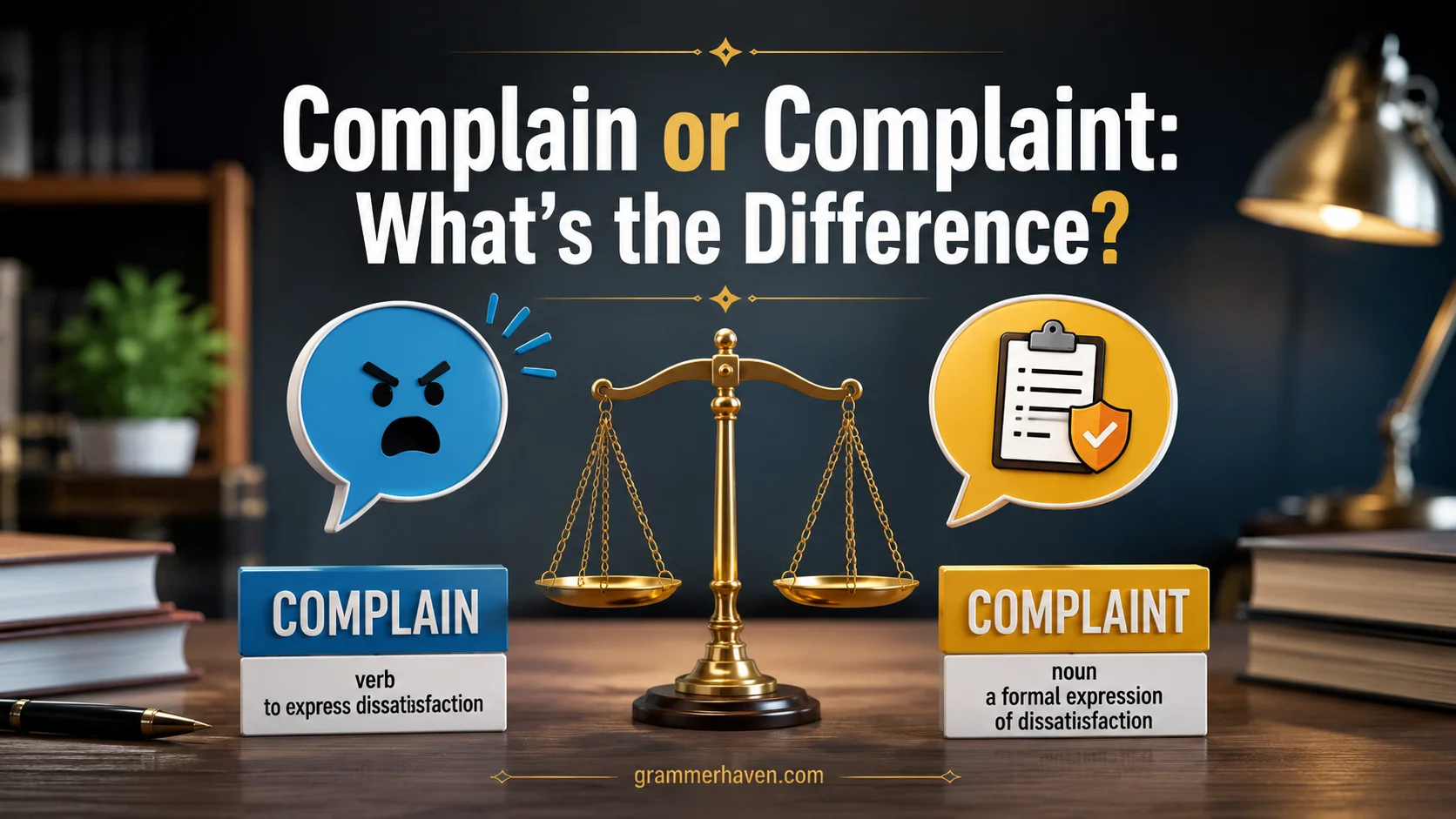
For English learners, the difference between complaint and complain can seem small, but each word has a different grammatical function. Complain is a verb used when you express dissatisfaction, while complaint is a noun that names the thing or reported issue itself. In simple English grammar, the verb usage describes an action, whereas the noun usage refers to an issue that someone wants to report. The same root gives both words a similar sound and appearance, which often causes confusion for learners, speakers, student writers, and even fluent speakers. If you’re choosing between the two, a useful hint is to ask whether you’re describing an action word or a thing word. That small check usually makes the grammar difference much easier to understand correctly.
You’ll see these words in many situations, including emails, daily conversation, customer service, customer service messages, customer service communication, school communication, school notices, news reports, news reporting, and other formal communication. For example, a customer may complain about poor service, while the company may receive a complaint about that service. This word choice matters because confusing the forms can make writing unclear, especially in formal writing, professional writing, and official contexts. When you understand the noun form, verb form, singular, plural, and grammatical role of each form, the common mistakes become easier to avoid. The related words and similar words may look connected, but they perform different jobs in a sentence.
The first sentence uses a verb to describe what she does; the second uses a noun for the issues she reported. In my experience working with English language usage, this approach makes the confusion disappear once you connect the meaning to the function of each form.
Complaint or Complain: Quick Answer
The main difference between complaint and complain comes down to their grammatical roles.
| Word | Part of Speech | Meaning | Example |
| Complaint | Noun | A statement or expression of dissatisfaction | The customer filed a complaint. |
| Complain | Verb | The act of expressing dissatisfaction | The customer complained about the service. |
Think of it this way:
- Complaint = the problem or statement
- Complain = what someone does about the problem
A person can complain and make a complaint.
Example:
Sarah complained to the manager because her order was wrong. She also submitted a written complaint.
The first sentence focuses on the action. The second sentence focuses on the official document or statement.
What Does Complaint Mean?
Complaint Definition and Meaning
Complaint is a noun that refers to an expression of dissatisfaction, criticism, or a problem someone reports.
A complaint can be informal or formal.
For example:
- Your friend says, “This restaurant takes too long.”
- That is a casual complaint.
- A customer writes a letter to a company about poor service.
- That is a formal complaint.
The word complaint names the issue itself. It does not describe the action of expressing dissatisfaction.
Examples of Complaint in Sentences
- The customer submitted a complaint about the damaged product.
- The company received several complaints about delivery delays.
- Her complaint was investigated by the manager.
- The teacher listened carefully to the student’s complaint.
- The neighbour made a noise complaint.
Notice how complaint acts like a thing. You can:
- make it
- file it
- submit it
- receive it
- investigate it
- resolve it
These actions happen to a complaint.
When Should You Use Complaint?
Example:
The hotel manager apologized after receiving a complaint about the dirty room.
The complaint is the report about the problem.
You are not describing the action of speaking. You are describing the thing that was submitted.
Complaint in Professional and Formal Writing
The word complaint appears frequently in workplaces, businesses, legal situations, and customer service.
Common examples include:
- customer complaint
- formal complaint
- written complaint
- official complaint
- workplace complaint
- noise complaint
- safety complaint
Businesses often track complaints because they reveal problems that need fixing.
For example:
| Situation | Complaint Example |
| Customer service | A customer filed a complaint about a delayed refund. |
| Workplace | An employee submitted a complaint about unfair treatment. |
| Housing | A tenant made a complaint about loud neighbours. |
| Public services | Residents filed complaints about road conditions. |
A complaint often creates a record. Companies use complaints to improve products, train employees, and solve recurring issues.
What Does Complain Mean?
Complain Definition and Meaning
Complain is a verb. It describes the action of expressing dissatisfaction, discomfort, or disagreement.
When someone complains, they communicate that something is wrong.
Examples:
- She complained about the noise.
- They complained to the manager.
The word changes depending on tense because verbs describe actions.
| Tense | Example |
| Present | I complain about the weather. |
| Third person present | He complains about everything. |
| Past | She complained yesterday. |
| Present continuous | They are complaining right now. |
| Future | We will complain if the problem continues. |
When Should You Use Complain?
If someone is actively expressing dissatisfaction, use complain.
Examples:
- The passengers complained about the delay.
- My neighbour complains every morning.
- Customers are complaining about the new update.
- She complained to the manager politely.
The focus is on the person doing something.
A useful question to ask:
“Is someone doing the action of expressing dissatisfaction?”
If yes, use complain.
Complaint vs Complain: Side-by-Side Comparison
Understanding the difference becomes easier when you compare them directly.
| Feature | Complaint | Complain |
| Grammar role | Noun | Verb |
| Describes | A thing | An action |
| Can change tense? | No | Yes |
| Can become plural? | Yes | No |
| Common phrase | File a complaint | Complain about something |
| Example | I made a complaint. | I complained yesterday. |
The Grammar Rule That Separates Complaint and Complain
The biggest clue comes from grammar.
Complaint Is a Noun
A noun names a person, place, thing, or idea.
Examples:
- book
- problem
- idea
- complaint
Because complaint is a noun, you can place words before it:
- a complaint
- the complaint
- my complaint
- your complaint
- several complaints
Examples:
- I have a complaint.
- The complaint was resolved.
- Her complaints were ignored.
Complain Is a Verb
A verb describes an action.
Examples:
- run
- write
- speak
- complain
Because complain is a verb, it changes based on time.
Examples:
Present:
People complain about high prices.
Past:
People complained about high prices.
Continuous:
People are complaining about high prices.
Easy Memory Trick for Complaint vs Complain
Many learners remember these words by focusing on their endings.
Complaint Ends With “-t”
Think:
Complaint = a thing
The letter T can remind you of “thing.”
Examples:
- a complaint
- the complaint
- several complaints
Complain Ends With “-in”
Think:
Complain = something someone is doing
It represents an action.
Examples:
- I complain.
- She complains.
- They complained.
Another simple trick:
Ask yourself:
“Can I put ‘a’ or ‘the’ before this word?”
Correct:
✅ I have a complaint.
Incorrect:
❌ I have a complain.
Common Phrases With Complaint
English speakers usually use complaint with certain verbs. Learning these combinations makes your writing sound natural.
File a Complaint
Meaning: To officially report a problem.
Examples:
- The customer filed a complaint against the company.
- She filed a complaint with the airline after losing her luggage.
Make a Complaint
Meaning: To express dissatisfaction, often formally.
Examples:
- He made a complaint about the poor service.
- Customers can make complaints through the website.
Submit a Complaint
Meaning: To send an official complaint.
Examples:
- Employees can submit a complaint to human resources.
- The resident submitted a complaint about construction noise.
Receive a Complaint
Meaning: To get a complaint from someone.
Examples:
- The restaurant received several complaints this month.
- The company received a complaint about product quality.
Resolve a Complaint
Meaning: To solve the problem.
Examples:
- Good managers know how to resolve customer complaints quickly.
- The support team resolved my complaint within one day.
Common Phrases With Complain
Just like complaint, the verb complain appears with common word combinations.
Complain About
This is the most common structure.
It means expressing dissatisfaction about something.
Examples:
- She complained about the food.
- They complained about the long waiting time.
- He always complains about traffic.
Complain To
This shows the person or organization receiving the complaint.
Examples:
- I complained to the manager.
- She complained to the airline.
- They complained to their landlord.
Complain That
This introduces the problem someone mentions.
Examples:
- Customers complained that the website was slow.
- He complained that nobody listened to him.
Complain Of
This structure often appears in medical contexts.
Examples:
- The patient complained of severe pain.
- She complained of feeling tired.
Read also: Perfect or Prefect: What’s the Difference?
FAQs:
1. What is the difference between complaint and complain?
Complain is a verb that describes the action of expressing dissatisfaction. Complaint is a noun that refers to the issue, concern, or report itself. For example, “I complain about the service” uses the verb, while “I filed a complaint” uses the noun.
2. Is complain a noun or a verb?
Complain is a verb. You use it when someone expresses dissatisfaction about something. For example, “Customers often complain about long waiting times.”
3. Is complaint a noun or a verb?
Complaint is a noun. It refers to a concern, grievance, or statement of dissatisfaction. For example, “The manager received a complaint from a customer.”
4. Should I say “make a complaint” or “make a complain”?
You should say “make a complaint.” The word complaint is the noun needed after “make.” For example, “She decided to make a complaint about the poor service.” “Make a complain” is incorrect.
5. What is the easiest way to remember complaint vs. complain?
Remember that complain describes an action, while complaint names the issue or report. If you’re doing it, you complain. If you’re submitting it, you make a complaint.
Conclusion:
Understanding complaint and complain becomes simple once you remember their grammatical roles. Complain is a verb that describes the action of expressing dissatisfaction, while complaint is a noun that names the concern or report. When you’re writing an email, filing a customer service issue, or talking about a problem, choosing the correct form will make your English clearer and more professional. Just remember: you complain about a problem, but you submit or make a complaint about it.