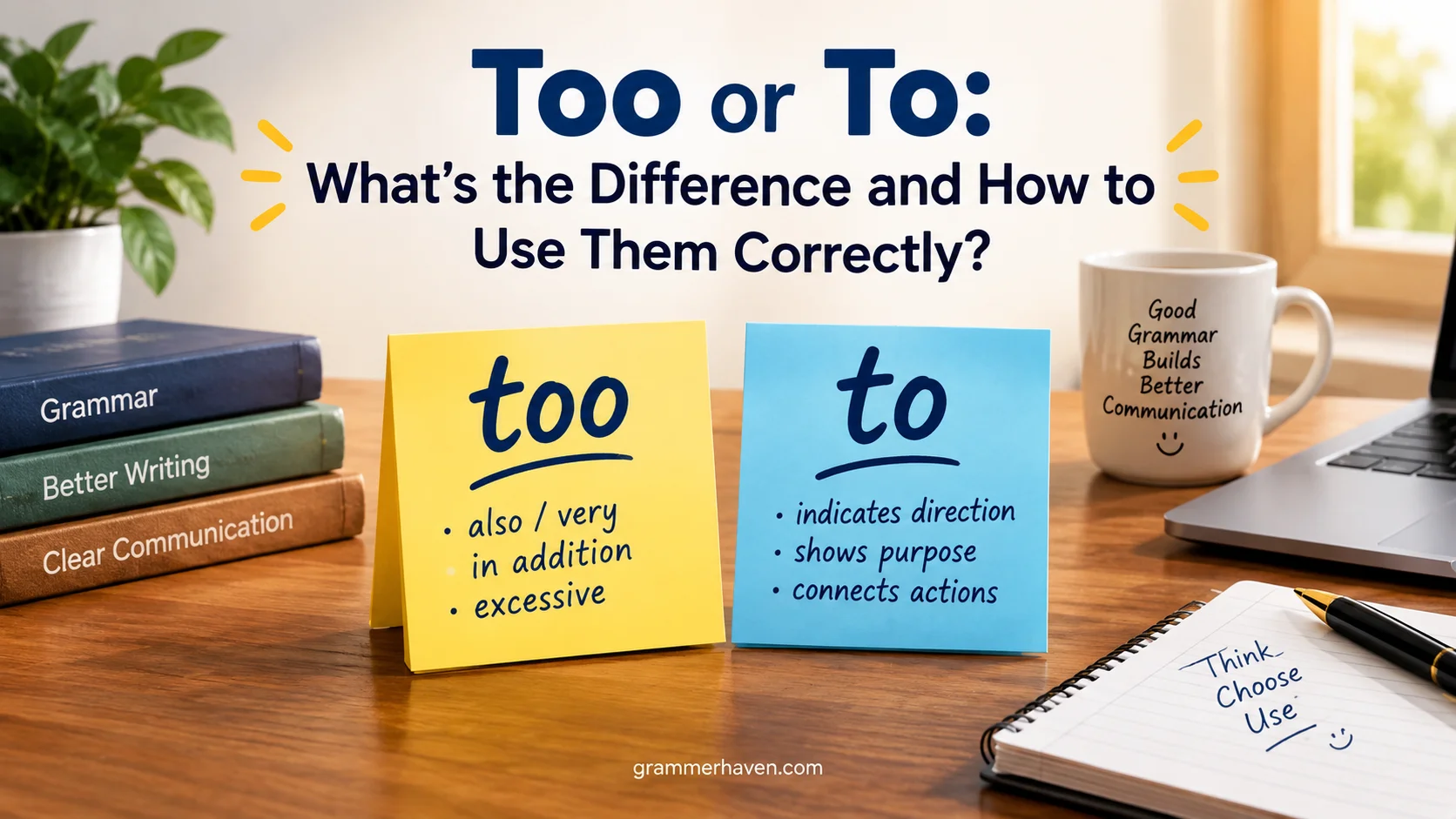
Too or To can confuse language learners because to and too have similar pronunciation but different meanings, spelling, and grammatical roles in English grammar. To can show direction or introduce a verb, while too means also or more than necessary. The extra o in too can help you remember its extra meaning. In written English, written language, and written communication, context helps you understand the difference and choose the correct one. Context clues can make these two words easier to identify in sentences, conversation, and conversation context. English words can have different functions even when their standard pronunciation sounds the same way. Spanish and other languages may create a similar confusion for language learners, making English lessons and online English lessons useful for practice.
The usage of to and too depends on their roles in a sentence. To commonly appears before a verb, as in “I want to learn,” and it can indicate direction, as in “We walked to school.” Too can mean also, as in “I want to go too,” or more than necessary, as in “The bag is too heavy.” These different situations show why correct usage requires attention to context and sentence structure. Learners can use these ways to learn the distinction by reading, writing, and practicing spoken language. The pattern becomes less tricky when you check the meaning before choosing the word.
A useful memory aid is to, too, two: to works with direction and verbs, too expresses also or excess, and two represents a number. Common mistakes often happen when learners focus only on pronunciation instead of grammar, usage, and meaning. The correct one becomes easier to choose when you know which one to use from the context. Tricky examples, repeated practice, and attention to related word patterns can help you learn the distinction. These English words may seem challenging at first, but recognizing their grammatical functions can reduce confusion and improve both writing and conversation.
Quick Answer: Too or To?
Use to when you’re talking about direction, a recipient, purpose, or an infinitive verb.
Use too when you mean “also” or “more than necessary.”
| Word | Main meaning | Example |
| to | Direction or destination | We went to school. |
| to | Infinitive marker | I want to sleep. |
| to | Recipient | Give it to Sarah. |
| to | Purpose | She called to ask a question. |
| too | Also | I want one too. |
| too | More than necessary | It’s too expensive. |
| two | Number 2 | I bought two books. |
A useful shortcut is simple:
To connect, direct, or introduce a verb. Too adds something or indicates excess.
The distinction isn’t merely a spelling preference. To and too have different grammatical functions. Cambridge Dictionary classifies too as an adverb and gives its main uses as expressing excess and addition.
What Does To Mean?
To is one of the most frequently used words in English. Its job changes depending on the sentence, but its major uses involve direction, relationships, purpose, and infinitive verbs.
Understanding these patterns makes it much easier to recognize when to is correct.
To as a Preposition
As a preposition, to can show movement toward a destination.
For example:
- We drove to the airport.
- She walked to the park.
- He moved to New York.
- They traveled to California.
Here, to establish a relationship between an action and a destination.
Think of it as an arrow:
you → destination
For example:
She walked → to → the library.
The word doesn’t describe the library itself. Instead, it shows where the movement ends.
To for Direction
To can also indicate direction without describing a complete journey.
Consider:
- Turn to the right.
- He looked to the sky.
- She pointed to the door.
- The path leads to the river.
In each sentence, to connect one thing with another point, place, or direction.
That relationship can be physical or figurative.
For example:
The company turned to a new strategy.
Nobody physically moved toward a strategy. Instead, to establish the relationship between the action and its target.
To for a Recipient
Another common use appears when something moves from one person to another.
- Give the letter to John.
- She sent an email to her manager.
- He handed the keys to his brother.
- We donated the clothes to a local shelter.
In these examples, to identify the recipient.
Compare:
She sent the package to Maria.
The package is being sent to Maria.
Using too would completely change the sentence and create a spelling error.
To for Purpose
English frequently uses to + verb to explain why someone does something.
- I went outside to get some air.
- She studied hard to pass the exam.
- He called to ask about the schedule.
- They saved money to buy a house.
Here, to introduce the purpose of the action.
You can often translate the structure mentally as “in order to.”
For example:
She studied hard to pass the exam.
This means:
She studied hard in order to pass the exam.
That quick substitution can help you identify the correct spelling.
To as an Infinitive Marker
One of the most important uses of to appears before the base form of a verb.
Examples include:
- to eat
- to sleep
- to write
- to understand
- to improve
- to learn
Now look at them in sentences:
- I want to learn.
- She needs to study.
- We decided to leave.
- They hope to win.
In these cases, to doesn’t mean “toward.” It helps form what grammarians call the to-infinitive.
This explains one of the most common mistakes:
❌ I want too go home.
✅ I want to go home.
The word before go must be to because to go forms the infinitive.
What Does Too Mean?
Unlike to, too works as an adverb. It has two major everyday meanings:
- Also
- More than necessary, wanted, suitable, or enough
Those meanings may seem unrelated at first. Context makes them easy to separate.
Too Meaning “Also”
When too means “also,” it adds another person, thing, or idea.
For example:
- I like pizza too.
- She wants to come too.
- He plays guitar too.
- We enjoyed the movie too.
You could usually replace too with also without changing the basic meaning.
I like pizza too.
means:
I also like pizza.
Cambridge notes that too meaning “also” commonly appears at the end of a clause, especially in informal English.
That’s why this familiar exchange is perfectly natural:
“I love chocolate.”
“Me too.”
Too Meaning “More Than Necessary”
The second major use describes excess.
Consider:
- The coffee is too hot.
- The bag is too heavy.
- The room is too small.
- The music is too loud.
- The test was too difficult.
In each case, too suggests that something exceeds a desirable or acceptable level.
For example:
The coffee is very hot.
This simply describes a high temperature.
But:
The coffee is too hot.
suggests that the temperature has crossed a limit. Perhaps you can’t drink it yet.
Cambridge describes this use of too as meaning “more than is needed or wanted” or more than is suitable or enough.
That’s an important distinction.
Very increases intensity. Too indicates excess.
Too vs. To: The Biggest Difference
The easiest way to understand the difference is to look at what each word contributes to the sentence.
| If you want to express… | Use | Example |
| Movement toward somewhere | to | She went to work. |
| A recipient | to | Give it to me. |
| Purpose | to | I came to help. |
| An infinitive | to | I want to leave. |
| Also | too | I want to leave too. |
| Excess | too | It’s too late. |
Here’s a practical test.
If you can replace the word with “also,” choose too.
I want dessert too.
→ I want dessert also.
If you can replace it with “more than necessary,” choose too.
The box is too heavy.
→ The box is heavier than necessary.
If the word introduces a verb or shows movement toward something, to will usually be the right choice.
Too vs. To vs. Two
There’s a third word that sounds exactly like to and too: two.
This trio causes plenty of spelling mistakes.
What Does Two Mean?
Two represents the number 2.
Examples:
- I have two brothers.
- She bought two tickets.
- We waited two hours.
- He owns two cars.
So you can remember the three words this way:
| Word | Think of it as… | Example |
| to | Direction, connection, or infinitive | I want to go. |
| too | Also or excessive | I want to go too. |
| two | Number 2 | I have two tickets. |
This gives you a powerful little mental shortcut:
To = connects.
Too = adds or exceeds.
Two = counts.
Common Too and To Mistakes
Most errors happen because people write what they hear rather than what the sentence requires.
Mistake: Too Before a Verb
❌ I want too eat.
✅ I want to eat.
Why?
Because to eat is an infinitive.
Other examples:
❌ She needs too study.
✅ She needs to study.
❌ We decided too leave.
✅ We decided to leave.
❌ He hopes too win.
✅ He hopes to win.
Mistake: To Instead of “Also”
❌ I want some ice cream to.
✅ I want some ice cream too.
Here, too means also.
You can test it:
I want some ice cream also.
That works. Therefore, too is correct.
Mistake: To Instead of “Excessively”
❌ This shirt is to expensive.
✅ This shirt is too expensive.
The meaning involves excess. The shirt costs more than the speaker considers acceptable.
Therefore, use it too.
Mistake: Too for Direction
❌ We went too school.
✅ We went to school.
The sentence describes movement toward a destination. It doesn’t mean “also” or “excessively.”
Therefore, to is required.
How to Remember the Difference Between Too and To
Memorizing definitions works, but a few quick tests make the distinction even easier.
Use the “Also” Test
Ask:
Could I replace this word with “also”?
If yes, use it too.
She likes coffee too.
→ She also likes coffee.
He came too.
→ He also came.
Use the “Excess” Test
Ask:
Does this mean more than necessary or wanted?
If yes, use too.
The suitcase is too heavy.
You’re driving too fast.
This room is too cold.
Look at the Word After It
When to appears before a base verb, it’s often an infinitive marker.
- to run
- to swim
- to write
- to think
- to understand
That pattern gives you a reliable clue.
Remember the Extra “O”
A popular memory trick says:
Too has two O’s because it can mean “also” or “more than enough.”
It isn’t a grammatical rule, but it’s an effective spelling reminder.
When you’re typing quickly and hesitate between to and too, ask what the sentence means. Then let grammar make the decision.
Too and To in the Same Sentence
Don’t assume that one sentence must use only one of these words.
They often appear together.
Consider:
It’s too late to call.
The first word, too, indicates excess.
The second, to, introduces the infinitive call.
Another example:
I want to come too.
Here, to introduce the verb come, while too means also.
More examples:
- She was too tired to continue.
- He wants to join us too.
- It’s too expensive to buy.
- I need to leave too.
- They arrived too late to get tickets.
These sentences show why spelling by sound doesn’t work. The words sound alike, yet their grammatical jobs differ.
The Structure “Too + Adjective + To”
One particularly useful pattern is:
too + adjective/adverb + to + verb
For example:
- too tired to work
- too cold to swim
- too expensive to buy
- too difficult to understand
- too heavy to carry
Consider:
The box is too heavy to lift.
The sentence suggests that the box exceeds the weight the person can reasonably lift.
Similarly:
The water is too cold to swim in.
The temperature has crossed a practical limit.
Cambridge specifically identifies the too + adjective/adverb + to-infinitive pattern as a standard construction.
Why the Two Words Work Together
Look at:
The bag is too heavy to carry.
Too modifies heavy.
To introduce carry.
So the grammatical structure is:
too + heavy + to + carry
Once you see the roles, the spelling becomes much easier.
Too vs. Very
These words sometimes look interchangeable, but they often communicate different ideas.
| Sentence | Meaning |
| The room is very cold. | The room has a low temperature. |
| The room is too cold. | The room is colder than desirable. |
| She is very young. | She is young. |
| She is too young to drive. | Her age prevents the action. |
| The bag is very heavy. | The bag has substantial weight. |
| The bag is too heavy to carry. | Its weight creates a problem. |
This distinction matters because too often implies a consequence.
The soup is very hot.
Nothing necessarily prevents you from eating it.
The soup is too hot to eat.
Now the temperature creates a problem.
Cambridge makes the same distinction: very intensifies an adjective or adverb, whereas too indicates that something exceeds what is necessary or appropriate.
Too Much vs. Much Too
Word order changes the grammatical function.
Too Much
Use too much when discussing an excessive amount.
- There is too much sugar in the coffee.
- I have too much work.
- He spends too much money.
- We received too much information at once.
Much Too
Use much too to strengthen too before an adjective or adverb.
- The coffee is much too sweet.
- The car is much too expensive.
- You’re driving much too fast.
- The room is much too small.
Compare:
There is too much noise.
with:
The music is much too loud.
The first describes quantity. The second emphasizes the degree.
Cambridge also notes that much too and far too can add emphasis to the idea of excess.
Too Much vs. Too Many
The noun determines which expression you need.
Use Too Much With Uncountable Nouns
Examples:
- too much water
- too much money
- too much information
- too much traffic
- too much time
You don’t normally count these nouns individually in these contexts.
Use Too Many With Countable Nouns
Examples:
- too many people
- too many questions
- too many books
- too many cars
- too many mistakes
The distinction is straightforward:
too much + uncountable noun
too many + plural countable noun
Cambridge also distinguishes too much, too many, too few, and too little according to quantity and noun type.
Too, Also, and As Well
When “too means “also,” you have several alternatives.
Compare:
- I want to come too.
- I also want to come.
- I want to come as well.
All three express addition, but their usual placement and tone differ.
Too commonly appears at the end of a clause:
She came too.
Also often appears before the main verb:
She also came.
As well usually appears at the end:
She came as well.
Cambridge notes that also, as well, and too all express addition, while their normal positions differ.
In casual conversation, too is particularly natural.
“I love this song.”
“Me too.”
That’s short, natural, and completely standard.
A Closer Look at “Me Too”
Me too is one of the most familiar uses of too in everyday American English.
Suppose someone says:
“I’m exhausted.”
A natural response is:
“Me too.”
The phrase means:
“I’m exhausted too.”
In informal conversation, me too is much more natural than forcing a formal construction such as I too into every situation.
The important point is that too means also.
It has nothing to do with direction, infinitives, or excess.
A Practical Case Study: One Sentence, Three Words
Consider this sentence:
I want to buy two books too.
It contains all the important distinctions.
I
Subject.
want
Main verb.
to buy
Infinitive.
Here, to introduce the verb buy.
two books
The word two tells us the quantity.
too
The final too means also.
The complete meaning is:
The speaker wants to purchase two books in addition to something previously mentioned.
This tiny sentence is a useful test because it demonstrates to, two, and too working together.
Tricky Examples: Too or To?
Let’s examine sentences where the distinction isn’t immediately obvious.
“I have to go too.”
The first to introduce the verb go.
The final too means also.
Meaning: I also have to go.
“It’s too late to call.”
The first too means that the time has exceeded an acceptable point.
The second to introduce the infinitive call.
“She bought two tickets too.”
Two identifies the number of tickets.
Too means she bought them also or in addition to something else.
“He was too tired to drive.”
Too expresses excessive tiredness.
To introduce the verb drive.
“We went to the store to buy two shirts too.”
This sentence contains all three homophones:
- first to = destination
- second to = purpose
- two = number
- too = also
That is about as useful a stress test as English can offer.
Common Mistakes to Watch For
Before publishing, emailing, texting, or submitting an assignment, watch for these patterns:
- ❌ I need too finish this.
- ✅ I need to finish this.
- ❌ She went too the office.
- ✅ She went to the office.
- ❌ I want some to.
- ✅ I want some too.
- ❌ This costs to much.
- ✅ This costs too much.
- ❌ There are to many people here.
- ✅ There are too many people here.
- ❌ I have two go.
- ✅ I have to go.
The fastest correction method isn’t memorizing hundreds of examples. Identify the meaning and grammatical role first.
A Simple Decision Guide for Too or To
When you’re unsure, work through these questions:
Does the word mean “also”?
→ Use too.
Does it mean “more than necessary”?
→ Use too.
Does it show movement or direction?
→ Usually use to.
Does it identify a recipient?
→ Use to.
Does it introduce a base verb?
→ Usually use to.
Does it mean the number 2?
→ Use two.
Here’s the shortcut worth remembering:
To = toward, connection, purpose, or verb.
Too = also or excessive.
Two = 2.
Practice Quiz: Too or To?
Choose to, too, or two for each blank.
- I want ___ learn French.
- She wants ___ come with us.
- This coffee is ___ hot.
- I would like some cake ___.
- We went ___ the store.
- He bought ___ shirts.
- There are ___ many people here.
- I need ___ finish my work.
- The box is ___ heavy ___ carry.
- She wants ___ tickets ___.
- They arrived ___ late.
- Give the letter ___ James.
- I like that movie ___.
- He has ___ dogs.
- It’s ___ expensive ___ buy.
Answer Key
- to — introduces the infinitive learn.
- to — introduces the infinitive come.
- too — means excessively.
- too — means also.
- to — shows destination.
- two — refers to the number 2.
- too — indicates an excessive quantity.
- to — introduces the infinitive finish.
- too, to — excessive degree + infinitive.
- two, too — number 2 + also.
- too — indicates an excessive degree.
- to — identifies the recipient.
- too — means also.
- two — refers to the number 2.
- too, to — excessive degree + infinitive.
Quick Facts About Too and To
- To has several grammatical functions, including preposition and infinitive marker.
- Too functions primarily as an adverb.
- Too can mean “also.”
- Too can indicate an amount or degree beyond what is wanted or needed.
- Two represents the number 2.
- To, too, and two are pronounced alike in standard English.
- Too commonly appears at the end of a clause when it means “also.”
- Too + adjective + to + verb is a common English structure.
- Too much generally goes with uncountable nouns.
- Too many goes with plural countable nouns.
See also: Verses vs. Versus: What’s the Difference & Which One Is Correct?
Final Cheat Sheet: Too or To Explained
| Meaning | Correct Word | Example |
| Direction | to | Go to school. |
| Destination | to | Drive to work. |
| Recipient | to | Give it to her. |
| Purpose | to | I called to ask. |
| Infinitive | to | I want to learn. |
| Also | too | I want one too. |
| Excess | too | It’s too expensive. |
| Number 2 | two | I bought two books. |
FAQs:
Is “too” grammatically correct at the end of a sentence?
Yes. When too means “also,” it commonly appears at the end of a sentence or clause.
I want to go too.
Is “to” always followed by a verb?
No. To can function as a preposition and can be followed by a noun or pronoun.
She went to school.
It can also introduce an infinitive:
She wants to study.
Does too always mean “also”?
No. Too has two major everyday meanings. It can mean “also” or “more than necessary.”
I want one too.
It’s too expensive.
What’s the difference between too and very?
Very increases intensity. Too generally indicates excess.
The room is very cold.
The room has a low temperature.
The temperature is lower than desired or suitable.
Is “me too” correct?
Yes. Me too is a standard informal response meaning “I do too” or “I am too,” depending on the preceding statement.
What’s the difference between too much and too many?
Use too much with uncountable nouns:
too much water
Use too many with plural countable nouns:
too many bottles
Are to, too, and two homophones?
Yes. In standard English, they have the same pronunciation while having different meanings and spellings.
Can too mean “very”?
Sometimes, depending on the construction and variety of English. Cambridge lists a use of too ” meaning “very” or “completely,” as in “too kind” or “not too sure.” However, the common core uses learners need to master are “also” and “more than enough.”
What’s the easiest way to remember too vs. to?
Ask what you mean.
If you mean also, use too.
If you’re showing direction, purpose, a recipient, or introducing an infinitive, use to.
Conclusion:
Understanding Too or To becomes easier when you focus on meaning, usage, and context. Use to for direction or before a verb, while too means also or more than necessary. Remembering to, too, two can help you choose the correct one and avoid common mistakes in English grammar, writing, and spoken language.