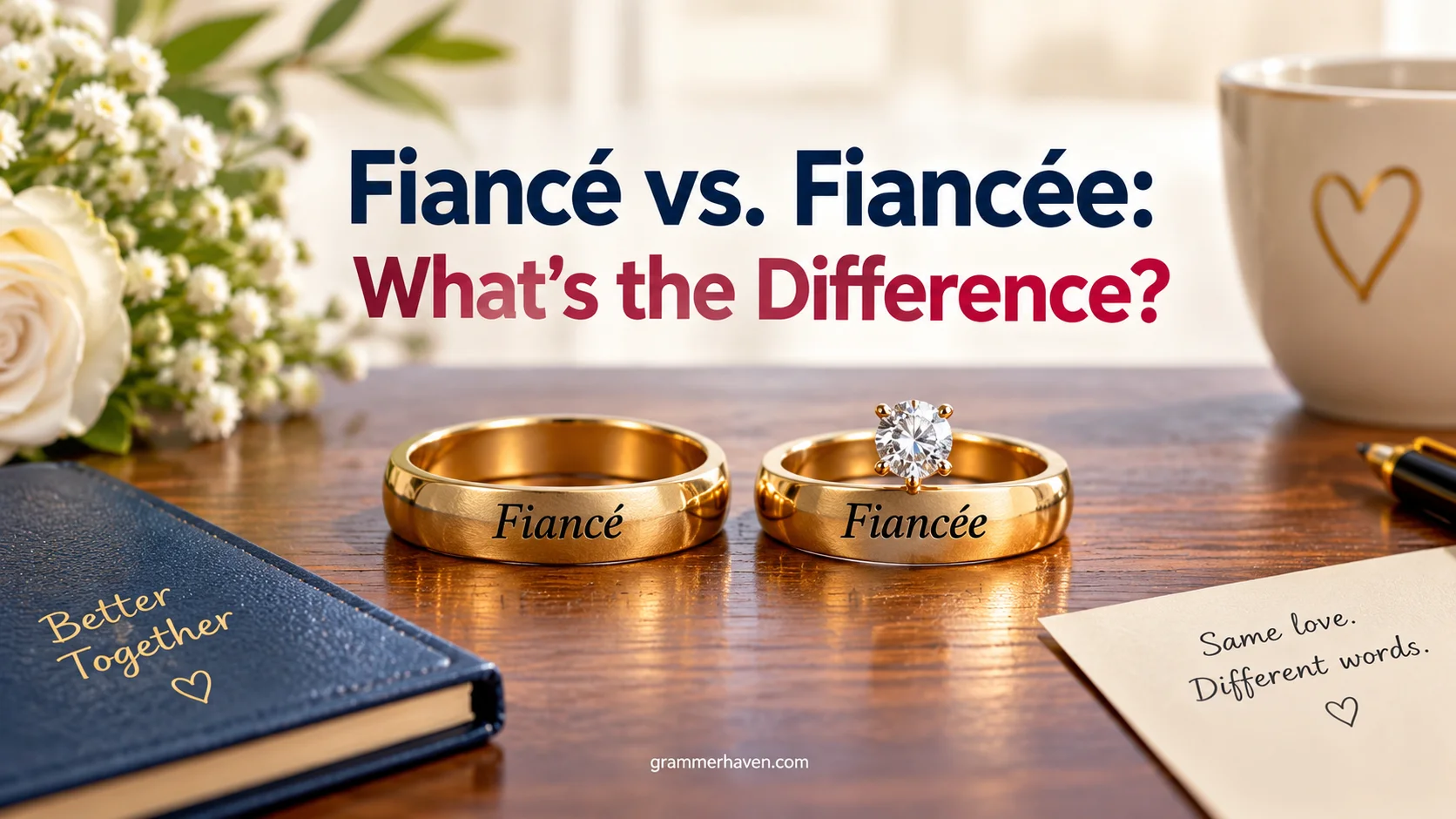
Fiancé vs. Fiancée can confuse English readers because the words look almost identical and sound alike, yet their basic meaning has one important difference: gender.
Fiancé traditionally describes a man who is engaged to be married, while fiancée describes a woman in the same situation. The extra e signals the feminine form. Both terms come from a French word and are English borrowed terms with grammatical gender. In modern English, people, writers, and dictionaries may still follow this traditional distinction. The spelling can look unusual, but the main difference is simple. The final letter provides the gender reference. When describing a person who is engaged, check whether you mean a man or woman. The terms aren’t truly interchangeable in traditional usage, even though casual conversations may treat them that way. Careful writing keeps the distinction clear.
For practical writing, this usage matters in a wedding invitation, email, caption, or announcement. Use the correct spelling when you refer to someone’s engagement or marriage. If you’re talking about someone promised to marry, the correct term helps you accurately describe their relationship status and prevents confusion. My own experience with this spelling shows that context usually solves the problem quickly: one e points to fiancé, while the extra e identifies fiancée.
Quick Answer: Fiancé vs. Fiancée
Fiancé traditionally means a man who is engaged to be married.
Fiancée traditionally means a woman who is engaged to be married.
The easiest way to remember the difference is this:
- Fiancé → traditionally an engaged man
- Fiancée → traditionally an engaged woman
- Both describe someone who has agreed or promised to marry another person.
- The extra e in fiancée marks the traditional feminine form.
- The two words are generally pronounced the same in English.
For example:
Emma introduced her fiancé to her parents.
Here, fiancé refers to Emma’s male partner.
David introduced his fiancée to his coworkers.
Here, fiancée refers to David’s female partner.
Cambridge gives the same traditional distinction, defining fiancé as the man someone is engaged to marry and fiancée as the woman someone is engaged to marry.
Fiancé vs. Fiancée at a Glance
| Word | Traditional meaning | Traditional gender | Example |
| Fiancé | Someone engaged to be married | Male | Her fiancé proposed last summer. |
| Fiancée | Someone engaged to be married | Female | His fiancée is planning the ceremony. |
| Partner | A romantic or life partner | Gender-neutral | My partner is coming tonight. |
| Future spouse | Someone you plan to marry | Gender-neutral | My future spouse works nearby. |
| Spouse | Someone you are already married to | Gender-neutral | My spouse works from home. |
The most important distinction isn’t the relationship itself. Both fiancé and fiancée describe an engaged person. The traditional difference lies in the person’s gender.
What Does Fiancé Mean?
Fiancé Definition
Fiancé is traditionally a noun meaning a man who is engaged to be married.
If a man has accepted a marriage proposal and the couple intends to marry, his partner may refer to him as her fiancé.
For example:
- My fiancé and I are choosing a wedding venue.
- Her fiancé lives in Boston.
- I met Daniel’s fiancé at the dinner.
- Her fiancé proposed during their vacation.
The word refers to an engagement rather than a marriage. That distinction matters.
Someone remains a fiancé until the marriage takes place. After the wedding, the person becomes a husband or spouse, depending on the relationship and terminology being used.
How to Use Fiancé in a Sentence
Use fiancé when you’re following the traditional masculine form.
For example:
My fiancé is helping me organize the guest list.
The word identifies the speaker’s male partner as someone who is engaged to marry them.
You can also use fiancé in formal and informal settings:
- I’d like you to meet my fiancé.
- My fiancé and I booked the venue yesterday.
- Her fiancé works in the finance department.
- We invited her fiancé to the family dinner.
The word doesn’t necessarily describe the wedding itself. It simply identifies the person’s relationship status.
What Does Fiancée Mean?
Fiancée Definition
Fiancée is traditionally a noun meaning a woman who is engaged to be married.
The spelling contains an additional e compared with fiancé. That extra letter reflects the feminine form inherited from French.
For example:
- My fiancée and I are moving next month.
- His fiancée chose the invitations.
- I met Sarah’s fiancée yesterday.
- Her fiancée works at a local hospital.
Cambridge defines fiancée specifically as the woman someone is engaged to marry.
How to Use Fiancée in a Sentence
Use fiancée when referring traditionally to an engaged woman.
Consider this sentence:
James introduced his fiancée to his colleagues.
The spelling tells the reader that James’s engaged partner is a woman.
The word works naturally in everyday conversation, formal announcements, wedding-related writing, and personal messages.
The Main Difference Between Fiancé and Fiancée
The difference between fiancé and fiancée comes down to one extra letter and the traditional gender distinction.
Fiancé has one final é.
Fiancée has ée at the end.
Here’s the simplest comparison:
| Spelling | Traditional use |
| fiancé | Engaged man |
| fiancée | Engaged woman |
The words aren’t different because the relationships have different meanings. Both indicate an engagement.
Think of them as two branches growing from the same linguistic tree. The meaning is almost identical, while the traditional form changes according to gender.
A Simple Memory Trick
Here’s an easy trick:
Fiancé → one final e sound in the spelling → traditionally male.
Fiancée → the extra e makes the word longer → traditionally female.
Another way to remember it is to associate the second e with the traditional feminine form.
It isn’t a perfect grammar rule for every French-derived word. However, it works well for distinguishing these two terms in English.
Why Does Fiancée Have an Extra E?
The spelling makes more sense when you look at the words’ French origins.
The French verb fiancer means to engage or promise someone in marriage. The French noun forms fiancé and fiancée distinguish masculine and feminine forms. The Académie Française defines fiancé, fiancée as a person bound by a promise of marriage.
English borrowed these forms rather than creating a completely separate English word.
The feminine -e therefore isn’t an accidental addition. It reflects the traditional French gender distinction that English retained.
The words also have a long history. Etymological records trace fiancée in English to the 19th century, while fiancé became established in English later in that century. Both ultimately connect to French fiancer.
The deeper history is interesting because the underlying idea goes beyond weddings. The French word is connected historically with concepts of trust, promise, and commitment.
Are Fiancé and Fiancée Pronounced the Same?
Yes. In standard American English, fiancé and fiancée are generally pronounced the same.
Cambridge gives the US pronunciation as approximately /ˌfiː.ɑːnˈseɪ/ for both forms.
That creates one of the most common problems with these words.
You can hear the word correctly and still have no idea which spelling belongs on the page.
For example, if someone says:
My fiancé is coming tonight.
You cannot normally determine from the sound alone whether the writer means fiancé or fiancée.
The surrounding context supplies the missing information.
That’s why these words are primarily a spelling and usage problem, not a pronunciation problem.
Is Fiancé or Fiancée Gender-Specific?
Traditionally, yes.
The conventional distinction is:
- Fiancé = an engaged man
- Fiancée = an engaged woman
This distinction comes directly from the French forms and remains reflected in major English dictionaries.
However, modern English doesn’t always preserve gender distinctions inherited from other languages. Some speakers prefer gender-neutral expressions, especially when gender isn’t relevant to the sentence.
Possible alternatives include:
- engaged partner
- partner
- future spouse
- person I’m engaged to
- betrothed
The best choice depends on context and personal preference.
If someone describes their engaged partner as their fiancé, there’s no need to assume that every speaker follows the traditional distinction. Usage can vary, particularly in informal English.
Fiancé vs. Fiancée in Modern English
Modern English has become more flexible about gendered language.
The traditional distinction between fiancé and fiancée remains widely understood. At the same time, some speakers use gender-neutral alternatives or use one form more broadly.
Dictionary.com notes that English has sometimes relaxed the foreign characteristics of borrowed words. It also identifies the traditional distinction between fiancé for a man and fiancée for a woman.
This creates an important practical rule:
Traditional usage and modern personal usage aren’t always identical.
If you’re writing about a specific person, their preferred terminology can matter more than an abstract spelling rule.
For general grammar writing, however, fiancé for a man and fiancée for a woman remains the clearest traditional distinction.
Common Mistakes With Fiancé and Fiancée
Using Fiancé for a Woman
Under the traditional distinction, this is incorrect.
Incorrect:
Maria introduced her fiancé.
If Maria’s engaged partner is a woman and you’re following traditional usage, write:
Maria introduced her fiancée.
Using Fiancée for a Man
The reverse mistake happens just as often.
Incorrect under traditional usage:
James introduced his fiancée.
If James’s engaged partner is a man, use:
James introduced his fiancé.
Assuming the Words Have Different Relationship Meanings
This is another common misunderstanding.
Fiancé and fiancée don’t describe different stages of engagement.
Both refer to someone engaged to be married.
The difference is traditionally based on gender.
Forgetting the Accent Marks
The standard spellings are fiancé and fiancée.
You may also see fiance and fiancee without accent marks, especially in informal English typing.
Dictionary.com lists fiance and fiancee as forms used in English without the accent marks.
For polished writing, however, retaining the accents is a good choice:
- fiancé
- fiancée
This is particularly useful in formal writing, edited articles, wedding materials, and professional publications.
Confusing Fiancé With Husband or Wife
An engagement isn’t a marriage.
Before the wedding:
She is my fiancée.
After the wedding:
She is my wife.
Likewise:
He is my fiancé.
becomes:
He is my husband.
The exact terminology can vary according to someone’s relationship and personal preferences. The key grammatical distinction is that fiancé/fiancée describes an engaged person, while spouse describes someone who is married.
Fiancé vs. Fiancée vs. Partner
The word partner has a broader meaning.
Someone can call another person their partner without being engaged. A fiancé or fiancée, by contrast, traditionally implies a specific commitment to marry.
| Term | Engagement implied? | Gender specified? |
| Fiancé | Yes | Traditionally male |
| Fiancée | Yes | Traditionally female |
| Partner | No | No |
| Future spouse | Usually | No |
| Spouse | No longer merely engaged | No |
This difference becomes useful when choosing precise language.
For example:
My partner is visiting this weekend.
This tells the reader about the relationship but doesn’t indicate an engagement.
Compare it with:
My fiancée is visiting this weekend.
Now the sentence communicates an engagement as well.
Neither word is inherently better. They simply communicate different information.
Fiancé vs. Fiancée vs. Spouse
The timeline makes this distinction easy to understand.
Dating → Engaged → Married
During the engagement stage, someone can traditionally be called a fiancé or fiancée.
After marriage, the person becomes a spouse.
For example:
| Relationship stage | Traditional term |
| Dating | Partner / boyfriend / girlfriend |
| Engaged | Fiancé / fiancée |
| Married | Spouse / husband / wife |
This is why calling someone a spouse before the wedding can create confusion. It suggests that the marriage has already taken place.
Can You Use Fiancé or Fiancée for an Unmarried Partner?
Yes, if the person is engaged to be married.
Being unmarried isn’t enough by itself.
For example:
Alex is my partner.
This doesn’t tell us whether Alex is a fiancé, spouse, or dating partner.
But:
Alex is my fiancé.
traditionally tells us that Alex is a man whom the speaker plans to marry.
Similarly:
Alex is my fiancée.
traditionally identifies Alex as a woman whom the speaker plans to marry.
The engagement is the defining factor.
Can Fiancé and Fiancée Be Used for Same-Sex Couples?
The traditional forms are gendered. That means the conventional choice depends on the gender of the person being described rather than the gender combination of the couple.
For example, under traditional usage, an engaged man can be called a fiancé, regardless of the gender of his partner. An engaged woman can be called a fiancée, regardless of the gender of her partner.
However, people don’t always use these forms according to that traditional rule.
Some prefer:
- fiancé
- fiancée
- partner
- engaged partner
- future spouse
The most respectful wording in a personal context is generally the terminology the person uses for themselves.
For general writing, explain the traditional distinction rather than assuming that every speaker follows it.
Is “Fiance” Without the Accent Correct?
Fiance is commonly seen in English without the accent.
The standard borrowed spellings are fiancé and fiancée, but English sometimes drops diacritical marks from words borrowed from other languages. Dictionary.com specifically notes this pattern for these terms.
In a casual text message, someone might write:
My fiance is picking me up.
That spelling is common and easily understood.
In polished writing, though, these versions are preferable:
My fiancé is picking me up.
or
My fiancée is picking me up.
The accent isn’t merely decorative. It preserves the conventional spelling of the borrowed French word.
Fiancé vs. Fiancée: Which Spelling Should You Use?
Choosing between the two is straightforward if you follow traditional English usage.
Use fiancé when referring to an engaged man.
Use fiancée when referring to an engaged woman.
If gender isn’t relevant, or if the person prefers gender-neutral terminology, use a word such as partner or engaged partner.
Here’s a quick decision guide:
| Situation | Traditional choice |
| Engaged man | fiancé |
| Engaged woman | fiancée |
| Gender isn’t relevant | partner |
| You want a gender-neutral engaged-person term | engaged partner |
| Already married | spouse |
One important point remains: don’t choose the spelling based on the person proposing marriage.
Choose it based on the person you’re describing.
If Sarah is engaged to Michael, then Sarah is Michael’s fiancée, while Michael is Sarah’s fiancé.
The relationship works both ways, but the spelling changes according to the traditional gender distinction.
Examples of Fiancé and Fiancée in Real-Life Situations
Introducing Your Fiancé or Fiancée
Natural introductions often use these words without any special formality.
- This is my fiancé, Daniel.
- I’d like you to meet my fiancée, Maria.
- Have you met my fiancé yet?
- My fiancée is joining us for dinner.
Wedding Planning
The terms are especially common in wedding-related conversations.
- My fiancé is choosing the music.
- My fiancée has already ordered the invitations.
- My fiancé and I booked the venue.
- My fiancée wants a small ceremony.
Workplace Conversations
You might use these words casually at work when discussing personal plans.
- My fiancé and I are getting married in June.
- My fiancée is moving to Chicago.
- I need to leave early because my fiancé has an appointment.
The terms aren’t inherently informal. Context determines how they sound.
Social Media Captions
They also appear naturally in social posts.
Examples include:
- So excited to marry my fiancé!
- Forever grateful for my fiancée.
- Wedding planning with my fiancé has officially begun.
- Counting down the days with my fiancée.
Fiancé and Fiancée in Formal vs. Informal Writing
Both words can appear in formal writing.
For example, a wedding announcement might say:
The couple announced their engagement and plans to marry next spring.
A personal message might be much more relaxed:
My fiancé surprised me with dinner tonight.
Formal writing doesn’t require avoiding these words. What matters is whether the term accurately describes the person and fits the context.
In professional writing, partner can sometimes be more neutral. In wedding-specific writing, fiancé and fiancée may provide more precise information.
A Useful Case Study: Choosing the Correct Word
Imagine that Alex and Jordan are engaged.
Suppose Alex is a man and Jordan is a woman.
If Jordan is speaking about Alex, she might traditionally say:
Alex is my fiancé.
If Alex is speaking about Jordan, he might traditionally say:
Jordan is my fiancée.
Now reverse the situation.
If two engaged men are discussing their relationship, the traditional term for either man is fiancé.
If two engaged women are discussing their relationship, the traditional term for either woman is fiancée.
The key isn’t who is speaking. The key is who the noun describes.
That’s the detail that solves most fiancé-versus-fiancée questions.
Fiancé vs. Fiancée Grammar Test
Try these sentences before checking the answers.
- Maria introduced her ______ to the family.
- James and his ______ are planning the ceremony.
- My ______ proposed during our vacation.
- Her ______ works in New York.
- Daniel said his ______ had already chosen the venue.
Answers
- fiancée, if Maria’s engaged partner is a woman.
- fiancée, if James’s engaged partner is a woman.
- fiancé, if the engaged person being described is a man.
- fiancée, if the person being described is a woman.
- fiancée, if Daniel’s engaged partner is a woman.
The pattern becomes much easier once you stop focusing on pronunciation.
Ask one question:
Who does the word describe?
That usually gives you the answer.
See also: In the Same Day or On the Same Day: Which Is Correct?
FAQs:
What is the difference between fiancé and fiancée?
Traditionally, fiancé refers to an engaged man, while fiancée refers to an engaged woman. Both words describe someone who has agreed or promised to marry another person.
Is fiancé for a man or a woman?
Traditionally, fiancé is used for a man who is engaged to be married. Cambridge lists this as the standard distinction in its English dictionary.
Is fiancée the female spelling?
Yes. Fiancée is traditionally the feminine form and refers to a woman who is engaged to be married.
Are fiancé and fiancée pronounced the same?
Generally, yes. In American English, both are commonly pronounced approximately /ˌfiː.ɑːnˈseɪ/.
Can fiancé and fiancée be used for same-sex couples?
Yes. Under traditional usage, the choice depends on the gender of the person being described, not the gender combination of the couple. People may also prefer gender-neutral terms such as partner.
Can I write fiance without an accent?
Fiance appears commonly in English without the accent mark, especially in informal writing. However, fiancé is the standard traditional spelling for the masculine form.
What is the gender-neutral word for fiancé or fiancée?
Partner and engaged partner are common gender-neutral alternatives. Future spouse can also work when the intended meaning is clear.
Does fiancé mean husband?
No. Traditionally, a fiancé is an engaged man who isn’t yet married to his partner. After marriage, he may be described as a husband or spouse.
Does fiancée mean wife?
No. A fiancée is traditionally an engaged woman. The term doesn’t mean that the marriage has already happened.
What is the plural of fiancé and fiancée?
The traditional English plurals are fiancés and fiancées. The plural keeps the relevant spelling distinction.
Conclusion:
The difference between fiancé and fiancée is simple once you know the rule. Fiancé traditionally refers to a man who is engaged to be married, while fiancée refers to a woman who is engaged. Both words have the same basic meaning and describe someone who plans to marry.
The easiest way to remember the spelling is to notice the extra e in fiancée. If you prefer gender-neutral language, you can also use partner or engaged partner. With this simple distinction in mind, choosing the correct word becomes much easier.