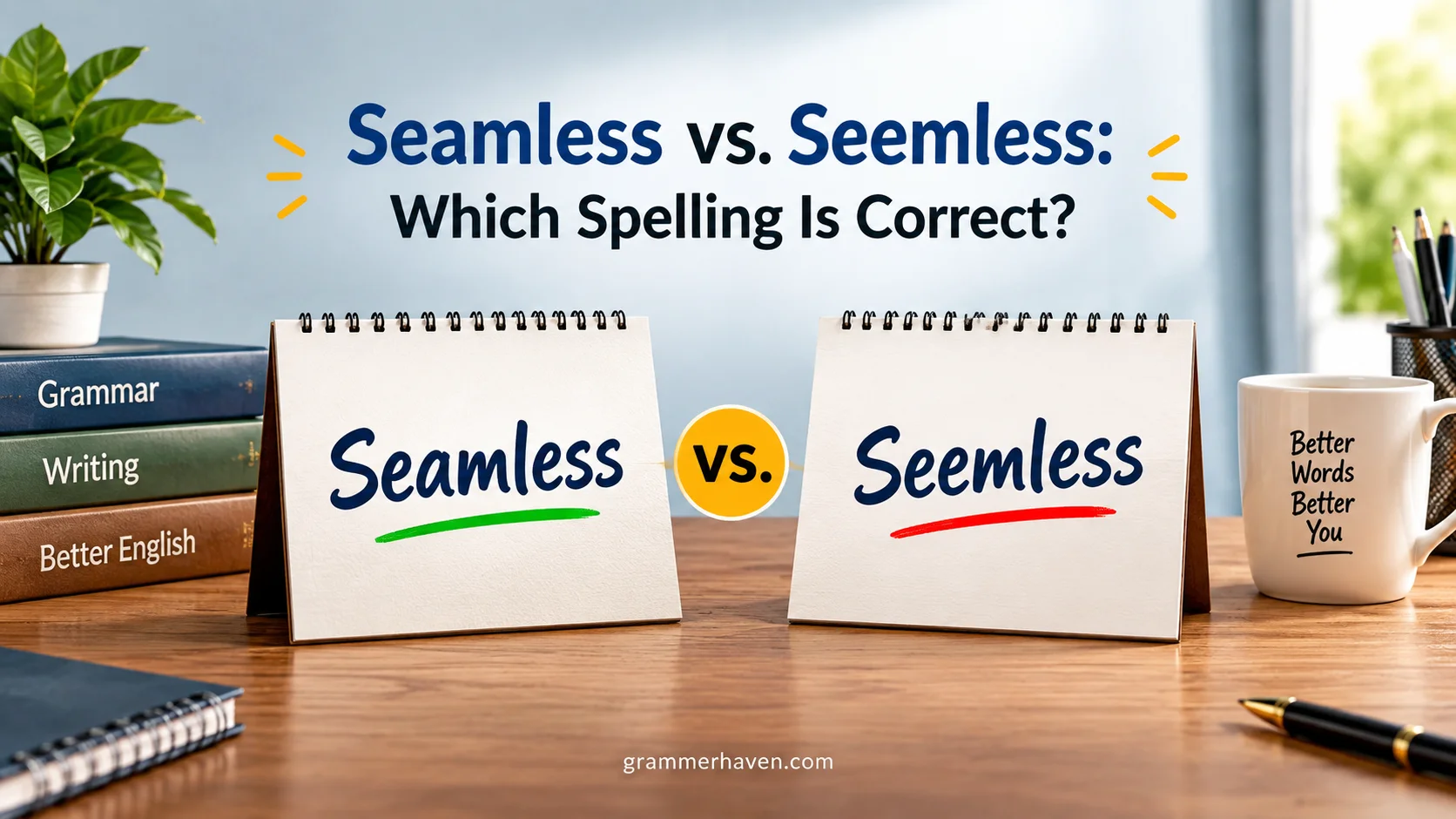
Seamless vs. Seemless explains why seamless is the correct spelling, while seemless is incorrect in standard English despite their similar sound. The two words can sound exactly alike when you hear them, but their meanings and spelling differ. A seam is a line where pieces of material join or come together.
The suffix -less means without, so seamless literally means without a seam. Seem has a different meaning and relates to how something appears. The Cambridge Dictionary gives seamless a literal meaning and a broader figurative meaning, describing something that happens smoothly, continuously, and without noticeable breaks. The connection between seam and seamless helps you remember the correct spelling.
The meaning of seamless extends beyond clothing and physical material. A floor can have a seamless surface that looks smooth and has no noticeable breaks or additional parts. A seamless transition describes a change that moves smoothly from one stage to another without a hitch.
The word appears everywhere today in technology, business, design, communication, travel, entertainment, and customer experiences. Agriculture & Forestry can be seamless for a process that works effectively, without issues, and stays consistent.
Quick Answer: Seamless or Seemless?
Seamless is the correct spelling.
Seemless is generally a misspelling when you mean something smooth, continuous, or without noticeable interruptions.
| Word | Correct? | Meaning | Example |
| Seamless | ✅ Yes | Without seams, breaks, or noticeable transitions | The transition was seamless. |
| Seemless | ❌ No | Not the standard spelling for this meaning | ❌ The transition was seemless. |
So, if you want to say that two things connect smoothly, write seamless.
Correct: The new software provides a seamless user experience.
Incorrect: The new software provides a seemless user experience.
The easiest way to remember it is seam + less = seamless.
What Does “Seamless” Mean?
Seamless is an adjective with both a literal and a figurative meaning.
In its literal sense, something seamless has no seams or visible joins. Think about a piece of clothing made without the stitched lines you normally see where separate pieces of fabric meet. Cambridge Dictionary gives this literal meaning as “without any seams,” while Oxford defines it similarly as “without a seam.”
The word also has a much broader figurative meaning. Something is seamless when it moves from one part to another without sudden changes, interruptions, difficulty, or noticeable gaps.
For example:
- The website offers a seamless shopping experience.
- The actors made a seamless transition between scenes.
- The two computer systems now work together seamlessly.
- She made a seamless transition from teaching to administration.
In simple English, seamless means so smooth that you barely notice where one part ends and another begins.
The Literal Meaning of Seamless
The original idea is easy to visualize.
Imagine two pieces of fabric joined together. Usually, you can see a line where they meet. That line is a seam.
If the material has no such visible join, it can be described as seamless.
Examples include:
- seamless stockings
- seamless underwear
- seamless garments
- seamless tubes
- seamless construction
Oxford and Cambridge both recognize this literal sense.
The Figurative Meaning of Seamless
The figurative meaning takes that physical idea and applies it to experiences, processes, and transitions.
Imagine watching a movie. One scene ends, another begins, and the change feels completely natural. You don’t stop and think, “That transition was awkward.” Instead, everything flows.
That’s seamless.
The same idea works for:
- software integration
- business processes
- conversations
- travel connections
- customer service
- storytelling
- design
- teamwork
Cambridge describes this sense as something happening without sudden changes, interruption, or difficulty.
What Does “Seemless” Mean?
Here’s where the confusion starts.
“Seemless” is not the standard spelling you should use when you mean “seamless.”
The mistake makes sense phonetically. Seam and seem have the same pronunciation, so someone who hears the word might naturally connect it to the more familiar word seem.
But they are completely different words.
Seem means to appear or give a particular impression:
You seem tired.
It seems like a good idea.
Seam, on the other hand, refers to a join between pieces of material:
The seam on the shirt came loose.
The word seamless comes from the second word, not the first.
Why “Seemless” Looks Correct
English spelling creates plenty of traps like this.
When you hear seamless, you hear something close to “seem-less.” Since seem is a common English word, the spelling seemless can look perfectly reasonable at first glance.
There’s just one problem: the word’s meaning and history point to seam, not seem.
Think of it this way:
seam → a join
-less → without
seamless → without a join
That connection gives you a reliable spelling rule.
Seam + -less: Why Is Seamless Spelled With an “A”?
The spelling becomes much clearer once you break the word into parts.
Seamless = seam + less
The noun seam refers to a line where two pieces of material are joined. The suffix -less means “without.”
So:
seam + less = without a seam
This word formation also matches a familiar pattern in English.
| Word | Parts | Basic meaning |
| Seamless | seam + less | without a seam |
| Endless | end + less | without an end |
| Careless | care + less | without care |
| Wireless | wire + less | without wires |
| Homeless | home + less | without a home |
| Colorless | color + less | without color |
The word seamless has been recorded in English since the late 15th century, according to Collins, with its origin listed as seam + -less.
That history gives you an excellent memory trick: the “a” belongs there because the root word is seam.
Why Do People Confuse Seamless and Seemless?
The confusion isn’t random. Several features of English make this particular spelling mistake easy to make.
They Sound the Same
The biggest reason is pronunciation.
Seam and seem are homophones. They sound alike but have different spellings and meanings.
That means you can’t rely on pronunciation to choose the correct spelling.
Compare:
- seam — a join in material
- seem — appear or give an impression
The same sound leads to two different words.
“Seem” Is More Familiar
Most English speakers encounter seem regularly.
You might say:
- You seem happy.
- It seems strange.
- She seems busy.
- They seem ready.
By contrast, people may encounter seam less often unless they talk about clothing, textiles, manufacturing, or construction.
As a result, the brain may automatically favor seem when spelling the longer word.
The Figurative Meaning Hides the Original Connection
Modern English uses seamless far beyond clothing.
You may hear:
seamless integration
seamless communication
When the word appears in these contexts, its connection to sewing isn’t obvious anymore.
Yet the original metaphor remains underneath the surface. A process is “seamless” because you don’t notice the join between its parts.
Fast Writing Encourages Sound-Based Spelling
When you’re typing quickly, especially in a message or draft, you may write the word exactly as it sounds.
That’s how seemless can slip onto the page.
A quick spell-check often catches it, but knowing the word’s structure is even better. It lets you recognize the mistake before a computer does.
Seamless vs. Seemless: The Core Difference
There really isn’t a complicated grammatical distinction between these two spellings.
One is the standard word.
The other is the common spelling error.
| Feature | Seamless | Seemless |
| Standard spelling | ✅ | ❌ |
| Standard adjective | ✅ | ❌ |
| Related to “seam” | ✅ | ❌ |
| Means “without seams” | ✅ | ❌ |
| Means “smooth or uninterrupted” | ✅ | ❌ |
| Appropriate in formal writing | ✅ | ❌ |
| Appropriate in professional writing | ✅ | ❌ |
If you mean smooth, continuous, uninterrupted, or without noticeable breaks, choose seamless.
There’s no need to search for a hidden difference in meaning between seamless and seemless. In ordinary modern writing, the latter is simply the spelling you should avoid.
How to Use “Seamless” Correctly
Once the spelling is settled, the next question is usage.
Seamless works naturally when something connects, changes, or operates without noticeable disruption.
Seamless Transition
This is one of the most common combinations.
The company made a seamless transition to its new accounting system.
The phrase tells readers that the change happened without major disruption.
You can use it for:
- career changes
- software migrations
- leadership changes
- scene changes
- organizational changes
- changes in routines
For example:
The film makes a seamless transition from comedy to drama.
Seamless Experience
Businesses frequently use this phrase to describe an experience that feels smooth from beginning to end.
The new app gives customers a seamless experience across mobile and desktop devices.
The idea is that users shouldn’t have to struggle when moving between different parts of the service.
Seamless Integration
This phrase is particularly common in technology and business writing.
The platform provides seamless integration with existing software.
Here, seamless suggests that the systems work together without creating obvious friction for the user.
Seamless Process
A process can be seamless when each stage connects naturally to the next.
Automation created a more seamless process for handling customer orders.
The phrase works especially well when you’re discussing workflows, administration, logistics, or operations.
Seamless Connection
Use this phrase when two things communicate or interact smoothly.
The update created a seamless connection between the mobile app and the website.
The emphasis falls on continuity rather than physical connection.
20 Examples of “Seamless” in Sentences
Seeing the word in different contexts makes its meaning much easier to grasp.
Everyday Examples
- The move to our new apartment was surprisingly seamless.
- The conversation developed into a seamless exchange of ideas.
- Her explanation created a seamless connection between the two concepts.
- The children made a seamless transition from playtime to dinner.
Work and Business
- The team made a seamless transition to the new schedule.
- The merger required seamless coordination between both offices.
- The updated system created a seamless workflow.
- Better communication helped create a seamless process.
Technology
- The app provides a seamless experience across different devices.
- The software supports seamless integration with existing tools.
- Users can enjoy a seamless login process.
- The platform allows seamless data transfer between applications.
Entertainment and Design
- The director created a seamless transition between scenes.
- The designer achieved a seamless blend of traditional and modern styles.
- The soundtrack fits into the movie with seamless precision.
- The colors form a seamless visual pattern.
Clothing and Physical Objects
- These seamless socks are comfortable for long walks.
- The manufacturer produces seamless garments for athletic activities.
- The machine creates seamless tubes from a single piece of material.
- The dress has a seamless design that gives it a smooth appearance.
Notice how the meaning changes slightly depending on context. In clothing, seamless can be literal. In technology or business, it usually describes a smooth process or connection.
Common Incorrect Uses of “Seemless”
Because the error comes from pronunciation, it often appears in otherwise perfectly understandable sentences.
Here are some common examples:
| Incorrect | Correct |
| The transition was seemless. | The transition was seamless. |
| We created a seemless experience. | We created a seamless experience. |
| The systems work together in a seemless way. | The systems work together in a seamless way. |
| The process was seemless. | The process was seamless. |
| She made a seemless transition. | She made a seamless transition. |
| The software offers seemless integration. | The software offers seamless integration. |
The sentences aren’t difficult grammatically. The problem is the spelling of the adjective.
That’s an important distinction because someone can understand the intended meaning immediately while still recognizing seemless as an error in standard edited English.
Seamless vs. Smooth vs. Effortless
Although these words overlap, they don’t always communicate exactly the same idea.
| Word | Main idea | Example |
| Seamless | No noticeable breaks or awkward joins | The transition was seamless. |
| Smooth | Easy, steady, or free from problems | The meeting went smoothly. |
| Effortless | Appearing to require little effort | She gave an effortless performance. |
| Continuous | Continuing without stopping | The machine provides continuous operation. |
| Uninterrupted | Not stopped or broken | We enjoyed uninterrupted service. |
Consider these sentences:
The meeting was smooth.
This tells you the meeting went well.
The meeting was seamless.
This suggests that different parts of the meeting connected without awkward transitions.
Her presentation looked effortless.
This focuses on how little effort she appeared to need.
The words overlap, but each one highlights a slightly different quality.
Seamless vs. Seamlessly
A common grammar question concerns the difference between seamless and seamlessly.
The rule is straightforward.
Seamless is an adjective. It describes a noun.
The transition was seamless.
We created a seamless experience.
Seamlessly is an adverb. It describes how an action happens.
The systems work seamlessly together.
The scenes flow seamlessly into one another.
Cambridge defines seamlessly as an adverb meaning without sudden changes, interruptions, or problems.
A Simple Grammar Test
Ask yourself:
Am I describing a thing?
Use seamless.
a seamless transition
Am I describing how something happens?
Use seamlessly.
The transition happened seamlessly.
That small distinction prevents many awkward constructions.
Seamless vs. Seamlessness
There’s also a noun form: seamlessness.
The three related forms work like this:
| Form | Part of speech | Example |
| Seamless | Adjective | It was a seamless transition. |
| Seamlessly | Adverb | The systems integrated seamlessly. |
| Seamlessness | Noun | The seamlessness of the design impressed users. |
For example:
The seamless integration saved time.
The applications integrated seamlessly.
Users appreciated the seamlessness of the experience.
The noun is less common in everyday conversation, but it can be useful when discussing the quality itself.
Is “Seamless” the Same in American and British English?
Yes.
Seamless is the standard spelling in both American and British English.
| Variety of English | Correct spelling |
| American English | seamless |
| British English | seamless |
| Canadian English | seamless |
| Australian English | seamless |
There isn’t a standard American/British spelling split here.
That’s worth remembering because English has many words where regional spelling differs, such as color/colour and center/centre. Seamless isn’t one of them.
Cambridge provides both UK and US entries while retaining the spelling seamless.
How to Remember the Correct Spelling
A good memory trick should connect spelling to meaning.
Think “Seam”
Remember:
SEAM + LESS = SEAMLESS
A seam is a join.
Something seamless has no visible join.
That’s the entire trick.
Picture a Piece of Fabric
Imagine a shirt with no visible stitched line.
You would call it seamless.
Now connect that picture to the figurative meaning:
no visible seam → no noticeable break → smooth transition
The literal meaning gives you a path to the figurative meaning.
Keep “Seem” in Its Own Lane
Remember that seem means “appear.”
You seem tired.
It seems unusual.
It has nothing to do with the spelling of seamless.
So when you want the word meaning “smooth and uninterrupted,” think seam, not seem.
Is “Seamless” Always the Best Word?
Not necessarily.
Seamless is useful, but it can become vague if writers use it for every positive experience. In business and marketing language, the word sometimes appears so often that it loses some of its punch.
For example:
We provide a seamless and exceptional customer experience.
That sentence sounds polished, but it doesn’t tell the reader much.
A more precise sentence might say:
Customers can move from the website to the mobile app without entering their information again.
The second version explains what makes the experience seamless.
That’s a useful writing principle: don’t simply label something seamless. Explain the specific feature that makes it smooth.
When “Seamless” Works Well
Use it when you want to emphasize:
- smooth transitions
- invisible joins
- uninterrupted movement
- coordinated systems
- consistent experiences
- natural connections
When a More Specific Word Is Better
Depending on context, you might choose:
- smooth
- continuous
- uninterrupted
- integrated
- coherent
- consistent
- effortless
- connected
- fluid
The best word depends on exactly what you’re trying to describe.
Common Phrases With “Seamless”
Some combinations occur so frequently that they’re worth learning as complete phrases.
Popular Collocations
- seamless transition
- seamless experience
- seamless integration
- seamless connection
- seamless process
- seamless communication
- seamless workflow
- seamless collaboration
- seamless operation
- seamless interaction
- seamless design
- seamless transfer
- seamless service
- seamless coordination
- seamless user experience
Collocations matter because native English speakers don’t choose words in isolation. They tend to use familiar word combinations that sound natural together.
For instance, seamless transition is immediately recognizable. Seamless interruption sounds contradictory because an interruption creates a break.
“Seamless” in Different Contexts
The word becomes especially useful when you understand how its meaning adapts to different fields.
| Context | What “seamless” suggests | Example |
| Clothing | No visible seams | seamless underwear |
| Technology | Systems work smoothly together | seamless integration |
| Business | Change occurs without disruption | seamless transition |
| Entertainment | Parts connect naturally | seamless editing |
| Customer service | The experience feels smooth | seamless service |
| Design | Elements blend without obvious breaks | seamless pattern |
| Travel | Transfers happen without difficulty | seamless connection |
| Communication | Ideas or exchanges flow naturally | seamless conversation |
The underlying idea stays the same: the joins aren’t causing noticeable friction.
A Practical Case Study: Why “Seamless” Works So Well for Transitions
Consider a company moving employees from an old software platform to a new one.
A poor transition might require employees to:
- Create new accounts.
- Re-enter customer information.
- Learn an unfamiliar process immediately.
- Switch between two systems.
- Contact support repeatedly.
That transition isn’t seamless.
Now imagine the company transfers existing data automatically, keeps familiar workflows, provides single sign-on, and trains employees before the switch.
The change feels almost invisible.
You could reasonably call that a seamless transition.
The important point is that seamless doesn’t mean literally perfect. It describes the absence of noticeable breaks or difficulty from the user’s perspective. Cambridge specifically includes the idea of avoiding sudden changes, interruptions, or difficulty.
See also: Theater or Theatre: Which Spelling Is Correct?
Seamless vs. Seemless: Quick Reference
| Question | Answer |
| What is the correct spelling? | Seamless |
| Is “seemless” correct? | ❌ Not when you mean seamless |
| What does seamless mean literally? | Without seams |
| What does seamless mean figuratively? | Smooth, continuous, or without noticeable breaks |
| What is the root word? | Seam |
| What does “-less” mean? | Without |
| What is the adverb? | Seamlessly |
| What is the noun? | Seamlessness |
| Does the spelling change in British English? | No |
| Why is it often misspelled? | Seam and seem sound alike |
FAQs:
Is “seamless” or “seemless” correct?
Seamless is correct. Seemless is a common misspelling when you mean something smooth or uninterrupted.
Is “seemless” a real word?
In standard modern English, you shouldn’t use seemless as an alternative spelling of seamless. If you mean smooth, continuous, or without seams, use seamless.
Why is seamless spelled with an “a”?
Because it comes from seam + -less. A seam is a join between pieces of material, while -less means without.
Is seamless one word?
Yes. Seamless is written as one word.
Is seamless an adjective?
Yes. Seamless is an adjective.
The transition was seamless.
What does seamless mean?
It can literally mean without seams. Figuratively, it means smooth, continuous, or without noticeable changes and interruptions.
What is the opposite of seamless?
The best opposite depends on context. Possible choices include disjointed, interrupted, fragmented, uneven, awkward, or disconnected.
What is the adverb form of seamless?
The adverb is seamlessly.
The two systems work seamlessly together.
What is the noun form of seamless?
The noun is seamlessness.
The seamlessness of the transition impressed the team.
Is seamless the same in American and British English?
Yes. Seamless is the standard spelling in both American and British English.
Conclusion:
Seamless is the correct spelling, while seemless is incorrect. Remember the simple connection between seam and seamless: seam + less = seamless. Use seamless when you mean something smooth, continuous, or without noticeable breaks.