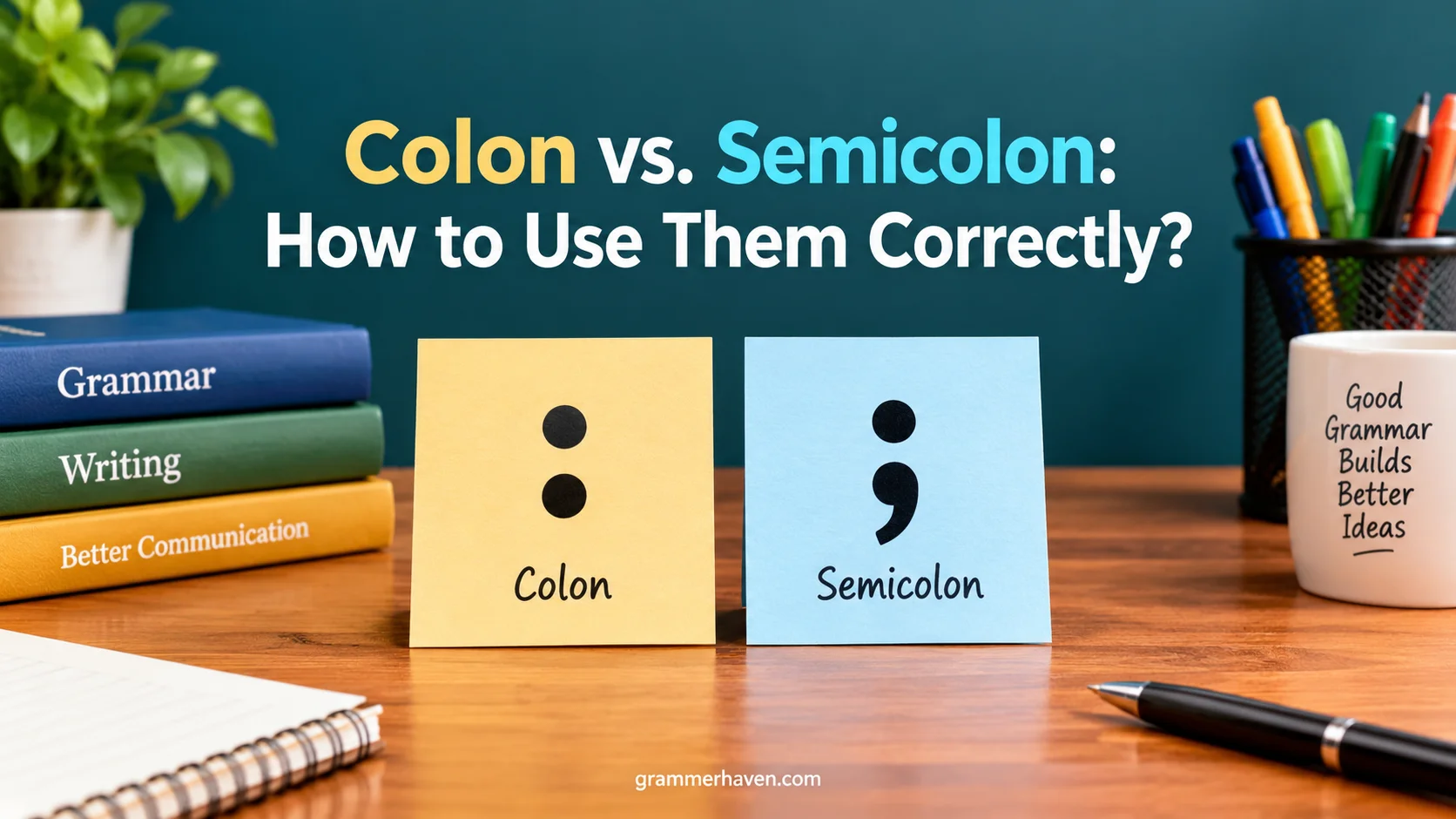
Colon vs. Semicolon helps you distinguish two punctuation marks that connect ideas but perform different jobs in a sentence. A colon creates a pause before an explanation, list, example, specification, or quotation. A semicolon creates a stronger connection between independent clauses and closely related thoughts.
These rules help you understand when to use each punctuation mark. The colon tells the reader that specific information follows; the semicolon joins complete thoughts. Their similarity can confuse experienced writers, especially when both marks appear within a single sentence. The usage becomes clearer when you examine the difference between introducing information and joining complete sentences.
A colon can introduce a series, complicated items, an example, or an explanation. A semicolon can separate independent clauses when the ideas share a close connection. A comma cannot perform the same job in every case. The right mark improves clarity, precision, and punctuation precision in academic writing and professional communication. A practical decision framework asks whether the second part explains, specifies, or lists information, or whether it forms another complete thought. This framework gives you a useful guide for choosing the correct mark contextually. A simple example makes the distinction clear: “The document needs three things: accuracy, precision, and clarity.” Another sentence can show the semicolon: “The report was complete; the writer submitted it.”
Side-by-side examples make the approach easier to follow. The colon acts as a signal that something specific follows, while the semicolon shows a direct connection between complete thoughts. Purdue Writing Lab and the Writing Lab provide useful references when you need to check a particular rule. The basic principle remains simple: use a colon to introduce information and a semicolon to link or separate independent clauses. This distinction helps writers make accurate punctuation choices in professional and academic work.
Quick Answer: Colon vs. Semicolon
The simplest way to remember colon vs. semicolon is this:
- Use a colon (:) when the second part explains, introduces, identifies, or expands the first part.
- Use a semicolon (;) when you want to connect two closely related independent clauses.
- Use a semicolon to separate complex items in a list when those items already contain commas.
- A colon generally points forward.
- A semicolon generally links ideas side by side.
Compare These Examples
Colon: She had one goal: finish the project today.
The words after the colon explain what her goal was.
Semicolon: She had one goal; she wanted to finish the project today.
Here, two independent clauses sit beside each other. The semicolon emphasizes their close relationship.
Here’s another useful comparison:
| Punctuation | Main job | Example |
| Colon (:) | Introduces or explains | He needed three things: time, money, and patience. |
| Semicolon (;) | Connects related independent clauses | He needed more time; the deadline was approaching. |
| Semicolon (;) | Separates complex list items | We visited Dallas, Texas; Denver, Colorado; and Phoenix, Arizona. |
Think of the colon as an arrow pointing toward information that follows. Think of the semicolon as a bridge connecting two related thoughts.
What Is a Colon?
A colon is the punctuation mark :. It consists of two vertically aligned dots.
Its most useful grammatical function is to tell readers that the material following it develops or clarifies what came before it.
For example:
There was only one problem: nobody had the key.
The first part creates an expectation. The second part reveals the problem.
That forward-looking quality is the colon’s defining feature.
When to Use a Colon
You can use a colon in several important situations.
Use a Colon to Introduce a List
One of the most familiar uses of a colon is introducing a list.
You need four things: a notebook, a pen, a charger, and patience.
The phrase “four things” prepares the reader for the information that follows.
The colon works because the material before it forms a suitable grammatical introduction.
However, don’t insert a colon automatically before every list.
Incorrect:
You need: a notebook, a pen, and a charger.
Better:
You need a notebook, a pen, and a charger.
The colon shouldn’t separate a verb from its object simply because a list follows.
Use a Colon to Introduce an Explanation
A colon can introduce information that explains the statement before it.
The meeting ended early: the manager had another appointment.
The second clause explains why the meeting ended early.
This relationship makes the colon more appropriate than a semicolon.
Compare:
The meeting ended early; the manager had another appointment.
This version is grammatically possible, but the relationship feels more like two connected facts.
With the colon, the second clause feels like the answer to an implied question:
Why did the meeting end early?
The manager had another appointment.
That’s the colon’s sweet spot.
Use a Colon to Introduce an Example
A colon can also signal that an example is coming.
Some punctuation marks can connect ideas: the semicolon is one example.
The information after the colon illustrates the statement before it.
However, don’t assume that every phrase such as “for example” needs a semicolon. The grammatical structure determines the punctuation.
Chicago’s guidance specifically notes that semicolon use with expressions such as “that is” and “for example” depends on whether the material that follows forms an independent clause.
Use a Colon to Introduce a Quotation
A colon can introduce a quotation when the preceding material creates an appropriate introduction.
The editor offered one simple piece of advice: “Keep the sentence clear.”
The quotation provides the exact advice mentioned in the first part.
A colon also adds a little more emphasis than a comma or no punctuation in certain quotation structures. Chicago notes that punctuation before quotations can vary with context, but a colon is especially suitable when the quotation elaborates on or demonstrates the preceding material.
Use a Colon After “As Follows”
A colon commonly follows “as follows” when introducing information.
The instructions are as follows: read the passage, answer the questions, and review your answers.
You can sometimes rewrite such sentences with a period. Still, the colon remains a conventional choice after “as follows.”
Use a Colon to Introduce a Specific Statement
A colon can introduce a specific conclusion or statement that gives substance to the preceding words.
She knew exactly what she wanted: a fresh start.
The phrase “what she wanted” is completed by the specific information after the colon.
What Is a Semicolon?
A semicolon is the punctuation mark ;.
Its central function differs from the colon. Instead of introducing information that explains what came before, the semicolon usually connects two independent clauses that are closely related.
An independent clause can stand alone as a complete sentence.
For example:
The store was closing.
and
We hurried inside.
Both are complete sentences.
You can connect them with a semicolon:
The store was closing; we hurried inside.
The semicolon keeps the ideas together without using a coordinating conjunction such as and.
Purdue Writing Lab explains that semicolons signal the closeness of the relationship between independent clauses and can also clarify complex series containing internal commas.
When to Use a Semicolon
Use a Semicolon Between Closely Related Independent Clauses
This is the semicolon’s most important use.
The deadline is tomorrow; we still have three sections to finish.
Both sides can stand independently:
- The deadline is tomorrow.
- We still have three sections to finish.
Because the ideas are closely connected, the semicolon works naturally.
You could use a period:
The deadline is tomorrow. We still have three sections to finish.
That’s grammatically correct too. The difference is one of connection and rhythm.
The semicolon says, in effect, “These are separate thoughts, but keep them together.”
Use a Semicolon Before Conjunctive Adverbs
Words such as however, therefore, nevertheless, moreover, consequently, and otherwise can connect independent clauses.
For example:
The forecast looked terrible; however, the game continued.
The standard structure is:
Independent clause + semicolon + conjunctive adverb + comma + independent clause
Another example:
The first plan seemed practical; however, it would’ve cost too much.
Or:
The evidence was incomplete; therefore, the committee postponed its decision.
Don’t confuse conjunctive adverbs with coordinating conjunctions. Words such as and, but, for, nor, or, so, and yet follow different punctuation patterns.
Use Semicolons to Separate Complex List Items
This is another major reason writers use semicolons.
Suppose each item in a list already contains a comma:
The conference attracted speakers from Austin, Texas; Portland, Oregon; and Boston, Massachusetts.
Without semicolons, the boundaries between the cities and states could become difficult to see.
Semicolons act as larger separators.
The same principle works with more complicated items:
The project requires three stages: research, including interviews and surveys; testing, including field trials and revisions; and publication, including editing and design.
Here, the semicolons separate the major items while the commas operate inside those items.
Chicago’s current guidance emphasizes that semicolons can clarify genuinely complex series, but writers shouldn’t add them when ordinary commas already make the list clear.
That’s an important distinction.
Complexity justifies the semicolon. Complexity alone doesn’t demand it.
Use a Semicolon When a Sentence Contains “However”
This is one of the most common punctuation questions involving semicolons.
Correct:
The instructions looked simple; however, the final step caused problems.
Incorrect:
The instructions looked simple, however, the final step caused problems.
The second version creates a comma splice because two independent clauses are being joined incorrectly.
You can also rewrite the sentence:
The instructions looked simple. However, the final step caused problems.
Both versions work. The semicolon simply keeps the relationship tighter.
Colon vs. Semicolon: The Core Difference
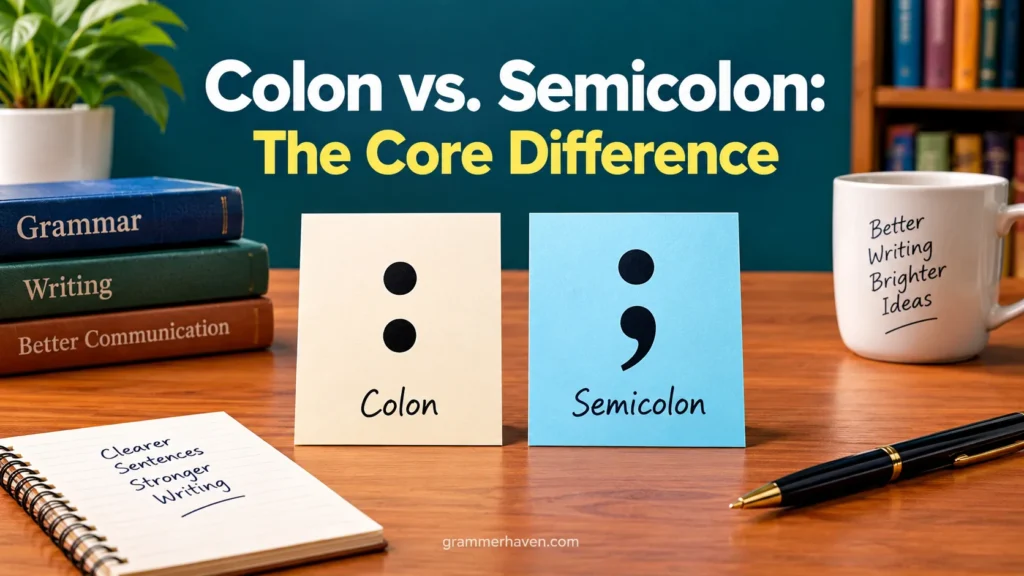
The most important distinction isn’t how long the pause feels.
It’s the relationship between the ideas.
A colon often creates this relationship:
Statement → explanation
A semicolon often creates this relationship:
Independent thought ↔ related independent thought
Consider these examples.
She had one concern: the deadline.
The second part identifies the concern.
Now compare:
She worried about the deadline; the project wasn’t finished.
The second clause is related, but it doesn’t simply identify the first clause.
A Simple Mental Model
| Think of the mark as… | Punctuation | What it does |
| An arrow | : | Points toward an explanation or expansion |
| A bridge | ; | Connects closely related independent clauses |
| A divider | ; | Separates complex list items |
| An announcement | : | Signals that something specific is coming |
This isn’t a substitute for grammar rules. It’s a practical shortcut that helps you make a decision quickly.
Colon vs. Semicolon Examples
Seeing the two marks side by side makes the distinction much clearer.
Example: List vs. Related Ideas
Colon:
I bought three things: bread, milk, and eggs.
Semicolon:
I bought the groceries; my sister picked up the drinks.
The colon introduces the contents of the list. The semicolon joins two related independent clauses.
Example: Explanation vs. Connection
Colon:
There was one problem: the computer crashed.
Semicolon:
The computer crashed; we lost the unsaved file.
In the first sentence, the second part identifies the problem. In the second, the clauses describe connected consequences.
Example: Specification vs. Independent Clause
Colon:
She wanted one thing: an honest answer.
Semicolon:
She wanted an honest answer; nobody would give her one.
The first sentence uses the second part to specify one thing. The second sentence connects two complete thoughts.
Can a Colon Join Two Complete Sentences?
Yes.
This point causes considerable confusion because many people learn that a colon introduces a list. That’s only one of its functions.
A colon can appear between independent clauses when the second clause explains, illustrates, or expands the first.
For example:
He knew what would happen next: the meeting would end early.
Both sides have substantial grammatical structure, but the relationship matters.
The second clause explains what “what would happen next” means.
Compare that with:
He knew the meeting would end early; everyone else was still waiting.
Here, the semicolon connects two related independent clauses.
Purdue’s punctuation guidance similarly describes a colon as a signal that the second part illustrates or explains the first, provided the grammatical structure supports that relationship.
Can You Use a Semicolon Before a List?
Yes, but there’s an important catch.
A semicolon can separate items within a complex list, but it generally doesn’t introduce the list itself.
Correct:
The finalists came from Miami, Florida; Chicago, Illinois; and Seattle, Washington.
Here, the semicolons divide the three locations.
The colon can introduce the entire series:
The finalists came from three cities: Miami, Florida; Chicago, Illinois; and Seattle, Washington.
Notice how each punctuation mark has a different job.
- Colon: introduces the list.
- Semicolons: separate the complex list items.
That’s a useful example of how the two marks can work together.
Colon vs. Semicolon With “However”
The word however deserves special attention because it frequently appears in incorrect punctuation.
Correct
The weather was terrible; however, the event continued.
Also Correct
The weather was terrible. However, the event continued.
Usually Incorrect
The weather was terrible, however, the event continued.
Why?
Because however it doesn’t function like the coordinating conjunction but in that sentence.
You can write:
The weather was terrible, but the event continued.
But when you use, however, between two independent clauses, the semicolon provides the necessary separation.
The basic pattern is:
Independent clause; however, independent clause.
Colon vs. Semicolon With “Therefore,” “For Example,” and “That Is”
These expressions can create confusion because punctuation depends on the structure around them.
With “Therefore”
The roads were flooded; therefore, the school closed.
Both sides contain independent clauses.
With “For Example”
Don’t automatically put a semicolon before for example.
Consider:
Many fruits contain potassium, for example, bananas and oranges.
The punctuation here depends on the sentence’s construction and style.
A semicolon becomes appropriate when the expression introduces another independent clause:
Many foods contain potassium; for example, bananas are a convenient source.
Chicago specifically notes that semicolons can appear before expressions such as “that is” when what follows forms an independent clause. It doesn’t recommend using semicolons merely because those phrases appear.
The takeaway is simple:
Don’t memorize punctuation based on one transition word. Examine the grammar.
Capitalization After a Colon
Should you capitalize the first word after a colon?
The answer depends partly on style guide and sentence structure.
This is an area where modern style guidance has changed.
The 18th edition of The Chicago Manual of Style, released in 2024, changed its rule so that the first letter of a complete sentence following a colon is now capitalized.
For example:
Please remember this: Always check your work.
However, if the material after the colon isn’t a complete sentence, lowercase may be appropriate:
She brought three things: a notebook, a pen, and a laptop.
Why You’ll See Different Answers Online
Different style guides don’t always make identical choices.
That means you may encounter:
The answer is simple: Use the semicolon here.
You may also encounter older material that follows a different capitalization convention.
For professional writing, follow the style guide required by your publication, school, employer, or client. Consistency matters.
Common Colon Mistakes
A colon can be powerful, but writers often place it where the sentence doesn’t need one.
Mistake: Putting a Colon Between a Verb and Its Object
Incorrect:
The three things you need are: patience, practice, and time.
Better:
The three things you need are patience, practice, and time.
The introductory phrase already works grammatically. The colon interrupts the structure.
Mistake: Adding a Colon After “Such As”
Incorrect:
You can use several tools, such as: dictionaries, style guides, and grammar books.
Better:
You can use several tools, such as dictionaries, style guides, and grammar books.
Such as already introduces examples.
Mistake: Using a Colon Just Because a List Follows
A list alone doesn’t automatically justify a colon.
Ask whether the words before the list create a complete and natural introduction.
If they don’t, rewrite the sentence rather than forcing punctuation into it.
Mistake: Using a Colon When a Semicolon Fits Better
Consider:
The deadline is close: we need to work faster.
This can work because the second clause explains the implication of the first.
But:
The deadline is close; we need to work faster.
Here, the semicolon presents two related facts without making the second clause explicitly explanatory.
Both can be grammatical. The intended relationship determines the better choice.
Common Semicolon Mistakes
Semicolons have their own collection of traps.
Mistake: Using a Semicolon Between a Dependent Clause and an Independent Clause
Incorrect:
Although the weather was bad; we continued the game.
The first part cannot stand alone.
Better:
Although the weather was bad, we continued the game.
Mistake: Treating the Semicolon Like a Fancy Comma
A semicolon isn’t simply a stronger comma.
Incorrect:
We bought apples; oranges; bananas; and grapes.
Better:
We bought apples, oranges, bananas, and grapes.
The list doesn’t contain internal complexity that requires semicolons.
Mistake: Using Semicolons When Commas Are Clearer
Chicago specifically cautions against unnecessary semicolons in simple series. If commas clearly separate the items, semicolons can actually make the sentence harder to read.
Good punctuation should reduce friction.
It shouldn’t create it.
Colon vs. Semicolon in Complex Lists
Complex lists deserve special attention because they’re one of the few situations where semicolons regularly appear alongside colons.
Consider:
The research team studied three groups: students from Boston, Massachusetts; teachers from Denver, Colorado; and parents from Austin, Texas.
The punctuation hierarchy is clear:
- Colon introduces the list.
- Commas separate city and state.
- Semicolons separate the larger list items.
That structure prevents punctuation from becoming a tangled mess.
Simple List
We visited Boston, Denver, and Austin.
Complex List
We visited Boston, Massachusetts; Denver, Colorado; and Austin, Texas.
The second sentence needs stronger internal boundaries.
Colon vs. Semicolon in Academic Writing
Academic writing often benefits from both marks because complex ideas need clear relationships.
A colon works well when you introduce:
- an explanation
- evidence
- a definition
- an example
- a list
- a conclusion
- a quotation
For example:
The study reached an important conclusion: sleep affects academic performance.
A semicolon works well when connecting related claims:
The sample was relatively small; the researchers therefore recommended further study.
The key isn’t to make academic prose sound formal for its own sake.
Use punctuation to expose the logic of your argument.
That makes difficult material easier to follow.
Colon vs. Semicolon in Business Writing
Professional writing benefits from the same principles.
Colon Example
The project has one immediate priority: completing the security review.
The colon draws attention to the priority.
Semicolon Example
The deadline is approaching; the development team needs final approval.
The semicolon links two related business facts.
You’ll also see colons frequently in:
- reports
- instructions
- agendas
- technical documents
- presentations
- formal announcements
Semicolons appear more often when a writer needs to connect related statements without breaking them into separate sentences.
Colon vs. Semicolon in Creative Writing
Punctuation also shapes voice and rhythm.
A semicolon can keep two thoughts moving together:
She wanted to leave; she couldn’t.
A colon can create anticipation:
She knew what she had to do: leave.
Those sentences don’t merely differ grammatically. They create different emotional effects.
The semicolon feels like tension between two connected realities.
The colon feels more like a revelation.
That’s why punctuation isn’t just mechanical. It influences how readers experience the sentence.
Chicago’s guidance also recognizes that semicolon use can sometimes involve editorial or stylistic judgment, particularly in creative writing.
Colon and Semicolon in Time, Ratios, Titles, and Other Uses
Not every colon or semicolon appears because of sentence structure.
The colon also has several specialized uses.
Time
The meeting starts at 8:30 a.m.
Ratios
The mixture uses a 2:1 ratio of water to concentrate.
Biblical References
John 3:16
Titles and Subtitles
Grammar Basics: A Practical Guide
These uses are conventions rather than examples of the colon’s sentence-level grammatical role.
A semicolon has fewer comparable specialized uses, which is another reason you shouldn’t think of the two marks as interchangeable.
Colon vs. Semicolon: A Practical Decision Guide
When you’re unsure, ask yourself a few quick questions.
Are You Introducing Something?
If you’re introducing a list, explanation, example, specification, or quotation, a colon may be appropriate.
She brought everything she needed: a laptop, charger, and notebook.
Are You Connecting Two Complete Thoughts?
If both sides can stand alone and the ideas are closely related, consider a semicolon.
She brought her laptop; she forgot the charger.
Are You Separating Complicated List Items?
If the individual items already contain commas, a semicolon can make the boundaries clearer.
The winners came from Tampa, Florida; Reno, Nevada; and Boise, Idaho.
Does the Second Part Explain the First?
A colon may be the stronger choice.
He had one concern: the cost.
Could a Period Work?
If you’re connecting independent clauses with a semicolon, try replacing it with a period.
If both versions work, choose based on the relationship and rhythm you want.
Colon vs. Semicolon Quick Reference
| Situation | Best choice | Example |
| Introduce a simple list | Colon | Bring three things: water, food, and a map. |
| Introduce an explanation | Colon | There was one issue: the cost. |
| Specify something previously mentioned | Colon | She wanted one thing: honesty. |
| Introduce a formal quotation | Colon | He gave one instruction: “Stay calm.” |
| Connect related independent clauses | Semicolon | It was late; we kept working. |
| Connect clauses with “however” | Semicolon | It was late; however, we continued. |
| Separate complex list items | Semicolon | Miami, FL; Dallas, TX; and Denver, CO |
| Separate simple list items | Comma | Miami, Dallas, and Denver |
| Separate unrelated sentences | Period | It was late. We went home. |
Colon vs. Semicolon: Real-World Case Study
Consider this sentence:
The company faced three problems: rising costs, declining sales, and staff shortages.
The colon works because it introduces the three problems.
Now imagine the items become more detailed:
The company faced three problems: rising costs, especially for shipping; declining sales, particularly in international markets; and staff shortages, mainly in customer support.
The semicolons now separate the three major problems. The commas remain inside each item.
This example shows why punctuation works like a visual map. Each mark tells the reader how pieces of information fit together.
Colon vs. Semicolon Practice
Try choosing the punctuation before checking the answers.
Questions
- She had one goal ___ finish before noon.
- The deadline was close ___ everyone worked late.
- The trip included Miami, Florida ___ Dallas, Texas ___ and Denver, Colorado.
- The plan looked promising ___ however, the budget was too small.
- He needed three things ___ time, money, and patience.
- There was only one explanation ___ the data had been entered incorrectly.
- The store was closing ___ we hurried inside.
- The instructions were simple ___ read, answer, and submit.
Answers
- Colon — It introduces the specific goal.
- Semicolon — Both sides are independent clauses.
- Semicolons — The list items contain internal commas.
- Semicolon — “However” connects two independent clauses.
- Colon — It introduces a list.
- Colon — It introduces an explanation.
- Semicolon — It connects two closely related independent clauses.
- Colon — It introduces a series of actions.
See also: Hi or Hello: Which Greeting Should You Use?
FAQs:
Is a colon stronger than a semicolon?
Not exactly.
They perform different grammatical jobs. A colon often creates anticipation or explanation, while a semicolon creates connection between related independent clauses.
Can a semicolon replace a colon?
Sometimes the sentence can remain grammatical, but the meaning or emphasis may change.
She had one problem: money.
The colon identifies the problem.
She had one problem; money was running out.
The semicolon connects two thoughts.
They’re not interchangeable simply because both create a strong pause.
Can a colon connect two independent clauses?
Yes.
A colon can connect independent clauses when the second clause explains, illustrates, or expands the first.
He knew the truth: nobody had checked the data.
Can you use a semicolon before “and”?
Yes, but it isn’t the normal choice for ordinary compound sentences.
Usually:
The rain stopped, and we went outside.
A semicolon can appear when the clauses are unusually long or contain internal punctuation:
The rain finally stopped after several hours of heavy storms; and the hikers, who had been waiting in the shelter, began their journey.
However, don’t use a semicolon simply to make a sentence look more formal.
Do you capitalize after a colon?
It depends on the style guide and grammatical structure.
Current Chicago Manual of Style 18th edition guidance capitalizes the first word of a complete sentence following a colon.
For publication, follow the style guide you’re using consistently.
Can a semicolon introduce a list?
Not normally.
The colon generally introduces the list:
We need three supplies: paper, ink, and envelopes.
The semicolon can then separate complex list items:
We need offices in Dallas, Texas; Denver, Colorado; and Phoenix, Arizona.
What’s the easiest way to remember colon vs. semicolon?
Remember this:
Colon = “Here comes the explanation.”
Semicolon = “These complete thoughts belong together.”
It’s a simple trick, but it works remarkably well.
Conclusion:
Understanding the difference between a colon and a semicolon makes your writing clearer and more precise. Use a colon to introduce an explanation, list, example, or other information that follows. Use a semicolon to connect closely related independent clauses. Once you understand what each punctuation mark signals, choosing the right one becomes much easier in academic writing, professional communication, and everyday sentences.