The phrase Is It Correct to Say “Aforementioned”? Meaning, Usage explains how this formal word works in modern English language and writing.
The History of the English language shows how every word we choose can paint a unique picture for the listener and reader. Strong language requires precision, proper language rules, and a clear message that matches the intended meaning. In the vast ocean of words, aforementioned can stand out because of its formal attire and old-school charm. It often appears in legal documents, academic papers, formal reports, and professional writings where writers want to refer to something already discussed. The use of English continues through language evolution, where context decides whether a word feels natural or outdated.
The aforementioned term has a formal tone and can create perfect harmony in modern writing when used properly. Although some people see it as an outdated fashion trend, a closer look reveals its intriguingly complex layers. Many writers keep questioning whether such formal words still belong in today’s communication style. The curiosity around this word grows because it can make writing sound polished, but when misused, it may confuse readers. Understanding its meaning, usage, and context helps you decide when it fits in emails, essays, contracts, and other forms of formal language.
From my experience with professional writing and communication, this phrase and expression work best when clarity and the right audience matter. Good word usage, vocabulary, grammar, and correctness improve your word choice, style, and overall writing quality. A useful guide helps you understand what aforementioned means, how to use it correctly, and how to avoid common mistakes through alternatives and style considerations.
What Does “Aforementioned” Mean?
The word “aforementioned” means previously mentioned or mentioned earlier in the text or conversation.
Writers use it to refer back to something they have already discussed.
Simple Definition
Aforementioned: Mentioned previously; referred to earlier.
For example:
- The aforementioned policy will take effect next month.
- Employees must comply with the aforementioned requirements.
- The aforementioned report was approved by management.
In each sentence, the word points back to something already introduced.
Origin of the Word
“Aforementioned” combines two older English elements:
- Afore = before
- Mentioned = referred to
Together, they literally mean:
“Mentioned before.”
The term has existed in English for centuries and became especially common in legal and official documents.
Why the Word Exists
Writers often need a way to avoid repeating the same noun repeatedly.
Consider this example:
The employment agreement was reviewed by legal counsel. The employment agreement was then approved by management.
That repetition feels clumsy.
Instead:
The employment agreement was reviewed by legal counsel. The aforementioned agreement was then approved by management. The aforementioned agreement became effective on January 1.
The second version reduces repetition, although some readers may still prefer a simpler alternative.
Quick Definition Table
| Term | Meaning | Example |
| Aforementioned | Mentioned earlier | The aforementioned policy remains active. |
| Previously mentioned | Mentioned before | The previously mentioned policy remains active. |
| Earlier | Mentioned earlier in the discussion | The earlier proposal was approved. |
| Referenced above | Mentioned above in writing | The referenced above document applies here. |
Is It Correct to Say “Aforementioned”?
Yes. “Aforementioned” is grammatically correct English.
Major dictionaries recognize it as a standard adjective.
You can confidently use it in formal writing without worrying about grammar errors.
Why Some People Think It Is Incorrect
Many people confuse correctness with style.
A sentence can be grammatically correct while still sounding awkward or overly formal.
For example:
The aforementioned information shall be reviewed by the aforementioned committee regarding the aforementioned proposal.
This sentence is technically correct.
It also sounds like it escaped from a legal document written decades ago.
That distinction matters.
Grammar vs. Readability
Good writing balances both:
| Factor | Aforementioned |
| Grammatically correct | Yes |
| Widely recognized | Yes |
| Suitable for formal writing | Yes |
| Suitable for casual conversation | Usually no |
| Most natural choice in modern writing | Not always |
The word itself isn’t wrong.
Its effectiveness depends on context.
When Is It Correct to Use “Aforementioned”?
The word works best in highly formal environments.
Legal Documents
Lawyers use “aforementioned” because legal writing often requires precision and consistency.
Examples:
- The aforementioned party agrees to the terms herein.
- The aforementioned provisions remain enforceable.
Government Documents
Government agencies frequently use formal terminology.
Examples include:
- Regulations
- Administrative notices
- Public policies
- Official reports
Academic Writing
Researchers occasionally use “aforementioned” when referring to earlier concepts.
Example:
The aforementioned theory supports the findings presented below.
Business Documentation
Formal reports and internal policies may also contain the word.
Examples:
- Compliance reports
- Employee handbooks
- Corporate policies
- Audit documents
When “Aforementioned” Sounds Unnatural
Although the word is correct, it often feels stiff in everyday communication.
Casual Conversation
Nobody naturally says:
Did you read the aforementioned text message?
Most people simply say:
Did you read that text message?
Blog Posts
Online readers prefer clear, conversational language.
Instead of:
The aforementioned techniques improve productivity.
Many writers would choose:
These techniques improve productivity.
Marketing Copy
Marketing relies on connection and clarity.
“Aforementioned” can create distance between the writer and reader.
Customer Communication
Customers generally appreciate straightforward language.
Compare these examples:
Formal
Please review the aforementioned instructions.
Natural
Please review the instructions above.
The second version feels more approachable.
How to Use “Aforementioned” Correctly in a Sentence
Most writers use the word as an adjective.
It typically appears before a noun.
Standard Pattern
The aforementioned + noun
Examples:
- The aforementioned agreement
- The aforementioned report
- The aforementioned policy
- The aforementioned employee
Correct Examples
- The aforementioned proposal received unanimous approval.
- We reviewed the aforementioned document.
- The aforementioned regulations remain in effect.
- The aforementioned findings support our conclusion.
Incorrect Examples
- The aforementioned was approved.
- We discussed aforementioned yesterday.
- Aforementioned completed the project.
The word usually needs a noun immediately after it.
Easy Formula
Use this structure:
The aforementioned + thing already mentioned
Examples:
- The aforementioned contract
- The aforementioned request
- The aforementioned issue
This formula works in almost every correct use case.
Common Mistakes When Using “Aforementioned”
Many writers misuse the word even when they understand its meaning.
Referring to Multiple Things at Once
Consider this example:
Sarah reviewed the report and the proposal. The aforementioned document was approved.
Which document?
The report?
The proposal?
Readers can’t tell.
Always make sure the reference is clear.
Using It Too Often
One appearance may sound professional.
Five appearances on one page can feel excessive.
For example:
The aforementioned policy applies to the aforementioned department. The aforementioned employees must follow the aforementioned procedures.
The repetition quickly becomes distracting.
Choosing Formality Over Clarity
Sometimes writers use “aforementioned” because it sounds sophisticated.
That’s rarely a good reason.
Strong writing prioritizes clarity over complexity.
Using It in Everyday Communication
Imagine receiving this text:
Please bring the aforementioned charger.
It sounds strangely formal.
Most people would simply write:
Please bring the charger.
Is “Aforementioned” Formal or Old-Fashioned?
This question sparks a surprising amount of debate.
The answer is nuanced.
It Is Formal
Nobody disputes that.
The word belongs to formal English.
It appears most often in:
- Contracts
- Legal filings
- Government publications
- Academic papers
- Policy manuals
It Is Not Obsolete
Some people assume the word is outdated.
That’s not true.
Professional writers still use it regularly.
You can find thousands of recent examples in modern legal and corporate documents.
Why It Feels Old-Fashioned
Modern writing trends have changed dramatically.
Readers today prefer:
- Simplicity
- Clarity
- Direct language
- Shorter sentences
As a result, words like “aforementioned” can sound heavier than necessary.
The Plain-Language Movement
Many organizations now encourage plain-language writing.
The goal is simple:
Write so readers understand information quickly.
Under this philosophy, simpler alternatives often outperform “aforementioned.”
Better Alternatives to “Aforementioned”
In many situations, another phrase works better.
Common Alternatives
- Previously mentioned
- Mentioned earlier
- Discussed above
- Referenced above
- Earlier
- Noted earlier
Simple Alternatives
Often you don’t need a replacement at all.
You can use:
- This
- That
- These
- Those
Examples:
Instead of:
The aforementioned findings suggest improvement.
Use:
These findings suggest improvement.
The sentence becomes shorter and easier to read.
Professional Alternatives
Business writers often prefer:
- Identified
- Listed
- Referenced
- Specified
- Noted
Examples:
- The specified requirements
- The listed conditions
- The referenced policy
Comparison Table: Aforementioned vs. Alternatives
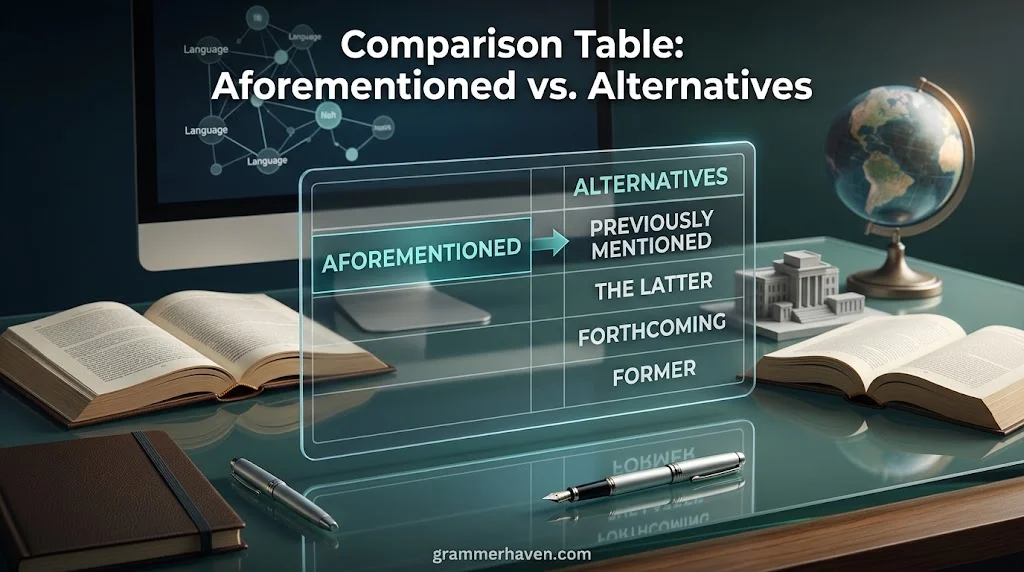
| Expression | Formality | Readability | Best Use |
| Aforementioned | Very High | Moderate | Legal and official writing |
| Previously mentioned | High | High | Professional writing |
| Mentioned above | Medium | High | Articles and reports |
| Earlier | Medium | Very High | General writing |
| This | Low | Very High | Everyday communication |
| These | Low | Very High | Blogs and web content |
For most online content, “this” or “these” often provide the strongest readability.
“Aforementioned” vs. Similar Words
Many expressions perform the same job.
However, subtle differences exist.
Aforementioned vs. Previously Mentioned
Meaning:
- Nearly identical
Tone:
- “Aforementioned” sounds more formal.
- “Previously mentioned” sounds more natural.
Example:
The aforementioned policy remains active.
vs.
The previously mentioned policy remains active.
Most modern readers prefer the second version.
Aforementioned vs. Above-Mentioned
Both refer to something already introduced.
However:
- “Aforementioned” appears more frequently in legal writing.
- “Above-mentioned” appears more often in administrative writing.
Both remain correct.
Aforementioned vs. Said
Legal documents often use “said.”
Example:
Said property shall remain under the owner’s control.
Historically, lawyers used “said” instead of repeating nouns.
Today, many legal professionals consider both “said” and “aforementioned” unnecessarily formal.
Aforementioned vs. Referenced
“Referenced” implies an explicit citation or mention.
“Aforementioned” simply indicates prior mention.
The meanings overlap but aren’t identical.
Real-World Examples of “Aforementioned”
Let’s examine how professionals actually use the word.
Legal Example
The aforementioned parties agree to arbitration in accordance with state law.
Why it works:
- Formal setting
- Precise reference
- Consistent terminology
Corporate Example
The aforementioned findings were presented to senior leadership.
Why it works:
- Internal reporting context
- Professional tone
Academic Example
The aforementioned studies demonstrate similar outcomes.
Why it works:
- References earlier research
- Avoids repeating study titles
Regulatory Example
The aforementioned provisions remain effective until amended.
Why it works:
- Official documentation
- Formal administrative language
Case Study: Rewriting “Aforementioned” for Better Readability
Consider this paragraph:
Original Version
The aforementioned report identified several risks. The aforementioned recommendations were subsequently approved.
This version feels repetitive.
Improved Version
The report identified several risks. Management later approved the recommendations. The committee then implemented the changes.
Notice what happened.
The revised version:
- Uses fewer words
- Reads faster
- Sounds more natural
- Maintains the same meaning
This example illustrates an important lesson:
Correct writing is not always effective writing.
What Professional Editors Usually Recommend
Editors increasingly favor direct language.
Many editing teams follow a simple rule:
If a simpler phrase communicates the same meaning, choose the simpler phrase.
That doesn’t mean “aforementioned” is wrong.
It simply means there may be a better option.
Common Editor Preferences
Instead of:
- Aforementioned
Editors often choose:
- Earlier
- Previously mentioned
- This
- These
- That
- Those
These alternatives reduce complexity without sacrificing accuracy.
Should You Use “Aforementioned” in Modern Writing?
The answer depends entirely on your audience.
Use It When Writing
- Contracts
- Legal agreements
- Regulatory documents
- Academic papers
- Government reports
- Formal policies
Avoid It When Writing
- Blog posts
- Website content
- Marketing materials
- Product descriptions
- Social media posts
- Customer support emails
Quick Decision Guide
| Situation | Use Aforementioned? |
| Legal contract | Yes |
| Academic paper | Usually |
| Government report | Yes |
| Business policy | Often |
| Blog article | Rarely |
| Marketing copy | No |
| Social media post | No |
| Friendly email | No |
See also: Later or Later On? What Is the Difference?
FAQs:
1. Is it correct to say “aforementioned”?
Yes, “aforementioned” is a correct English word. It is used to refer to something that has already been mentioned earlier in a document, conversation, or written text.
2. What does “aforementioned” mean?
“Aforementioned” means “mentioned before” or “previously stated.” It points back to a person, thing, idea, or statement that appeared earlier.
3. Where is the word “aforementioned” commonly used?
The word is commonly found in legal documents, academic papers, contracts, official reports, and formal writing. It is less common in casual conversations.
4. Can I use “aforementioned” in everyday writing?
You can, but it may sound overly formal. In everyday writing, phrases like “mentioned earlier,” “previously discussed,” or “the above” are often clearer and more natural.
5. What are some alternatives to “aforementioned”?
Common alternatives include previously mentioned, stated earlier, the above-mentioned, noted before, and mentioned above. The best choice depends on the tone and context of your writing.
Conclusion:
Using “aforementioned” is correct when you want to refer to something already mentioned in a formal context. It works well in legal documents, academic papers, contracts, and professional writing where precision matters. However, in everyday conversations and casual writing, simpler alternatives like “mentioned earlier,” “previously stated,” or “the above” often sound more natural. Understanding its meaning, usage, and context helps you decide when this formal word improves your writing and when it may feel unnecessary or too stiff.
Latest Post:
- Result In or Result To: Which Is Correct? (With Examples)
- A Dime a Dozen: Meaning, Definition, Origin and Real-Life Usage
- Hooplehead Definition, Meaning, Usage and Examples
- Whole vs Hole: What’s the Difference?
- Acumen vs Acuity vs Acuteness: What’s the Difference?