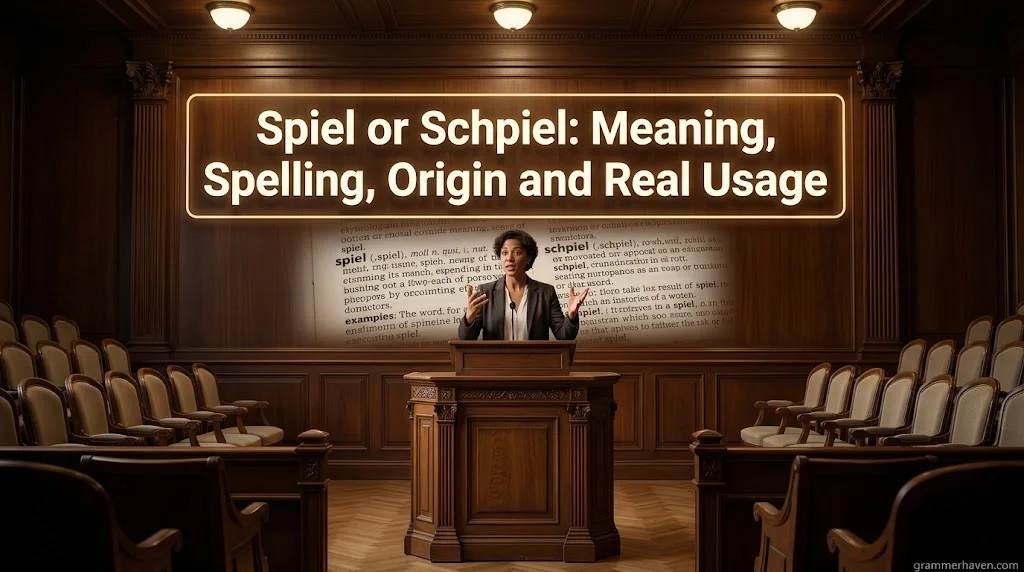
Spiel or Schpiel – Meaning, Spelling, Origin explains why these words are easily confused and how their similar sound creates confusion in usage. Without making the topic feel like boring jargon, this term takes a leisurely stroll through its origin, correct spelling, practical usage, and examples. In the English language, schpiel and spiel create confusion because people often use them in day-to-day conversation without knowing the essential rules behind their meaning.
The definition of spiel refers to a length or dragged-out speech where someone explains something from one side. A salesperson pitching products or services may deliver a spiel, and a teacher giving a speech can also use the term when an explanation becomes a longer-than-needed message. Spiel is the common word and the official word in the English language, while schpiel has the exact same meaning but remains a less common form.
The origin of schpiel connects to a Yiddish word, which is why some people question its correct spelling. Both terms share the same idea, but spiel remains the standard choice in writing. Understanding these spelling differences helps you choose the right word and avoid unnecessary confusion. Example 1 shows how the term can work naturally in everyday communication.
Spiel or Schpiel – Meaning, Spelling, Origin, and Why It Matters in English Today
At its core, spiel (or schpiel) refers to a long, often rehearsed piece of speech. It usually sounds persuasive, slightly repetitive, and sometimes a bit “too polished.”
You’ve definitely heard one before.
- A salesman explaining a product for 10 minutes
- A friend repeating the same story with full dramatic flair
- A politician delivering a carefully crafted message
That’s a spiel.
But here’s the twist: not all spiels feel the same. Some sound professional. Others sound annoying. A few even feel funny or theatrical.
That’s why understanding this word matters more than you think.
What “Spiel” Actually Means in Real English Usage

Let’s strip away confusion first.
A spiel is:
- A long or fluent speech
- Often repeated or rehearsed
- Used to persuade, explain, or entertain
It can be neutral, positive, or slightly negative depending on tone.
Simple definition
A spiel is a prepared or flowing speech that feels practiced or persuasive.
Everyday examples
- “The salesman gave his usual spiel about discounts.”
- “She launched into a long spiel about why the plan would work.”
- “I’ve heard his political spiel before.”
Key idea
A spiel is not just talking.
It’s talking that feels structured, practiced, or slightly “performed.”
Is It “Spiel” or “Schpiel”? Clearing the Spelling Confusion
Here’s where most people get stuck.
Correct spelling: SPIEL
This is the standard, dictionary-accepted form used in:
- American English
- British English
- Academic writing
- Journalism
Schpiel: informal variant
“Schpiel” shows up in:
- Casual writing
- Social media
- Phonetic spelling attempts
- Informal speech transcription
It reflects how some people hear the word, especially due to Yiddish pronunciation influence.
Clear takeaway
- Spiel = correct standard English
- Schpiel = informal, nonstandard spelling
If you’re writing anything professional, stick with spiel.
Origin of “Spiel” – A Word with Cultural Layers
This word didn’t just appear randomly in English. It traveled.
Step 1: German origin
The word comes from German “Spiel,” meaning:
- play
- game
- performance
Step 2: Yiddish influence
Yiddish-speaking communities adapted and carried similar sounding forms into American English, especially in urban centers.
Step 3: English adaptation
Over time, English speakers shifted the meaning away from “play” toward:
- persuasive speech
- sales talk
- rehearsed explanation
Modern meaning shift
| Stage | Meaning |
| German | Play / game |
| Yiddish influence | Performance / talk |
| English usage | Rehearsed or persuasive speech |
So when you hear “spiel” today, you’re hearing a word that evolved across languages and cultures.
Modern Meaning of “Spiel” in Today’s English
Today, “spiel” has nothing to do with games.
Instead, it usually refers to:
- Sales pitches
- Repeated explanations
- Persuasive talking
- Structured storytelling
Where you’ll hear it most
- Sales conversations
- Business meetings
- Political discussions
- Everyday informal speech
Real-world example
A real estate agent might say:
“Let me give you the full spiel about this property.”
That usually means a polished, rehearsed explanation about features, benefits, and pricing.
Tone and Connotation: Why “Spiel” Feels Different Each Time

Here’s something interesting: spiel doesn’t have a fixed emotional tone.
It changes depending on context.
Neutral tone
- “He gave his spiel about the project.”
- Means: just a normal explanation
Negative tone
- “I don’t need your sales spiel.”
- Means: overly long or annoying talk
Playful tone
- “Here comes your health spiel again.”
- Means: joking about repetition
Insight
The word doesn’t carry meaning alone. It carries attitude.
That’s why people sometimes misunderstand it.
Where “Spiel” Shows Up in Real Life
Let’s make this practical.
Sales and marketing
This is the most common environment.
Example:
“The car dealer gave a 20-minute spiel about fuel efficiency.”
Sales spiels are often scripted or semi-scripted. Companies even train employees on them.
Everyday conversation
People use it casually when someone talks too much.
Example:
“Don’t start your fitness spiel again, I already get it.”
Politics and media
Politicians often deliver structured messaging that gets labeled as a “spiel.”
Example:
“The candidate repeated his economic spiel during the debate.”
Entertainment
Characters in movies or shows often use exaggerated or rehearsed speech that viewers recognize as a spiel.
Common Mistakes People Make with “Spiel”
Even native speakers get this wrong sometimes.
Mistake 1: Thinking it always means lying
❌ “A spiel is always dishonest.”
✔ Reality: It can be truthful but still feel rehearsed.
Mistake 2: Overusing “schpiel” in writing
❌ “He gave his schpiel.”
✔ Better: “He gave his spiel.”
Mistake 3: Treating it like a formal speech
❌ “The president delivered a spiel.”
✔ Better alternatives:
- speech
- address
- statement
“Spiel” is informal, not ceremonial.
Spiel vs Similar Words: What Makes It Unique
Let’s compare it with similar words.
| Word | Meaning | Tone | Usage |
| Spiel | Rehearsed or persuasive talk | Neutral to negative | Casual/business slang |
| Pitch | Sales presentation | Professional | Business |
| Speech | Formal address | Neutral/formal | Public speaking |
| Rant | Emotional, uncontrolled talk | Negative | Informal criticism |
Key insight
A spiel sits between speech and pitch, but feels less formal and more repetitive.
Grammar and Natural Usage Patterns
English speakers don’t just use words randomly. They form patterns.
Common phrases with “spiel”
- give a spiel
- launch into a spiel
- go into a spiel
- deliver a spiel
Less natural phrases
- ❌ “make a spiel”
- ❌ “perform a spiel”
Example usage
- “He launched into his usual spiel about saving money.”
- “She gave a quick spiel before the presentation.”
These patterns matter more than strict grammar rules.
Where “Spiel” Is Most Commonly Used in the World
Geographic usage
- United States: very common
- Canada: common in casual speech
- UK: understood but less frequent
- Australia: used, especially in informal contexts
Why the US leads usage
American English developed strong ties to:
- marketing culture
- sales-driven communication
- media slang
That made “spiel” a natural fit.
Real-World Case Studies: How “Spiel” Works in Practice

Case Study 1: Sales training scenario
A telecom company trains employees with scripted messaging.
- Employee A repeats product benefits daily
- Customers recognize the repetition
- One customer says:
“I’ve heard this whole spiel before.”
👉 Here, “spiel” means rehearsed persuasion.
Case Study 2: Classroom discussion
A teacher explains climate change.
- Student hears repeated explanation
- Student comments:
“We already know this spiel.”
👉 Here, tone becomes mildly critical.
Case Study 3: Political debate
A candidate repeats campaign promises.
- Media labels it as “familiar spiel”
- Audience sees it as repetitive messaging
👉 Here, it signals skepticism.
Why “Spiel” Became So Popular in Modern English
Three major forces pushed the word into everyday speech:
1. Sales culture growth
Modern economies rely heavily on persuasion:
- ads
- pitches
- marketing scripts
Spiel fits perfectly.
2. Media and pop culture
Movies and TV shows frequently portray:
- salespeople
- hustlers
- persuasive speakers
These characters often “deliver a spiel.”
3. Informal American slang
American English tends to shorten and simplify expressive language. “Spiel” became a compact way to say:
“long, rehearsed talk”
Quick Memory Trick to Remember “Spiel”
Here’s a simple way to lock it in:
Spiel = Speech you’ve heard before
Or even shorter:
If it sounds rehearsed, it’s a spiel.
See also: Deduce vs Induce: What’s the Difference?
FAQs:
1. Is spiel or schpiel the correct spelling?
Both spiel and schpiel are used, but spiel is the standard and more widely accepted spelling in the English language. Schpiel is a less common variation influenced by its Yiddish word origin.
2. What does the word spiel mean?
A spiel means a long, often repeated, or prepared explanation, speech, or presentation. A salesperson giving a product pitch or someone explaining an idea in detail may deliver a spiel.
3. Is schpiel an official English word?
Schpiel is recognized and understood by many English speakers, but it is not as commonly considered an official standard English spelling. It mainly appears because of its Yiddish influence.
4. Are spiel and schpiel pronounced the same?
Yes, spiel and schpiel usually have the same pronunciation and nearly identical meaning. The main difference is their spelling and usage frequency.
5. When should I use spiel instead of schpiel?
You should use spiel in formal writing, professional communication, and general English usage because it is the more common and accepted form. Use schpiel only when you specifically want to reflect its Yiddish origin or informal style.
Conclusion:
Understanding Spiel or Schpiel – Meaning, Spelling, Origin helps clear up a common spelling confusion in the English language. Both words have the same meaning and refer to a long explanation, speech, or sales pitch, but spiel is the more accepted and common word in modern writing. Schpiel comes from a Yiddish word and still appears in casual conversations, but it is considered less common. Knowing the difference allows you to use the correct spelling confidently in everyday communication.
Latest Post:
- Result In or Result To: Which Is Correct? (With Examples)
- A Dime a Dozen: Meaning, Definition, Origin and Real-Life Usage
- Hooplehead Definition, Meaning, Usage and Examples
- Whole vs Hole: What’s the Difference?
- Acumen vs Acuity vs Acuteness: What’s the Difference?