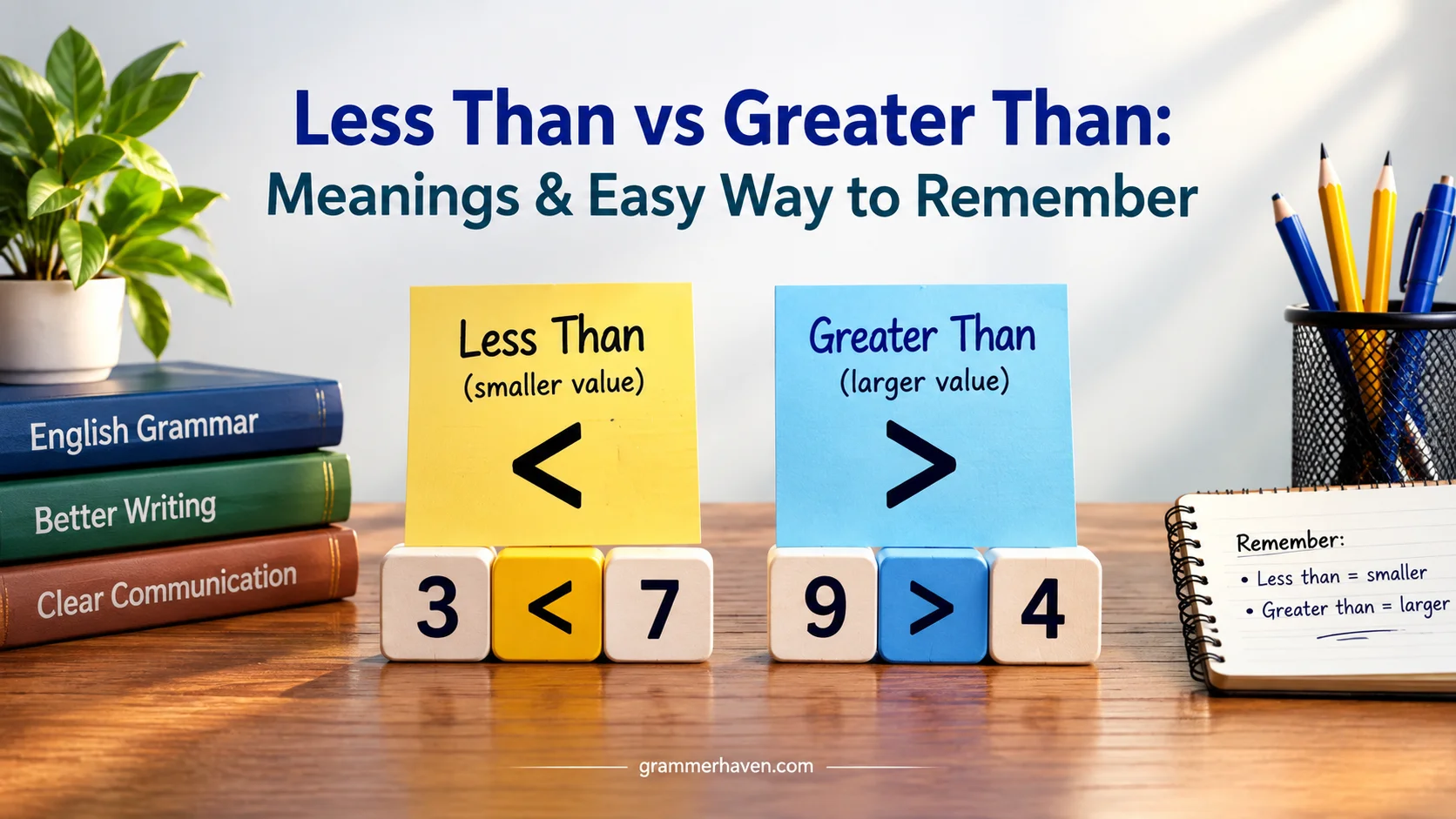
Less Than vs Greater Than becomes easier when you connect each symbol to a number’s position, size, and relationship instead of memorizing rules. In math, < shows that one value is smaller than another, while > shows that one value is larger. When comparing numbers, the number line gives a clear picture: numbers farther to the left are smaller, and numbers farther to the right are larger. This relationship also applies to negative numbers, where position shows the difference between values. This visual language can make the rule easier to remember.
A student, writer, or English learner may see less than and greater than in word problems, expressions, writing, and grammar. Understanding how to use these forms correctly matters, especially when the symbols seem confusing. In solving inequalities, you can translate the symbols into words and identify the greater values and smaller values. The sideways arrows offer a quick visual language clue: the pointed side faces the smaller amount, while the open side faces the larger amount. Comparing, translating, and solve tasks become easier with practice.
If you have paused and wondered about a tiny difference between two numbers, you are not alone. Mistakes can happen when you rush, yet simple examples and simple tricks can reduce hesitation. When solving inequalities or checking a clear grammar expression in English, remember what each symbol represents and compare both sides. The guide becomes practical when you stay confident and check the difference between smaller and larger values. A learner can avoid a mistake by using the number line, checking the relationship, and applying the symbols with care.
Quick Answer: Less Than vs Greater Than
< means “less than.”
> means “greater than.”
For example:
- 3 < 8 means 3 is less than 8.
- 8 > 3 means 8 is greater than 3.
- 5 = 5 means both values are equal.
Here’s the easiest visual rule:
The open side faces the larger number, while the pointed side faces the smaller number.
So:
2 < 9
The wide opening faces 9 because 9 is larger.
Reverse the comparison:
9 > 2
The same relationship remains true. Only the order of the numbers has changed.
| Symbol | Meaning | Example | Read it as |
| < | Less than | 4 < 9 | 4 is less than 9 |
| > | Greater than | 9 > 4 | 9 is greater than 4 |
| = | Equal to | 6 = 6 | 6 equals 6 |
| ≤ | Less than or equal to | x ≤ 10 | x is less than or equal to 10 |
| ≥ | Greater than or equal to | x ≥ 10 | x is greater than or equal to 10 |
| ≠ | Not equal to | 7 ≠ 5 | 7 isn’t equal to 5 |
These comparison symbols form the foundation of inequalities and appear throughout elementary mathematics, algebra, statistics, and other quantitative subjects.
What Does Less Than Mean in Math?
Less than tells you that one value has a smaller numerical value than another.
The symbol is <.
For example:
4 < 10
Read this as:
“Four is less than ten.”
The comparison doesn’t mean that 4 and 10 are merely different. It specifically tells you that 4 has the smaller value.
Consider a few more examples:
- 2 < 7
- 15 < 20
- 0 < 6
- 0.4 < 0.9
- -8 < -3
That final example matters because negative numbers often trip people up. On a number line, -8 sits to the left of -3. Therefore, -8 is less than -3.
How to Recognize a Less-Than Statement
When you see:
a < b
you know that a has a smaller value than b.
The comparison works in either direction when you rewrite it correctly:
3 < 9
is equivalent to:
9 > 3
Both statements communicate the same relationship from opposite directions.
What Does Greater Than Mean?
Greater than tells you that one value has a larger numerical value than another.
The symbol is >.
For example:
12 > 5
means:
“Twelve is greater than five.”
You can use the symbol with whole numbers, decimals, fractions, negative numbers, variables, and many other mathematical expressions.
Examples include:
- 10 > 3
- 25 > 17
- 0.8 > 0.5
- 7/8 > 3/8
- -2 > -9
The last example may look strange at first. After all, 9 appears larger than 2. But the negative signs change the comparison.
On a number line, -2 is farther to the right than -9. Therefore, -2 is greater than -9.
Less Than vs Greater Than Symbols Explained
The two symbols are opposites:
- < = less than
- > = greater than
Their shape provides a useful visual clue.
Think of the symbol as having two sides:
- The point faces the smaller value.
- The wide opening faces the larger value.
For example:
5 < 13
The point faces 5.
The opening faces 13.
Reverse the numbers:
13 > 5
The point still faces 5.
The opening still faces 13.
That’s the important idea. The open side doesn’t automatically mean “greater than” just because it looks wider. The entire comparison determines what the symbol means.
A Simple Way to Remember < and >
Try this rule:
Small point, small number. Wide opening, large number.
So if you compare 4 and 11:
4 < 11
The point touches 4.
If you compare 11 and 4:
11 > 4
The point still faces 4.
This visual approach is often more reliable than trying to memorize the symbols separately.
The Alligator Trick for Less Than and Greater Than
Many students learn the alligator or crocodile trick:
The alligator’s mouth always opens toward the larger number.
For example:
3 < 8
Imagine the symbol as a hungry crocodile. Its mouth opens toward 8 because 8 is larger.
Then:
8 > 3
The mouth still opens toward 8.
This mnemonic can help beginners, especially children who are just learning comparison symbols. However, it shouldn’t become your only method. If the numbers become negative, fractional, or algebraic, understanding the actual relationship matters more than remembering an animal.
The Number Line Makes Less Than and Greater Than Easier
When you’re unsure about a comparison, use a number line.
A number line gives you a reliable visual rule:
Numbers farther right are greater. Numbers farther left are less.
For example:
-5 — -4 — -3 — -2 — -1 — 0 — 1 — 2 — 3
From this line:
- -5 is less than -2.
- -2 is less than 1.
- 3 is greater than 0.
- 2 is greater than -3.
You can write those comparisons as:
-5 < -2
-2 < 1
3 > 0
2 > -3
This method works particularly well with negative numbers because the visual position immediately reveals the relationship.
Less Than vs Greater Than With Negative Numbers
Negative numbers create one of the most common comparison mistakes.
Here’s the key rule:
On a number line, the number farther to the right is always greater.
That means:
-2 > -8
Even though 8 is larger than 2, the negative values reverse the intuitive comparison.
Think about temperature.
Suppose one city has a temperature of -2°F, while another has a temperature of -8°F.
The city at -2°F is warmer.
Therefore:
-2°F > -8°F
Likewise:
-8°F < -2°F
The same principle applies to money. If one person owes $8 and another owes $2, representing the debts as -8 and -2 gives:
-8 < -2
A larger negative debt represents a smaller numerical value.
Comparing Positive and Negative Numbers
Positive numbers are always greater than negative numbers.
For example:
- 5 > -5
- 12 > -1
- 0 > -7
- -3 < 4
Zero sits between negative and positive values on the number line.
So:
negative numbers < 0 < positive numbers
This simple structure resolves many comparisons immediately.
Less Than vs Greater Than With Decimals
Decimals require you to compare place values carefully.
Consider:
0.7 and 0.65
At first glance, 65 looks larger than 7. However, the decimal places matter.
Write 0.7 as:
0.70
Now compare:
0.70 > 0.65
Therefore:
0.7 > 0.65
Trailing zeros don’t change a decimal’s value. They simply make the place values easier to compare.
More Decimal Examples
- 0.25 < 0.5
- 1.8 > 1.25
- 3.14 < 3.41
- 5.60 > 5.06
- 7.125 < 7.2
When comparing decimals, work from left to right. Compare the whole-number part first. If those values match, compare the tenths, hundredths, thousandths, and so on.
Less Than vs Greater Than With Fractions
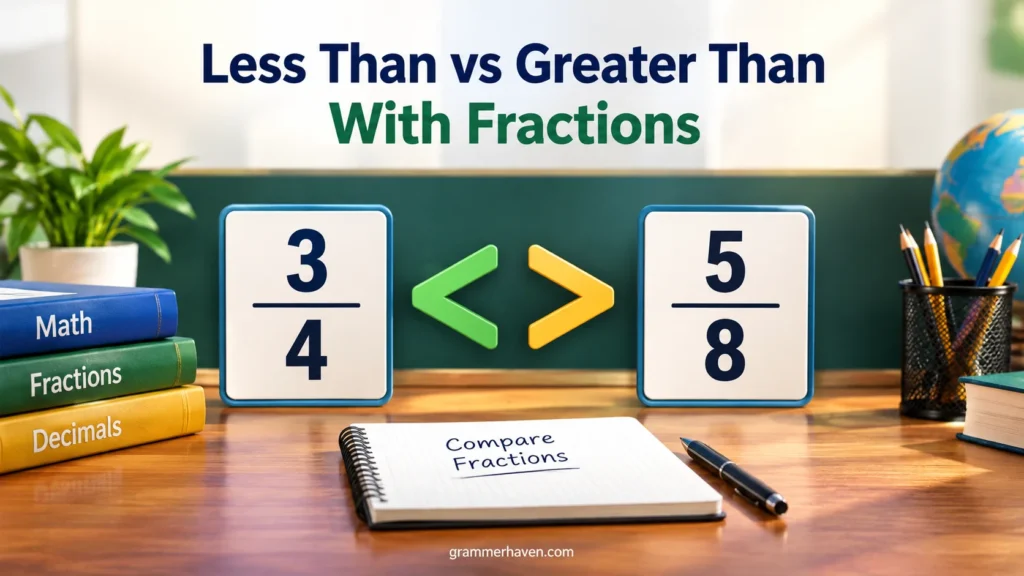
Fractions can be trickier because the numerator and denominator work together to determine the value.
For fractions with the same denominator, compare the numerators:
3/8 < 5/8
Because 3 eighths is less than 5 eighths.
However, different denominators require more care.
Consider:
3/4 and 2/3
Convert them to decimals:
- 3/4 = 0.75
- 2/3 ≈ 0.667
Therefore:
3/4 > 2/3
You can also use cross multiplication.
Compare:
3/4 and 2/3
Multiply diagonally:
- 3 × 3 = 9
- 2 × 4 = 8
Since 9 > 8:
3/4 > 2/3
Fraction Comparison Quick Guide
| Situation | Useful method |
| Same denominator | Compare numerators |
| Same numerator | Compare denominators carefully |
| Different denominators | Cross multiplication |
| Easy decimal conversion | Convert to decimals |
| Visual learners | Use a fraction number line |
Less Than and Greater Than With Variables
The symbols become even more important once you enter algebra.
Instead of comparing two known numbers, you might compare an unknown variable with a known value.
For example:
x < 10
This doesn’t say that x equals one specific number.
Instead, it says x can be any value less than 10.
Depending on the number system you’re using, possible values could include:
- 9
- 5
- 0
- -3
- -100
Likewise:
x > 10
means x can be any value greater than 10.
Possible values include:
- 11
- 15
- 25
- 100
This distinction separates inequalities from equations. An equation such as x = 10 identifies one value. An inequality such as x > 10 describes a range of possible values.
Less Than or Equal To vs Less Than
The symbol ≤ means less than or equal to.
That’s different from plain less than.
Compare:
x < 10
with:
x ≤ 10
In the first statement, 10 isn’t included.
In the second, 10 is included.
For example:
9 < 10 is true.
10 < 10 is false.
But:
10 ≤ 10 is true.
That tiny horizontal line changes the meaning.
Greater Than or Equal To vs Greater Than
The same principle applies to ≥.
x > 5 means x must be greater than 5.
x ≥ 5 means x can be greater than 5 or exactly 5.
Therefore:
- 6 ≥ 5 → true
- 5 ≥ 5 → true
- 4 ≥ 5 → false
Here’s the complete comparison:
| Symbol | Meaning | Is equality included? |
| < | Less than | No |
| ≤ | Less than or equal to | Yes |
| > | Greater than | No |
| ≥ | Greater than or equal to | Yes |
Less Than vs Greater Than in Word Problems
Math problems often hide the symbols inside ordinary language.
You need to translate the wording into a mathematical relationship.
Common phrases meaning less than
- less than
- fewer than
- below
- under
- smaller than
Example:
A class has fewer than 30 students.
If s represents the number of students:
s < 30
Common phrases meaning greater than
- greater than
- more than
- above
- over
- larger than
Example:
A runner needs more than 10 miles of training.
If m represents miles:
m > 10
Phrases involving equality
Some phrases include the boundary value:
- at least → ≥
- at most → ≤
- no more than → ≤
- no fewer than → ≥
For example:
A ticket must cost at least $20.
Mathematically:
price ≥ $20
The ticket can cost $20. It can also cost more.
A Common Trap: “Five Less Than x”
English word order can cause a subtle algebra mistake.
Consider:
Five less than x
This means:
x – 5
It does not mean:
5 – x
Now compare that with:
x is less than 5
That means:
x < 5
These statements look similar in English, but they describe completely different mathematical ideas.
Compare the Two
| Phrase | Mathematical meaning |
| Five less than x | x – 5 |
| x is less than five | x < 5 |
| Five greater than x | x + 5 |
| x is greater than five | x > 5 |
When translating word problems, focus on the relationship rather than blindly following the order of the words.
Less Than vs Greater Than in Algebraic Inequalities
Inequalities follow many of the same rules as equations. However, there’s one crucial exception:
When you multiply or divide both sides of an inequality by a negative number, reverse the inequality sign.
For example:
-2x > 8
Divide both sides by -2.
Because you’re dividing by a negative number, reverse > to <:
x < -4
This isn’t an arbitrary classroom rule. Multiplication by a negative number reverses the order of numbers on the number line. Khan Academy demonstrates the same principle when solving linear inequalities.
Why Does the Sign Reverse?
Start with:
2 < 5
Multiply both sides by -1:
- 2 × -1 = -2
- 5 × -1 = -5
You get:
-2 ? -5
But -2 is actually greater than -5.
Therefore:
-2 > -5
The direction has reversed.
That’s why algebra requires you to flip the inequality whenever you multiply or divide both sides by a negative number.
Less Than vs Greater Than in Statistics
Inequality symbols also appear frequently in statistics.
For example:
p < 0.05
This tells you that the reported p-value is below 0.05.
You’ll also see comparisons such as:
- x > average
- value < median
- confidence level ≥ 95%
- error ≤ 2%
The symbol gives the reader an immediate sense of where one value sits relative to another.
However, don’t confuse the comparison itself with the interpretation of a statistical result. The symbol tells you the numerical relationship. The surrounding statistical method determines what that relationship means.
Less Than vs Greater Than in Programming
The symbols < and > also appear in computer programming.
For example, a programming language may evaluate:
5 < 10
as true.
Likewise:
10 > 5
evaluates as true.
Programmers also commonly use:
- < → less than
- > → greater than
- <= → less than or equal to
- >= → greater than or equal to
- == → equal to
- != → not equal to
The exact syntax can vary between programming languages. The basic comparison idea remains familiar.
There’s another important distinction: in many programming languages, = assigns a value, while == tests whether two values are equal.
So mathematical notation and programming syntax overlap, but they aren’t identical in every detail.
Less Than and Greater Than in HTML
The characters < and > have another role in HTML.
They can mark the boundaries of HTML tags, such as:
<p>
and:
</p>
In that setting, they’re not functioning as mathematical comparison operators.
This is a useful reminder that symbols can have different meanings depending on context. Angle brackets can also resemble the less-than and greater-than signs, which can create confusion when you’re moving between mathematics, programming, and markup.
Common Less Than and Greater Than Mistakes
Mistake: Reversing the symbols
Incorrect:
9 < 4
Correct:
9 > 4
Ask which number is larger before choosing the symbol.
Mistake: Comparing negative numbers by their digits
Incorrect reasoning:
“8 is bigger than 2, so -8 must be greater than -2.”
That’s false.
Correct:
-8 < -2
The number line settles the issue immediately.
Mistake: Forgetting equality
x < 10 doesn’t include 10.
x ≤ 10 does.
That small line matters.
Mistake: Misreading word problems
“Five less than x” means x – 5.
“x is less than five” means x < 5.
Never assume those phrases mean the same thing.
Mistake: Forgetting to flip the inequality
When solving:
-3x > 12
divide by -3 and reverse the sign:
x < -4
Failing to flip the symbol produces the wrong solution set.
Real-World Examples of Less Than and Greater Than
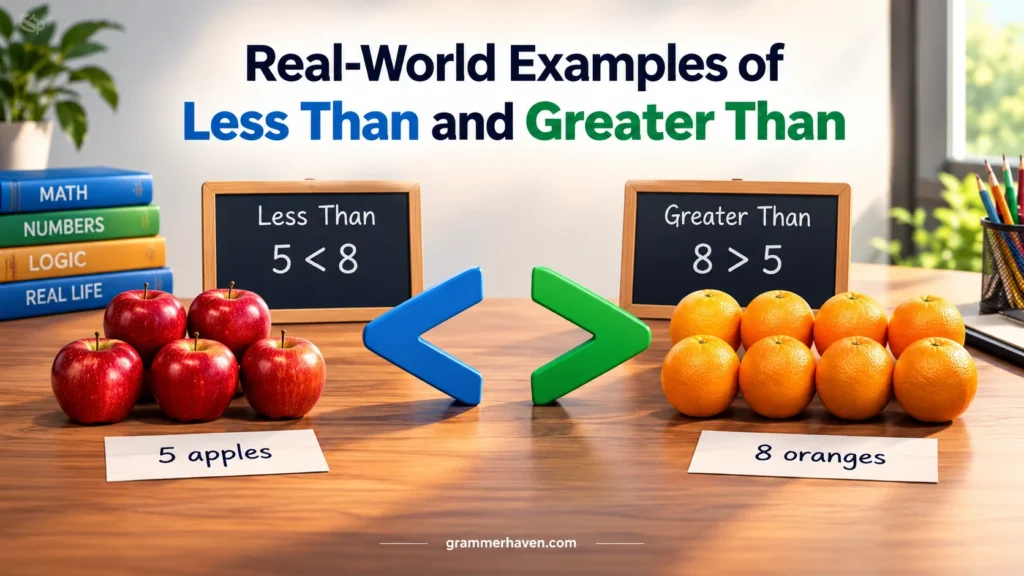
These symbols aren’t just classroom decorations. You use comparisons constantly.
Age
If one person is 18 and another is 14:
18 > 14
Price
If one product costs $80 and another costs $50:
$80 > $50
Speed
If one car travels at 70 mph and another travels at 55 mph:
70 > 55
Weight
If one package weighs 3 kg and another weighs 7 kg:
3 < 7
Test Scores
If you score 92 while another score is 78:
92 > 78
Temperature
If today’s temperature is -2°F and yesterday’s was -9°F:
-2 > -9
The symbols simply compress these relationships into a form that’s quick to read.
Case Study: Comparing Two Students’ Scores
Suppose Alex scores 84 on a test and Jordan scores 91.
To compare them:
84 < 91
Therefore, Jordan’s score is greater.
Now reverse the statement:
91 > 84
Nothing about the underlying relationship changed. The comparison simply starts from the other number.
This example illustrates a powerful idea:
Less than and greater than are opposite directions describing the same numerical relationship.
Less Than vs Greater Than: A Complete Comparison Chart
| Concept | Symbol | Example | Meaning |
| Less than | < | 3 < 7 | 3 is smaller |
| Greater than | > | 7 > 3 | 7 is larger |
| Less than or equal to | ≤ | x ≤ 7 | x is 7 or smaller |
| Greater than or equal to | ≥ | x ≥ 7 | x is 7 or larger |
| Equal to | = | 7 = 7 | Both values match |
| Not equal to | ≠ | 7 ≠ 3 | Values differ |
A useful way to think about the first four symbols is this:
< and > exclude equality.
≤ and ≥ include equality.
How to Teach Less Than and Greater Than to Children
Young learners usually understand comparisons more easily when they can see or touch the quantities before working with symbols.
Start with physical objects.
For example, place three apples beside seven apples. Ask:
Which group has fewer?
Then ask:
Which group has more?
Only after the child understands the relationship should you introduce:
3 < 7
and:
7 > 3
A number line provides another strong visual tool. It turns an abstract idea into a spatial one: left means less, right means greater. Early mathematics standards explicitly introduce comparison using symbols such as <, >, and = alongside number comparisons.
The alligator trick can add some fun, too. Just make sure the learner eventually understands why the symbol points the way it does.
A Simple Mental Checklist for < and >
When you’re stuck, don’t guess.
Ask yourself:
- Which value is smaller?
- Which value is larger?
- Where would each number appear on a number line?
- Does the pointed end face the smaller value?
- Does the open side face the larger value?
- Does the comparison include equality?
For example, compare:
-4 and 3
The number 3 sits farther right on the number line.
Therefore:
-4 < 3
Now compare:
12 and 7
12 is larger.
Therefore:
12 > 7
Five seconds of reasoning can prevent a very easy mistake.
Practice: Choose the Correct Less Than or Greater Than Symbol
Try these comparisons before checking the answers.
Beginner
- 3 __ 8
- 12 __ 5
- 7 __ 7
- 0 __ 4
Intermediate
- -2 __ -7
- 0.6 __ 0.45
- 3/5 __ 4/5
- -9 __ 1
Advanced
- 2x + 1 __ 9
- -3x > 12
- 5/6 __ 7/9
Answers
- 3 < 8
- 12 > 5
- 7 = 7
- 0 < 4
- -2 > -7
- 0.6 > 0.45
- 3/5 < 4/5
- -9 < 1
- The correct symbol depends on the value of x.
- x < -4
- 5/6 > 7/9
For number 10, the negative coefficient requires the inequality to reverse when you divide by -3.
Key Facts to Remember
- < = less than
- > = greater than
- The pointed end faces the smaller value.
- The open side faces the larger value.
- On a number line, left means less and right means greater.
- Negative numbers follow the same number-line rule.
- ≤ includes equality, while < doesn’t.
- ≥ includes equality, while > doesn’t.
- Multiplying or dividing an inequality by a negative number reverses its direction.
See also: Vice Versa or Visa Versa: Which Spelling Is Correct?
FAQs:
Is < less than or greater than?
< means less than.
For example:
4 < 9
means 4 is less than 9.
Is > less than or greater than?
> means greater than.
For example:
9 > 4
means 9 is greater than 4.
Which side of the symbol faces the larger number?
The open side faces the larger number.
The pointed end faces the smaller number.
Is the alligator trick accurate?
Yes, it works as a beginner-friendly mnemonic. However, understanding the number line and numerical relationship gives you a stronger foundation.
Is -5 less than -2?
Yes.
-5 < -2
On a number line, -5 lies to the left of -2.
Is 0 greater than a negative number?
Yes.
For example:
0 > -6
Zero lies to the right of -6.
What’s the difference between < and ≤?
< means strictly less than.
≤ means less than or equal to, so it includes the value itself.
What’s the difference between > and ≥?
> means strictly greater than.
≥ means greater than or equal to, so it includes the value itself.
Why do you reverse an inequality after multiplying or dividing by a negative?
A negative multiplication or division reverses the order of values on the number line. Therefore, the inequality direction must reverse to keep the statement true.
Conclusion:
Understanding Less Than vs Greater Than becomes easier when you connect each symbol with the number line and compare the values on both sides. Remember that < means less than and > means greater than. With a few simple examples and regular practice, you can avoid common mistakes, solve inequalities more confidently, and use these symbols correctly in math and everyday expressions.













