
Learn Deduce vs Induce: What’s the Difference? as you navigate English language confusion between similar terms and meanings with clear insights. When you explore these words, you may notice a thick fog of confusion and misunderstandings around deduce and induce. At first glance, they appear like two sides of the same coin, but when you dig deeper, you find vastly different meanings. By peeling back layers, breaking down the ideas into simpler parts, and trying to clear the fog, you can reveal what is lurking beneath the surface and discover the real difference between these concepts.
To deduce means to draw a specific conclusion from a general principle, while induce means to derive a general principle from observations. The distinction between these verbs connects to their corresponding nouns, deduction and induction, which form the basis of deductive and inductive reasoning. A philosopher or logician may explain these ideas further, but a simple example makes them easier to understand. If animals with hair are mammals, we can identify a furry animal outside as a mammal through deduction.
However, every mammal we have seen having hair does not always prove that all mammals have hair, making such ideas questionable when they create broad statements. Induction offers useful starting points for experiments, while deductions are often more correct because they rely on sound principles and specific claims. Induct can also mean to admit someone as a member or place them in a position. Its root is different from induce, and a similar linguistic oddity appears with deduct, which has the meaning to take away. Although these words have different roots, deduction connects these ideas.
Deduce vs Induce – What’s the Difference? Core Meaning of Deductive vs Inductive Reasoning
Before anything else, you need clean definitions. No fluff. Just clarity.
Deduction (Deductive Reasoning)
Deduction moves from general truth → specific conclusion.
If the starting rule is true, the conclusion must be true.
Think of it like a locked system. You plug in correct inputs, and you always get a guaranteed output.
Simple definition:
- General rule + specific case = certain conclusion
Induction (Inductive Reasoning)
Induction moves from specific observations → general conclusion.
Instead of certainty, you get probability. The conclusion feels right, but it can still be wrong.
Simple definition:
- Repeated observations = likely general rule
Quick mental snapshot
- Deduction = certainty engine
- Induction = probability engine
That one distinction drives everything else.
Deductive vs Inductive Reasoning – Direction of Thought Matters Most

Here’s where things start to click.
Reasoning always moves in a direction. That direction changes everything about how truth behaves.
Deduction: top-down thinking
You start wide, then narrow down.
- Big rule → small case
- Law → application
- Formula → result
Example flow:
- All metals expand when heated
- Iron is a metal
- Therefore, iron expands when heated
You don’t discover anything new here. You simply apply truth.
Induction: bottom-up thinking
You start small, then build upward.
- Observations → pattern → rule
Example flow:
- The sun rose today
- The sun rose yesterday
- The sun rose every recorded day
- Therefore, the sun always rises
You just built a rule from repeated experience.
Simple analogy
Imagine building a house:
- Deduction = following blueprints exactly
- Induction = designing the blueprint based on houses you’ve seen
One applies truth. The other creates it.
Deductive Reasoning Explained – How Deduction Actually Works
Deduction follows strict logic. It doesn’t care what you “feel” or “observe” unless those inputs match the rule.
Structure of deductive reasoning
Deduction always follows this pattern:
- General rule (premise 1)
- Specific case (premise 2)
- Logical conclusion
If both premises hold true, the conclusion becomes unavoidable.
Classic example of deduction
- All humans are mortal
- Socrates is a human
- Therefore, Socrates is mortal
This example comes from classical logic traditions tied to Aristotle, who formalized syllogistic reasoning.
Key features of deductive reasoning
1. Certainty
If premises are true, conclusion cannot fail.
2. Structure matters more than content
Even nonsense content can be logically valid:
- All blips are flarps
- John is a blip
- Therefore, John is a flarp
The logic still holds.
3. No new information
Deduction only unpacks what already exists.
Where deduction dominates in real life
Law
- Judges apply general laws to specific cases
Math
- Proofs rely on strict logical steps
Programming
- If-then logic mirrors deduction exactly
Philosophy
- Formal arguments depend on validity, not observation
Case study: debugging code
A developer sees a bug:
- Rule: “If user input is empty, system throws error”
- Observation: system throws error
- Deduction: input must be empty
This saves hours of guessing because logic narrows possibilities instantly.
Inductive Reasoning Explained – How Humans Actually Build Knowledge

Induction feels more natural because your brain already uses it constantly.
You don’t wake up building formal proofs. You watch patterns.
How induction works
Induction builds truth step by step:
- Observe repeated events
- Detect pattern
- Form general rule
Example of induction
- I ate apples three times and felt fine
- I ate apples ten times and felt fine
- Therefore, apples are safe for me
But here’s the catch:
You might eat an apple tomorrow and have an allergic reaction.
That uncertainty defines induction.
Key features of inductive reasoning
1. Probabilistic, not certain
Induction gives likelihood, not guarantees.
2. Strength grows with data
More observations → stronger conclusion.
3. Can fail
Even strong patterns can break.
Where induction dominates
Science
Scientists observe patterns before forming theories.
Psychology
Behavioral trends come from repeated studies.
AI and machine learning
Models learn patterns from massive datasets.
Everyday life
You assume traffic patterns, weather changes, and people’s habits.
Case study: weather prediction
- For 30 days, clouds appear before rain
- Meteorologists infer a pattern
- Forecast predicts rain when clouds form
However, unexpected atmospheric shifts can break the pattern. That’s induction in action.
Deduction vs Induction – Side-by-Side Comparison Table
| Feature | Deductive Reasoning | Inductive Reasoning |
| Direction | General → Specific | Specific → General |
| Output | Certain conclusion | Probable conclusion |
| Basis | Logic, rules | Observation, patterns |
| Reliability | High (if valid) | Variable |
| Risk of error | Low (logical validity issues only) | Higher (pattern may fail) |
| Example fields | Math, law, coding | Science, psychology, forecasting |
Deduce vs Induce – The Key Difference Most People Miss
Here’s where most explanations fall short.
The real difference isn’t just direction. It’s what each method can actually do.
Deduction does not create new knowledge
It only reveals what already exists inside the system.
If your rules are complete, deduction simply unpacks them.
Induction creates new knowledge
But it always carries uncertainty.
It builds ideas from reality instead of extracting them from rules.
Simple truth
- Deduction proves what must be true
- Induction suggests what might be true
That distinction shapes science, logic, and even AI design.
Real-Life Examples of Deductive vs Inductive Reasoning
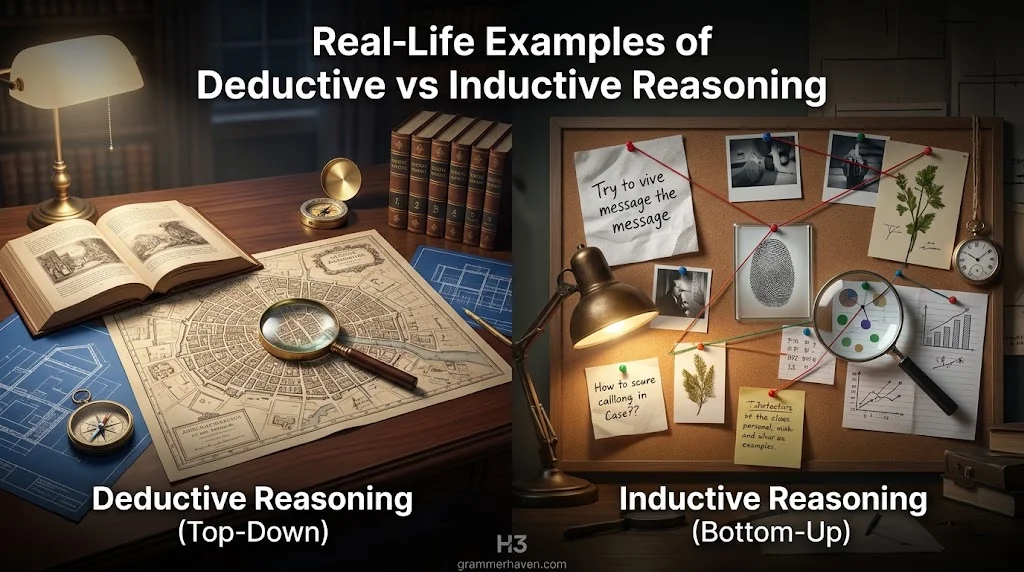
Let’s ground this in real thinking, not textbook language.
Case study 1: Health decisions
Induction
- Every time I drink coffee late, I struggle to sleep
- So coffee affects my sleep
Deduction
- Caffeine blocks sleep hormones
- Coffee contains caffeine
- So coffee disrupts sleep
One builds a theory. One applies biology.
Case study 2: Workplace behavior
Induction
- My manager gets quiet before big deadlines
- So silence means pressure is coming
Deduction
- If managers review projects before deadlines
- And silence signals review phase
- Then a deadline review is happening
One guesses a pattern. One applies logic.
Case study 3: Technology troubleshooting
Induction
- App crashed after last three updates
- Updates likely cause crashes
Deduction
- If memory leak exists in update version
- And system is running that version
- Then crash occurs
One suspects. One confirms logically.
Common Mistakes in Deductive vs Inductive Thinking
People mix these up more than they realize.
Mistake 1: Treating induction as certainty
- “It worked before, so it will always work”
That leads to false confidence.
Mistake 2: Using deduction with weak premises
- If your starting rule is wrong, deduction still produces a wrong answer.
Example:
- All birds can fly
- Penguin is a bird
- Therefore penguin can fly
Logic works. Reality doesn’t.
Mistake 3: Confusing correlation with logic
Just because two things appear together doesn’t mean one guarantees the other.
Mistake 4: Overgeneralizing from small samples
Three experiences do not define universal truth.
How Deduction and Induction Work Together in Real Life
The smartest thinkers don’t choose one. They combine both.
Science uses a loop
- Observe patterns (induction)
- Form hypothesis
- Test predictions (deduction)
- Refine theory
This cycle drives nearly all modern scientific discovery.
Artificial intelligence follows the same logic

- Induction → model learns from data
- Deduction → model applies learned patterns to new inputs
That combination powers systems like recommendation engines and language models.
Simple takeaway
Induction builds the map. Deduction navigates it.
Deduction vs Induction Memory Trick (Easy Recall Method)
Here’s a quick way to lock it in your mind:
- Deduction = Downward certainty
- Induction = Into patterns
Or even simpler:
- Deduction = rule → result
- Induction = results → rule
Say it a few times and it sticks fast.
Deduce vs Induce – Final Clarity Without Confusion
Let’s bring everything together.
- Deduction starts with truth and applies it logically
- Induction starts with reality and builds truth from it
- Deduction guarantees conclusions if rules hold
- Induction suggests conclusions based on evidence
Neither is superior. They solve different problems.
See also: Relate to or Relate With: Which Is Correct?
FAQs:
1. What is the main difference between deduce and induce?
The main difference is the direction of reasoning. Deduce means reaching a specific conclusion from a general rule, while induce means forming a general rule from specific examples or observations.
2. Is deduction more reliable than induction?
Deduction is usually considered more reliable because it follows established principles and can produce a certain conclusion if the starting information is correct. Induction can be useful but may create conclusions that are not always guaranteed.
3. What is an example of deduction?
If you know that all birds have feathers and you see a bird outside, you can deduce that the bird has feathers. You apply a general fact to a specific case.
4. What is an example of induction?
If you observe many birds having feathers, you may induce that all birds have feathers. You create a general idea based on repeated observations.
5. Are deduce and deduct the same thing?
No, they are different. Deduce means to reach a conclusion through reasoning, while deduct usually means to take away or subtract something. Their roots are different, even though their related noun deduction connects to both ideas.
Conclusion:
Understanding the difference between deduce and induce helps you use these terms correctly in everyday communication, academic writing, and logical thinking. Deduce focuses on moving from a general principle to a specific conclusion, while induce works in the opposite direction by creating a general idea from specific observations. Both forms of reasoning play an important role in how we analyze information, solve problems, and understand the world around us. Once you recognize their direction and purpose, these two words become much easier to remember and apply.
Latest Post:
- Is It Correct to Say “A Big Congratulations”? The Complete Grammar Guide
- Two Crows Being an Attempted Murder: Meaning, Origins & Real Behavior
- Farther vs. Further: What’s the Difference?
- Result In or Result To: Which Is Correct? (With Examples)
- A Dime a Dozen: Meaning, Definition, Origin and Real-Life Usage