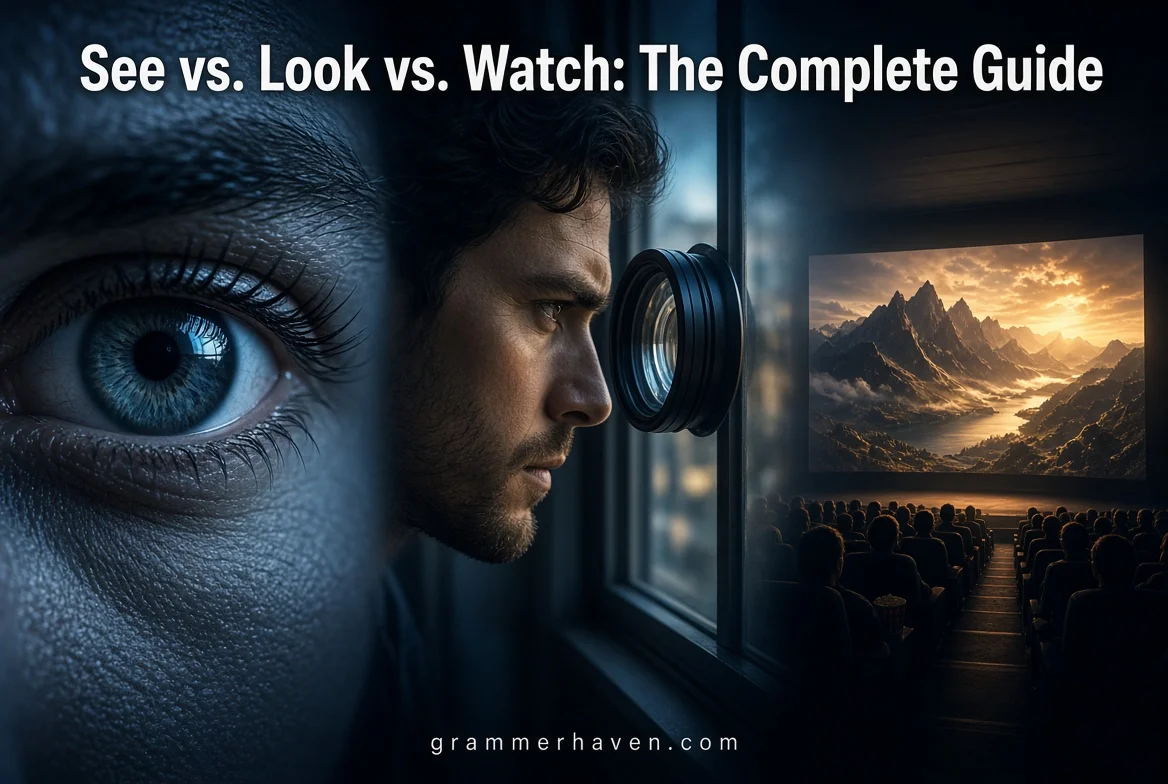
See vs. Look vs. Watch: The Complete Guide helps you master these common English language words with simple grammar, clear examples, and real-life communication tips.
This complete guide explains why English learners, learners, and even native speakers often confuse these verbs. At first glance, they look the same, but the differences, subtle differences, distinctions, and overall difference in meaning truly matter. From my experience with teaching and editing English, I have noticed that even seasoned speakers can trip up when choosing the right verb. The good news is that once you understand the underlying logic, everything feels more natural. This guide breaks down everything you need to know, includes clear examples, a useful comparison, practical grammar, grammar rules, rules, memory, memory tricks, and regular practice, including English pronunciation practice, to improve your skills for every day and everyday communication in real-life situations.
Understanding the Core Difference Between See, Look, and Watch
Before diving into detailed explanations, let’s simplify the distinction.
Think of these three verbs as different levels of visual attention.
| Verb | Basic Meaning | Effort Required | Duration |
| See | Notice something with your eyes | No | Usually brief |
| Look | Direct your eyes toward something | Yes | Usually short |
| Watch | Observe something carefully over time | Yes | Usually longer |
A simple way to remember this is:
See happens naturally. Look happens intentionally. Watch happens continuously.
Let’s explore each verb in depth.
What Does “See” Mean?
The verb see describes visual perception that happens naturally.
You don’t usually make a conscious decision to see something. Your eyes notice it automatically.
For example:
- I saw a rainbow after the storm.
- She saw her friend across the street.
- We saw smoke coming from the building.
In all three examples, the person noticed something visually. They didn’t necessarily focus on it or study it.
The event simply entered their field of vision.
Think of See as Passive Observation
Imagine walking through a park.
Suddenly, you notice a squirrel running across the path.
You didn’t search for it.
You didn’t deliberately focus on it.
That’s the essence of the verb see.
Common Situations Where We Use See
Seeing People
One of the most common uses involves noticing people.
Examples:
- I saw Michael at the grocery store.
- Did you see Sarah today?
- We saw our neighbors this morning.
In these situations, visual recognition occurred naturally.
Seeing Objects
You can also use see when referring to things.
Examples:
- Can you see the mountain?
- I can’t see my phone.
- She saw a strange package near the door.
The object becomes visible.
Nothing more complicated than that.
Seeing Events
People frequently use see for unexpected events.
Examples:
- I saw the accident happen.
- They saw lightning strike a tree.
- We saw the announcement online.
Notice that these events occurred naturally in front of the observer.
Seeing Something Unexpected
Many native speakers use see when surprise is involved.
Examples:
- Suddenly, I saw a snake.
- He saw someone hiding behind the fence.
- We saw a shooting star.
The observation wasn’t planned.
It simply happened.
Advanced Meanings of See
Many learners believe see only refers to vision.
Actually, native speakers use it in several other ways.
See Meaning “Understand”
This usage appears constantly in conversation.
Examples:
- I see what you’re saying.
- Now I see the problem.
- Do you see my point?
Here, see means understand, not physically observe.
Example
Imagine someone explains a difficult math problem.
At first you’re confused.
Then everything clicks.
You might say:
“Oh, I see now.”
You aren’t looking at anything new.
You’re expressing understanding.
See Meaning “Meet”
English speakers often use see when talking about appointments or visits.
Examples:
- I’m seeing my dentist tomorrow.
- She went to see her doctor.
- We’re seeing a client next week.
In this context, see means meet with someone.
See Meaning “Experience”
Sometimes see means witness or experience.
Examples:
- The city sees millions of visitors every year.
- The company has seen rapid growth.
- The region saw heavy rainfall.
This meaning frequently appears in formal writing.
Common Expressions With See
English contains dozens of idioms featuring see.
Some of the most useful include:
| Expression | Meaning |
| See you later | Goodbye |
| Wait and see | Be patient and find out |
| See for yourself | Verify personally |
| See the point | Understand |
| See the difference | Notice distinctions |
| See eye to eye | Agree completely |
Example in Context
“Let’s wait and see what happens.”
This phrase appears frequently in both spoken and written English.
What Does “Look” Mean?
While see happens naturally, look requires action.
When you look, you deliberately direct your eyes toward something.
This is the key difference.
Consider these examples:
- Look at the sky.
- Look at this picture.
- Look at that bird.
In each case, someone intentionally focuses their attention.
The action is deliberate.
Why Look Is Different From See
Let’s compare two sentences.
I Saw the Moon
This sentence means the moon entered your field of vision.
Nothing else is implied.
I Looked at the Moon
This sentence suggests a conscious decision.
You intentionally directed your eyes toward the moon.
The difference seems small.
Yet native speakers immediately recognize it.
The Grammar Rule Most Learners Miss
One of the biggest mistakes involves forgetting the preposition at.
Most of the time, you don’t simply “look at something.”
Instead, you:
- Look at a picture.
- Look at the sky.
- Look at the screen.
Incorrect
❌ Look the picture.
Correct
✅ Look at the picture.
This rule alone can dramatically improve your English.
Important Phrasal Verbs With Look
The verb look creates many phrasal verbs.
Each carries a different meaning.
Look For
Meaning: Search for something.
Examples:
- I’m looking for my keys.
- She’s looking for a new job.
Look Around
Meaning: Explore.
Examples:
- We looked around the museum.
- They looked around the city.
Look Into
Meaning: Investigate.
Examples:
- Police are looking into the case.
- Management will look into the complaint.
Look Through
Meaning: Examine quickly.
Examples:
- She looked through the report.
- He looked through old photographs.
Look After
Meaning: Take care of.
Examples:
- Can you look after the dog?
- She looks after her younger brother.
This phrasal verb has nothing to do with vision.
That surprises many learners.
Common Expressions With Look
English speakers use countless expressions featuring look.
Popular examples include:
- Look on the bright side.
- Look before you leap.
- Look out.
- Look alive.
- Look up to someone.
- Look down on someone.
Quick Example
“Look on the bright side. At least nobody got hurt.”
This expression encourages optimism during difficult situations.
What Does “Watch” Mean?
Now we arrive at the third verb.
Watch combines intention with duration.
When you watch something, you observe it carefully over a period of time.
Examples:
- We watched a movie.
- They watched the football game.
- She watched the children play.
Unlike see, watching is intentional.
Unlike look, watching usually lasts longer.
Why Duration Matters
Think about a movie.
You don’t glance at it for one second.
You pay attention for an extended period.
That’s why English uses watch.
The same principle applies to:
- Sports
- Television
- Wildlife
- Performances
- Moving objects
- Live events
The observation continues over time.
The Movement Principle
Many language experts explain watches using movement.
Generally speaking, people watch things that move, change, or develop.
Examples:
- Watch a soccer match.
- Watch a child play.
- Watch fireworks.
- Watch birds flying.
- Watch traffic.
The action unfolds over time.
Your attention follows it.
Common Situations Where We Use Watch
Watching Television
Perhaps the most common use.
Examples:
- We watched TV all evening.
- She watched a documentary.
- They watched a comedy series.
Notice that native speakers say:
✅ Watch TV
Not:
❌ Look TV
Not:
❌ See TV
Watching Sports
Sports involve continuous action.
Examples:
- We watched the game.
- He watched the championship match.
- They watched the Olympics.
Because the action develops over time, watch is the natural choice.
Watching People and Animals
Examples:
- We watched dolphins swimming.
- She watched the children playing.
- They watched birds migrate south.
The focus remains on ongoing activity.
Watching Events Unfold
Examples:
- Watch the sunset.
- Watch the fireworks.
- Watch the parade.
- Watch the ceremony.
Each event develops gradually.
That makes watch the perfect verb choice.
When NOT to Use Watch
Many learners overuse watches.
They assume anything visible can be watched.
That’s not always true.
Incorrect Examples
- Watch a photograph.
- Watch a painting.
- Watch a wall.
- Watch a statue.
These sound unnatural because the objects are static.
They don’t move.
Native speakers would usually say:
- Look at the photograph.
- Look at the painting.
- Look at the wall.
- Look at the statue.
The object remains still.
Therefore, it looks better.
A Simple Memory Trick
Imagine three levels of visual attention:
See = Notice
You notice something naturally.
Look = Aim
You direct your eyes intentionally.
Watch = Follow
You follow something over time.
This simple framework helps learners choose the correct verb quickly.
See vs. Look: The Difference Explained Clearly
Let’s compare similar sentences.
I Saw the Mountain
Meaning:
The mountain became visible to me.
No deliberate effort is required.
I Looked at the Mountain
Meaning:
I intentionally directed my attention toward the mountain.
The action is deliberate.
Even though both sentences involve the same object, the meaning changes because the speaker’s intention changes.
See also: Please Advise vs Please Advice: Understanding the Right Choice
FAQs:
1. What is the main difference between See, Look, and Watch?
See is automatic because you notice something with your eyes. Look means you intentionally direct your eyes toward something. Watch means you observe something for a period of time, especially if it is moving.
2. Can I use See, Look, and Watch interchangeably?
No. Although all three verbs relate to vision, they have different meanings. Using the wrong one can make a sentence sound unnatural or confusing.
3. Why do English learners confuse See, Look, and Watch?
These verbs all involve using your eyes, so they appear similar at first. However, they differ in intention, attention, and whether the action is passive or continuous.
4. Which verb should I use for movies and TV?
Use Watch because you follow the action over time. For example, “We watched a movie last night.”
5. How can I remember the difference between See, Look, and Watch?
A simple trick is to remember: See = notice naturally, Look = direct your eyes, and Watch = observe over time. Practicing with real-life examples will help you remember the correct usage.
Conclusion:
Understanding See, Look, and Watch becomes much easier once you focus on the purpose behind each verb. See happens naturally, Look requires intention, and Watch involves following something over time, usually when there is movement. These small differences can make your English sound more natural and accurate. The more you read, listen, and practice these verbs in real-life situations, the more confidently you will use them in everyday communication.