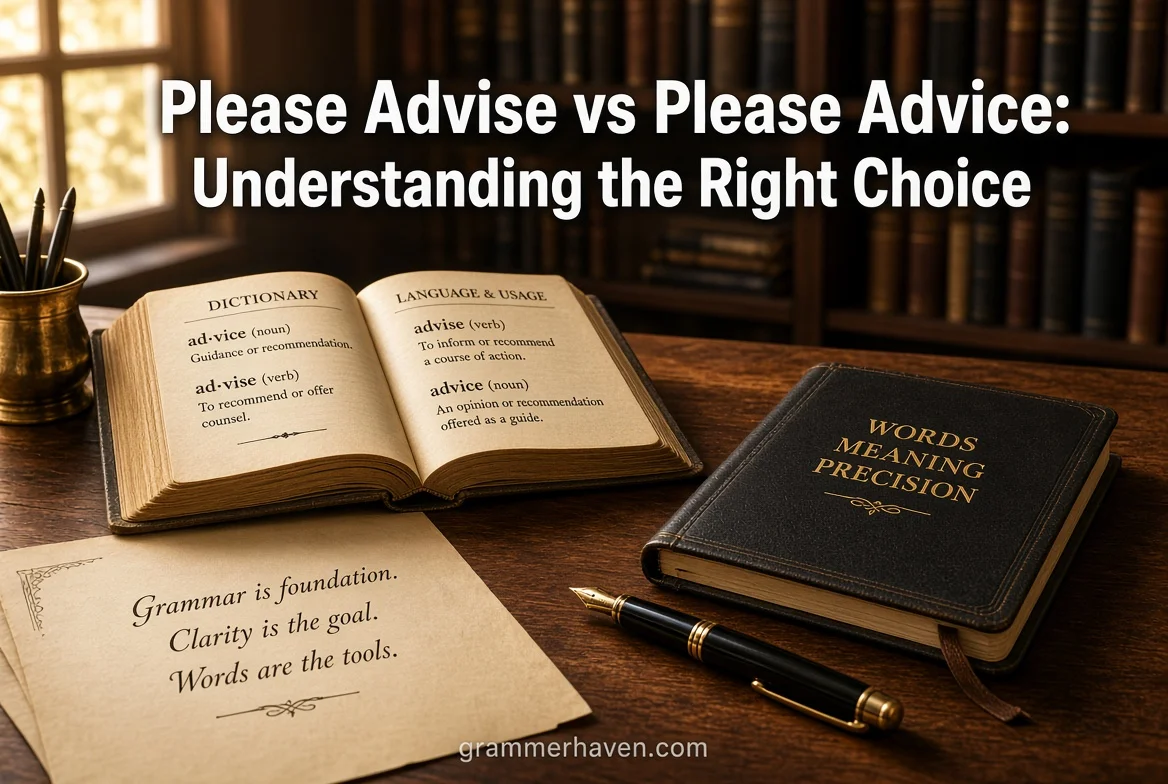
Please Advise vs Please Advice: Understanding the Right Choice helps clear confusion in English by explaining the right choice. Many English learners pause while typing an email, message, or official correspondence because the two phrases have similar pronunciation. From my experience, this small mistake appears often in professional communication. Advise is a verb, while advice is a noun. In English grammar, advise means helping someone, and advice means recommendation, suggestions, guidance, assistance, or helpful information that a person gives. Learning this difference improves word choice, grammar, grammatical correctness, clarity, expression, written communication, and helps you communicate clearly in every sentence.
The phrase Please Advise is a formal, commonly used expression in official communication, official writing, official emails, official letters, letters, emails, and older telegrams sent through telegram services. Its popularity increased from the late 17th century into the 19th century, when every word was charged and writers tried to reduce the number of words. English specialists explain that advise is a transitive verb, also called a transitional verb, so an object can follow, such as please advise me or please advise her. Many sources, including Dictionaries, Encyclopedias, Feed Aggregation, and Social Bookmarking sites, discuss different takes, different opinions, linguistic usage, semantics, contextual meaning, and how the tone of the message, context, and situation influence the phrase meaning.
Using Please Advise with politeness, courtesy, and professional etiquette suits formal language and follows the conventional requirement to observe polite behaviour among associates, members, or a group in a profession. However, some people consider the phrase old, stale, quick, incomplete, negative, impolite, forceful, or even passive-aggressive, suggesting indirect resistance, direct confrontation, dumping responsibility, or that someone has washed their hands of the matter. For example, when you ask for answers, a response, best possible advice, recommendation given, advice given, giving instruction, best measures, or an information request in the right official context, your reader is more likely to respond positively. Remember, knowing the meaning, roles, spoken language, spoken form, direct communication, indirect communication, and how to pass on information correctly ensures clear writing.
The Core Grammar Truth Behind “Please Advise vs Please Advice”
Let’s strip this down to the basics. No jargon. No fluff.
English has two closely related words:
- Advise → a verb (an action word)
- Advice → a noun (a thing or idea)
That one-letter difference changes everything.
Think of it like this:
- Advise = to give guidance
- Advice = the guidance itself
A simple mental picture helps:
- When someone advises, they are doing something.
- When you receive advice, you are getting something.
So when you write “please ___”, you must ask yourself:
Are you requesting an action or a thing?
You request an action. That is why “please advise” works and “please advice” fails.
Why English Makes This Mistake So Common
English creates confusion here for a few real reasons.
First, both words come from the same root: Latin advisare, meaning “to consider or consult.” Over time, English split them into verb and noun forms.
Second, pronunciation hides the difference. In spoken English, both sound almost identical. So your brain does not catch the error easily when writing quickly.
Third, email culture makes it worse. People see “please advise” everywhere in professional communication. Then they try to copy it without fully understanding the grammar.
Finally, autocorrect does not always help. It may accept both forms depending on context.
So yes, even native speakers occasionally slip. But in formal writing, the difference matters.
What “Please Advise” Really Means in Professional English

Let’s break down the correct phrase.
“Please advise” is a polite, formal request asking someone to guide you or give instructions.
It does not mean “give me advice” in a casual sense. Instead, it means:
“Please tell me what I should do next.”
You will see it often in business emails because it stays short and neutral. It avoids emotional tone. It also avoids long explanations.
Common correct examples:
- “Please advise on the next steps.”
- “Please advise if you approve the proposal.”
- “Please advise regarding the payment schedule.”
- “Please advise how to proceed with this issue.”
Why professionals use it:
- It sounds neutral and respectful
- It keeps communication brief
- It avoids sounding demanding
- It fits legal and corporate tone
One HR manager once put it simply:
“We use ‘please advise’ because it sounds like a clean handoff. No emotion. Just clarity.”
That explains its popularity in workplaces.
What “Advice” Means and Why “Please Advice” Is Wrong
Now let’s look at the noun form.
Advice means guidance, suggestions, or recommendations.
You receive advice. You do not perform advice.
Correct usage examples:
- “She gave me excellent advice about my career.”
- “I need your advice on this decision.”
- “His advice helped me avoid a mistake.”
Now here is the problem phrase:
❌ “Please advice”
This is wrong because it mixes a verb structure (“please”) with a noun (“advice”) that cannot function as an action.
You cannot ask someone to “please a thing.” That is the easiest way to remember it.
If you try to fix it, you would say:
- “Please give me advice.”
- “I would like your advice.”
Notice the shift. You either use “advise” as the action word or you reframe the sentence.
Quick Comparison Table: Please Advise vs Please Advice
| Phrase | Word Type | Meaning | Correct Usage | Common Issue |
| Please advise | Verb phrase | Request for action or instruction | “Please advise on the issue.” | Correct |
| Advice | Noun | Guidance or suggestions | “I need your advice.” | Correct alone |
| Please advice | Incorrect mix | Attempts to request a noun as action | ❌ Wrong usage | Grammar error |
This table is simple, but it clears 90% of confusion instantly.
Real-World Case Studies of the Mistake

Let’s look at how this error shows up in real life.
Case Study 1: Job Application Email
A university graduate writes:
“Dear Hiring Manager, please advice me about interview timing.”
What happens?
The recruiter notices the mistake immediately. It does not destroy the application, but it weakens the first impression. In competitive hiring, small grammar issues matter.
Correct version:
“Dear Hiring Manager, please advise me about the interview timing.”
Case Study 2: Freelance Client Communication
A freelancer sends:
“Please advice on the project direction.”
The client reads it twice. It feels slightly off. Not unprofessional in intent, but incorrect in structure.
Correct version:
“Please advise on the project direction.”
That small correction makes communication feel sharper and more confident.
Case Study 3: Customer Support Email
A customer writes:
“Please advice me how to fix this issue.”
Support agents see this daily. They still understand the request, but the wording signals less polish.
Correct version:
“Please advise how I can fix this issue.”
These examples show something important. People understand your meaning either way. However, grammar shapes perception. Clean writing builds trust faster.
Why Native Readers Instantly Notice the Error
Native readers do not analyze grammar rules consciously. They feel the error instead.
When they see “please advice”, it triggers a subtle mismatch in rhythm. The sentence feels “off.” Not broken, but incorrect.
Here is why:
- “Please” expects a verb after it
- “Advice” cannot function as a verb
- The brain detects structural imbalance
Think of it like hearing a musical note slightly out of tune. You may not know the theory, but you hear the difference.
That is why this mistake stands out more than many others.
Simple Memory Tricks to Never Mix Them Up Again
Let’s make this easy.
Trick 1: Action vs Thing Rule
- If you need an action, use advise
- If you need a thing, use advice
Trick 2: Replace Test
Try replacing the word with “inform.”
- “Please inform me” works → use advise
- “Please inform” does not work with noun → avoid advice here
Trick 3: Sentence Swap Trick
- “Please advise” = “Please tell me what to do”
- “Advice” = “Guidance”
Trick 4: The “E” Reminder
- Advise ends with E → it acts (verb energy)
- Advice ends with CE → it is a thing (noun container)
Simple. Fast. Memorable.
Common Variations You Will See in Real Communication

English does not stay fixed. People modify tone depending on context.
Formal variations:
- Kindly advise
- Please advise at your earliest convenience
- We would appreciate your advice
Neutral professional tone:
- Please advise on next steps
- Please advise if this works
Casual alternatives:
- Let me know
- What do you think?
- Can you check this?
Important note:
“Please advise” sounds formal. In casual conversations, it may feel stiff. So choose based on the audience.
Quick Grammar Rules Cheat Sheet
Here is a compact guide you can use anytime:
- Use advise when someone performs an action
- Use advice when talking about suggestions
- Never combine “please” with “advice”
- If unsure, rephrase the sentence
- Prefer clarity over formality
A strong writer does not just follow rules. They choose clarity first.
See also: Sleeve vs Sleave – Which Is Correct?
FAQs:
1. Is “Please Advise” grammatically correct?
Yes. Please Advise is grammatically correct because advise is a verb that means to give guidance or recommendations.
2. Why is “Please Advice” incorrect?
Please Advice is incorrect because advice is a noun. After the word “please,” you need a verb, which is advise.
3. Is “Please Advise” considered polite?
Yes, it can be. In professional communication, Please Advise is generally polite when used with a respectful tone and appropriate context.
4. Can I say “Please Advise Me” instead of “Please Advise”?
Yes. Many English experts prefer Please Advise Me because it includes the object, making the request more complete and direct.
5. Where is “Please Advise” commonly used?
Please Advise is commonly used in business emails, official letters, customer service messages, and other forms of professional communication when requesting information or guidance.
Conclusion:
Choosing between Please Advise and Please Advice becomes easy once you know the difference. Please Advise is the correct phrase because advise is a verb, while advice is a noun. Using the right form improves your grammar, makes your writing more professional, and helps you communicate clearly in emails, letters, and other formal messages. Whenever you’re asking someone for guidance or a response, remember to use Please Advise with a polite and appropriate tone.