Don’t Rain on My Parade is a colorful English idiom for protecting your happiness, excitement, and plans from someone’s negativity or criticism. Its meaning comes from the image of rain spoiling a parade, a joyful event. The phrase is especially common in American English, conversational speech, and everyday conversation. A friend might use it after discouraging comments about a new job, dream vacation, or personal goal. Someone who has finally reached a goal, booked a vacation, or landed a new job may hear listing of every risk and everything that could go wrong. The phrase lets you point out that negativity without sounding extremely angry. Its playful expression can show a mildly irritated or defensive reaction.
The phrase has a famous connection with the 1964 musical Funny Girl. Barbra Streisand helped make it widely recognizable through Broadway and the original cast album. The English phrase appears in movies and songs, supporting its American usage in everyday conversations. People use it while celebrating exciting news or protecting your happiness from criticism, negative comments, and discouragement. Its figurative meaning matters more than actual rain. You are telling others not to put a damper on your celebration, success, or joy.
The conversational expression fits situations involving someone’s happiness or someone’s plans. An excited person planning an upcoming birthday party may hear a person criticizing their choices and respond with the phrase. The idea is simple: don’t ruin the fun, reduce the joy, or create a negative situation. Someone may say it intentionally or unintentionally when people react without considering another person’s feelings. The expression can help keep their spirits up while telling someone that their reaction is unhelpful. It is important to understand and use this colorful expression as part of your English toolbox, especially when actual parades are not involved.
Quick Answer: What Does “Don’t Rain on My Parade” Mean?
“Don’t rain on my parade” means “Don’t spoil my happiness or excitement.”
You use it when someone says or does something that threatens to turn a positive moment into a negative one.
For example:
“I finally got the job I wanted!”
“That’s great, but you’ll probably have to work sixty hours a week.”
“Come on, don’t rain on my parade. Let me enjoy the good news!”
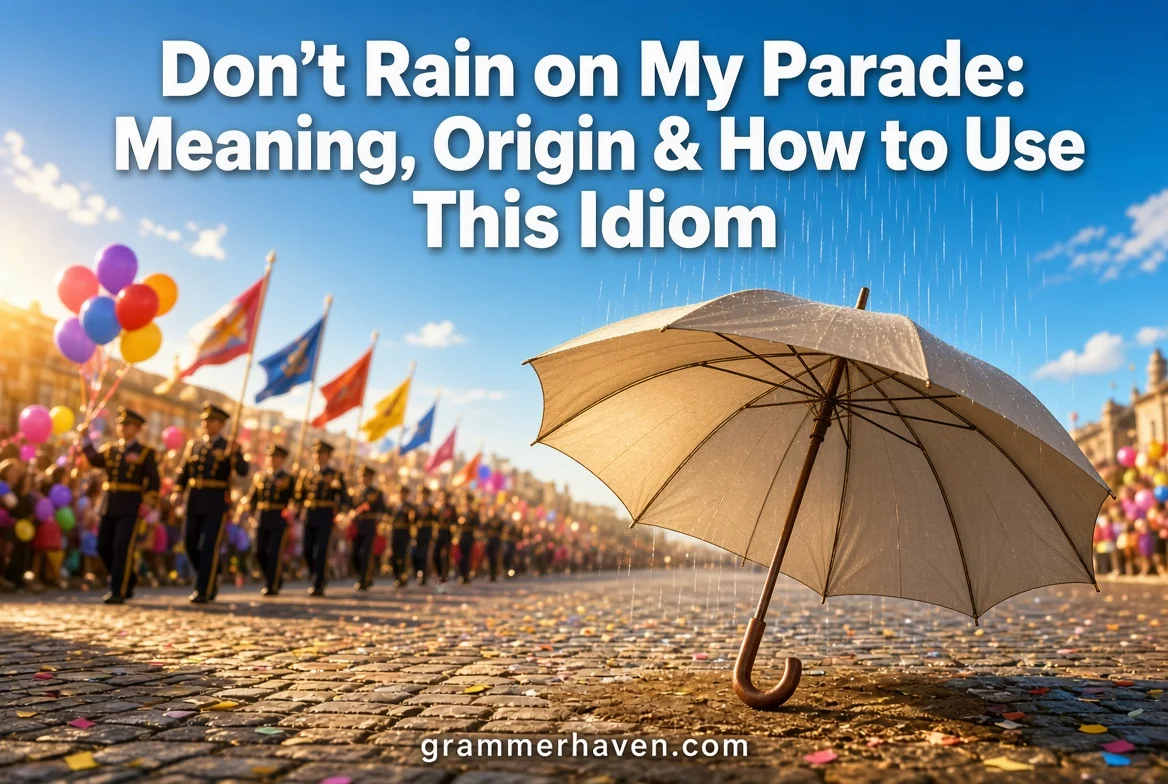
The phrase doesn’t literally refer to rain. “Rain” represents negativity or disappointment, while “parade” represents something joyful, exciting, or worth celebrating.
What Does “Don’t Rain on My Parade” Mean?
The idiom “don’t rain on my parade” is a request for someone to stop being negative about something you’re enjoying or looking forward to.
In simple terms, it can mean:
- Don’t spoil my excitement.
- Don’t ruin this moment for me.
- Let me enjoy this.
- Don’t discourage me.
- Don’t focus on the negative right now.
- Don’t put a damper on my happiness.
The expression often appears when two people view the same situation differently. One person sees an opportunity, achievement, or reason to celebrate. The other sees problems, risks, or reasons for concern.
For example, imagine that you’ve planned a beach vacation for months. You tell your friend about it, and they immediately start talking about possible storms, expensive food, flight delays, and crowded beaches.
You might laugh and say:
“I know there could be problems, but don’t rain on my parade. I’m excited about the trip.”
The phrase doesn’t necessarily mean that the other person is wrong. It simply communicates that their negativity isn’t welcome at that particular moment.
The Meaning Behind “Rain” and “Parade”
The metaphor makes the idiom memorable.
| Word | Figurative meaning |
| Rain | Negativity, disappointment, criticism, or discouragement |
| Parade | Happiness, celebration, excitement, plans, or success |
| Rain on my parade | Spoil something I’m enjoying or looking forward to |
Think about an actual parade. People prepare costumes, music, floats, decorations, and celebrations. Then heavy rain arrives.
The event might continue, but the weather can certainly spoil the experience.
The idiom applies the same idea to emotions. Someone’s negative comments become the figurative rain.
Is “Don’t Rain on My Parade” Positive or Negative?
The phrase itself isn’t exactly positive or negative. Its tone depends heavily on the situation.
A friend might say it jokingly:
“Don’t rain on my parade! I’m ordering dessert even though I’m already full.”
Someone who feels annoyed might use it more sharply:
“I’ve made my decision. Please don’t rain on my parade.”
In another situation, it can sound defensive:
“I know you have concerns, but don’t rain on my parade before I’ve even started.”
So, context matters. The same words can sound playful, irritated, or genuinely frustrated.
“Don’t Rain on My Parade” Examples
The best way to understand an idiom is to see how people actually use it.
Example in Everyday Conversation
Mia: “I’m going to start taking photography classes next month.”
Jake: “That’s expensive. You’ll probably lose interest after a few weeks.”
Mia: “Hey, don’t rain on my parade. I’m really excited about it.”
Here, Mia doesn’t necessarily disagree with Jake. She simply doesn’t want his skepticism to spoil her enthusiasm.
Example About Good News
“I got promoted today!”
“Congratulations! Just remember that the new position comes with a lot more responsibility.”
“Thanks, but don’t rain on my parade. I want to celebrate first.”
Example About Travel
“We’re finally going to Italy this summer.”
“You know how expensive everything is there, right?”
“Yes, but don’t rain on my parade. I’ve been looking forward to this for years.”
Example With Friends
“I’m going to ask her out tonight.”
“What if she says no?”
“Don’t rain on my parade. I’m going to give it a shot.”
Example in a Text Message
“My vacation starts tomorrow! 🎉”
“Hopefully your flight doesn’t get canceled.”
“Haha, don’t rain on my parade!”
The final example shows why the expression works particularly well in casual texting. It can soften irritation with humor.
How to Use “Don’t Rain on My Parade” in a Sentence
“Don’t rain on my parade” usually works as a direct statement or response.
Common patterns include:
- Don’t rain on my parade.
- Please don’t rain on my parade.
- Hey, don’t rain on my parade!
- I know you’re trying to help, but don’t rain on my parade.
- Don’t rain on my parade before I’ve even had a chance to try.
The expression usually refers to something the speaker personally values.
“Don’t Rain on My Parade” vs. “I Don’t Mean to Rain on Your Parade”
These expressions look similar, but they perform opposite conversational jobs.
“Don’t rain on my parade” asks another person not to spoil your excitement.
“I’m thrilled about the new apartment. Don’t rain on my parade.”
“I don’t mean to rain on your parade” usually introduces criticism, disappointing information, or an inconvenient fact.
“I don’t mean to rain on your parade, but the apartment building has a strict no-pet policy.”
The first expression protects the speaker’s enthusiasm.
The second expression softens the speaker’s criticism.
“Don’t Rain on My Parade” vs. “Rain on Someone’s Parade”
The possessive pronoun changes the perspective.
| Expression | Meaning | Example |
| Don’t rain on my parade | Don’t spoil my excitement | “I’m excited about the trip. Don’t rain on my parade.” |
| Rain on my parade | Spoil my happiness or plans | “I don’t want to rain on your parade.” |
| Rain on your parade | Spoil someone else’s excitement | “I hate to rain on your parade, but there’s a problem.” |
| Rained on her parade | Spoiled her excitement or plans | “The cancellation really rained on her parade.” |
The core metaphor remains the same. Only the person experiencing the disappointment changes.
“I Don’t Mean to Rain on Your Parade” Meaning
“I don’t mean to rain on your parade” is often used before someone delivers unwelcome information.
For example:
“I don’t mean to rain on your parade, but the deadline is tomorrow.”
The speaker recognizes that the information could reduce the other person’s enthusiasm. The phrase acts as a conversational cushion.
You may also hear:
- I hate to rain on your parade, but…
- I don’t want to rain on your parade, but…
- Sorry to rain on your parade, but…
These expressions don’t necessarily mean the speaker regrets giving the information. Instead, they acknowledge its disappointing effect.
That distinction matters. Someone can deliver useful criticism without simply being negative.
Synonyms for “Don’t Rain on My Parade”
There isn’t one perfect replacement for the idiom in every situation. Your choice should match the tone.
Casual Alternatives
- Don’t spoil the moment.
- Don’t kill my excitement.
- Let me have my moment.
- Don’t be a downer.
- Don’t ruin the fun.
Polite Alternatives
- Please let me enjoy this for a moment.
- I’d rather focus on the positive right now.
- I understand your concern, but I’m excited about this.
- I’d like to enjoy the good news before worrying about the problems.
Stronger Alternatives
- Don’t ruin this for me.
- Stop being so negative.
- Don’t put a damper on things.
- Stop taking the fun out of it.
The informal idiom works best when the conversation is relaxed. In a professional setting, a softer alternative can prevent your response from sounding dismissive.
Opposite Expressions of “Don’t Rain on My Parade”
If “don’t rain on my parade” pushes negativity away, its opposite encourages someone to support the celebration.
Useful alternatives include:
- Cheer me on.
- Celebrate with me.
- Be happy for me.
- Let me enjoy this.
- Keep the positive energy going.
- Support me.
- Share my excitement.
For example:
“I know there are challenges ahead, but right now I’d love it if you celebrated with me.”
That sentence communicates the same basic need without using an idiom.
The Tone of “Don’t Rain on My Parade”
Tone is one of the most important parts of using this expression correctly.
Playful
“Don’t rain on my parade! I’m having another slice of cake.”
Here, the speaker is clearly joking.
Humorous
“Don’t rain on my parade. I’ve already convinced myself this purchase is a brilliant idea.”
The speaker recognizes the possibility of criticism and turns it into a joke.
Defensive
“I’ve thought about this carefully. Don’t rain on my parade just because you wouldn’t make the same choice.”
This version carries more emotional weight.
Irritated
“I’ve told you how happy I am. Please don’t rain on my parade.”
The speaker now wants the criticism to stop.
Sarcastic
“Oh, wonderful. Another warning about everything that could go wrong. Don’t rain on my parade.”
The words may be polite on the surface while the tone communicates frustration.
Is “Don’t Rain on My Parade” Rude?
It can be, but it isn’t automatically rude.
Among close friends, the phrase often sounds lighthearted. In a serious professional discussion, however, it might sound as though you’re refusing to consider legitimate concerns.
Consider these two situations.
Casual:
“Don’t rain on my parade! I’m celebrating tonight.”
This sounds harmless.
Professional:
“Don’t rain on my parade. I don’t want to hear your concerns.”
That version could sound dismissive.
If someone raises a genuine safety, financial, legal, or practical concern, brushing them off as a “downer” may create unnecessary conflict.
A better approach is sometimes:
“I appreciate the concern. Let me enjoy the good news for now, and we can talk about the practical side afterward.”
You still protect the moment without shutting down the conversation.
When Should You Use “Don’t Rain on My Parade”?
The idiom fits particularly well when someone is unnecessarily dampening your enthusiasm.
Use it when:
- you’re celebrating an achievement
- you’re excited about a new opportunity
- you’re looking forward to a trip
- you’re starting a new hobby
- you’re making personal plans
- you’re sharing good news
- someone keeps focusing on unlikely problems
- a friend responds to your excitement with excessive negativity
The key word is excessive.
If someone gives one reasonable warning, that isn’t necessarily “raining on your parade.” If they keep listing problems after you’ve acknowledged the risks, the idiom becomes much more appropriate.
When Should You Avoid “Don’t Rain on My Parade”?
The expression isn’t ideal for every situation.
Avoid it when:
- someone is warning you about an immediate danger
- a coworker identifies a serious project problem
- you’re discussing an important financial decision
- someone provides evidence that could change your decision
- you’re having a serious disagreement
- formal business communication requires a more neutral tone
For example, imagine that you’re about to invest a large amount of money.
Your friend says:
“Don’t rain on my parade!”
You respond:
“I’m not trying to spoil your excitement. I’m pointing out that the company has reported major losses.”
In that situation, dismissing the warning could be a mistake.
Optimism and good judgment can coexist.
“Don’t Rain on My Parade” in Texting and Social Media
The phrase works naturally in digital conversations because texting often relies on short, expressive language.
Texting Example
“I finally bought the concert tickets!”
“They’re pretty expensive though.”
“Don’t rain on my parade 😂”
The laughing emoji changes the emotional temperature. Without it, the message might sound more irritated.
Group Chat Example
“Guys, we’re going camping this weekend!”
“What if it rains?”
“DON’T RAIN ON MY PARADE 😭”
Here, capitalization adds playful emphasis.
Social Media Example
Someone posts:
“Starting a new chapter and feeling incredibly excited!”
A friend might comment:
“Don’t let anyone rain on your parade. Enjoy the moment!”
In this case, the phrase becomes supportive rather than defensive.
Origin and History of “Don’t Rain on My Parade”
The history of “don’t rain on my parade” has two important layers.
First, the underlying image of “raining on someone’s parade” existed before the famous song. Historical usage shows that the metaphor was already appearing in American English in the early 20th century. One documented example from 1922 uses “rain-on-the-parade” to describe a person who dampens someone else’s enthusiasm.
Second, the exact wording “Don’t Rain on My Parade” became strongly associated with the 1964 Broadway musical Funny Girl. The musical opened at the Winter Garden Theatre on March 26, 1964. Its score was written by composer Jule Styne and lyricist Bob Merrill.
So it would be misleading to say that the musical invented the entire metaphor. The broader expression predates the show, while Funny Girl helped popularize the memorable “Don’t Rain on My Parade” form.
“Don’t Rain on My Parade” in Funny Girl
The phrase became especially famous through Barbra Streisand’s performance in Funny Girl.
The musical follows the career and personal life of entertainer Fanny Brice. Streisand played Brice in the original Broadway production and later reprised the role in the 1968 film. The show’s score included “Don’t Rain on My Parade,” which became one of Streisand’s signature performances.
The original Broadway cast recording lists the song as track 11 and also includes a reprise later in the show.
The song was written by Bob Merrill with music by Jule Styne. It was recorded for the original Broadway cast in 1964 and later appeared in the 1968 film adaptation.
The song’s cultural impact gave the idiom an extra layer of recognition. Today, someone can use the expression without knowing Funny Girl at all. Still, the musical connection explains why the wording is so deeply embedded in American popular culture.
Common Mistakes With “Don’t Rain on My Parade”
Taking the Idiom Literally
The phrase isn’t about actual weather.
“The storm rained on our parade.”
This could be literal.
“My brother rained on my parade by criticizing my plans.”
This is figurative.
Treating Every Warning as Negativity
Not every criticism deserves the label.
If someone tells you that your passport expires next week before an international trip, they’re probably helping you.
If you’ve already handled the practical details and someone continues listing reasons your trip will fail, “don’t rain on my parade” makes more sense.
Confusing “My” and “Your”
These forms have different meanings:
- Don’t rain on my parade = Don’t spoil my happiness.
- Don’t rain on your parade = Don’t spoil your own happiness.
- I don’t mean to rain on your parade = I don’t want to spoil your excitement, but I need to tell you something.
That small pronoun can completely change the sentence.
Using It in Highly Formal Writing
The idiom is conversational and expressive. It can work in informal writing, personal emails, dialogue, blogs, and social media.
For formal reports, academic writing, or official business documents, a clearer phrase such as “discourage,” “dampen enthusiasm,” or “undermine the positive response” may be more suitable.
“Don’t Rain on My Parade” vs. Similar Idioms
Several English expressions describe the idea of spoiling someone’s enjoyment. However, each carries a slightly different shade of meaning.
| Expression | Meaning | Tone | Best Use |
| Don’t rain on my parade | Don’t spoil my excitement | Casual | Good news or personal plans |
| Rain on someone’s parade | Spoil someone’s happiness | Casual | General situations |
| Put a damper on something | Make something less enjoyable | Neutral | Events and experiences |
| Burst someone’s bubble | Destroy someone’s excitement or belief | Casual | Correcting expectations |
| Be a downer | Make a situation less enjoyable | Informal | Social conversations |
| Kill the mood | Make an enjoyable situation unpleasant | Informal | Parties and social moments |
| Spoil the fun | Prevent someone from enjoying something | Neutral | Activities and entertainment |
For example, “burst someone’s bubble” often suggests that someone has learned an unpleasant reality. “Don’t rain on my parade” focuses more directly on protecting someone’s enthusiasm.
How to Respond When Someone Says “Don’t Rain on My Parade”
Your response should depend on what caused the disagreement.
If You Were Being Too Negative
“Fair enough. I’m glad you’re excited. Congratulations!”
If You Have a Genuine Concern
“I don’t want to spoil your excitement. I just think this is worth considering.”
If You’re Joking
“Fine, fine. Parade saved!”
If You Want to Support Them
“You’re right. Enjoy the moment. You’ve earned it.”
The goal isn’t always to win the argument. Sometimes someone simply wants a few minutes to enjoy good news before discussing everything that could go wrong.
Can You Say “Don’t Rain on My Parade” at Work?
Yes, but context matters.
It can work in an informal workplace where colleagues have a relaxed relationship.
“We finally finished the project. Don’t rain on my parade by reminding me about next month’s deadline!”
That sounds playful among coworkers who know each other well.
However, a formal email to a manager or client would usually benefit from more neutral wording.
Instead of:
“Don’t rain on my parade.”
Try:
“I appreciate the concern. I’d like to celebrate the milestone while we address those issues separately.”
That version keeps the positive message while showing that you’re willing to engage with legitimate concerns.
Case Study: When “Don’t Rain on My Parade” Works
Imagine Sarah has spent six months applying for jobs. She finally receives an offer from a company she really likes.
She tells her brother:
“I got the job!”
Her brother immediately responds:
“That’s great, but the commute is terrible, the salary isn’t as high as you wanted, and the company has mixed reviews.”
Sarah says:
“I know there are things to consider, but don’t rain on my parade. I’m really proud of myself.”
Sarah isn’t necessarily ignoring his advice. She’s separating celebration from evaluation.
That distinction is important.
A healthy response might be:
“Let me enjoy the good news tonight. Tomorrow, I’ll look at the salary, commute, and benefits carefully.”
This approach captures the spirit of the idiom without turning optimism into recklessness.
See also: ‘Prove’ vs. ‘Proof’: Meaning, Differences and Correct Usage
FAQs:
What does “Don’t rain on my parade” mean?
It means don’t spoil my happiness, excitement, plans, or celebration with negative comments or discouragement. It is an informal English idiom.
Is “Don’t rain on my parade” an idiom?
Yes. “Don’t rain on my parade” is an idiomatic expression. Its meaning is figurative rather than literal.
Is “Don’t rain on my parade” rude?
It can sound rude if delivered sharply. Among friends, however, it often sounds playful or humorous. Your tone and the situation determine how the listener interprets it.
What is another way to say “Don’t rain on my parade”?
You can say “Don’t spoil the moment,” “Let me have my moment,” “Don’t kill my excitement,” or “Don’t put a damper on things.”
Where did “Don’t rain on my parade” come from?
The broader metaphor “rain on someone’s parade” was already in use before the 1960s. The exact phrase became strongly associated with the 1964 musical Funny Girl, particularly through Barbra Streisand’s performance.
What is the difference between “rain on my parade” and “rain on your parade”?
“Rain on my parade” refers to spoiling the speaker’s happiness. “Rain on your parade” refers to spoiling someone else’s happiness.
Can I use “Don’t rain on my parade” at work?
You can use it in relaxed workplace conversations, especially with coworkers. For formal communication, a more neutral expression is usually safer.
What does “I don’t mean to rain on your parade” mean?
It means “I don’t want to spoil your excitement, but I need to tell you something potentially disappointing or concerning.” It often introduces criticism or bad news politely.
Conclusion:
“Don’t rain on my parade” is a colorful idiom that means don’t spoil my happiness, excitement, plans, or celebration with negativity. It works best in casual conversations when someone focuses on the problems instead of letting you enjoy a positive moment. The phrase can sound playful, humorous, or slightly annoyed depending on your tone and the situation.
Although the broader idea of “raining on someone’s parade” existed before the 1960s, the phrase became especially famous through the musical Funny Girl and Barbra Streisand’s iconic performance. Today, you can use it naturally in conversations, texts, and informal writing. Just remember that not every warning is negativity. Sometimes useful advice deserves attention. The real skill is knowing when to listen and when to simply enjoy the moment without letting someone rain on your parade.