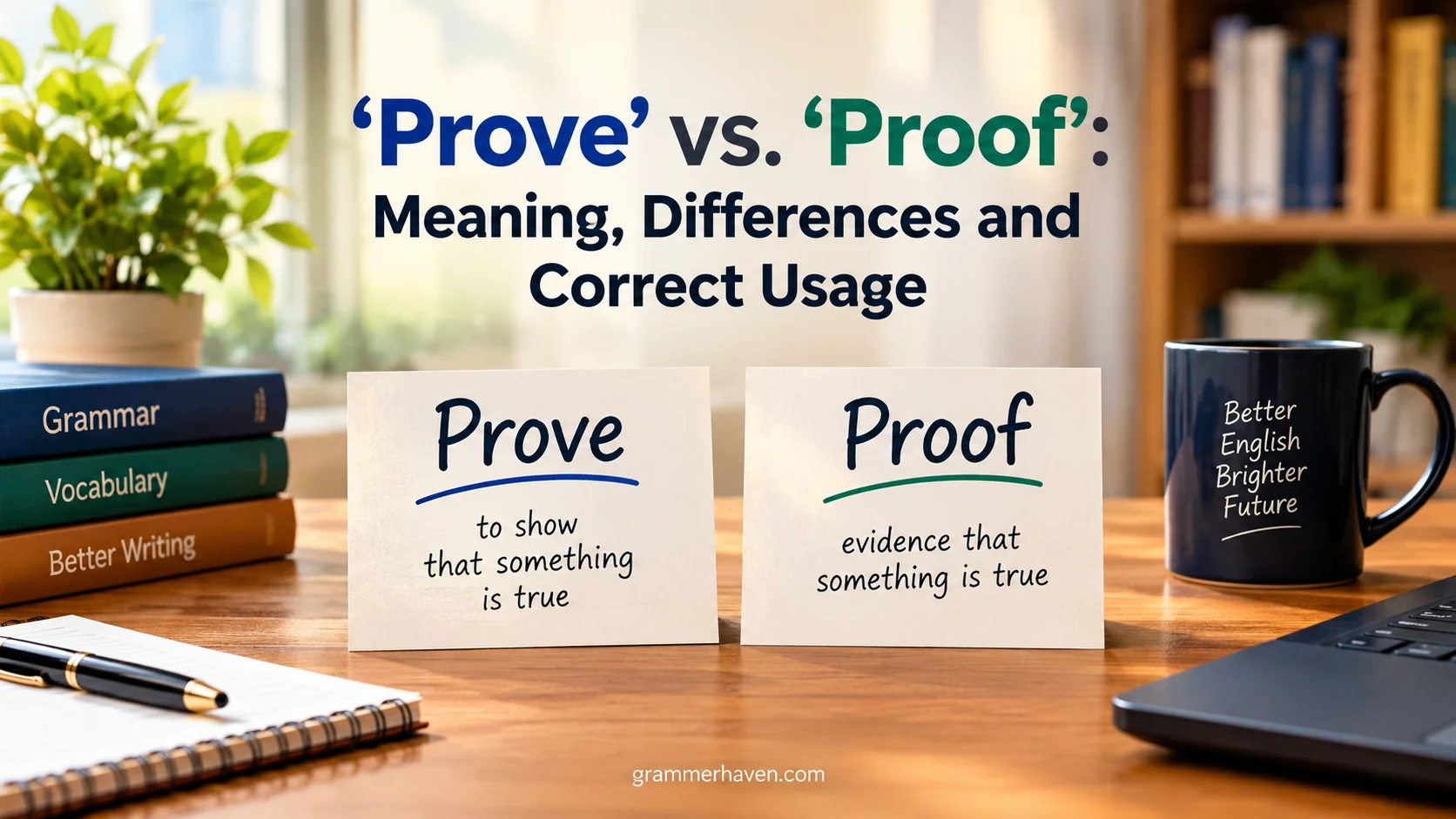
‘Prove’ vs. ‘Proof’: These words are closely related, but prove is a verb for an action while proof is a noun for evidence. Prove and proof can sound pretty much the same, yet their meanings are not interchangeable. Think of them as twins with different personalities and a common root. In learning English, knowing how to use each makes everyday English, academic writing, mathematics, legal language, and professional communication easier.
Their grammatical roles show the difference. In the first sentence, “She wants to prove her theory,” prove is the verb that names the action. In the second sentence, “He had the proof needed,” proof is the noun that names the evidence. You can compare these sentences to see how grammar changes the role of each word.
You prove something by showing it through evidence or an argument. Proof is the evidence or argument used to convince someone. An experiment can provide proof, while a researcher may prove a theory through evidence. This meaning applies to academic, legal, professional, and mathematical writing and language. Learners who understand these distinct uses can choose the right word with greater accuracy, making their communication more correct and natural.
Quick Answer
Prove is a verb that means to show or establish that something is true, correct, or genuine. Proof is a noun that means evidence, information, or documentation showing that something is true.
| Word | Part of Speech | Meaning | Example |
| Prove | Verb | To establish something as true | The records prove his claim. |
| Proof | Noun | Evidence that establishes something as true | The records are proof of his claim. |
A useful rule is:
You prove something. You provide proof of something.
For example:
- Can you prove that the statement is accurate?
- Do you have proof that the statement is accurate?
- The photographs prove that she was there.
- The photographs provide proof that she was there.
Both words belong to the same word family, but they aren’t interchangeable.
What Does “Prove” Mean?
Prove is a verb. It describes the act of showing that something is true, accurate, valid, or genuine.
Cambridge defines prove as showing that something is true and also uses it for situations where something demonstrates a particular quality or result over time. Oxford similarly defines it in terms of using facts or evidence to establish truth.
Consider this sentence:
The security footage proved that the suspect was inside the building.
Here, proved describes an action. The security footage established something as true.
How “Prove” Works in a Sentence
You can use prove in several common structures.
Prove + Noun
Use prove directly before an object when you establish something as true.
- The documents prove his ownership.
- The test proved the machine’s reliability.
- The photograph proves her presence at the event.
The noun after prove identifies what has been established.
Prove + That-Clause
This structure is especially common when you want to state the fact being established.
- The evidence proves that he was telling the truth.
- The results prove that the treatment works.
- The records prove that the payment was made.
The word that can sometimes be omitted in informal English.
- The evidence proves that he was there.
- The evidence proves he was there.
Both versions are grammatical.
Prove + Adjective
Prove can also describe something that turns out to have a particular quality.
- The plan proved successful.
- The task proved difficult.
- The prediction proved accurate.
This use doesn’t always involve formal evidence. Instead, experience or events demonstrate what something is really like.
Cambridge gives examples such as an operation that proved a complete success and a dispute that proved impossible to resolve.
Prove to Be
You can also use prove to be when something turns out to have a particular quality.
- The new method proved to be effective.
- The decision proved to be costly.
- The experiment proved to be successful.
This construction is common in formal and professional writing.
What Does “Proof” Mean?
Proof is primarily a noun. It refers to evidence, information, facts, or documents that show something is true.
Cambridge defines proof as a fact or piece of information showing that something exists or is true. Oxford also identifies documents and other information that establish truth as proof.
For example:
The receipt is proof of purchase.
The word proof doesn’t describe the action of establishing the fact. Instead, it names the evidence itself.
That’s the key difference.
How “Proof” Works in a Sentence
Several patterns are especially common.
Proof of + Noun
This is one of the most useful structures.
- proof of identity
- proof of ownership
- proof of purchase
- proof of payment
- proof of citizenship
- proof of fraud
Examples:
- You need proof of identity to open the account.
- Keep the receipt as proof of purchase.
- The documents provide proof of ownership.
Proof That + Clause
Use proof that when the following words express a complete idea.
- There is proof that the system failed.
- The results provide proof that the method works.
- They found proof that the account had been accessed.
Oxford lists both proof of something and proof that… as standard structures.
Provide Proof
This phrase is extremely common in formal writing.
- Please provide proof of address.
- The applicant must provide proof of income.
- The company provided proof that the transaction was legitimate.
Here, provide is the verb while proof functions as the noun.
That’s an important grammatical clue. You don’t need to turn proof into a verb because another verb already performs the action.
‘Prove’ vs. ‘Proof’: The Main Difference
The easiest way to understand prove vs. proof is to think about action versus evidence.
Prove describes what someone or something does.
Proof describes the evidence used to establish something.
| Feature | Prove | Proof |
| Main part of speech | Verb | Noun |
| Basic idea | Establish truth | Evidence of truth |
| Describes an action? | Yes | No |
| Common pattern | prove something | proof of something |
| Another common pattern | prove that… | proof that… |
| Example | The evidence proves his claim. | The evidence is proof of his claim. |
Think of it like a courtroom.
A witness may provide proof through testimony or documents. The evidence may help a lawyer prove a claim.
The first word names the evidence. The second describes the act of establishing the claim.
A Simple Memory Trick
Remember this:
Prove = do the showing.
Proof = what helps with the showing.
For example:
- The video proves what happened.
- The video is proof of what happened.
If you’re unsure which word to use, check whether your sentence needs an action or a thing.
If you need a verb, prove is usually the right choice.
‘Prove’ vs. ‘Proof’ in Different Contexts
The distinction becomes even clearer when you look at how these words work in different fields.
In Everyday Conversation
Both words appear frequently in ordinary discussions.
Imagine a friend says:
I didn’t break the vase.
You might ask:
Can you prove it?
Here, prove describes the action of establishing innocence.
If your friend produces a security-camera recording, you might say:
That’s proof that you didn’t break it.
The grammatical roles remain consistent even though the situation is informal.
In Academic Writing
Academic writing often uses prove when describing what research, calculations, or evidence establishes.
- The experiment proves the hypothesis.
- The data prove that the relationship exists.
- The researchers proved their prediction incorrect.
However, academic writers often distinguish proof from evidence. In many scientific contexts, evidence supports a conclusion without establishing it with the absolute certainty associated with mathematical proof.
That distinction matters.
A scientific study might provide strong evidence for a conclusion without being described as mathematical proof. The appropriate word depends on the field and the strength of the claim.
In Mathematics
Mathematics gives us one of the clearest examples of the relationship.
Prove is the verb:
We need to prove the theorem.
Proof is the noun:
We need to provide a proof of the theorem.
A mathematical proof is a logical argument that establishes a mathematical statement from accepted premises, definitions, and previously established results. Cambridge specifically identifies proof as a logical argument showing that a mathematical or scientific statement is correct.
So:
- The mathematician proved the theorem.
- The mathematician presented a proof of the theorem.
The relationship is almost impossible to miss.
In Legal Contexts
Legal writing frequently uses both words, but they still have different grammatical roles.
- The prosecution must prove its case.
- The prosecution presented proof of the defendant’s involvement.
- The documents provided proof of ownership.
- The witness testimony helped prove the allegation.
Legal language also uses the phrase burden of proof, which refers to the obligation to establish a claim under the applicable legal standard. Oxford lists burden of proof as a standard expression.
In Science
Science requires a little more care.
People often say that an experiment “proved” something. In scientific writing, however, researchers usually discuss evidence, support, confirmation, or demonstration because scientific conclusions remain open to further testing.
For example:
- The experiment provided strong evidence for the hypothesis.
- The results support the proposed explanation.
- The findings demonstrated that the treatment produced a measurable effect.
That doesn’t make prove incorrect in every scientific context. It simply means that proof can carry a stronger sense of certainty than researchers intend.
Common Mistakes With “Prove” and “Proof”
Using “Proof” as a Verb
A common error is treating proof as though it were the ordinary verb corresponding to prove.
Incorrect:
The documents proof that he owns the property.
Correct:
The documents prove that he owns the property.
Another correct version is:
The documents provide proof that he owns the property.
The difference is simple. Prove already functions as the verb.
Using “Prove” as a Noun
The opposite mistake happens when someone needs a noun but chooses prove.
Incorrect:
We need prove of his identity.
Correct:
We need proof of his identity.
You could also write:
We need to prove his identity.
Notice how changing the word changes the entire grammatical structure.
Confusing Proof With Evidence
Proof and evidence overlap considerably, but they aren’t always identical in tone or use.
Evidence can mean information that indicates something is true. Proof often suggests information that establishes or demonstrates truth more decisively.
Compare:
- The fingerprints are evidence that he was there.
- The fingerprints are proof that he was there.
The second statement makes a stronger claim about what the fingerprints establish.
In careful writing, especially when certainty matters, choose the word that matches the strength of your evidence.
‘Prove’ vs. ‘Proof’ Examples
Seeing the words side by side makes the distinction much easier.
Examples With “Prove”
- The receipt proves that she paid the bill.
- The photographs prove his presence at the scene.
- The experiment proved successful.
- The records prove that the payment was made.
- She worked hard to prove her ability.
- The evidence proved him innocent.
Examples With “Proof”
- The receipt is proof that she paid the bill.
- The photographs provide proof of his presence.
- The successful experiment was proof that the method worked.
- The records are proof of payment.
- Her achievements are proof of her ability.
- The documents provided proof of his innocence.
Side-by-Side Comparison
| Prove | Proof |
| The receipt proves she paid. | The receipt is proof that she paid. |
| The photo proves he was there. | The photo is proof of his presence. |
| The records prove ownership. | The records provide proof of ownership. |
| The test proved the product was safe. | The test provided proof of the product’s safety. |
| The data prove the claim. | The data provide proof for the claim. |
The sentence structure changes because the grammatical role changes.
Related Words: “Proved,” “Proven,” and “Proof”
Understanding proved and proven can prevent another common source of confusion.
Proved is the standard past tense of prove. It can also function as a past participle.
- She proved her point.
- The test proved effective.
- They have proved their case.
Proven is also used as a past participle, especially in North American English. Cambridge notes proved or mainly US proven in its entry for prove, while Oxford identifies proven as especially common in North American English.
For example:
- The method has proven effective.
- She has proven her ability.
- The technology is proven to work.
Proven is also common as an adjective:
- a proven method
- a proven strategy
- a proven track record
Cambridge defines proven as something shown to be true.
Prove, Proved, Proven, and Proof
| Word | Role | Example |
| Prove | Present-tense verb | We need to prove the claim. |
| Proves | Third-person singular verb | The evidence proves the claim. |
| Proved | Past tense/past participle | The test proved effective. |
| Proven | Past participle/adjective | The method has proven effective. |
| Proof | Noun | The results provide proof. |
The word family is closely connected, but each form has its own grammatical function.
“Prove” vs. “Proof” vs. “Evidence” vs. “Demonstrate”
These words can overlap, but they’re not perfect substitutes.
| Word | Part of Speech | Main Function | Example |
| Prove | Verb | Establish truth | The evidence proves the claim. |
| Proof | Noun | Evidence establishing truth | The evidence is proof of the claim. |
| Evidence | Noun | Information supporting a conclusion | The evidence supports the claim. |
| Demonstrate | Verb | Show clearly through evidence or action | The experiment demonstrates the effect. |
When “Evidence” May Be Better Than “Proof”
Use evidence when you’re describing information that supports a conclusion without necessarily claiming absolute certainty.
For example:
The study provides evidence that regular exercise improves cardiovascular health.
That wording leaves room for scientific interpretation and additional research.
By contrast:
The study provides proof that regular exercise improves cardiovascular health.
This sounds much more absolute.
Neither sentence is automatically right or wrong. The context determines which word communicates the intended level of certainty.
How to Choose Between “Prove” and “Proof”
Choosing between these words becomes straightforward when you look at the sentence structure.
Use “Prove” When:
- You need a verb.
- Someone or something establishes a fact.
- You describe the action of demonstrating truth.
- You want to use structures such as prove that or prove something.
Examples:
- Can you prove your claim?
- The evidence proves his innocence.
- The results prove that the system works.
Use “Proof” When:
- You need a noun.
- You’re talking about evidence or documentation.
- You use structures such as proof of or proof that.
- You want to name the material supporting a claim.
Examples:
- Do you have proof?
- We need proof of identity.
- The results provide proof that the system works.
A Quick Grammar Test
When you’re stuck, try replacing the word with show.
If the sentence needs an action, prove may fit:
The document ___ that he paid.
→ The document shows that he paid.
Therefore:
The document proves that he paid.
Now try replacing the word with evidence.
The document is ___ of payment.
→ The document is evidence of payment.
That suggests:
The document is proof of payment.
This isn’t a foolproof grammar test for every sentence, but it’s a useful shortcut.
A Practical Case Study: “Prove” or “Proof”?
Imagine that a company claims it refunded a customer $500.
The customer disputes the claim. The company has a bank transaction record showing that the refund was processed.
You could write:
The bank record proves that the company issued the refund.
Here, proves is a verb. It describes what the record does.
You could also write:
The bank record is proof that the company issued the refund.
Here, proof is a noun. It identifies the record as evidence.
You could even use both in one sentence:
The bank record provides proof that the company issued the refund and therefore proves the transaction occurred.
The words work together because they perform different grammatical jobs.
Other Meanings of “Proof”
The word proof has meanings beyond evidence.
Proof in Printing
A proof can refer to a preliminary printed copy that someone checks for errors before final publication.
For example:
The editor reviewed the page proofs before publication.
Cambridge lists this as a distinct noun meaning a printed copy examined and corrected before final copies are produced.
Proof as a Suffix
You also see -proof in words such as:
- waterproof
- fireproof
- bulletproof
- weatherproof
- frost-proof
In these compounds, -proof generally conveys the idea of protection against or resistance to something. Cambridge identifies this use as a suffix meaning “protecting against” or “not damaged by” a particular thing.
For example:
The jacket is waterproof.
Here, proof isn’t being used in the ordinary noun sense of evidence.
Proof in Alcohol Terminology
Proof also has a specialized meaning related to alcoholic strength in the United States. In that context, the proof number is twice the alcohol-by-volume percentage.
For example, a drink labeled 80 proof contains 40% alcohol by volume.
This meaning has nothing to do with proving a claim. It’s simply another historical use of the same word.
See also: Dialog vs. Dialogue: Which Spelling Is Correct?
FAQs:
Is “prove” a verb or a noun?
Prove is primarily a verb. It means to establish or demonstrate that something is true, correct, or genuine.
Example:
The documents prove his identity.
Is “proof” a verb or a noun?
Proof is primarily a noun when it means evidence showing that something is true.
Example:
The documents are proof of his identity.
However, proof can also function as a verb in specialized contexts, such as proofing a surface against water. Cambridge lists this specialized verb use.
What is the difference between “prove” and “proof”?
Prove describes the action of establishing something as true. Proof refers to the evidence that establishes or supports that conclusion.
In short:
Prove = verb
Proof = noun
Is “proof” the same as “evidence”?
Not always. The two words overlap, but proof can suggest stronger or more conclusive support than evidence.
For example, evidence may support a theory while proof may be used when the writer believes the evidence establishes the matter conclusively.
Is “proven” the same as “proved”?
Both are forms of prove. Proved is the standard past tense and past participle, while proven is also widely used as a past participle, particularly in North American English. Proven is especially common as an adjective, as in a proven method.
Conclusion:
The difference between prove and proof comes down to their grammatical roles. Prove is a verb that describes the action of showing something is true, while proof is a noun that refers to the evidence used to establish that truth. You can prove a claim, but you need proof of a claim.
For example, “The documents prove his identity” describes what the documents do. In contrast, “The documents are proof of his identity” describes what the documents represent. Once you recognize this simple distinction between action and evidence, choosing the correct word becomes much easier. Keep prove for the action and proof for the evidence, and you’ll avoid one of the most common mistakes involving these closely related words.