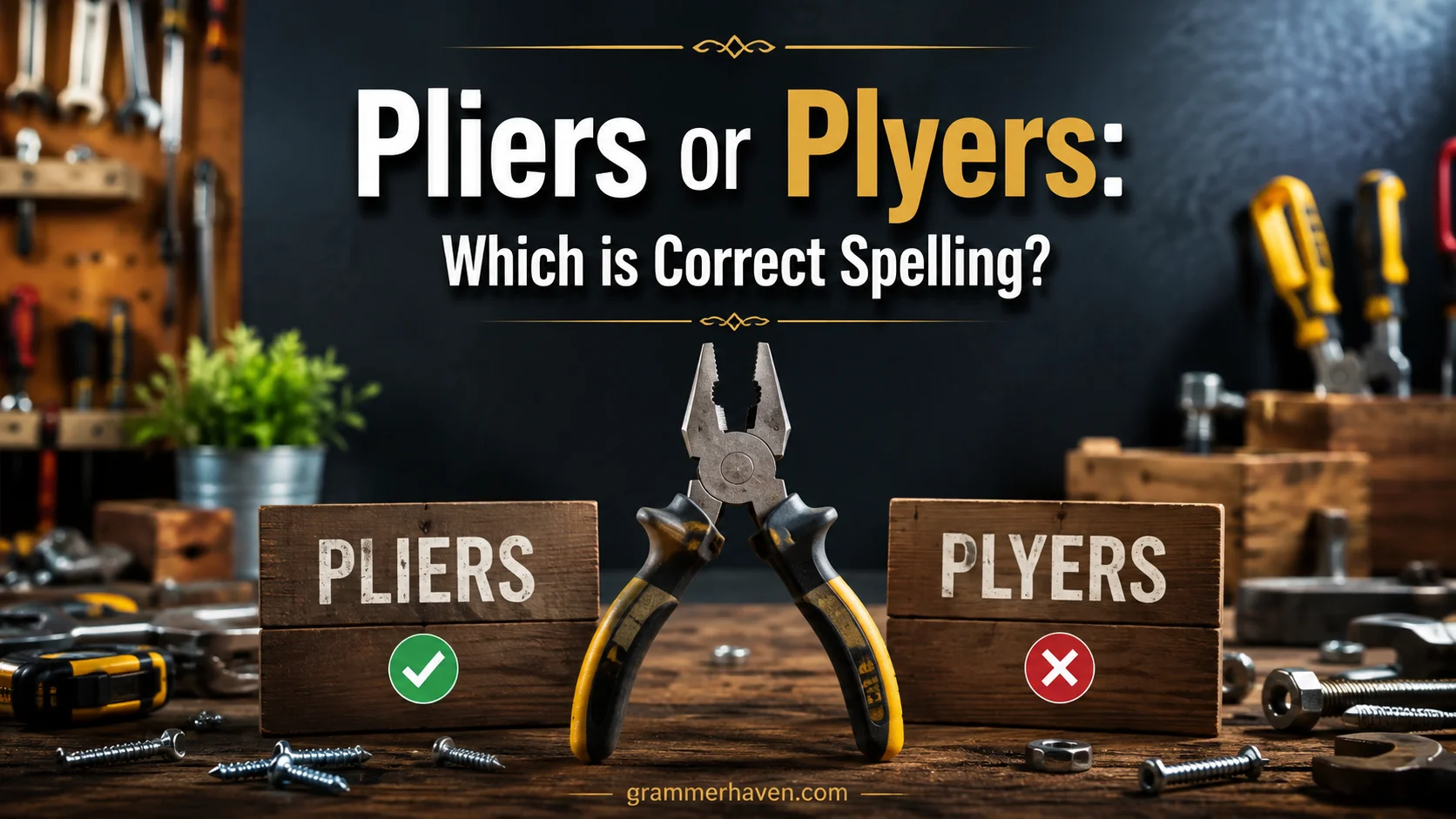
Pliers or Plyers: Which is Correct Spelling? can help you avoid a common spelling mistake when you’re writing homework, DIY guides, or blog posts. Have you ever typed plyers and paused, thinking about whether pliers is the right word instead? You’re not alone. Many people search for plyers or pliers because the two words sound exactly the same. This confusion is common in homework, DIY guides, shopping lists, and blog posts, where one small spelling mistake can make your writing look careless or unprofessional. That matters even more in school assignments, technical documents, and an everyday business document.
The correct spelling is pliers, while Plyers is a nonstandard misspelling. The pronunciation creates the difference problem because both forms may sound alike when spoken. In American English and British English, pliers remains the correct form. Modern English dictionaries and professional style guides support this spelling, so you can use it confidently in English writing. From reviewing practical examples, I’ve found that spelling errors like this often happen when people rely on sound instead of checking established terminology.
When you create educational content, a product description, or more DIY guides, use Pliers, not Plyers. The clear answer follows a simple rule: choose pliers every time. A useful memory trick is to connect the word with the tool that plies, bends, and grips material. This can help you remember the correct spelling and avoid mistakes. The common mistakes often come from treating Pliers vs Plyers as two accepted forms, but only pliers is the standard choice. Whether you’re working on everyday writing or professional material, the correct form improves clarity, professionalism, and credibility.
Pliers or Plyers: Which Spelling Is Correct?
The correct word is pliers.
The spelling “plyers” is a common mistake that appears because the pronunciation sounds similar. Many people type “plyers” when searching online because English pronunciation does not always make spelling obvious.
However, when you’re talking about the hand tool, the correct spelling is:
Pliers = a tool used for gripping, bending, cutting, twisting, and holding objects.
The word “plyers” does have a connection to English vocabulary because “ply” means to work with, use, or apply something. However, it is not the accepted spelling for the tool.
Quick comparison: Pliers vs Plyers
| Word | Correct spelling? | Meaning |
| Pliers | ✅ Yes | A hand tool with jaws used for gripping, cutting, bending, or holding |
| Plyers | ❌ No | A common spelling mistake when referring to the tool |
A simple way to remember it:
“Pliers grip. Plyers don’t exist as a tool name.”
What Are Pliers?
Pliers are handheld tools designed to grip and manipulate objects. They consist of two metal levers connected by a pivot point, allowing the user to apply more force than they could with their fingers alone.
At first glance, pliers may seem like basic tools. Yet their design is based on one of the most important principles in mechanics: leverage.
When you squeeze the handles, the pivot transfers your hand force to the jaws. The jaws then apply concentrated pressure to the object being held.
For example, removing a tight wire connector with your fingers would be difficult. A pair of pliers gives you the extra grip needed to twist and pull it free.
The History of Pliers
Pliers have existed for thousands of years. Early versions appeared during the Bronze Age when metalworkers needed tools to handle hot materials.
Ancient blacksmiths used simple gripping tools to hold heated metal while shaping weapons, tools, and household items.
Over time, pliers evolved from basic metal clamps into specialized tools designed for specific industries.
Modern pliers now serve many fields, including:
- Electrical work
- Automotive repair
- Plumbing
- Jewelry making
- Construction
- Manufacturing
- Electronics repair
- Home maintenance
Today, there are dozens of plier designs, each built for a specific purpose.
How Do Pliers Work?
Pliers work through the principle of mechanical advantage.
A person’s hand can only produce a certain amount of force. Pliers multiply that force by using a lever system.
The basic mechanics include:
- Effort force: The pressure applied by your hand on the handles
- Pivot point: The joint connecting both sides of the tool
- Load force: The gripping pressure created at the jaws
The closer the jaws are to the pivot point, the greater the gripping force becomes.
Example:
Imagine trying to bend a thick wire with your fingers.
You might struggle because your fingers cannot create enough pressure. When you use pliers, the tool transfers your hand movement into a stronger gripping force, making the job much easier.
Main Parts of Pliers
Understanding the parts of pliers helps you choose the right tool and use it correctly.
| Part | Function |
| Jaws | Grip, hold, twist, or manipulate materials |
| Pivot joint | Allows the two halves of the tool to move together |
| Handles | Provide control and leverage |
| Cutting edges | Cut wire or thin materials on certain models |
| Tip | Provides precision for detailed work |
| Grip coating | Improves comfort and reduces slipping |
Different pliers change these parts depending on their purpose.
For example:
- Needle nose pliers have long, narrow jaws for precision work.
- Lineman’s pliers have strong jaws and cutters for electrical tasks.
- Tongue and groove pliers have adjustable jaws for larger objects.
Types of Pliers and Their Uses
Not all pliers perform the same job. Choosing the wrong type can damage materials, reduce efficiency, or even create safety risks.
Below are the most common types of pliers and what they are designed to do.
Slip Joint Pliers
Slip joint pliers are among the most common household pliers.
They feature an adjustable pivot that allows users to change the jaw opening size. This makes them useful for general repairs where you need flexibility.
Common uses:
- Tightening nuts
- Holding pipes
- Gripping hardware
- Removing nails
- Adjusting household fixtures
Best for:
Homeowners who need one versatile pair of pliers for basic repairs.
A typical toolbox often starts with slip joint pliers because they handle many small tasks without requiring specialized equipment.
Needle Nose Pliers (Long Nose Pliers)
Needle nose pliers have long, narrow jaws that allow users to reach areas where normal pliers cannot fit.
They are especially useful when working with small components.
Common uses:
- Electronics repair
- Jewelry work
- Bending wires
- Holding tiny objects
- Reaching inside tight spaces
Example:
A technician repairing a circuit board may use needle nose pliers to position a small wire without touching nearby components.
Their narrow design provides control rather than maximum gripping power.
Lineman’s Pliers
Lineman’s pliers are heavy-duty tools commonly used by electricians.
They combine gripping jaws with powerful cutting edges, making them useful for handling electrical wires.
Common uses:
- Cutting electrical cable
- Twisting wires together
- Pulling wire
- Removing insulation in certain situations
Professional electricians often carry lineman’s pliers because they combine multiple functions in one tool.
Important safety note:
Never use regular pliers on live electrical systems. Electrical work requires properly rated insulated tools and appropriate safety procedures.
Diagonal Cutting Pliers
Diagonal cutting pliers, also called side cutters, are designed primarily for cutting.
Unlike gripping pliers, their jaws meet at an angle that creates a powerful cutting action.
Common uses:
- Cutting wire
- Trimming cable ties
- Cutting small metal components
- Removing excess material
They are popular among:
- Electricians
- Technicians
- Craftspeople
- DIY users
A dedicated cutting tool often creates cleaner results than using general-purpose pliers.
Tongue and Groove Pliers
Tongue and groove pliers are sometimes called channel-lock pliers, although Channel Lock is a specific brand name.
These pliers have adjustable grooves that allow the jaws to open wider.
Common uses:
- Plumbing repairs
- Pipe fittings
- Large nuts and bolts
- Automotive work
Their wide adjustment range makes them useful when working with objects of different sizes.
For example, a plumber may use tongue and groove pliers to hold a pipe while tightening a fitting.
Locking Pliers
Locking pliers use a special mechanism that allows them to clamp onto an object and stay locked.
They are often known by the brand name Vise-Grip, although many manufacturers produce similar tools.
Common uses:
- Holding parts during repairs
- Removing damaged bolts
- Clamping materials together
- Temporary gripping
Locking pliers are especially useful when you need both hands free while keeping an object secure.
Snap Ring Pliers
Snap ring pliers are specialized tools designed for installing and removing retaining rings.
These rings hold components in place inside machinery, engines, and mechanical systems.
Common uses:
- Automotive repairs
- Equipment maintenance
- Machine assembly
They come in two main versions:
| Type | Purpose |
| Internal snap ring pliers | Used inside holes or bores |
| External snap ring pliers | Used around shafts |
Using the correct type prevents damage to the ring and surrounding components.
Circlip Pliers
Circlip pliers serve a similar purpose to snap ring pliers. They handle circlips, which are small retaining rings used in mechanical assemblies.
They are commonly found in:
- Automotive repair shops
- Motorcycle maintenance
- Industrial equipment servicing
Because circlips are often small and spring-loaded, specialized pliers provide better control than standard tools.
See also: Per Se or Per Say: Which Spelling Is Correct?
FAQs:
1. Is it “pliers” or “plyers”?
Pliers is the correct spelling. Plyers is a common misspelling and isn’t considered standard English.
2. Why do people spell pliers as plyers?
People often write plyers because both spellings sound the same when spoken. The pronunciation can make the correct spelling easy to forget.
3. Is “plyers” accepted in American English?
No. Pliers is the standard spelling in American English. You should use it in formal and everyday writing.
4. Is “pliers” also correct in British English?
Yes. Pliers is the standard spelling in British English as well, so you don’t need a different spelling based on the variety of English you use.
5. How can I remember the spelling of pliers?
Think of pliers as the tool that grips, bends, and pulls materials. Linking the spelling to the tool can help you remember that pliers is correct.
Conclusion:
When you’re choosing between pliers and plyers, always use pliers. Although both forms sound alike, plyers is a nonstandard spelling. Whether you’re writing a school assignment, DIY guide, product description, or professional document, using pliers keeps your writing clear, accurate, and professional.