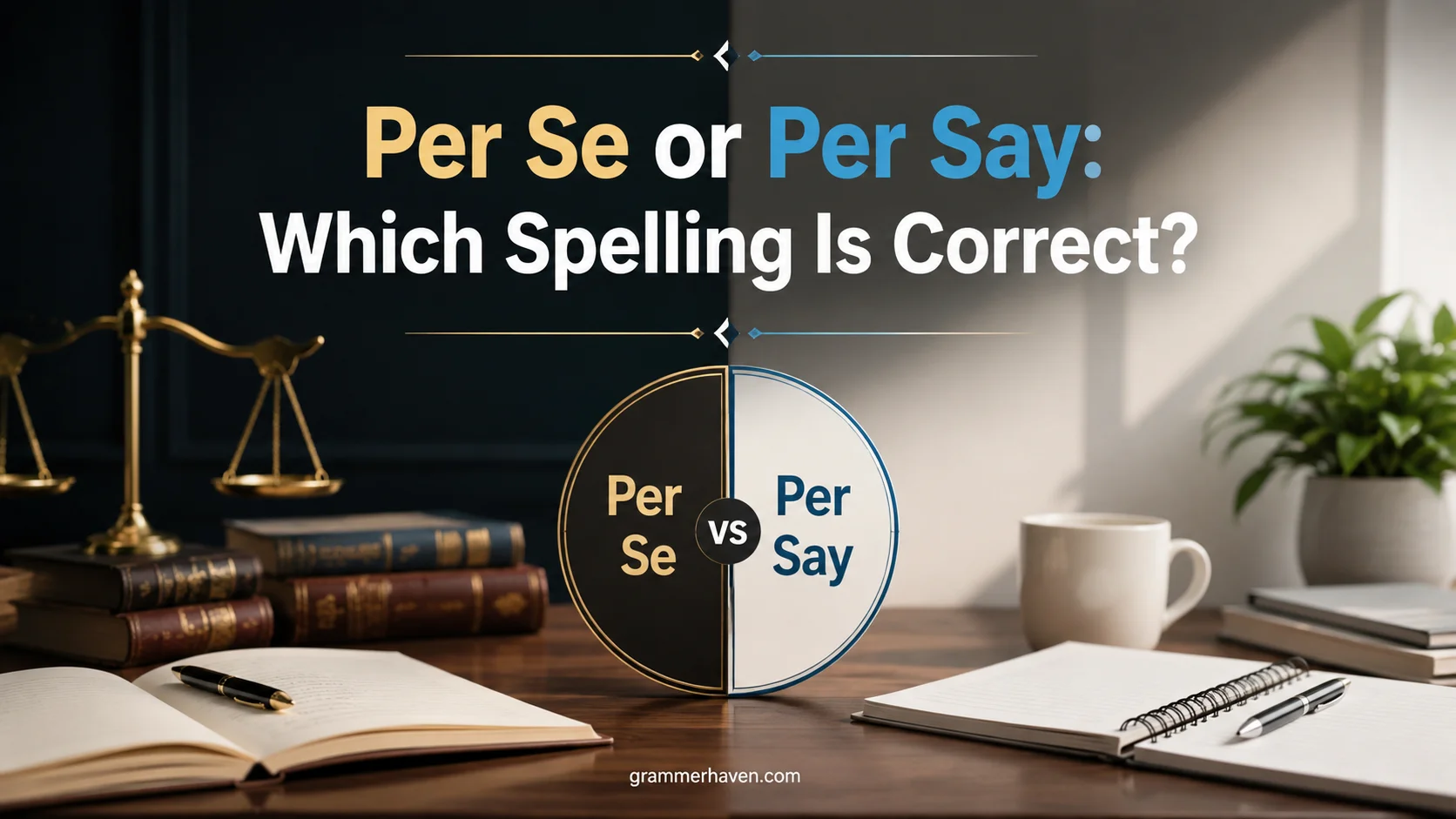
Per Se or Per Say: Which Is Correct? explains why per se is the correct spelling, while per say is a common misspelling. If you’ve ever typed “per say,” paused, and looked right at it, you’re not alone. Many English learners, students, and professionals get confused because both phrases sound alike when spoken. The phrase per se comes from Latin and means “by itself” or “in itself.” You can use it to describe the nature of something without focusing on its related details or effects. For example, “Working late isn’t bad per se, but doing it every night may be a bad idea.” The meaning depends on the context, so calling something inherently unfair or Incorrect without considering the situation can be an unfair way to judge it.
A simple memory tip can help you remember the original spelling: per se uses “se,” not “say,” because it’s a fixed phrase from Latin. When you choose the spelling for writing, emails, essays, social posts, or a polished article, per se is the form you should use. I’ve found that explaining the meaning first makes this tricky spelling easier for language learners to remember. Don’t mix it up simply because the phrase sounds like “per say.” The rule should be applied fairly, because people may make mistakes in English spelling while learning the language. The better evidence is the standard form per se, which keeps your communication clear and helps you write confidently.
Per Se or Per Say: The Quick Answer
The correct phrase is per se.
The phrase per say does not exist in standard English. It appears because people often write words based on how they hear them. Since se sounds like “say,” many writers accidentally replace the Latin spelling with the English word say.
Here is the difference:
| Phrase | Correct? | Meaning |
| Per se | ✅ Correct | By itself; in itself; considered independently |
| Per say | ❌ Incorrect | Not a recognized English phrase |
Correct examples:
- “The plan isn’t expensive per se, but the long-term costs add up.”
- “Social media isn’t harmful per se; the problem comes from how people use it.”
- “The product isn’t revolutionary per se, but it improves existing technology.”
Incorrect examples:
- “The plan isn’t expensive per say.” ❌
- “The movie wasn’t terrible per say.” ❌
The fix is always the same:
Replace “per say” with “per se.”
What Does Per Se Mean?
The phrase per se means “in itself” or “by itself.”
When you use it, you are looking at something separately from outside influences, comparisons, or related issues.
Think of it like examining a single ingredient in a recipe.
A cake might taste bad because of poor baking, too much sugar, or the wrong combination of ingredients. But if someone asks, “Is sugar bad per se?” they are asking whether sugar itself is automatically bad when considered alone.
The phrase helps you separate the thing itself from everything around it.
Simple Definition of Per Se
Per se means something considered independently, without adding outside factors.
Here are some easy examples:
Example 1: Money
“Money isn’t evil per se.”
Meaning:
Money itself is not automatically evil. The way someone uses it determines whether the result is positive or negative.
Example 2: Technology
“Technology isn’t dangerous per se.”
Meaning:
Technology itself is not always dangerous. Problems usually come from misuse, poor design, or irresponsible behavior.
Example 3: Exercise
“Running isn’t difficult per se, but training for a marathon requires commitment.”
Meaning:
Running itself is not necessarily difficult. The challenge comes from the larger goal.
Per Se Meaning in Everyday English
Although per se sounds formal, people use it in normal conversations, workplace discussions, and writing.
It often appears when someone wants to make a careful distinction.
Instead of saying:
“That idea is wrong.”
Someone might say:
“That idea isn’t wrong per se, but it needs more evidence.”
The speaker is softening the statement and showing a more balanced view.
This makes per se useful when discussing complicated topics where a simple yes-or-no answer does not work.
The Origin of Per Se: Why Does English Use This Latin Phrase?
The phrase per se comes from Latin.
In Latin:
- per means “by” or “through”
- se means “itself”
Together, per se literally means “by itself.”
English borrowed thousands of words and phrases from Latin because Latin influenced law, education, science, religion, and philosophy for centuries.
Some common Latin expressions still used in English include:
| Latin Phrase | Meaning | Example |
| Per se | By itself | “The rule isn’t unfair per se.” |
| Per capita | Per person | “Income per capita increased.” |
| Ad hoc | For a specific purpose | “They created an ad hoc committee.” |
| De facto | In reality | “English is the de facto global business language.” |
| Bona fide | Genuine | “She is a bona fide expert.” |
| Vice versa | The opposite way around | “The same rule applies vice versa.” |
Unlike many borrowed phrases that changed significantly, per se kept its original meaning fairly closely.
Why Do People Confuse Per Se and Per Say?
The per se vs per say mistake happens mainly because English spelling does not always match pronunciation.
When someone hears:
“That isn’t true per se.”
They hear something close to:
“That isn’t true per say.”
The brain naturally tries to connect unfamiliar sounds with familiar words.
This happens with many English words.
Examples:
| Correct Word | Common Mistake | Reason |
| Per se | Per say | Sounds identical |
| Definitely | Definately | Pronunciation confusion |
| Separate | Seperate | Spelling follows sound |
| Receive | Recieve | Letter pattern confusion |
Because say is a common English word, people often choose it without realizing the phrase comes from Latin.
How to Use Per Se Correctly
Using per se correctly requires understanding its purpose.
The phrase usually appears when you want to say:
“This thing alone is not necessarily the problem.”
The structure often looks like this:
Subject + is/isn’t + quality + per se
Examples:
- “The policy isn’t unfair per se.”
- “The design isn’t ugly per se.”
- “The argument isn’t wrong per se.”
- “The restaurant isn’t expensive per se.”
Per Se Sentence Examples in Different Situations
Workplace Examples
In professional conversations, per se helps people express opinions carefully.
Example:
“The meeting wasn’t unproductive per se, but we could have prepared better.”
Meaning:
The meeting had value, but improvements were possible.
Another example:
“Remote work isn’t difficult per se; managing communication is the real challenge.”
Academic Examples
Researchers often use per se when separating concepts.
Example:
“The technology is not harmful per se; the ethical concerns come from its application.”
This distinction matters because academic discussions often examine causes, effects, and conditions.
Business Examples
Business professionals use the phrase when evaluating products, strategies, or decisions.
Example:
“The marketing campaign wasn’t unsuccessful per se, but it failed to reach the intended audience.”
Meaning:
The campaign itself had some strengths, but it did not achieve its goal.
Everyday Conversation Examples
You can use per se casually when you want to be precise.
Examples:
“I don’t dislike vegetables per se. I just prefer fruit.”
“The restaurant wasn’t bad per se, but I wouldn’t visit again.”
“I’m not against change per se. I just want a better plan.”
See also: Roll Call vs. Role Call: Which Spelling Is Correct?
Per Se vs Per Say: Common Mistakes Explained
Many people make the same mistakes repeatedly because they misunderstand what the phrase means.
Here are the most common errors.
| Mistake | Why It Happens | Correct Version |
| Writing “per say” | It sounds correct when spoken | Per se |
| Using it when you mean “specifically” | Confusing meanings | Use “specifically” instead |
| Overusing it in every sentence | Trying to sound formal | Use only when it adds clarity |
| Treating it as a synonym for “literally” | Different meanings | Use the correct word |
FAQs:
1. Is “per se” or “per say” correct?
Per se is the correct spelling. Per say is a common misspelling caused by the way the phrase sounds when spoken.
2. What does “per se” mean?
Per se is a Latin phrase that means “by itself” or “in itself.” It focuses on something in its own nature, without considering other factors.
3. Why do people spell “per se” as “per say”?
People often write per say because per se sounds similar when spoken. This makes the spelling tricky, especially for English learners.
4. How do you use “per se” in a sentence?
You can use per se when you want to say that something isn’t necessarily good or bad by itself. For example: “Working late isn’t bad per se, but doing it every night can cause problems.”
5. Is “per se” suitable for formal writing?
Yes. Per se works well in formal and everyday writing, including emails, essays, articles, and professional communication. Just make sure you spell it correctly.
Conclusion:
Per se is the correct form, while per say is a misspelling. Since the phrase comes from Latin and means “by itself” or “in itself,” remembering its original spelling can help you avoid this common mistake. Whenever you’re unsure, choose per se for clear and polished English.