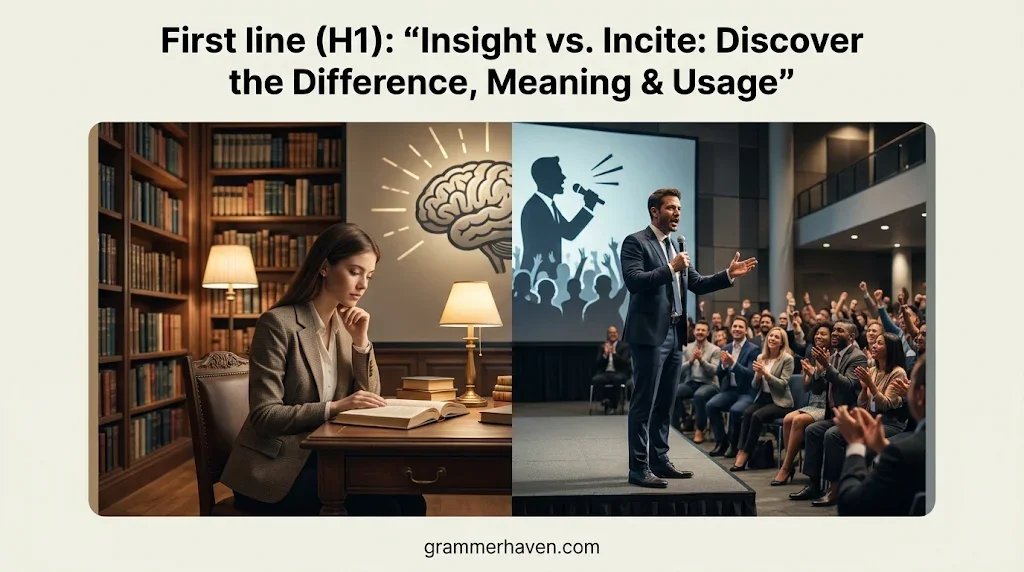
Insight vs. Incite: Discover the Difference helps you master similar English words with clear meanings, stronger vocabulary, and confident writing.
Words can be tricky creatures, especially when similar terms sound alike but carry a different meaning. Today, you are tackling Insight vs. Incite to build a better understanding of their difference while polishing your vocabulary. Picking the right tool for the job lets you communicate clearly in the world of English. Through learning, mastering key distinctions, and avoiding grammar mistakes, your writing stands apart. Skip the long lecture and focus on clear, plain definitions that explain each word effectively. This twist may surprise you, yet the small detail is crucial for better communication, deep knowledge, seeing every situation, grasping the true nature of each word, and improving your language use.
From my editing experience, one example often involves gaining insight into human behavior to help solve social issues. In contrast, incite means to stir, provoke, or encourage action in a negative sense. It means encouraging someone to act, often causing trouble, violence, or conflict. For instance, inciting a crowd may lead to unrest. The language plays tricks on the eye because these words look alike but belong to different worlds. Swap one letter, and the meaning flips from calm understanding to emotional action. That small change can shift the tone, intent, legality, and overall use of a sentence.
With regular practice, it becomes simple to avoid errors. Many people mix or mix up these words, including writers, students, marketers, journalists, and professionals. This misuse happens every day, and the result is often confusion, lost credibility, serious misunderstandings, or a lasting misunderstanding. This guide breaks down the topic with real clarity, real examples, and real usage, not fluff or vague claims. A solid approach develops language mastery, produces stronger and trustworthy writing, and improves clarity, behavior, tone, intent, emotional context, calm expression, every change, every letter, proper usage, credibility, mastery, making your writing more accurate and trustworthy.
Insight vs. Incite at a Glance
Before diving deeper, here’s a quick comparison.
| Feature | Insight | Incite |
| Part of Speech | Noun | Verb |
| Meaning | Deep understanding of something | To encourage or provoke action |
| Connotation | Positive or neutral | Usually negative |
| Common Usage | Business, research, psychology, learning | Politics, conflict, law, social issues |
| Example | “Her insight improved the strategy.” | “The speech incited violence.” |
The Simplest Rule
If you’re talking about understanding, use insight.
If you’re talking about provoking action, use incite.
What Does Insight Mean?
The word insight refers to a deep, accurate understanding of a person, situation, idea, or problem.
Unlike ordinary knowledge, insight involves seeing beneath the surface. It helps people recognize patterns, uncover causes, and make better decisions.
Definition of Insight
Insight (noun): A clear and deep understanding of a complicated issue, person, or situation.
Example
“The customer survey provided valuable insight into buyer behavior.”
In this example, the survey revealed useful understanding rather than simply presenting raw information.
Why Insight Matters
Insight plays a crucial role in nearly every field.
Businesses rely on insights to understand customers.
Psychologists use insights to understand behavior.
Researchers seek insights to solve complex problems.
Individuals gain insights that help them make better life decisions.
Without insight, people often react based on assumptions instead of evidence.
Common Contexts Where Insight Is Used
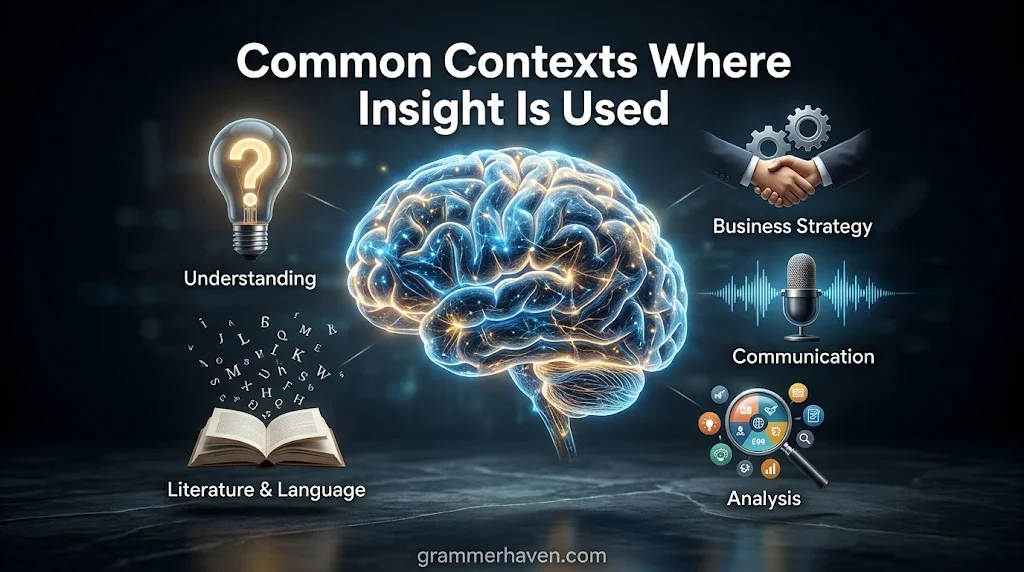
Business and Marketing
Companies spend millions collecting customer insights.
A business may discover:
- Why customers abandon shopping carts
- Which products perform best
- What motivates purchases
- Which marketing campaigns drive conversions
The difference between data and insight is significant.
Data tells you what happened.
Insight explains why it happened.
Example
| Data | Insight |
| Website traffic dropped 20% | Mobile users experienced slower page load times |
| Sales increased 15% | New product bundles encouraged larger purchases |
Psychology
Psychologists often discuss personal insight.
A person with insight may understand:
- Emotional triggers
- Behavioral patterns
- Relationship challenges
- Decision-making habits
Greater self-awareness often leads to healthier choices.
Education
Students who develop insight don’t simply memorize information.
Instead, they understand:
- Concepts
- Relationships
- Causes
- Implications
That’s why insight is often associated with critical thinking.
Personal Development
Many life-changing moments begin with insight.
Someone may suddenly realize:
- Why a habit persists
- Why a relationship struggles
- Why a goal remains unmet
These realizations frequently lead to personal growth.
What Does Incite Mean?
While insight involves understanding, incite involves action.
The word generally means encouraging, provoking, or stirring someone to do something.
Often, the action has negative consequences.
Definition of Incite
Incite (verb): To encourage, provoke, or urge someone to take action.
Example
“The leader was accused of inciting unrest.”
The leader encouraged actions that resulted in disorder.
Why Incite Often Carries a Negative Meaning
Most uses of incite involve harmful or disruptive behavior.
Examples include:
- Inciting violence
- Inciting riots
- Inciting hatred
- Inciting conflict
- Inciting rebellion
Because of these associations, the word usually appears in legal, political, or news contexts.
Common Situations Where Incite Appears
News Reporting
Journalists frequently use the word when discussing public events.
Examples include:
- Political speeches
- Public demonstrations
- Civil unrest
- Social conflicts
Legal Discussions
Many legal systems recognize “incitement” as a serious issue.
Courts often examine whether someone’s actions intentionally encouraged unlawful behavior.
Social Media
Modern discussions frequently involve claims that online content can incite:
- Harassment
- Violence
- Extremism
- Dangerous behavior
The rise of digital communication has made this topic increasingly important.
The Core Difference Between Insight and Incite

At their core, these words operate in completely different ways.
Insight affects understanding.
Incite affects behavior.
Here’s another comparison.
| Insight | Incite |
| Creates understanding | Encourages action |
| Focuses on knowledge | Focuses on influence |
| Noun | Verb |
| Usually positive | Often negative |
| Used in analysis | Used in persuasion or provocation |
A Simple Analogy
Imagine you’re standing at a crossroads.
Insight helps you see where each road leads.
Incite pushes you toward one of those roads.
One provides understanding.
The other creates motivation or pressure to act.
That distinction makes all the difference.
Why Insight and Incite Are Commonly Confused
The confusion comes from three factors.
Similar Pronunciation
The words sound remarkably alike.
- Insight = IN-site
- Incite = IN-site
In normal conversation, they are often indistinguishable.
Similar Spelling
Only a few letters differ.
- Insight
- Incite
When typing quickly, mistakes become easy.
Autocorrect Limitations
Most grammar tools check spelling.
They don’t always understand context.
As a result, a sentence may be technically correct while still using the wrong word.
Insight vs. Incite Examples in Real Sentences
Seeing both words in context makes the distinction easier.
Business Examples
Insight
“The market research revealed valuable insight about customer preferences.”
Incite
“Misleading advertisements can incite public criticism.”
Academic Examples
Insight
“The study offers insight into climate change patterns.”
Incite
“Certain messages may incite aggressive behavior.”
Journalism Examples
Insight
“The investigation provided new insight into the issue.”
Incite
“Authorities claimed the speech incited violence.”
Everyday Conversation Examples
Insight
“Her insight helped me solve the problem.”
Incite
“His comments incited an argument.”
Common Mistakes Writers Make
Many mistakes occur because people understand one word better than the other.
Let’s examine the most frequent errors.
Mistake: Using Incite Instead of Insight
Incorrect:
“The report provided valuable incite.”
Correct:
“The report provided valuable insight.”
Reports provide understanding.
They do not provoke action.
Mistake: Using Insight as a Verb
Incorrect:
“The speaker insighted the audience.”
Correct:
“The speaker gave the audience valuable insights.”
Insight is generally used as a noun.
Mistake: Using Incite in Positive Situations
While possible, it often sounds awkward.
For example:
“The coach incited the team to work harder.”
Although grammatically correct, words such as encouraged, inspired, or motivated usually fit better.
How to Remember the Difference
Memory tricks make these words much easier to distinguish.
The “Sight” Trick
Look at the word:
InSIGHT
It contains the word sight.
When you gain insight, you gain clearer vision and understanding.
Think:
Insight = seeing clearly.
The “Action” Trick
Think about inciting a crowd.
The word incite often appears in stories involving action.
Think:
Incite = ignite action.
Although the spelling differs, the mental connection helps many people remember the meaning.
The Quick Question Test
Before choosing a word, ask:
Am I discussing understanding?
Use insight.
Am I discussing encouraging action?
Use incite.
The answer usually becomes obvious.
Synonyms for Insight
Sometimes another word fits better than insight.
Here are useful alternatives.
| Synonym | Meaning |
| Understanding | Grasp of a concept |
| Awareness | Knowledge of something |
| Perception | Ability to notice details |
| Wisdom | Sound judgment |
| Discernment | Ability to judge accurately |
| Comprehension | Full understanding |
When to Use These Alternatives

Understanding
Best for straightforward explanations.
Wisdom
Best when experience plays a role.
Discernment
Best when evaluating complex situations.
Perception
Best when discussing observation and interpretation.
Choosing the right synonym improves writing precision.
Synonyms for Incite
Several words share similar meanings with incite.
| Synonym | Meaning |
| Provoke | Trigger a reaction |
| Instigate | Initiate an action |
| Encourage | Support an action |
| Agitate | Stir emotions |
| Spur | Motivate movement |
| Trigger | Cause a response |
Important Differences
Not all synonyms carry the same tone.
For example:
- Encourage is often positive.
- Instigate can be negative.
- Provoke usually suggests conflict.
- Incite often implies deliberate encouragement toward disruptive behavior.
Understanding these nuances helps writers choose the most accurate word.
Insight and Incite in Business
Business leaders constantly seek insight.
Companies analyze:
- Customer behavior
- Market trends
- Competitor performance
- Revenue patterns
These insights support strategic decisions.
A company that understands customer motivations gains a competitive advantage.
Mini Case Study: Customer Insight
Imagine an online retailer notices rising cart abandonment.
The data reveals the problem.
Further analysis discovers that shipping costs appear only at checkout.
That discovery is the insight.
The company introduces transparent pricing.
Conversions improve.
Without insight, the business might never identify the true cause.
Insight and Incite in Journalism
Journalists use these words very differently.
Insight in Journalism
Reporters seek insight when investigating:
- Economic trends
- Social issues
- Elections
- Public policy
Insight helps audiences understand complex topics.
Incite in Journalism
News reports often use incite when discussing:
- Violence
- Riots
- Public disorder
- Hate speech allegations
Because the term carries legal implications, journalists typically use it carefully.
Insight and Incite in Law
The legal world treats incitement seriously.
Many legal systems distinguish between:
- Expressing opinions
- Encouraging unlawful actions
Courts often examine intent, context, and consequences.
A statement may be controversial without necessarily qualifying as incitement.
This distinction plays an important role in discussions involving free speech.
Why Word Choice Matters in Legal Writing
Consider these two statements:
“The article provided insight into public frustration.”
“The article incited public frustration.”
The first describes understanding.
The second suggests the article caused or encouraged a reaction.
The meanings differ dramatically.
Insight and Incite in Education
Teachers encourage students to develop insight.
Education becomes more valuable when learners:
- Analyze ideas
- Connect concepts
- Think critically
- Evaluate evidence
Memorization alone rarely produces meaningful understanding.
Insight transforms information into knowledge.
Example
A student may memorize historical dates.
Another student may understand why events happened and how they shaped the future.
The second student demonstrates insight.
See also: Unraveling Anastrophe: The Curious Case of Inverted Word Order
FAQs:
1. What is the main difference between insight and incite?
Insight refers to a deep understanding or clear realization of something. Incite means to encourage or provoke someone to take action, usually in a negative or unlawful way.
2. Can insight and incite be used interchangeably?
No. They have completely different meanings. Using one in place of the other changes the meaning of your sentence and may confuse readers.
3. How can I remember the difference between insight and incite?
Think of insight as something that happens in your mind—it brings understanding. Think of incite as something that influences action, often by provoking others.
4. Is incite always used in a negative context?
Most of the time, yes. Incite commonly refers to provoking violence, conflict, unrest, or other harmful actions, though it can occasionally describe encouraging strong action in a broader sense.
5. Why do people confuse insight and incite?
People often confuse them because they look similar and have nearly identical pronunciation. Learning their meanings and seeing them used in real examples makes it much easier to remember the correct word.
Conclusion:
Understanding Insight vs. Incite: Discover the Difference is easier once you focus on what each word truly means. Insight is about gaining knowledge, understanding, or a clear perspective, while incite means encouraging someone to take action, often in a harmful or aggressive way. Although the words look and sound similar, confusing them can completely change the meaning of your sentence. By practicing their usage and remembering the key difference, you’ll write with greater confidence, accuracy, and credibility.
Latest Post:
- Result In or Result To: Which Is Correct? (With Examples)
- A Dime a Dozen: Meaning, Definition, Origin and Real-Life Usage
- Hooplehead Definition, Meaning, Usage and Examples
- Whole vs Hole: What’s the Difference?
- Acumen vs Acuity vs Acuteness: What’s the Difference?