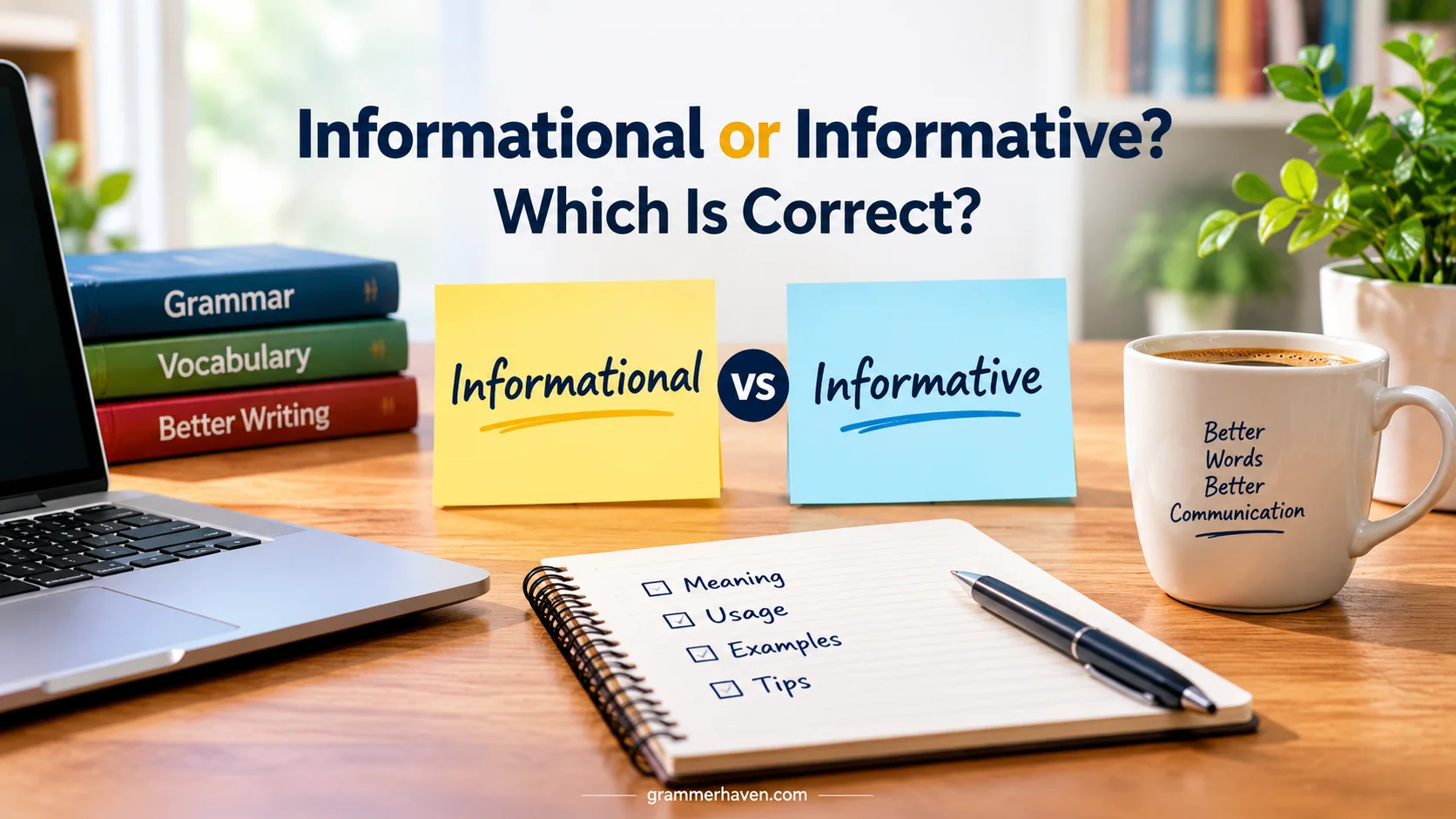
Informational or Informative? Understanding the Difference, Usage, explains how these terms differ in purpose, context, and meaning for learners. In the English language, many learners find these terms confusing because informational and informative can appear interchangeable at first glance. However, they have a crucial difference in usage, context, and connotation. Informational focuses on providing information through content, documents, texts, manuals, reports, and resources that deliver facts, data, statistics, and details. Informative focuses on creating value through knowledge, insights, explanations, and guidance that improve reader understanding and support learning.
When choosing between these words, consider the purpose, function, and effect of your material. An informational brochure, reference material, or website may provide factual information, factual content, and text and facts for reference purposes. In contrast, an informative article, informative lecture, or informative breakdown offers educational content, useful information, valuable insight, and educational value. As a writer, your writing goal, audience, and communication purpose help determine the right tone and word choice for your specific content.
Informational vs. Informative at a Glance
Before diving deeper, here’s a quick overview.
| Feature | Informational | Informative |
| Primary Meaning | Contains or provides information | Provides useful knowledge or understanding |
| Focus | Information exists | Information has value |
| Implies Quality | No | Usually yes |
| Common Usage | Search intent, documents, resources | Articles, presentations, lessons |
| Educational Value | Not always | Usually |
| Reader Benefit | May vary | Typically high |
Quick Rule to Remember
Informational = Contains information
Informative = Teaches or explains something useful
That simple distinction will help you choose the correct word in most situations.
What Does Informational Mean?
The word informational describes something that contains, delivers, or relates to information.
The key point is that the word says nothing about the quality or usefulness of that information.
A document can be informational even if nobody learns anything valuable from it.
A spreadsheet full of numbers is informational.
A company directory is informational.
A list of employee phone extensions is informational.
All of these items contain information. Whether they provide meaningful insight is a different question.
Informational Definition
Informational means:
Relating to, consisting of, or providing information.
Notice something important here.
The definition focuses on the existence of information rather than its usefulness.
That distinction often separates informational from informative.
Common Uses of Informational
The word appears frequently in professional, educational, and digital environments.
Informational Materials
Organizations often create informational materials to distribute facts.
Examples include:
- Informational brochures
- Informational pamphlets
- Informational handouts
- Informational fact sheets
- Informational packets
The goal is simply to provide information.
Whether readers find the material valuable depends on the quality of the content.
Informational Resources
Educational institutions frequently refer to:
- Informational websites
- Informational databases
- Informational archives
- Informational repositories
These resources store information that users can access when needed.
Informational Content in SEO
One of the most common modern uses appears in search engine optimization.
Marketers frequently discuss:
- Informational keywords
- Informational content
- Informational search intent
For example:
- What causes earthquakes?
- How does solar energy work?
- Why do cats purr?
These searches indicate that users want information rather than products or services.
What Does Informative Mean?
While informational focuses on the existence of information, informative focuses on the value of that information.
Something is informative when it helps people learn, understand, or gain useful knowledge.
An informative article doesn’t merely present facts.
It explains them.
It helps readers walk away smarter than they were before.
Informative Definition
Informative means:
Providing useful, helpful, or educational information.
The word carries a positive implication.
When someone describes an article as informative, they are usually offering praise.
They’re saying the content delivered genuine value.
What Makes Something Informative?
Not everything containing information qualifies as informative.
Several characteristics separate truly informative content from content that merely exists.
It Answers Important Questions
Great content solves problems.
It addresses reader concerns and removes confusion.
For example:
A guide titled “How to Start a Vegetable Garden” becomes informative when it explains:
- Soil preparation
- Plant selection
- Watering schedules
- Common mistakes
Without those explanations, it may only be informational.
It Provides Context
Facts alone rarely educate.
Context transforms information into understanding.
Consider this example:
Informational statement:
“The Earth travels around the Sun at approximately 67,000 miles per hour.”
Informative statement:
“The Earth travels around the Sun at roughly 67,000 miles per hour. Despite this incredible speed, people don’t feel the movement because the atmosphere moves with the planet.”
The second example teaches something.
That’s what makes it informative.
It Improves Understanding
The best informative content simplifies complexity.
Readers should leave with greater clarity.
That’s why informative articles often include:
- Examples
- Analogies
- Diagrams
- Comparisons
- Case studies
These tools help transform raw information into practical knowledge.
The Real Difference Between Informational and Informative
The easiest way to understand the distinction is to think about information versus value.
Informational Means Information Exists
The content contains data, facts, or details.
That’s all.
No judgment about usefulness appears in the word.
Informative Means Information Creates Understanding
The content helps readers learn something meaningful.
It has educational value.
It improves knowledge.
A Helpful Analogy
Imagine walking into a library.
The entire library is informational because it contains information.
However, only certain books may be informative for your specific needs.
A chemistry textbook may be highly informative for a chemistry student.
The same book might not be informative for someone researching medieval history.
The information exists in both cases.
The usefulness changes.
Informational vs. Informative: Side-by-Side Examples
Let’s compare real-world situations.
| Example | Informational | Informative |
| Telephone directory | Yes | Usually no |
| Product manual | Yes | Often yes |
| Academic textbook | Yes | Yes |
| Raw spreadsheet data | Yes | Not always |
| Educational tutorial | Yes | Yes |
| News article with context | Yes | Yes |
| Contact list | Yes | Usually no |
| How-to guide | Yes | Yes |
This table highlights an important truth.
Everything informative is informational.
Not everything informational is informative.
Think of informative as a subset of informational.
Informational vs. Informative in Writing
Writers often struggle with these terms because both appear in similar contexts.
The difference lies in emphasis.
Informational Writing
Informational writing focuses on presenting facts.
Characteristics include:
- Objective tone
- Factual content
- Limited analysis
- Minimal opinion
- Data-focused presentation
Examples include:
- Reference guides
- Directories
- Reports
- Fact sheets
Informative Writing
Informative writing goes further.
Characteristics include:
- Clear explanations
- Reader-focused structure
- Helpful examples
- Context and analysis
- Educational value
Examples include:
- Tutorials
- Explanatory articles
- Educational blogs
- Training materials
The best writers don’t stop at information.
They create understanding.
Informational vs. Informative in Education
Teachers frequently encounter both terms.
Although they overlap, they serve different purposes.
Informational Texts
Educational systems often use the phrase “informational text.”
These texts include:
- Articles
- Textbooks
- Reference materials
- Scientific reports
Their primary purpose is to convey facts.
Informative Teaching
An informative lesson goes beyond facts.
It helps students understand concepts.
For example:
A science teacher listing the planets provides informational content.
A science teacher explaining planetary formation provides informative instruction.
The second approach creates deeper learning.
Informational vs. Informative in Business Communication
Business professionals use both words regularly.
Choosing the right one improves clarity.
When Informational Is Better
Use informational when discussing resources or materials.
Examples include:
- Informational meeting
- Informational brochure
- Informational website
- Informational packet
The focus remains on delivering information.
When Informative Is Better
Use informative when evaluating quality.
Examples include:
- Informative presentation
- Informative workshop
- Informative webinar
- Informative discussion
These phrases suggest that people gained valuable knowledge.
Informational vs. Informative in Journalism
Modern journalism demonstrates the difference clearly.
Informational Reporting
Basic reporting may present facts such as:
- Who
- What
- When
- Where
This content is informational.
Informative Journalism
High-quality journalism goes deeper.
It explains:
- Why events happened
- Historical background
- Economic impact
- Social implications
Readers gain understanding rather than merely receiving facts.
That makes the content informative.
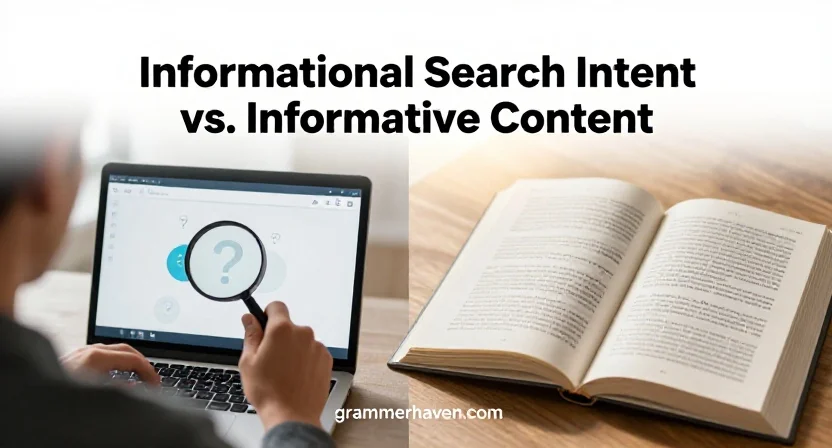
Informational Search Intent vs. Informative Content
This distinction matters greatly in SEO.
Many marketers confuse the two concepts.
What Is Informational Search Intent?
Informational search intent occurs when users seek knowledge.
Examples include:
- How does inflation work?
- What is artificial intelligence?
- Why do leaves change color?
- How do airplanes fly?
Users aren’t trying to buy anything.
They’re trying to learn.
Why Search Engines Favor Informative Content
Search engines increasingly reward content that satisfies users.
An article may target an informational keyword.
However, it must also be informative to rank well.
Imagine two articles targeting the same query:
Article A
- 500 words
- Basic definitions
- Few examples
Article B
- Detailed explanations
- Real-world examples
- Expert insights
- Clear structure
Both are informational.
Only one is truly informative.
Search engines typically favor the second version because readers find it more useful.
Case Study: Why Information Alone Isn’t Enough
Consider a software company creating customer documentation.
Version One
The manual lists every feature.
It contains hundreds of pages.
It includes technical descriptions.
The document is informational.
Version Two
The company adds:
- Step-by-step tutorials
- Screenshots
- Troubleshooting guides
- Real examples
- Frequently asked questions
The manual becomes informative.
Customer satisfaction rises because users can actually solve problems.
The information hasn’t disappeared.
The company simply transformed it into knowledge.
Common Mistakes People Make
Many writers misuse these words because the distinction seems subtle.
Let’s examine the most common errors.
Treating Them as Perfect Synonyms
The words overlap significantly.
However, they are not identical.
Replacing one with the other can change the meaning.
Assuming All Information Is Valuable
This mistake appears frequently.
Large amounts of data do not automatically create understanding.
A thousand facts can still confuse readers.
Useful explanation matters.
Using Informational as Praise
Consider this sentence:
“The presentation was very informational.”
While understandable, many native speakers would naturally say:
“The presentation was very informative.”
The second version emphasizes educational value.
Using Informative for Reference Materials
A phone directory usually isn’t informative.
It simply stores information.
Calling it informational is more accurate.
Informational Examples in Sentences
Here are examples where informational works best.
- The company distributed informational brochures at the event.
- The website contains informational resources for new customers.
- Students reviewed informational texts during class.
- The government published informational materials about public health.
- The database serves as an informational resource for researchers.
In each example, the emphasis falls on information being available.
Informative Examples in Sentences
Now look at examples using informative.
- The professor delivered an informative lecture on climate science.
- The article provided an informative explanation of blockchain technology.
- The documentary was surprisingly informative.
- The webinar offered informative insights about investing.
- The discussion became highly informative once experts joined.
Here, the focus shifts toward learning and understanding.
A Simple Test to Choose the Right Word
Whenever you’re unsure, ask yourself one question:
Is the Focus on Information Existing?
If yes, choose informational.
Examples:
- Informational website
- Informational database
- Informational materials
Is the Focus on Learning and Understanding?
If yes, choose informative.
Examples:
- Informative guide
- Informative presentation
- Informative article
This simple test works in most situations.
Quick Decision Framework
Use this framework when writing.
| Question | Choose |
| Does it contain information? | Informational |
| Does it teach something useful? | Informative |
| Are you describing a resource? | Usually informational |
| Are you evaluating quality? | Usually informative |
| Does it improve understanding? | Informative |
| Is it simply providing facts? | Informational |
Expert Writing Tip
Many experienced writers naturally reserve informative for praise.
Consider these examples:
- “The report was informative.”
- “The seminar was informative.”
- “The interview was informative.”
Each statement implies positive value.
By contrast:
- “The report was informational.”
This sounds more neutral.
It merely indicates that information was present.
That subtle difference explains why informative appears more often in reviews, recommendations, and evaluations.
See also: Deactivate or Inactivate? Which Is Correct?
FAQs:
1. What is the main difference between informational and informative?
The main difference is their focus. Informational describes content that provides facts, details, or data, while informative describes content that teaches, explains, and gives valuable understanding.
2. Can informational and informative be used interchangeably?
No, they are not always interchangeable. Although both words relate to information, informational focuses on the presence of information, while informative focuses on how useful or educational that information is.
3. Is a brochure informational or informative?
A brochure is usually informational because it provides facts, details, and reference material. However, it can also be informative if it explains topics clearly and helps readers gain useful knowledge.
4. When should I use the word informative?
Use informative when describing content that teaches something, provides insights, explains ideas clearly, or helps readers understand a topic better, such as an article, lecture, or educational resource.
5. When should I use the word informational?
Use informational when referring to materials created mainly to provide facts, instructions, data, or reference details, such as reports, manuals, guides, brochures, and websites.
Conclusion:
Understanding the difference between informational and informative helps you choose the right word for your writing, speaking, and communication. While informational focuses on sharing facts, data, and details, informative focuses on providing deeper knowledge, insights, and useful learning experiences. When you create content, think about your purpose, audience, and desired impact. If your goal is simply to provide information, use informational. If you want to educate, explain, and add value, informative is the better choice.