Deactivate or Inactivate? Understanding the Difference explains the difference in simple English, helping you compare each word with the right meaning and context.
When you study the concept, the definition, the distinction, and the interpretation, the comparison becomes much easier. Deactivate usually refers to an active device, system, software, hardware, or other technology that you stop from working on purpose. Inactivate, however, means making something inactive, nonfunctional, or unable to perform its normal function, action, process, or activity. This terminology often creates confusion, but a quick glance at the contexts usually provides the answer. The selection of the proper term depends on the subject, application, and the situation, even though the words may seem interchangeable or similar.
From my experience, learning these terms feels like steering along a smooth road instead of falling into a pothole. At first, I kept wondering whether both words always fits, but knowing the main sense moved me closer towards the best understanding. However, the proper application is not decided alone by a dictionary because the middle of a sentence and the purpose of communication also matter. You can activate, disable, or neutralize something, keep it paused, make it working again, or clarify its intended meaning through good grammar, the right verbs, language, and practical tools. This simple clarification can be a pleasant surprise, reduce inability, and improve communication across the world.
What Does “Deactivate” Mean?
The verb deactivate means to make something no longer active, operational, functioning, or available for use.
In everyday English, deactivate usually refers to turning off, disabling, shutting down, or removing access to something.
Definition of Deactivate
A simple definition is:
Deactivate: to cause something to stop functioning or operating.
The word combines the prefix “de-“, meaning removal or reversal, with “activate,” meaning to make active.
Essentially, deactivate means reversing activation.
Common Situations Where “Deactivate” Is Used
You will often see deactivate used in:
- Software applications
- Online accounts
- Electronic devices
- Security systems
- Membership programs
- Subscription services
- Business systems
Examples of Deactivate in Sentences
Consider these examples:
- Please deactivate your account before leaving the platform.
- The administrator deactivated the employee’s login credentials.
- You can deactivate notifications in the settings menu.
- The technician deactivated the alarm system.
- Users may deactivate location tracking at any time.
Each example involves stopping a function, feature, or service.
Common Collocations With Deactivate
The word naturally pairs with specific nouns.
| Common Phrase | Example |
| Deactivate an account | Deactivate your social media account |
| Deactivate a device | Deactivate the old smartphone |
| Deactivate a feature | Deactivate automatic updates |
| Deactivate a subscription | Deactivate the monthly plan |
| Deactivate a security system | Deactivate the alarm before entering |
These combinations sound natural because they align with how native English speakers commonly use the word.
What Does “Inactivate” Mean?
The word inactivate has a more specialized meaning.
While deactivate usually refers to turning something off, inactivate generally means rendering something incapable of functioning through a biological, chemical, medical, or technical process.
Definition of Inactivate
A straightforward definition is:
Inactivate: to make something inactive by altering or suppressing its activity.
Unlike deactivate, inactivate often implies a process that changes the state of the object itself.
Where “Inactivate” Is Commonly Used
You’ll frequently encounter inactivate in:
- Biology
- Medicine
- Virology
- Chemistry
- Genetics
- Scientific research
- Laboratory procedures
Examples of Inactivate in Sentences
Examples include:
- Heat can inactivate certain viruses.
- Researchers used chemicals to inactivate bacterial cells.
- The treatment successfully inactivated the enzyme.
- Scientists inactivated the gene to study its function.
- Ultraviolet radiation can inactivate pathogens.
Notice something important.
You wouldn’t normally replace “inactivate” with “turn off.”
Viruses, bacteria, enzymes, and genes are not switched off like a smartphone. Instead, they are rendered inactive through biological or chemical mechanisms.
Common Collocations With Inactivate
| Common Phrase | Example |
| Inactivate a virus | Inactivate the virus before testing |
| Inactivate bacteria | Heat can inactivate bacteria |
| Inactivate an enzyme | The chemical compound inactivated the enzyme |
| Inactivate pathogens | Disinfectants help inactivate pathogens |
| Inactivate a gene | Researchers inactivated the target gene |
These expressions appear regularly in scientific literature and medical documentation.
Deactivate vs. Inactivate: The Core Difference
At their heart, both words involve stopping activity.
However, the way that activity stops is different.
The Easy Rule
Think about it this way:
- Deactivate = turn off, disable, shut down
- Inactivate = render inactive through a process
That simple distinction solves most usage problems.
Side-by-Side Comparison
| Feature | Deactivate | Inactivate |
| Primary Meaning | Turn off or disable | Render inactive |
| Common Audience | General public | Scientists and specialists |
| Everyday Usage | Very common | Relatively uncommon |
| Technology | Frequently used | Rarely used |
| Medical Research | Less common | Very common |
| User Accounts | Correct choice | Usually incorrect |
| Biological Functions | Rare | Standard usage |
| Software Documentation | Common | Uncommon |
Why Context Matters More Than Definition
Many English words share similar dictionary meanings but differ dramatically in actual usage.
Consider the words:
- House and residence
- Start and commence
- End and terminate
Technically similar.
Practically different.
The same principle applies to deactivate and inactivate.
Even when both words could theoretically fit a sentence, professional writers choose the term expected within a specific industry.
That’s what makes language sound natural.
Can Deactivate and Inactivate Be Used Interchangeably?
The short answer is:
Sometimes, but usually not.
Situations Where Both May Work
Certain technical fields occasionally use either term.
For example:
- Industrial systems
- Specialized engineering documentation
- Manufacturing processes
In these contexts, both words may appear depending on company standards.
Situations Where Only Deactivate Sounds Natural
Examples include:
- User accounts
- Mobile applications
- Security systems
- Electronic devices
- Website features
Correct:
- Deactivate your Facebook account.
- Deactivate the alarm system.
Unnatural:
- Inactivate your Facebook account.
- Inactivate the alarm system.
Native speakers rarely use inactivate in these contexts.
Situations Where Only Inactivate Sounds Natural
Examples include:
- Viruses
- Bacteria
- Enzymes
- Genes
- Pathogens
Correct:
- Researchers inactivated the virus.
Awkward:
- Researchers deactivated the virus.
Scientists generally avoid deactivate because biological organisms are not viewed as systems that can simply be switched off.
Which Word Is More Common?
In modern English, deactivate appears far more frequently than inactivate.
Why?
Most people regularly discuss:
- Accounts
- Apps
- Devices
- Memberships
- Software
Very few people routinely write about enzymes or genetic expression.
As a result, deactivate dominates everyday communication.
Industry Usage Comparison
| Industry | Preferred Term |
| Technology | Deactivate |
| Software Development | Deactivate |
| Social Media | Deactivate |
| Business Operations | Deactivate |
| Customer Support | Deactivate |
| Healthcare Research | Inactivate |
| Biology | Inactivate |
| Virology | Inactivate |
| Genetics | Inactivate |
| Chemistry | Inactivate |
The preferred term changes based on professional convention.
Deactivate vs. Disable vs. Inactivate
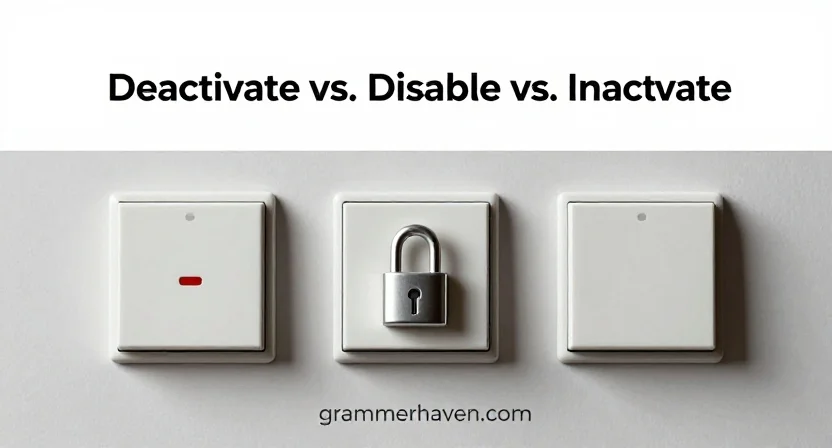
Many writers also confuse these three terms.
Let’s separate them.
Deactivate
Deactivate means removing active status or operation.
Examples:
- Deactivate an account
- Deactivate a subscription
- Deactivate a security system
Disable
Disable means preventing functionality.
Examples:
- Disable notifications
- Disable location tracking
- Disable comments
Something can remain active while specific functions become unavailable.
Inactivate
Inactivate means rendering something inactive through a process.
Examples:
- Inactivate bacteria
- Inactivate a virus
- Inactivate an enzyme
Comparison Table
| Word | Primary Meaning | Typical Context |
| Deactivate | Turn off or remove active status | Accounts and systems |
| Disable | Prevent operation of a feature | Settings and permissions |
| Inactivate | Render inactive through intervention | Science and medicine |
Real-World Examples Across Industries
The best way to understand vocabulary is through practical examples.
Technology Example
Imagine a user leaves a software platform.
The company may:
- Deactivate the account
- Remove login privileges
- Archive user data
The account still exists.
It simply no longer functions as an active account.
Healthcare Example
Suppose researchers create a vaccine.
One method involves exposing a virus to heat, chemicals, or radiation.
The goal is not to turn off the virus.
The goal is to alter it so it can no longer infect cells.
Scientists call this process:
Virus inactivation
That’s why “inactivate” dominates vaccine research literature.
Business Example
When an employee leaves a company:
- IT deactivates email access
- HR deactivates payroll permissions
- Administrators deactivate security credentials
Inactivate rarely appears in these scenarios.
Engineering Example
Manufacturing facilities may temporarily deactivate machinery during maintenance.
However, a chemical process may inactivate catalytic compounds.
The correct word depends entirely on the object involved.
Case Study: Why Scientists Prefer “Inactivate”
Imagine two researchers discussing a virus.
Researcher A says:
“We deactivated the virus.”
Researcher B says:
“We inactivated the virus.”
Most scientific journals would favor Researcher B’s wording.
Why?
Because the virus was not switched off like a machine.
Instead, researchers altered its biological function.
The term inactivate communicates that scientific reality more precisely.
Scientific writing values precision above simplicity.
As a result, specialized terminology becomes important.
Case Study: Why Businesses Prefer “Deactivate”
A software company sends this message:
“Your account has been deactivated.”
Users immediately understand the meaning.
Now consider:
“Your account has been inactivated.”
The message feels unusual.
Many users would wonder whether their account still exists or whether something else happened.
Businesses prioritize clarity.
Deactivate delivers that clarity.
Common Mistakes Writers Make
Even experienced writers occasionally misuse these terms.
Using Inactivate in Everyday Communication
Many writers believe inactivate sounds more formal.
Unfortunately, it often sounds unnatural.
Instead of saying:
- Inactivate your profile
Use:
- Deactivate your profile
The second option aligns with common English usage.
Using Deactivate in Scientific Papers
Scientific readers expect field-specific terminology.
Instead of writing:
- Researchers deactivated the enzyme
Most journals would prefer:
- Researchers inactivated the enzyme
Small wording choices influence credibility.
Assuming the Words Are Identical
The biggest mistake is treating them as perfect synonyms.
They overlap.
They do not match exactly.
Context determines which one sounds correct.
Ignoring Industry Standards
Every profession develops its own vocabulary.
Technical writers, scientists, software developers, and healthcare professionals often follow different conventions.
Understanding those conventions improves communication.
How to Choose the Right Word Every Time

When in doubt, use this simple decision framework.
Ask: What Is Being Affected?
If the answer is:
- Account
- Device
- Software
- Subscription
- Security system
Choose:
Deactivate
Ask: Is It Biological or Chemical?
If the answer is:
- Virus
- Bacteria
- Gene
- Enzyme
- Pathogen
Choose:
Inactivate
Ask: Who Is the Audience?
For a general audience:
Deactivate usually sounds more natural.
For scientists and researchers:
Inactivate may be the preferred term.
Quick Decision Diagram
What are you describing?
|
v
Account, Device,
Feature, System?
|
Yes
|
v
DEACTIVATE
|
No
|
v
Virus, Gene, Enzyme,
Bacteria, Pathogen?
|
Yes
|
v
INACTIVATE
This simple approach eliminates most confusion.
See also: Penny for Your Thoughts Idiom Meaning & Origin
FAQs:
1. What is the main difference between deactivate and inactivate?
Deactivate usually means turning off or disabling a device, system, or feature. Inactivate means making something unable to function, especially in scientific, medical, or biological contexts.
2. Can deactivate and inactivate be used interchangeably?
Sometimes they can, but they are not always interchangeable. The correct choice depends on the context. Deactivate is preferred for technology, while inactivate is more common in science and medicine.
3. Is deactivate used more often than inactivate?
Yes. Deactivate is more common in everyday English because people frequently use it when talking about phones, accounts, software, devices, and security systems.
4. When should I use inactivate?
Use inactivate when discussing biology, chemistry, medicine, laboratories, or scientific research. For example, scientists may inactivate a virus so it cannot cause disease.
5. How can I remember which word to use?
A simple trick is to think about the subject. If you’re talking about technology or a device, choose deactivate. If you’re discussing science, medicine, or biology, inactivate is usually the better choice.
Conclusion:
Understanding the difference between deactivate and inactivate helps you choose the right word for the right situation. Although both terms describe stopping something from being active, deactivate is more common for devices, systems, software, and technology, while inactivate is usually used in scientific, medical, and biological contexts. Paying attention to the context makes your writing and speaking more accurate, natural, and easier to understand. Once you know when each word fits, you’ll avoid common mistakes and communicate with greater confidence.