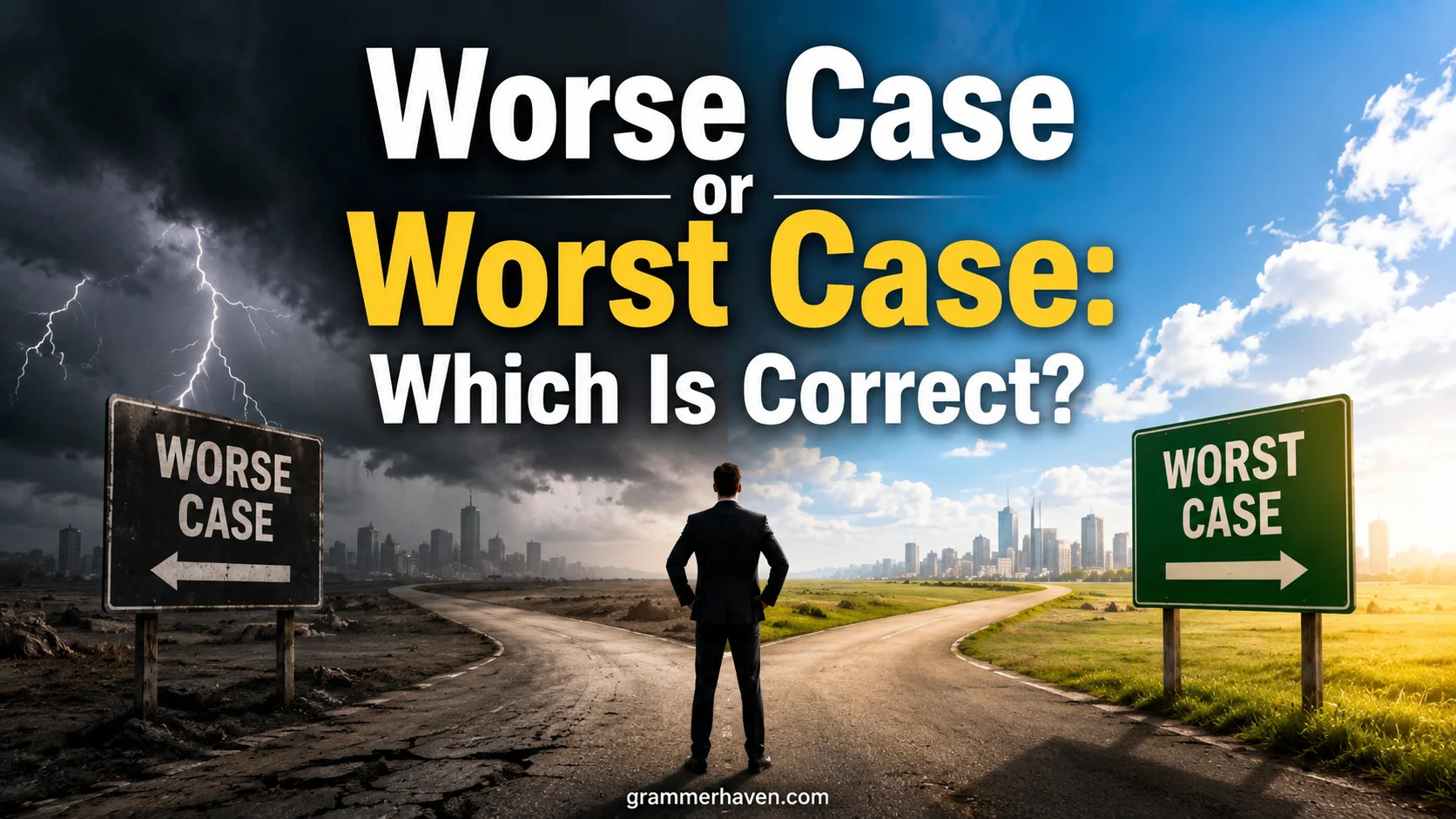
Worse Case or Worst Case: Which Is Correct? explains the difference between worse and worst, helping you understand meaning in English grammar today. In this article, I’ll break down these commonly confused words and provide a detailed explanation of their meaning, usage, and correct spelling. These terms are extremely useful because they help indicate levels of comparison, but many writers mix them due to their similar sound, pronunciation differences, and word forms. The adjective “worse” shows a comparative adjective meaning something is more bad, while “worst” works as a superlative adjective meaning the most bad option. This concept improves writing, communication, vocabulary, and language learning by building a stronger understanding of grammar concepts.
The main reason learners experience word confusion is that worse and worst are similar sounding words that appear alike in spoken English but have different meanings. These words relate to comparison rules, degree of comparison, and adjective forms. As linguistic terms, they connect with phonetics, orthography, lexical meaning, and correct usage. When you understand the difference between comparative and superlative adjectives, you can avoid incorrect spelling mistakes and choose the correct word in common expressions. These word pairs are important for anyone learning English grammar because they explain how adjectives change during comparison.
When we study these adjectives, the meaning becomes clearer through examples and real situations. The best way to clear up confusion is to remember that worse compares two things, while worst identifies the lowest level among three or more options. This article focuses on what these words mean, how they are used, and why pronunciation can sometimes make them easy to mix. Understanding these grammar concepts makes learning easier and improves practical usage in everyday language.
What Does “Worst Case” Mean?
The phrase worst case refers to the most unfavorable or most serious situation that could happen.
It describes the extreme negative possibility when you’re considering different outcomes.
For example:
- In the worst case, the project could be delayed by two weeks.
- We prepared for the worst case before launching the software.
- Always have a backup plan for the worst case.
The phrase appears everywhere, including:
- Business planning
- Medicine
- Engineering
- Emergency management
- Software development
- Finance
- Insurance
- Everyday conversations
Whenever people discuss risks, they often compare the best-case scenario with the worst-case scenario.
Think of it like planning a road trip. You hope traffic stays light, your car runs perfectly, and the weather cooperates. That’s the best case. But you also consider flat tyres, road closures, or storms. Those possibilities make up the worst case.
Why Is the Phrase So Common?
People naturally plan for uncertainty.
Whether you’re investing money, designing a bridge, performing surgery, or organizing a family vacation, thinking about the worst possible outcome helps you prepare instead of panic.
That’s why phrases like these are so common:
- Worst-case scenario
- Worst-case analysis
- Worst-case estimate
- Worst-case planning
- Worst-case outcome
They all focus on preparing for the maximum level of risk.
Is “Worse Case” Ever Correct?
In almost every situation, no.
The phrase worse case is not standard English.
Native speakers don’t intentionally use it because it doesn’t follow English grammar rules.
Instead, you’ll almost always see it as:
- a typing mistake
- an autocorrect error
- confusion between worse and worst
- a mistake made by English learners
For example:
❌ Worse case, we’ll miss the flight.
Correct version:
✅ Worst case, we’ll miss the flight.
Why Does the Mistake Happen?
English contains many words with similar endings.
Consider these:
- bigger → biggest
- smaller → smallest
- faster → fastest
- worse → worst
People sometimes remember that worse relates to something bad but forget that worst is the form used for the absolute extreme.
That small difference changes the grammar completely.
Worse vs. Worst: What’s the Difference?
Understanding these two words makes the entire topic easy.
| Word | Grammar | Meaning |
| Worse | Comparative adjective | More bad than another thing |
| Worst | Superlative adjective | The most bad among all possibilities |
Simply put:
- Worse compares.
- Worst identifies the extreme.
What Does “Worse” Mean?
Worse compares two situations, people, places, or things.
It answers questions like:
- Which one is more unpleasant?
- Which one is less desirable?
- Which one has declined?
Examples include:
- Today’s weather is worse than yesterday’s.
- This route is worse than the motorway.
- My headache feels worse this afternoon.
- The second draft was worse than the first.
- His condition became worse overnight.
Notice something?
Every sentence compares one thing with another.
That’s exactly what comparative adjectives do.
Common Patterns with “Worse”
You’ll often see worse in expressions such as:
- Worse than
- Getting worse
- Feel worse
- Worse off
- Worse performance
- Worse conditions
Examples:
- The traffic became worse after lunch.
- She feels worse today.
- Our results were worse than expected.
- Some areas were worse off after the storm.
None of these refer to the absolute extreme.
Instead, they compare one condition with another.
What Does “Worst” Mean?
Worst is the superlative form.
It refers to the most negative, least desirable, or most serious option.
Examples include:
- That was the worst movie I’ve ever seen.
- It became the worst storm in decades.
- This is the worst outcome imaginable.
- We planned for the worst case.
Unlike worse, the word worst doesn’t compare only two things.
Instead, it identifies the extreme end of a scale.
A Simple Progression
Understanding the progression makes everything click.
| Degree | Example |
| Bad | The weather is bad. |
| Worse | Today’s weather is worse than yesterday’s. |
| Worst | This is the worst storm this year. |
English follows this pattern with many adjectives.
| Positive | Comparative | Superlative |
| Good | Better | Best |
| Bad | Worse | Worst |
| Little | Less | Least |
| Far | Farther/Further | Farthest/Furthest |
Once you recognize the pattern, choosing the worst case becomes obvious.
Why “Worst Case” Is Grammatically Correct
The phrase worst case describes the most extreme possible case.
The noun case isn’t being compared with another specific case.
Instead, it refers to the single most unfavorable possibility among every possible outcome.
That’s exactly what a superlative adjective does.
Imagine you’re evaluating five possible outcomes.
- Outcome A
- Outcome B
- Outcome C
- Outcome D
- Outcome E
The absolute most negative outcome becomes the worst case.
Not the worse case.
How Adjective + Noun Combinations Work
English often places a superlative adjective directly before a noun.
Examples include:
- Best solution
- Biggest problem
- Highest mountain
- Lowest price
- Greatest achievement
- Worst nightmare
- Worst mistake
- Worst experience
Notice the pattern.
Each adjective identifies the extreme version of the noun.
The same logic applies to the worst case.
Why “Worse Case” Doesn’t Fit
The comparative adjective worse expects a comparison.
For example:
- This option is worse than the other.
- Monday was worse than Tuesday.
If you simply write a worse case, readers naturally expect another case being compared.
The phrase feels unfinished because the comparison is missing.
That’s why native speakers don’t use it.
Why People Accidentally Write “Worse Case”
Even experienced writers occasionally make this mistake.
Here are the most common reasons.
Confusing Comparative and Superlative Forms
Many learners memorize vocabulary before mastering adjective forms.
Since worse appears more often in conversation, it sometimes slips into writing where worst belongs.
Fast Typing
Sometimes the brain knows the correct word, but the fingers type another one.
This happens surprisingly often with:
- their / there
- affect / effect
- your / you’re
- farther / further
- worse / worst
Proofreading usually catches the mistake.
Pronunciation
In fast speech, worse and worst sound similar.
That similarity can influence spelling, especially when writing quickly.
Autocorrect Doesn’t Always Help
Unlike obvious spelling mistakes, worse is a correctly spelled English word.
Grammar checkers may not recognize that it’s incorrect within the phrase worse case.
That’s why context matters more than spelling.
Influence of Informal Online Writing
Social media, forums, and text messages often contain grammatical mistakes.
When people repeatedly see worse case, they may assume it’s acceptable.
However, repeated use doesn’t make it correct.
Professional publications, dictionaries, universities, and style guides consistently prefer worst case.
Worst Case vs. Worst-Case
This is another area that confuses writers.
Should there be a hyphen?
The answer depends on how the phrase functions in the sentence.
Use “Worst Case” as a Noun Phrase
When the phrase stands on its own as a noun, don’t use a hyphen.
Examples:
- Let’s prepare for the worst case.
- We discussed the worst case during the meeting.
- Nobody expected the worst case to happen.
- The company planned for the worst case before expanding.
Here, worst case acts as the thing being discussed.
So it stays open.
Use “Worst-Case” Before Another Noun
When the phrase describes another noun, use a hyphen.
Examples:
- worst-case scenario
- worst-case estimate
- worst-case analysis
- worst-case planning
- worst-case assumptions
- worst-case outcome
- worst-case forecast
Example sentences:
- Engineers performed a worst-case analysis before construction began.
- Investors reviewed several worst-case scenarios.
- The software passed every worst-case test.
The hyphen tells readers that the words work together as a single adjective modifying the noun that follows.
See also: Atleast or At Least: Which Is Correct?
FAQS:
1. Is “worse case” or “worst case” the correct phrase?
The correct phrase is “worst case.” It refers to the most negative or least favorable possible situation. For example, “In the worst case, we may need to restart the entire project.” “Worse case” is usually incorrect because worse is a comparative adjective used when comparing two things.
2. What is the difference between worse and worst?
The difference is based on comparison. Worse means something is more bad than another thing and compares two situations. Worst means the most bad option among three or more situations or the lowest possible level of quality.
3. How can I remember when to use worse and worst?
A simple trick is to remember that worse = two things, while worst = the final or highest level of negativity. If you are comparing one thing with another, use worse. If you are describing the most negative outcome, use worst.
4. Why do people confuse worse and worst?
People often confuse these words because they look and sound very similar. Their pronunciation is close, and both describe negative situations. However, their grammar roles are different because one is a comparative adjective and the other is a superlative adjective.
5. Is “worst case scenario” grammatically correct?
Yes, “worst case scenario” is a correct and common expression. It describes the most unfavorable situation that could happen. For example, “We should prepare for the worst case scenario before making a final decision.”
Conclusion:
Understanding the difference between worse and worst helps you avoid a common English grammar mistake. While both words describe negative situations, they serve different purposes. Worse compares two things, while worst describes the most negative possibility among multiple options. The phrase “worst case” is the correct expression because it refers to the most unfavorable outcome. By learning these comparison rules and practicing proper usage, you can improve your writing, vocabulary, and overall confidence in English communication.