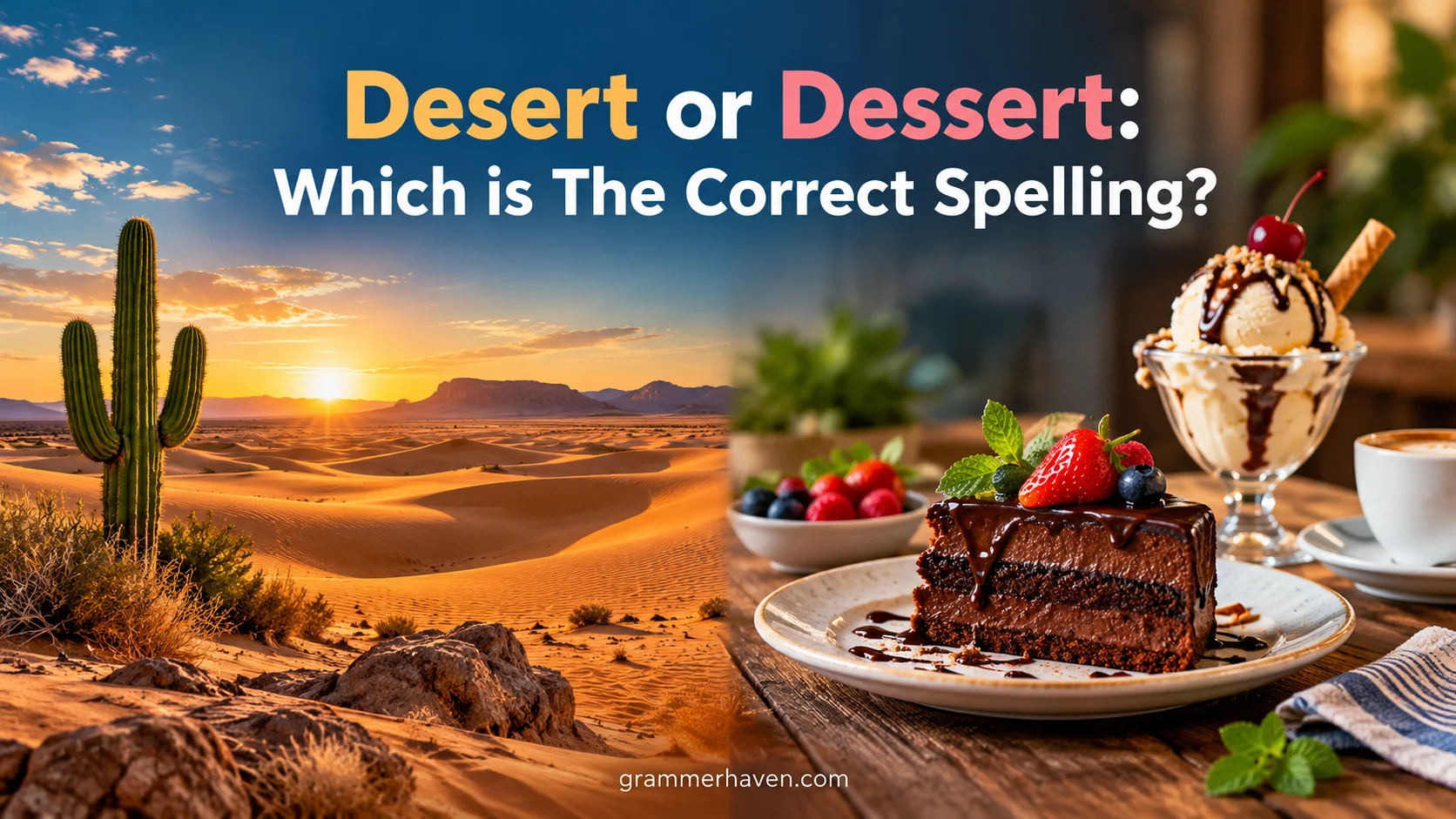
Desert or Dessert can confuse writers because the words have similar sounds but different meanings: desert means dry land or to abandon, while dessert means sweet food served after a meal. Knowing the meaning before checking pronunciation makes the spelling difference easier to remember. The desert pronunciation and dessert pronunciation can sound close, so relying only on sound may lead to confused writing. This distinction matters in a sentence, especially when you want your writing to connect spelling with meaning clearly.
For blogs, emails, essays, and social posts, simple quick tricks can reduce spelling mistakes. Think of dessert as the sweet course and desert as dry land, leaving someone, or something a person deserves.
Quick Answer: Desert or Dessert?
Both “desert” and “dessert” are correct words, but they don’t mean the same thing.
- Desert = a dry, usually arid region with little rainfall.
- Desert = to abandon or leave someone or something.
- Desert = something deserved, as in just deserts.
- Dessert = a sweet course or dish usually served at the end of a meal.
The easiest spelling trick is:
One S = sand. Two S’s = something sweet.
So, if you’re crossing a vast stretch of dry land, you’re crossing a desert. If you’re finishing dinner with cheesecake, you’re eating dessert.
| Word | Meaning | Pronunciation | Example |
| desert | Dry, arid land | DEZ-ert | The camel crossed the desert. |
| desert | To abandon | di-ZURT | Don’t desert your friends. |
| desert | Something deserved | di-ZURT | He got his just deserts. |
| dessert | Sweet food after a meal | di-ZURT | We ordered dessert. |
What Does Desert Mean?
The word desert has several meanings, so context matters. Its most familiar meaning describes a geographical environment, but English also uses it as a verb and as a noun meaning something deserved.
Desert as a Dry, Arid Region
A desert is an area with very little precipitation and generally sparse vegetation. People often picture endless sand dunes when they hear the word, but that’s only one kind of desert landscape.
Deserts can contain rocky terrain, gravel plains, mountains, salt flats, and even areas covered by ice. The defining feature is aridity, not simply heat or sand.
Merriam-Webster defines a desert as arid land with usually sparse vegetation. Its definition also notes that deserts can be associated with very low and sporadic rainfall.
For example:
- The hikers crossed the desert before sunrise.
- The desert receives very little rain.
- Camels can survive for long periods in harsh desert conditions.
- The landscape changed dramatically as the road entered the desert.
Some well-known deserts include:
- Sahara Desert
- Mojave Desert
- Gobi Desert
- Kalahari Desert
- Atacama Desert
- Antarctic Desert
Notice something important here: desert has only one s.
Desert Doesn’t Always Mean Hot
One common misconception deserves clearing up.
A desert doesn’t have to be scorching. Cold deserts exist, too. Antarctica, for example, qualifies as a desert because it receives extremely little precipitation.
That distinction matters because the word describes a climate or environment characterized by dryness. It doesn’t simply mean “a place with hot sand.”
Desert as a Verb
Now the pronunciation changes.
As a verb, desert means to abandon, leave, or withdraw from someone or something, usually without intending to return. It can also refer specifically to abandoning military service without authorization.
Examples include:
- Don’t desert your friends when they need you.
- The soldiers were punished for attempting to desert their posts.
- The family refused to desert their home.
- Her courage didn’t desert her during the crisis.
Here, desert sounds like dessert.
That’s where things get interesting.
Desert Can Also Mean Something Deserved
There’s another noun spelled desert that means a deserved reward or punishment.
This meaning appears most famously in the phrase “just deserts.” Merriam-Webster identifies this as a separate noun sense related to deserving something because of your actions or qualities.
For example:
The dishonest executive eventually got his just deserts.
This doesn’t mean the executive received a plate of cake.
It means the executive received the consequences he deserved.
What Does Dessert Mean?
Dessert is a noun referring to a sweet course or dish typically served at the end of a meal. Cakes, pies, ice cream, puddings, pastries, and many other sweet foods can serve as dessert.
Examples include:
- chocolate cake
- apple pie
- cheesecake
- ice cream
- pudding
- cookies
- pastries
- fruit-based sweets
For example:
- We had chocolate cake for dessert.
- Would you like dessert?
- She ordered ice cream for dessert.
- The restaurant offers several homemade desserts.
The important spelling clue is the second s.
Dessert = two S’s.
Why Does Dessert Have Two S’s?
The spelling isn’t just a random English-language obstacle.
Merriam-Webster traces dessert to French desserte, associated with food cleared from the table and the course served at the end of a meal. The word entered English around 1600.
So although the spelling can feel arbitrary today, it has a historical story behind it.
Desert vs. Dessert: The Main Difference
The simplest way to understand desert vs. dessert is to focus on meaning first and spelling second.
Desert
Desert can mean:
- A dry geographical region.
- To abandon or leave.
- Something deserved, particularly in just deserts.
Dessert
Dessert means:
- A sweet course or dish served after a meal.
Here’s the distinction in action:
The travelers crossed the desert before stopping for dessert.
One letter changed the meaning completely.
The first word describes the landscape. The second describes the food.
Desert vs. Dessert Pronunciation
Spelling causes confusion, but pronunciation makes the situation even more interesting.
How to Pronounce Desert as a Noun
When desert means dry land, it has stress on the first syllable:
DEZ-ert
Cambridge gives the US pronunciation as /ˈdez.ɚt/ for the noun.
Example:
The DEZ-ert was dry and unforgiving.
How to Pronounce Desert as a Verb
When desert means abandon, the stress shifts:
di-ZURT
Cambridge lists the US pronunciation as /dɪˈzɝːt/.
Example:
Don’t di-ZURT the people who depend on you.
How to Pronounce Dessert
Dessert is also pronounced:
di-ZURT
Cambridge lists the US pronunciation as /dɪˈzɝːt/.
So these two words sound alike:
- desert = to abandon
- dessert = sweet food
That means you can’t always rely on sound alone. Context has to do some of the heavy lifting.
| Word | Meaning | US Pronunciation |
| desert | Dry land | DEZ-ert |
| desert | Abandon | di-ZURT |
| desert | Something deserved | di-ZURT |
| dessert | Sweet food | di-ZURT |
Why Are Desert and Dessert So Easy to Confuse?
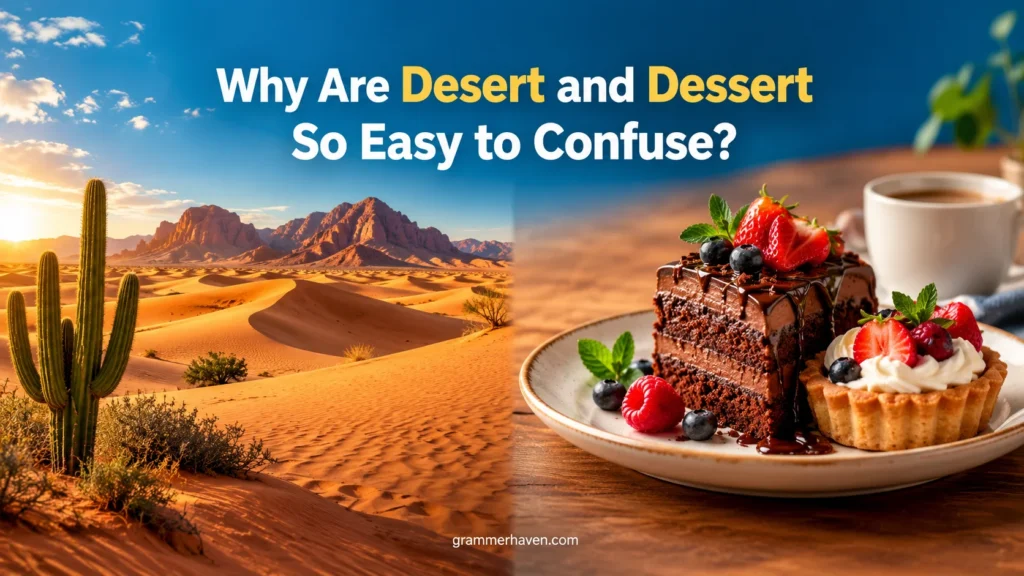
The confusion comes from a perfect storm of spelling and pronunciation.
First, the words differ visually by just one letter:
desert → dessert
Second, dessert and the verb desert have the same pronunciation.
Third, desert itself has multiple meanings.
That’s a lot of linguistic mischief packed into two short words.
Think of the extra s as a tiny signpost. When you see two s’s, think of sweet food. When you see one, think of sand or one of the other meanings of desert.
How to Remember Desert vs. Dessert
A good mnemonic can save you from second-guessing yourself every time you type the word.
The Two-S Rule
The most useful memory trick is:
Dessert has two S’s because you want seconds.
Imagine finishing a delicious slice of chocolate cake.
You want seconds.
That’s your extra S.
So:
dessert → two S’s → seconds
The Sand Rule
For desert, remember:
desert → one S → sand
It’s simple, visual, and fast.
The Sweet Rule
You can also connect the spelling directly to the meaning:
- Desert → dry land
- Dessert → sweet food
If you’re talking about something you might find on a dessert menu, use dessert.
If you’re talking about dunes, arid land, or a dry ecosystem, use desert.
Desert or Dessert: Common Examples
Seeing the words in real sentences makes the difference easier to retain.
Examples With Desert Meaning Dry Land
- The expedition entered the desert at dawn.
- Few plants grow in this harsh desert environment.
- The desert stretches for hundreds of miles.
- Scientists study how animals adapt to desert conditions.
Examples With Desert Meaning Abandon
- A true friend won’t desert you in difficult times.
- The soldiers were accused of attempting to desert their posts.
- The villagers refused to desert their homes.
- Her confidence never deserted her.
Examples With Dessert
- We had pie for dessert.
- The children asked for dessert after dinner.
- Chocolate cake is my favorite dessert.
- The chef prepared several elaborate desserts.
Examples With Just Deserts
- The dishonest player finally got his just deserts.
- The thief received his just deserts after the investigation.
- After years of mistreating people, he eventually got his just deserts.
“Just Deserts” or “Just Desserts”?
This phrase causes an entirely separate spelling headache.
The correct standard expression is:
just deserts
Not:
just desserts
Merriam-Webster explains that the deserts in this phrase comes from an older noun meaning a deserved reward or punishment. It is pronounced like dessert, which explains why people often spell it incorrectly.
What Does “Just Deserts” Mean?
Just deserts means the consequence, reward, or especially punishment that someone deserves because of their actions.
Today, the expression usually refers to a deserved punishment or negative consequence.
For example:
The scammer finally got his just deserts.
The sentence means the scammer received the punishment he deserved.
It has nothing to do with cake, ice cream, or pie.
Why Does “Just Deserts” Sound Like Dessert?
Because the two words are pronounced alike.
The spelling, however, comes from a different historical source. Merriam-Webster notes that just deserts predates the English use of dessert in this sense. The phrase was already established by the mid-16th century, while dessert entered English around 1600.
That’s one of those delightful quirks that makes English feel less like a neat mathematical system and more like an attic full of inherited treasures.
Desert and Dessert: Parts of Speech
Understanding grammar can make the distinction even clearer.
| Word | Part of Speech | Meaning | Example |
| desert | Noun | Arid land | The desert is enormous. |
| desert | Verb | Abandon | Never desert your family. |
| desert | Noun | Something deserved | He got his just deserts. |
| dessert | Noun | Sweet food | We ordered dessert. |
| deserts | Noun, plural | Things deserved | She received her just deserts. |
Notice that dessert functions as a noun in its standard food-related meaning.
Meanwhile, desert has considerably more grammatical range.
Desert vs. Dessert in Common Phrases
Both words appear in many everyday expressions.
Common Phrases With Desert
- desert island
- desert landscape
- desert climate
- desert wildlife
- desert region
- food desert
- desert the army
- desert a friend
The word can describe either a physical environment or the act of abandoning someone or something.
Common Phrases With Dessert
- dessert menu
- dessert course
- dessert plate
- dessert recipe
- chocolate dessert
- frozen dessert
- dessert table
- dessert spoon
Here, the meaning stays connected to food.
Common Mistakes With Desert and Dessert
Mistake 1: Using “Dessert” for a Dry Region
Incorrect:
The travelers crossed the dessert.
Correct:
The travelers crossed the desert.
The sentence describes a geographical environment, so desert needs one s.
Mistake 2: Using “Desert” for Sweet Food
Incorrect:
We ordered desert after dinner.
Correct:
We ordered dessert after dinner.
You’re talking about food, so use two s’s.
Mistake 3: Writing “Just Desserts”
Incorrect:
He got his just desserts.
Correct:
He got his just deserts.
The phrase uses the noun desert, meaning something deserved.
Mistake 4: Pronouncing Every “Desert” the Same Way
Don’t assume the geographical noun and verb have identical pronunciation.
Compare:
- DEZ-ert = dry region
- di-ZURT = abandon
- di-ZURT = something deserved
- di-ZURT = sweet food
The meaning determines the pronunciation of desert.
Desert vs. Dessert: A Practical Decision Guide
When you’re unsure which spelling to use, ask yourself what you’re describing.
Are You Talking About Food?
Use dessert.
We ordered cheesecake for dessert.
Are You Talking About a Dry Region?
Use desert.
The researchers traveled across the desert.
Are You Talking About Abandoning Someone?
Use desert.
He would never desert his closest friends.
Are You Talking About Something Someone Deserves?
Use deserts.
The corrupt official finally got his just deserts.
This four-question test solves nearly every everyday desert or dessert problem.
Desert vs. Dessert: A Real-World Memory Example
Imagine a traveler named Maya.
She spends the morning driving through a vast desert. The road cuts through rocky terrain, and the landscape seems to stretch forever.
By evening, Maya reaches a small restaurant.
After dinner, she orders dessert.
The contrast is easy to remember:
Morning: desert → dry land
Evening: dessert → sweet food
Now imagine Maya’s dishonest business partner abandons her during a difficult situation.
She could say:
He deserted me when I needed help.
If that partner later faces the consequences of his actions, she might say:
He finally got his just deserts.
One spelling pair. Three distinct meanings.
Desert vs. Dessert: Etymology and Word History
The difference becomes even more interesting when you look at where the words came from.
The History of Desert
The geographical noun desert traces back through Anglo-French to Latin dēserta, referring to uninhabited or wilderness areas. Merriam-Webster connects it with Latin dēsertus, meaning empty or uninhabited, from dēserere, meaning to abandon or leave uninhabited.
The verb desert also traces through French and Late Latin roots connected with leaving or abandoning.
The noun desert meaning something deserved has a different history. It comes through Anglo-French from a word associated with deserving, merit, reward, or punishment and connects with the verb deserve.
So even though these meanings share the spelling desert, their historical paths aren’t identical.
The History of Dessert
Dessert came into English through French desserte, associated with food cleared from the table and the course served at the end of a meal. Merriam-Webster gives its first known English use as 1600.
That history explains why dessert has a connection to serving and clearing the table.
Important Facts About Desert and Dessert
Here are the details worth remembering:
- Desert can be a noun or a verb.
- Dessert is normally a noun.
- The geographical desert is pronounced DEZ-ert in American English.
- The verb desert is pronounced di-ZURT.
- Dessert is pronounced di-ZURT.
- Just deserts uses one s in deserts.
- The geographical word desert can describe environments that aren’t hot or sandy.
- Dessert refers to a sweet course or dish generally served at the end of a meal.
- The extra s in dessert offers a useful spelling memory aid.
Desert or Dessert: Which Spelling Is Correct?
The answer depends on what you mean.
If you’re talking about dry, arid land, use desert.
If you’re talking about abandoning someone or something, use desert.
If you’re talking about something deserved, especially in the phrase just deserts, use deserts.
If you’re talking about sweet food after a meal, use dessert.
The quickest memory trick remains:
Desert has one S because sand has one S. Dessert has two S’s because you want seconds.
Once that distinction sticks, desert or dessert stops being a guessing game.
See also: Dreamed or Dreamt: Which Is Correct?
FAQs:
Is “desert” or “dessert” correct?
Both are correct. They simply have different meanings. Desert can refer to dry land, abandonment, or something deserved. Dessert refers to a sweet course served after a meal.
What is the difference between desert and dessert?
Desert has one s and commonly means a dry region or to abandon. Dessert has two s’s and means a sweet food served after a meal.
Does dessert have two S’s?
Yes. Dessert is spelled with two s’s. A useful mnemonic is that you may want seconds of dessert.
Is it “just deserts” or “just desserts”?
The standard expression is just deserts, with one s in deserts. It means the punishment or consequence someone deserves.
Is desert pronounced like dessert?
Sometimes. The verb desert, meaning “to abandon,” is pronounced like dessert. The noun desert, meaning dry land, has stress on its first syllable and is pronounced DEZ-ert.
Why is dessert spelled with two S’s?
The spelling comes from its French history. Dessert entered English through French desserte, connected with clearing the table and serving the final course.
How can you easily remember desert vs. dessert?
Use this simple rule:
One S = sand. Two S’s = sweet.
It isn’t the full history of the words, but it’s an excellent spelling shortcut.
Conclusion:
Understanding Desert or Dessert becomes simple when you focus on meaning instead of sound. Desert can refer to dry land, leaving someone or something, or what a person deserves in the expression “just deserts.” Dessert refers to sweet food served at the end of a meal. Remembering this difference can help you avoid common spelling mistakes in everyday writing, emails, essays, and social posts. When you’re unsure, think about the meaning first, then choose the spelling that matches your sentence.













