The word huckleberry can mean several different things depending on where you The Meaning of Huckleberry depends on context: it can describe a small fruit, a person for the job, or a familiar American expression in use. A huckleberry is a small berry that grows on shrubs or bushes. This fruit is small, round, and similar to a blueberry. It grows in North America and can have a sweet and slightly tart flavor.
Different species produce blue, black, or red berries. People use them in desserts and jams, while antioxidants, vitamins, and possible health benefits add to their appeal. In American English, the word also has figurative meanings. The phrase “I’m your huckleberry” is an old American expression meaning someone is the person for the job, ready for a challenge. In everyday language, this colloquial phrase can identify the right person for the job with confidence or a playful tone.
Its literary associations and cultural associations connect it with Mark Twain, Huckleberry, and the name Huck Finn in literature. The phrase became famous through Val Kilmer, who played Doc Holliday in the 1993 Western Tombstone, where it appeared as a memorable movie line. Understanding these uses, definitions, and examples makes the term easier to recognize in different context and sentence patterns. Its history, fruit-related sense, and cultural use give the word several unique qualities that remain relevant today.
Quick Answer: What Does Huckleberry Mean?
Huckleberry primarily means a small edible berry that grows on several species of shrubs. The word can refer to plants in genera such as Gaylussacia and Vaccinium, although everyday usage doesn’t always follow strict botanical boundaries.
In older American slang, huckleberry also developed figurative meanings. It could refer to something small or relatively insignificant. It could also describe a person who was useful, suitable, or a good companion.
The famous expression “I’m your huckleberry” means:
- I’m the right person for the job.
- I’m ready to help.
- I’m willing to take on the challenge.
- In a confrontational setting, I’m ready to face you.
The phrase is much older than Tombstone. Historical examples date to the 19th century, while the 1993 film helped make the expression widely recognizable to modern audiences.
What Does Huckleberry Mean Literally?
Huckleberry as a Fruit
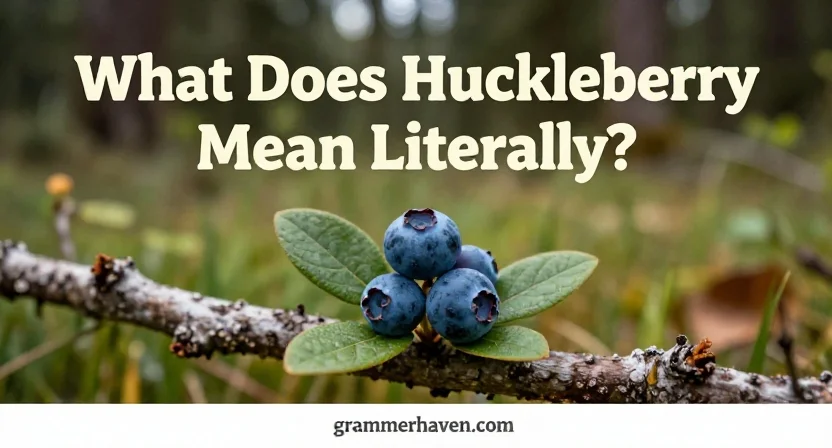
The literal huckleberry meaning refers to the fruit of various shrubs that produce small berries. These berries can be blue, black, red, or other dark shades depending on the species.
The name doesn’t identify one single botanical species. That’s an important distinction. People commonly use huckleberry as a broad common name for several related plants.
Etymological sources trace the English word back to older terms related to whortleberry, with huckleberry appearing in American English by the 1600s. The word eventually became a common name for several berry-producing plants in North America.
The fruit is generally small and often has a sweet or tart flavor. People use huckleberries in many of the same ways they use other small berries.
Common uses include:
- Pies
- Jams
- Jellies
- Syrups
- Sauces
- Muffins
- Pancakes
- Desserts
- Fresh eating
The exact appearance and flavor vary because huckleberry covers several different plants.
What Does a Huckleberry Look Like?
Huckleberries are generally small and round. Depending on the species, the fruit may appear deep red, purple, blue, or nearly black.
Some huckleberry species have relatively large, noticeable seeds. That characteristic can help distinguish certain huckleberries from cultivated blueberries.
However, appearance alone isn’t enough for reliable identification. Different species can look quite different, which is why botanical identification matters when you’re talking about wild plants.
The U.S. Forest Service, for example, describes bear huckleberry (Gaylussacia ursina) as a native shrub with small flowers and fruit containing multiple seed compartments.
How Is Huckleberry Used as Food?
Huckleberries have a long association with wild harvesting and regional cooking in North America. People commonly turn them into sweet preserves, baked goods, sauces, and desserts.
Their flavor can be described as sweet-tart, although individual species differ considerably.
A few natural examples include:
- “We picked fresh huckleberries during our mountain trip.”
- “She made a delicious huckleberry pie.”
- “The restaurant served pancakes with huckleberry syrup.”
In each sentence, huckleberry has its literal fruit meaning.
What Does “I’m Your Huckleberry” Mean?
The expression “I’m your huckleberry” has a very different meaning.
When someone says it figuratively, they’re essentially saying:
“I’m the person you need.”
Depending on the situation, it can also mean “I’m willing to do it,” “I’ll take the job,” or “I’m ready for the challenge.”
The phrase can sound friendly in one situation and threatening in another.
For example, imagine someone says:
“We need someone who knows how to fix this old engine.”
If you answer, “I’m your huckleberry,” you’re volunteering because you’re confident you can handle the job.
Now imagine the phrase appears during a confrontation. The meaning changes slightly:
“You want someone to face you? I’m your huckleberry.”
Here, the speaker is essentially accepting the challenge.
That flexibility is one reason the expression has survived. It’s short, memorable, and packed with attitude.
Examples of “I’m Your Huckleberry”
Here are several modern examples:
Accepting a task:
“Need someone to organize the event? I’m your huckleberry.”
Volunteering:
“If you need somebody to test the new equipment, I’m your huckleberry.”
Accepting a challenge:
“You think nobody can beat this level? I’m your huckleberry.”
Playful confidence:
“Looking for the best person to pick the restaurant? I’m your huckleberry.”
The common thread is readiness and suitability.
What Does “Huckleberry” Mean in Slang?
The slang huckleberry meaning developed from older American usage rather than from one single modern definition.
Historical sources show that huckleberry could describe something small or relatively insignificant. It could also function as a term of affection or companionship. Those older senses help explain why the word eventually appeared in expressions about being someone’s partner, helper, or suitable person.
One historical source records “I’m your huckleberry” in 1879. Other examples appear in American writing from the late 19th and early 20th centuries.
That history matters because it disproves a common assumption: the expression wasn’t invented for Tombstone.
The movie made it famous. It didn’t create the phrase.
Where Did “I’m Your Huckleberry” Come From?
The precise origin of the expression isn’t completely settled. Several explanations have circulated over the years, but the historical record gives us a safer conclusion.
The phrase was already being used in American English during the 19th century.
A documented example from 1879 uses “I’m your huckleberry” in a social setting. Later examples use it in contexts involving companionship, assistance, or participation in an activity.
That evidence suggests the phrase originally had broader meanings than the deadly challenge associated with Doc Holliday.
Early Uses of Huckleberry
Older American English used huckleberry in several figurative ways.
One documented sense referred to a person or thing of little consequence. Another related expression was “a huckleberry above a persimmon.” That expression suggested something slightly beyond one’s ability or something a little better or higher.
Over time, the word also developed associations with friendship, companionship, and usefulness.
That’s why the modern interpretation of “I’m your huckleberry” shouldn’t be reduced to “I will fight you.” Fighting is only one context in which the phrase can work.
Did Mark Twain Create the Expression?
No solid evidence shows that Mark Twain invented “I’m your huckleberry.”
The phrase existed in print before Adventures of Huckleberry Finn appeared in 1884. Historical examples from the 19th century establish that fact.
Twain did, however, give Huckleberry enormous cultural visibility by using it as Huck Finn’s first name.
That connection can make the history confusing. The character and the idiom share the same word, but that doesn’t mean Twain created the phrase.
Huckleberry and Mark Twain
Why Is Huckleberry Finn Called Huckleberry?
Mark Twain’s character Huckleberry Finn, commonly called Huck, first appeared in The Adventures of Tom Sawyer in 1876. He later became the central character in Adventures of Huckleberry Finn, published in 1884.
The name works especially well for the character because huckleberry already carried informal and sometimes dismissive associations in American English.
Historical research on the word notes that Twain used huckleberry in figurative ways elsewhere in his writing. In A Connecticut Yankee in King Arthur’s Court, for example, he used the word in a context meaning someone of little consequence.
So, Huckleberry Finn isn’t simply named after a piece of fruit. The word carried cultural and figurative associations that made it an interesting choice for Twain.
Huckleberry Finn vs. “I’m Your Huckleberry”
These two uses shouldn’t be treated as the same expression.
| Use | Meaning |
| Huckleberry | A type of berry |
| Huckleberry Finn | The fictional character created by Mark Twain |
| Huckleberry as old slang | A small or relatively insignificant person or thing |
| “I’m your huckleberry” | I’m your person, partner, helper, or match |
| “A huckleberry above a persimmon” | Something slightly beyond one’s ability or reach |
The shared word creates an obvious connection, but the meanings developed in different contexts.
“I’m Your Huckleberry” in Tombstone
The phrase became dramatically more famous through the 1993 Western film Tombstone.
In the movie, Val Kilmer plays Doc Holliday, who uses the expression while confronting Johnny Ringo. The line became one of the film’s most memorable pieces of dialogue.
Within that scene, “I’m your huckleberry” essentially means:
“I’m the opponent you’re looking for.”
It carries confidence rather than hesitation. Doc isn’t volunteering because he’s uncertain about the outcome. He’s accepting the confrontation with swagger.
That scene gave an older expression a new cultural life.
What Does Doc Holliday Mean by “I’m Your Huckleberry”?
The surrounding dialogue makes the meaning clear.
Johnny Ringo is looking for a confrontation. Doc Holliday steps forward and identifies himself as the person willing to meet him.
In that setting, the phrase means something like:
“You’ve found your man.”
It’s concise. It’s confident. It also sounds deliberately old-fashioned, which fits the film’s Western setting.
Historical research into the phrase also reveals that the wording appeared in Walter Noble Burns’s 1927 book Tombstone: An Iliad of the Southwest. That earlier literary use involved Doc Holliday and Johnny Ringo as well.
However, there is an important distinction.
There is no reliable contemporary evidence establishing that the real Doc Holliday actually said the phrase. The connection appears in later literary and cinematic portrayals rather than firmly documented firsthand records.
Huckleberry vs. Blueberry
People sometimes treat huckleberry and blueberry as interchangeable. They’re related in everyday conversation, but they’re not simply two names for exactly the same fruit.
| Feature | Huckleberry | Blueberry |
| General appearance | Can be red, purple, blue, or black | Usually blue to blue-black |
| Botanical range | Several plants can carry the name | Commonly refers to Vaccinium species |
| Seeds | Some species have relatively noticeable seeds | Seeds are generally smaller |
| Flavor | Often sweet-tart | Usually sweet with mild acidity |
| Common uses | Pies, jams, syrups, desserts | Fresh eating, baking, jams, syrups |
| Growing habit | Often associated with wild or native shrubs | Widely cultivated commercially |
The terminology gets complicated because huckleberry is a common name rather than one precise botanical category.
Etymological sources note that the name is technically associated with Gaylussacia but is also widely applied to related Vaccinium plants.
So, if you’re discussing a specific species, botanical identification matters more than the everyday name.
Is Huckleberry a Name?
Yes. Huckleberry can also function as a personal name, although it remains strongly associated with literature.
Mark Twain’s Huckleberry Finn is the most famous example. The character is generally called Huck, which makes Huckleberry function partly as an informal personal name.
The name has also appeared in modern naming culture because of its literary and rustic associations.
As a name, Huckleberry can evoke ideas such as:
- Nature
- Rural life
- Adventure
- Youthfulness
- Independence
- American literature
That meaning is quite different from the botanical sense of the word.
How to Use “Huckleberry” in a Sentence
Literal Huckleberry Examples
Here are examples where huckleberry refers to the fruit:
- “We picked wild huckleberries during our hike.”
- “She made a sweet huckleberry pie.”
- “The recipe calls for fresh huckleberries.”
- “Huckleberry jam has a rich, tart flavor.”
- “The trail was surrounded by shrubs covered with berries.”
Figurative Huckleberry Examples
These examples use the word in the idiomatic sense:
- “Need someone to repair the old truck? I’m your huckleberry.”
- “If you’re looking for a volunteer, I’m your huckleberry.”
- “You need someone willing to take the challenge? I’m your huckleberry.”
- “Want someone to handle the difficult assignment? I’m your huckleberry.”
The figurative version usually sounds playful, confident, old-fashioned, or theatrical.
Is “I’m Your Huckleberry” Positive or Negative?
The phrase itself isn’t automatically positive or negative.
Its tone comes from the situation.
If your friend asks for help moving furniture, saying “I’m your huckleberry” sounds playful and helpful.
If an opponent challenges you to a fight, the same words sound bold and confrontational.
Consider the difference:
“You need someone to organize the fundraiser? I’m your huckleberry.”
This sounds helpful.
Now compare:
“You want to settle this tonight? I’m your huckleberry.”
That sounds like a challenge.
The words haven’t changed. The context does the heavy lifting.
Is “Huckleberry” Still Used Today?
Yes, but its everyday uses differ.
You’ll most often encounter huckleberry in three broad contexts:
- Food and nature — referring to the berry or plant.
- Literature — especially Huckleberry Finn.
- Pop culture and idioms — particularly “I’m your huckleberry.”
The phrase isn’t something most English speakers use constantly in ordinary conversation. It’s relatively old-fashioned and can sound deliberately colorful.
That’s exactly why it works well in fiction, jokes, Western-themed dialogue, and playful speech.
Someone saying “I’m your huckleberry” today may be intentionally borrowing the expression’s old-timey flavor.
Common Misunderstandings About Huckleberry
Is Huckleberry the Same as Blueberry?
Not exactly.
The names can overlap in casual usage, but huckleberries and blueberries can belong to different plants and have different physical characteristics.
Does Huckleberry Always Mean a Fruit?
No.
It can refer to the fruit, a person in older figurative language, the character Huckleberry Finn, or someone described through the idiom “I’m your huckleberry.”
Did Tombstone Invent “I’m Your Huckleberry”?
No.
The phrase existed long before the 1993 movie. Historical examples go back to the 19th century. Tombstone simply gave the expression enormous modern visibility.
Is “Huckleberry” Always Slang?
No.
In its ordinary use, it is simply the name of a berry or the plant that produces it.
Calling every use of the word “slang” would miss its most basic meaning.
Does “I’m Your Huckleberry” Mean “I’m Your Friend”?
Not exactly.
The expression can carry an idea of companionship or partnership, especially in older usage. However, its better modern interpretation is “I’m the person for this” or “I’m ready to take this on.”
The “Huckle Bearer” Myth
One particularly persistent explanation claims that “I’m your huckleberry” is actually a misheard version of “I’m your huckle bearer.”
According to that theory, a “huckle bearer” supposedly carried a coffin and therefore the phrase meant something like “I’m ready to carry your coffin.”
That story makes for a dramatic explanation. Unfortunately, the historical evidence doesn’t support it well.
The phrase “I’m your huckleberry” has documented 19th-century uses. By contrast, the supposed historical term “huckle bearer” lacks comparable evidence. Modern discussions of the phrase therefore generally treat the “huckle bearer” explanation as an unsupported later theory rather than the established origin.
This is a useful lesson in word history: a colorful explanation isn’t necessarily an accurate explanation.
Huckleberry Meaning at a Glance
| Meaning | Explanation | Example |
| Fruit | A small berry produced by several shrubs | “We made huckleberry jam.” |
| Plant | A shrub producing huckleberry fruit | “The hillside has native huckleberry shrubs.” |
| Old figurative use | A small or relatively insignificant person or thing | Historical American usage |
| Partner or helper | Someone willing to assist or participate | “I’m your huckleberry.” |
| Person for the job | Someone ready and suited for a task | “Need a mechanic? I’m your huckleberry.” |
| Challenge or opponent | Someone willing to face another person | Doc Holliday’s use in Tombstone |
| Literary name | Huckleberry Finn, Mark Twain’s character | “Huck is Huckleberry Finn.” |
Why the Word Huckleberry Has So Many Meanings
The interesting thing about huckleberry is how its meanings accumulated over time.
It started as a plant and berry name. American speakers then used the word in figurative expressions. Literature gave it another layer through Huck Finn. Finally, movies such as Tombstone turned one old expression into a recognizable cultural catchphrase.
That progression looks roughly like this:
Berry → figurative slang → literary name → idiom → pop-culture catchphrase
Each stage added meaning without completely replacing the earlier ones.
That’s why context matters so much.
If you’re reading a recipe, huckleberry almost certainly means the fruit.
If you’re watching Tombstone, the phrase “I’m your huckleberry” signals confident acceptance of a confrontation.
See also: No Longer Exist or No Longer Exists? Which Is Correct?
FAQs:
What does huckleberry mean in slang?
In older American slang, huckleberry could refer to a small or relatively insignificant person or thing. It also developed associations with companionship and usefulness. In “I’m your huckleberry,” the word means someone who is ready or suited for the situation.
What does “I’m your huckleberry” mean?
It generally means “I’m the person you’re looking for” or “I’m ready for the job or challenge.” In Tombstone, the phrase carries a more confrontational meaning because Doc Holliday accepts Johnny Ringo’s challenge.
Is huckleberry a fruit or a person?
It can be either, depending on context. A huckleberry is a fruit, while Huckleberry Finn is a fictional character. The word also appears in older figurative expressions.
Why does Doc Holliday say “I’m your huckleberry”?
In Tombstone, Doc Holliday uses the phrase while accepting Johnny Ringo’s challenge. In that scene, it essentially means “I’m your man” or “I’m the opponent you’re looking for.”
Is huckleberry the same as blueberry?
No. The names can overlap in casual use, but huckleberry and blueberry aren’t identical botanical categories. Several plants called huckleberries differ from common cultivated blueberries in their species, fruit characteristics, and growing habits.
Did Mark Twain invent the phrase “I’m your huckleberry”?
No. Documented examples of the phrase predate Adventures of Huckleberry Finn. Twain made Huckleberry famous as a character name, but the idiom has an older history.
Conclusion:
The meaning of huckleberry changes with context. Literally, it refers to a small edible berry that grows on several North American plants. Figuratively, huckleberry has appeared in older American expressions and can describe someone suited to a particular task or challenge.
The phrase “I’m your huckleberry” is its best-known figurative use today. It usually means “I’m the person you need” or “I’m ready for the challenge.” The phrase existed before Tombstone, although Doc Holliday’s famous line helped bring it back into popular culture.
Whether you encounter huckleberry in a recipe, a Mark Twain novel, or a Western movie, context reveals the intended meaning. It may be a berry, a literary name, or a confident way of saying, “Count me in.”