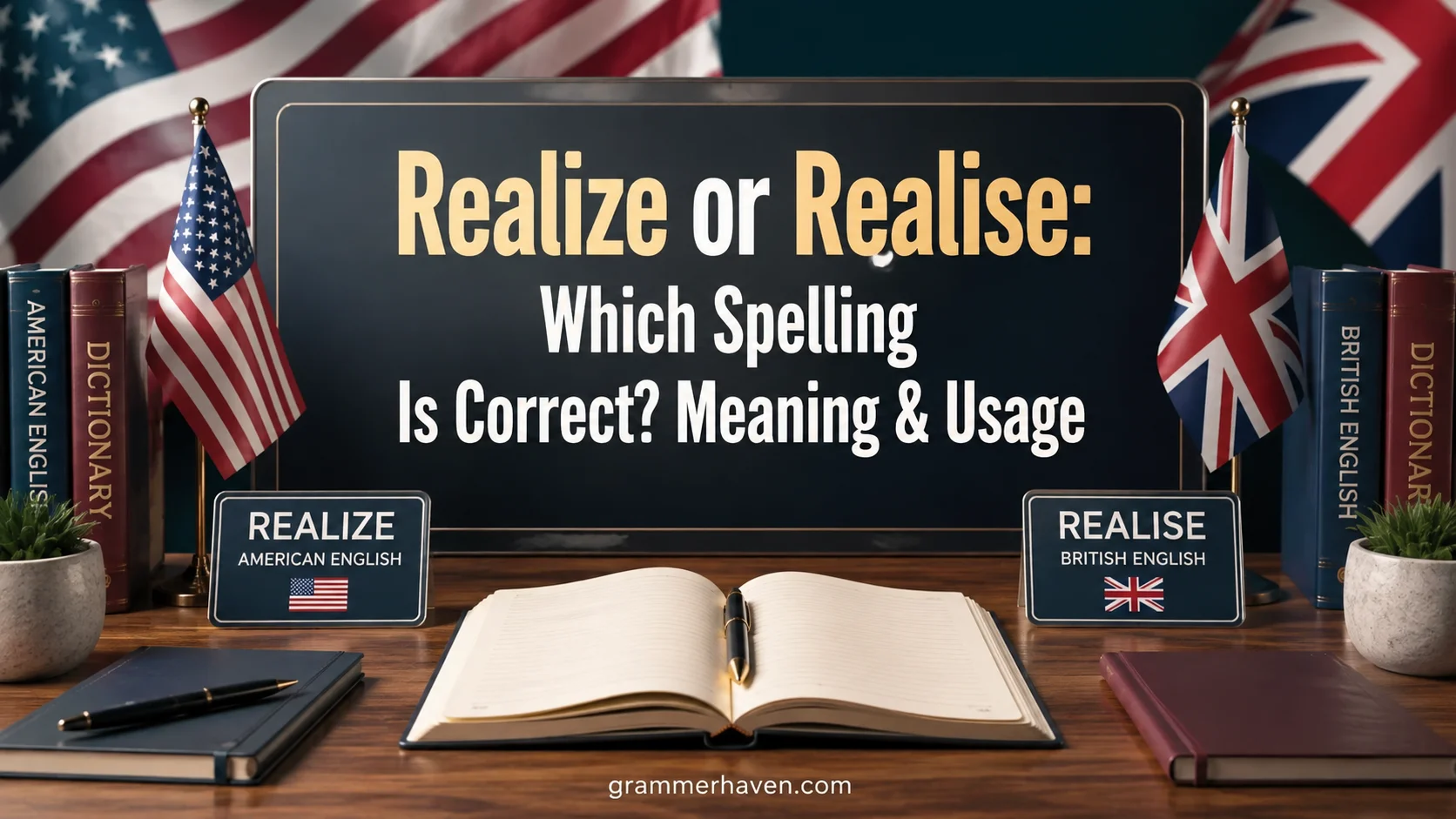
Realize or Realise: Which Spelling Is Correct? Meaning & Usage covers two spellings of the same verb used across different varieties of English. Realize is standard in American and Canadian English, while realise is more common in British, Australian, and New Zealand English. The difference also appears in related forms such as realized, realised, realizing, realising, realization, and realisation.
Your spelling choice should match your audience, English variety, and preferred writing standard. American and Canadian English generally use the -ize suffix, while British English and several other varieties commonly use -ise. The spelling -ize isn’t simply an American invention. It has a much older history, with the suffix connected to Ancient Greek and influenced by Latin. Both spellings remain recognized in modern English, so consistency matters more than treating one form as universally correct.
Historical Google Books data shows that spelling preferences have changed over time. British books and journals from 1800 to 2000 show periods when realise became more common, particularly during the late 19th and early 20th centuries. Realize had stronger usage before about 1875 and gained popularity again later. Major dictionaries such as Oxford, Cambridge, and Collins have helped document these spelling patterns. Modern British publications commonly favor realise, with some sources reporting it as roughly ten times more frequent than realize in 21st-century British news writing.
Writers using British English, Australian English, or New Zealand English can use either recognized spelling according to their chosen style guide. American books and journals show a stronger preference for realize and related -ize forms. Factors such as suffix usage, pronunciation, education, classical language study, and regional publishing standards have shaped these patterns. The key point is simple: realize and realise have the same meaning, and your choice mainly depends on the variety of English you’re writing for.
Realize vs Realise: Quick Answer
Here is the simple comparison:
| Spelling | Common English Variety | Where It Is Commonly Used | Example |
| Realize | American English | United States and some Canadian contexts | “I didn’t realize the deadline had changed.” |
| Realise | British English | United Kingdom, Australia, New Zealand, and many Commonwealth countries | “I didn’t realise the deadline had changed.” |
The main difference:
- Realize uses the letter z.
- Realise uses the letter s.
- Both words have the same meaning.
- Both words are pronounced the same way.
Think of them as two regional versions of the same word, similar to:
- Color vs colour
- Center vs centre
- Organize vs organise
Neither spelling is automatically better. The best choice depends on who will read your writing.
What Does Realize or Realise Mean?
The words realize and realise have several meanings depending on context. The most common meaning is to suddenly understand or become aware of something.
However, the word can also describe achieving a goal or receiving financial value from something.
Let’s look at each meaning.
Realize or Realise Meaning: To Understand Something
The most common use describes a moment when something becomes clear.
For example:
“She realized she had left her phone at home.”
Before that moment, she did not know where her phone was. Then she became aware of the problem.
Other examples:
- “I didn’t realize how difficult the project would be.”
- “He realised that he had made the wrong choice.”
- “They finally realized why the machine wasn’t working.”
This meaning often describes a mental shift. A person moves from uncertainty to understanding.
A simple way to think about it:
Before realizing: “I don’t know.”
After realizing: “Now I understand.”
Realize or Realise Meaning: To Achieve a Goal
The word can also mean making an idea, dream, or plan become real.
Examples:
- “The company realized its goal of expanding into international markets.”
- “The team realized its vision after years of hard work.”
- “She realized her dream of becoming a published author.”
In this context, realize means turning something imagined into something actual.
A useful comparison:
| Idea Stage | Reality Stage |
| A business plans a new product | The business launches the product |
| An athlete dreams of winning | The athlete wins the championship |
| A writer imagines a book | The writer publishes the book |
The dream becomes a result.
Realize or Realise Meaning in Finance and Business
A less common meaning appears in financial writing.
In this context, realize means to receive money from an asset, investment, or sale.
Example:
“The investor realized a profit after selling the property.”
This means the investor actually received the financial gain.
Another example:
“The company realized $5 million in revenue during the quarter.”
This usage appears frequently in business reports, accounting documents, and financial discussions.
Why Are There Two Spellings: Realize and Realise?
The difference between realize and realise comes from the history of English spelling.
English developed differently in different regions. As communities separated geographically, they created their own spelling preferences.
The United States gradually developed its own spelling standards, especially during the late 18th and 19th centuries.
American dictionary makers, including Noah Webster, supported spelling reforms that aimed to simplify English.
Some examples of American spelling changes include:
- Colour → color
- Centre → center
- Honour → honor
- Organise → organize
The goal was not to create a completely new language. Instead, reformers wanted spelling to become more consistent and practical.
British English generally kept more traditional spelling patterns, although British spelling has also changed over time.
Why Does American English Prefer “Realize”?
American English commonly prefers -ize endings.
Examples:
| American English | British English |
| Realize | Realise |
| Organize | Organise |
| Recognize | Recognise |
| Analyze | Analyse |
The -ize spelling is connected to the original Greek root found in many English words.
American dictionaries and style guides often recommend keeping the z spelling because it reflects that historical connection.
For example:
- “The company needs to organize its files.”
- “Scientists analyze the results.”
- “People recognize important changes.”
The pattern stays consistent.
Why Does British English Prefer “Realise”?
British English commonly uses -ise endings.
Examples:
- “I didn’t realise the mistake immediately.”
- “The organization hopes to realise its goals.”
- “Researchers analyse the data carefully.”
Many British writers use -ise because it matches common spelling conventions in the United Kingdom and several Commonwealth countries.
However, British English is not completely uniform. Some British dictionaries and organizations accept both forms.
The important point:
British English often prefers “realise,” but “realize” is not automatically wrong.
Is Realize or Realise More Correct?
A common question is:
Which spelling should I use?
The answer depends on your audience.
There is no universal winner.
Both spellings are recognized English words. The correct choice comes from the type of English you are using.
Use Realize If You Write for American Readers
Choose realize when your audience includes:
- People in the United States
- American businesses
- U.S. schools and universities
- American publications
- U.S.-based websites
Examples:
✅ “I didn’t realize the instructions had changed.”
✅ “The company hopes to realize its long-term goals.”
Use Realise If You Write for British Readers
Choose realise when your audience includes:
- People in the United Kingdom
- Many Australian readers
- New Zealand audiences
- Some Commonwealth countries
Examples:
✅ “I didn’t realise the instructions had changed.”
✅ “The company hopes to realise its long-term goals.”
Realize vs Realise Around the World
English is spoken globally, and spelling preferences vary by country.
Here is a general guide:
| Country or Region | Common Preference |
| United States | Realize |
| United Kingdom | Realise |
| Australia | Realise |
| New Zealand | Realise |
| Canada | Both are used, with “realize” common in many contexts |
| International businesses | Depends on target audience |
Keep in mind that language habits can vary between organizations and individuals.
For example, a global company headquartered in the United States may use American spelling worldwide. A British publisher may follow British spelling even for international readers.
Realize vs Realise Examples in Sentences
Seeing the words in context makes the difference easier to understand.
Everyday Conversations
American English
- “I didn’t realize you were already here.”
- “She realized she forgot her wallet.”
- “Did you realize how fast time passed?”
British English
- “I didn’t realise you were already here.”
- “She realised she forgot her wallet.”
- “Did you realise how fast time passed?”
The meaning remains unchanged.
Workplace Examples
American English
“The manager realized the team needed more resources.”
Meaning:
The manager understood this fact.
British English
“The manager realised the team needed more resources.”
Meaning:
Exactly the same.
Business Examples
American English
“The company realized significant growth after launching the new product.”
British English
“The company realised significant growth after launching the new product.”
Again, only the spelling changes.
See also: Gnaw or Knaw: Which Spelling Is Correct? Meaning and Usage
FAQs:
1. Is realize or realise correct?
Both realize and realise are correct spellings of the same word. Realize is preferred in American and Canadian English, while realise is more common in British, Australian, and New Zealand English.
2. Is realize American English?
Yes, realize is the standard and preferred spelling in American English. However, it isn’t an Americanism because the -ize spelling has a much older history in English.
3. Is realise British English real?
Yes. Realise is widely used in British English and is also common in Australian and New Zealand English. However, realize is also acceptable in these varieties.
4. What is the difference between realize and realise?
There is no difference in meaning or pronunciation. The only difference is spelling. The choice mainly depends on the variety of English you’re using.
5. Which spelling should I use in American English?
Use realize in American English. Its related forms include realized, realizing, and realization.
6. Which spelling should I use in British English?
Realise is a common choice in British English, especially in many newspapers and general publications. However, realize is also accepted, so follow the style guide of your publication or organization.
7. Is realise an incorrect spelling?
No. Realise isn’t incorrect. It’s a standard spelling used in several English varieties, particularly British, Australian, and New Zealand English.
8. Should I use -ize or -ise consistently?
Yes. Once you choose a spelling style, it’s best to use it consistently throughout your writing. This keeps your text clear and professionally edited.
Conclusion:
Realize and realise are both correct spellings of the same word. The main difference comes from regional spelling conventions. Use realize for American and Canadian English, while realise is widely preferred in British, Australian, and New Zealand English. Whichever form you choose, keep your spelling consistent throughout your writing.