Explore Sweet Tooth: Idiom Meaning, Origin, Examples to learn how this sweet tooth idiom describes a love for sugary foods, treats, and desserts. The sweet tooth idiom is a fun way to describe someone who has a love for sweet foods, such as chocolates, cakes, and other sugary snacks. When people use this phrase, they mean they enjoy all things sweet and often feel a strong craving or hankering for sweet treats. This term shows a person’s preferences and habits in a straightforward way. The meaning in English is easy to understand, but its origin and background make this tasty subject more interesting.
The sweet tooth phrase does not refer to a real tooth or teeth. It is an idiomatic expression and a fixed idiomatic expression that remains in its singular form. The correct term is sweet tooth, not sweet teeth, even though tooth has a plural form called teeth. In an informal context, people use this phrase to talk about their enjoyment of sweet things, sweet foods, and sugary treats. A family dentist may jokingly mention cavities and call them sweet teeth, but that is only a playful expression and not the proper phrase. This extra detail explains the common mistake and helps readers understand the phrase better.
The origin of the idiom sweet tooth goes back to the 14th century and connects with Chaucer and The Canterbury Tales, especially The Wife of Bath’s Prologue. In a famous line near the end, Chaucer mentioned keeping something for someone’s sweet tooth, along with ideas about blame, God, and truth.
What Does “Sweet Tooth” Mean?
A sweet tooth is a strong liking or preference for sweet foods and sugary treats.
When someone says they have a sweet tooth, they mean they enjoy eating desserts, candy, chocolate, pastries, ice cream, or other sweet foods more than most people.
Simple Definition
Sweet tooth (idiom): A strong desire for sweet foods or sugary snacks.
Example
- I have a sweet tooth, so I always order dessert after dinner.
- Sarah has such a sweet tooth that she keeps chocolate in her desk drawer.
- My grandfather had a sweet tooth and never skipped dessert.
The phrase does not refer to an actual tooth. Instead, it uses the word “tooth” figuratively to describe a person’s taste or preference.
Sweet Tooth Meaning Explained in Simple Terms
At its core, the idiom describes a person who enjoys sweet flavors.
Think about two people at a restaurant:
- One orders a cheeseburger and fries.
- The other immediately checks the dessert menu.
The second person probably has a sweet tooth.
Having a sweet tooth doesn’t necessarily mean someone eats sugar constantly. It simply means they naturally prefer sweet foods.
Signs Someone Has a Sweet Tooth
A person with a sweet tooth often:
- Craves desserts after meals
- Loves chocolate and candy
- Chooses sweet snacks over salty ones
- Enjoys baked goods regularly
- Looks forward to holiday treats
- Keeps sweets at home or work
Sweet Tooth vs. Occasional Dessert Lover
There is a difference between enjoying dessert sometimes and having a sweet tooth.
| Type | Description |
| Occasional Dessert Lover | Enjoys sweets from time to time |
| Sweet Tooth | Frequently craves and prefers sweet foods |
Someone with a sweet tooth actively seeks sweet flavors more often.
Why Is It Called a Sweet Tooth?
Many people find the phrase unusual because teeth do not actually taste food. The tongue handles taste, not teeth.
So why does English use the word “tooth”?
Historically, English speakers often used the word tooth to describe a liking or appetite for something.
Over time, the phrase sweet tooth became associated with a preference for sugary foods.
The expression eventually evolved into the modern idiom we use today.
Interesting Fact
The phrase has existed in English for hundreds of years. Historical records show variations of the expression appearing as early as the 14th century.
That makes “sweet tooth” one of the oldest food-related idioms still commonly used today.
The Origin and History of the Sweet Tooth Idiom
The origins of the expression can be traced back to Middle English.
In earlier forms of English, the word tooth often symbolized desire, appetite, or inclination.
Writers used phrases such as:
- A tooth for adventure
- A tooth for learning
- A tooth for sweets
Over time, most of these expressions disappeared. However, sweet tooth survived and became widely accepted.
How the Expression Evolved
| Period | Development |
| Middle English | Tooth associated with appetite and desire |
| Early Modern English | Sweet tooth became increasingly common |
| Modern English | Established as a standard idiom worldwide |
Today, people in the United States, Canada, the United Kingdom, Australia, and other English-speaking countries use the expression regularly.
How to Use the Sweet Tooth Idiom Correctly
The most common structure is:
Have + a sweet tooth
Examples
- I have a sweet tooth.
- You have a sweet tooth.
- They have a sweet tooth.
- She has a sweet tooth.
This pattern appears far more often than any other version.
Past Tense Examples
- He had a sweet tooth as a child.
- My grandmother had a sweet tooth her entire life.
Future Examples
- You’ll develop a sweet tooth if you keep eating candy every day.
- She may have a sweet tooth after trying those desserts.
Common Grammar Structures with Sweet Tooth
The idiom appears in several natural sentence patterns.
| Structure | Example |
| Have a sweet tooth | I have a sweet tooth. |
| Has a sweet tooth | She has a sweet tooth. |
| Had a sweet tooth | My father had a sweet tooth. |
| Develop a sweet tooth | He developed a sweet tooth in college. |
| Satisfy a sweet tooth | This pie will satisfy your sweet tooth. |
| Feed a sweet tooth | These cupcakes feed my sweet tooth. |
| Indulge a sweet tooth | She indulges her sweet tooth on weekends. |
These structures sound natural to native speakers.
Common Collocations Used with Sweet Tooth
Certain words frequently appear alongside the idiom.
Popular Collocations
- Huge sweet tooth
- Serious sweet tooth
- Major sweet tooth
- Sweet tooth craving
- Satisfy a sweet tooth
- Feed a sweet tooth
- Indulge a sweet tooth
Examples
- Jake has a huge sweet tooth.
- This bakery can satisfy any sweet tooth.
- I indulge my sweet tooth occasionally.
- Her serious sweet tooth makes dieting difficult.
Using these collocations makes your English sound more natural and fluent.
Sweet Tooth Examples in Everyday Conversations
The best way to learn an idiom is by seeing it in context.
Casual Conversation Examples
- I’ve always had a sweet tooth.
- Do you have a sweet tooth?
- My brother has a serious sweet tooth.
- She can’t resist donuts because she has a sweet tooth.
- We bought extra cookies because the kids have sweet teeth.
- I usually avoid candy despite having a sweet tooth.
- That chocolate cake is perfect for anyone with a sweet tooth.
- My roommate has a huge sweet tooth.
- This bakery is heaven for people with a sweet tooth.
- He developed a sweet tooth after moving abroad.
Sweet Tooth Examples in the Workplace
Although the idiom is informal, it often appears in workplace conversations.
Examples
- Someone with a sweet tooth keeps emptying the candy bowl.
- Linda has a sweet tooth, so she loves office birthday parties.
- These cupcakes disappeared quickly because several employees have a sweet tooth.
- Anyone with a sweet tooth should try the bakery across the street.
The expression sounds natural in casual professional settings.
Sweet Tooth Examples for Students and English Learners
Students often encounter the idiom in reading materials and exams.
Examples
- Emma has a sweet tooth and enjoys baking cookies.
- Having a sweet tooth can make healthy eating challenging.
- My cousin has a sweet tooth, so she always buys desserts.
- Tom’s sweet tooth led him straight to the candy aisle.
These examples demonstrate practical usage while keeping the meaning clear.
Real-Life Situations Where People Use Sweet Tooth
The idiom appears in many everyday situations.
At Restaurants
A customer might say:
“I have a sweet tooth, so I’d like to see the dessert menu.”
During Holidays
Many people describe their holiday eating habits this way:
“My sweet tooth gets worse during Christmas.”
Grocery Shopping
You may hear:
“My sweet tooth convinced me to buy ice cream.”
Family Gatherings
Relatives often joke:
“The kids inherited their mother’s sweet tooth.”
Baking Events
Home bakers frequently say:
“This recipe is perfect for anyone with a sweet tooth.”
Sweet Tooth and Health Discussions
The phrase also appears in conversations about nutrition.
People often mention a sweet tooth when discussing:
- Sugar intake
- Healthy eating
- Weight management
- Dessert habits
- Food cravings
Example
“I have a sweet tooth, so reducing sugar has been difficult.”
Notice that the idiom itself is neutral. It doesn’t automatically imply healthy or unhealthy behavior.
Common Mistakes People Make with Sweet Tooth
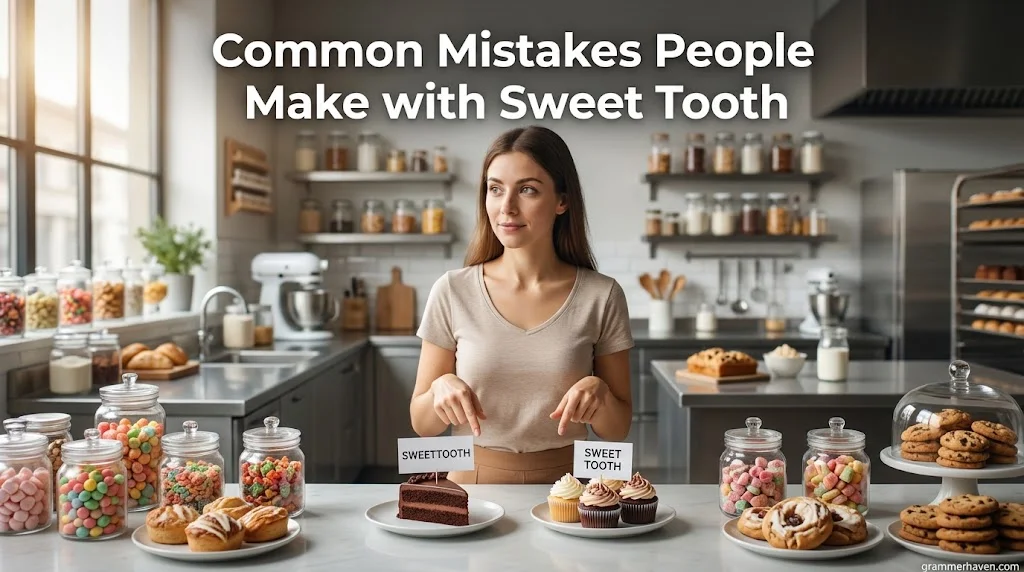
Many English learners misuse the idiom.
Let’s look at the most common errors.
Forgetting the Article
Incorrect:
- I have sweet tooth.
Correct:
- I have a sweet tooth.
The article “a” is usually required.
Taking the Expression Literally
Incorrect interpretation:
- A sweet tooth means a tooth that tastes sweet.
Correct interpretation:
- It means a person likes sweet foods.
Using the Wrong Verb
Less natural:
- I am a sweet tooth.
Natural:
- I have a sweet tooth.
Confusing It with Sugar Cravings
A sweet tooth refers to a general preference.
A sugar craving often refers to a specific desire at a particular moment.
Sweet Tooth vs. Craving Sweets
Many people assume these expressions mean the same thing.
They do not.
| Expression | Meaning |
| Sweet Tooth | Ongoing preference for sweets |
| Sugar Craving | Immediate desire for sugar |
Examples
- I have a sweet tooth. (General habit)
- I’m craving chocolate right now. (Current desire)
The difference is subtle but important.
Synonyms and Similar Expressions
English offers several alternatives.
Direct Alternatives
- Love sweets
- Enjoy desserts
- Crave sugary foods
- Dessert lover
- Candy lover
Informal Alternatives
- Dessert enthusiast
- Chocoholic
- Candy fanatic
Comparison Table
| Expression | Meaning | Tone |
| Sweet tooth | Loves sweet foods | Neutral |
| Dessert lover | Enjoys desserts | Neutral |
| Candy lover | Enjoys candy | Informal |
| Chocoholic | Loves chocolate | Informal |
| Sugar addict | Extremely fond of sugar | Informal |
Opposite Expressions of Sweet Tooth
Sometimes you need the opposite meaning.
Common alternatives include:
- Not fond of sweets
- Prefer savory foods
- Avoid sugary foods
- Dislike desserts
- Don’t enjoy sweet foods
Examples
- Unlike his sister, he isn’t fond of sweets.
- I prefer savory snacks to sugary desserts.
- My father rarely eats candy because he doesn’t enjoy sweets.
Sweet Tooth vs. Other Food-Related Idioms
Many learners confuse food idioms.
Let’s compare a few.
Sweet Tooth
Meaning:
- Loves sweet foods
Example:
- She has a sweet tooth.
Piece of Cake
Meaning:
- Very easy
Example:
- The test was a piece of cake.
Spill the Beans
Meaning:
- Reveal a secret
Example:
- Somebody spilled the beans.
Big Cheese
Meaning:
- Important person
Example:
- The company’s big cheese attended the meeting.
Comparison Table
| Idiom | Meaning |
| Sweet Tooth | Loves sweets |
| Piece of Cake | Easy task |
| Spill the Beans | Reveal a secret |
| Big Cheese | Important person |
Only “sweet tooth” relates directly to food preferences.
Is Sweet Tooth Formal or Informal?
The idiom falls into the neutral-to-informal category.
Most people use it comfortably in everyday speech.
Suitable Contexts
- Daily conversation
- Blogs
- Social media
- Lifestyle articles
- Food reviews
- Marketing content
Less Common Contexts
- Academic research papers
- Legal documents
- Formal business reports
Even in professional settings, the expression rarely sounds out of place when discussing food.
Sweet Tooth in Advertising and Marketing
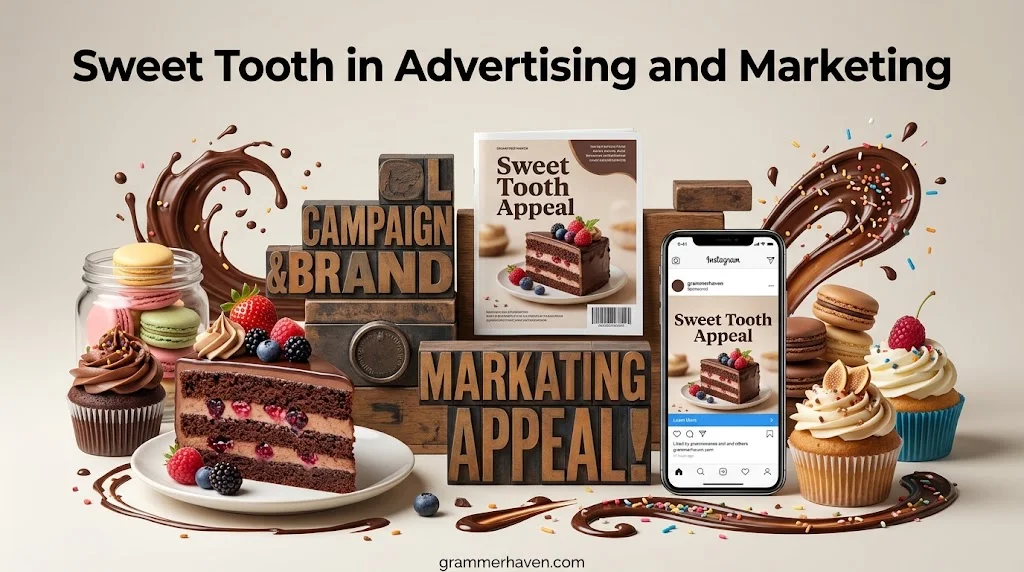
Food companies frequently use the phrase.
Why?
Because it instantly communicates a love for desserts and treats.
Examples of Marketing Messages
- Perfect for your sweet tooth.
- Satisfy your sweet tooth today.
- A dessert every sweet tooth will love.
- Treat your sweet tooth without guilt.
The phrase creates an emotional connection with consumers who enjoy sugary foods.
Sweet Tooth in Popular Culture
The idiom appears regularly in:
- Food blogs
- Cooking shows
- Restaurant menus
- Television programs
- Lifestyle magazines
- Social media posts
You’ll often see headlines such as:
- “Best Desserts for Every Sweet Tooth”
- “How to Manage a Sweet Tooth”
- “Ten Recipes That Will Satisfy Your Sweet Tooth”
Its popularity comes from its simplicity and universal appeal.
Quick Case Study: How Native Speakers Use Sweet Tooth
Imagine three friends discussing dessert after dinner.
Scenario
Michael says:
“I’m full.”
Jessica says:
“Me too.”
Ryan says:
“I still want cheesecake.”
Jessica laughs and replies:
“That’s because you have a sweet tooth.”
This conversation demonstrates exactly how native speakers use the idiom in real life.
Nobody explains the phrase because its meaning is widely understood.
Fun Facts About the Sweet Tooth Idiom
Fact #1
The expression is several centuries old.
Fact #2
It remains one of the most recognized food-related idioms in English.
Fact #3
The phrase appears in countless restaurant advertisements worldwide.
Fact #4
People often use it when discussing both food preferences and eating habits.
Fact #5
English speakers of all ages understand the idiom.
See also: Is It Correct To Say “Many A Time”? Meaning, Grammar and Usage
FAQs:
1. What does the idiom “sweet tooth” mean?
The idiom sweet tooth means that someone has a strong liking or craving for sweet foods, such as chocolates, cakes, candies, and other sugary treats.
2. Is it correct to say “sweet teeth”?
No, the correct phrase is sweet tooth. Although teeth is the plural form of tooth, the idiomatic expression always stays in its singular form.
3. Where did the phrase “sweet tooth” originate?
The phrase sweet tooth is connected to the writings of Chaucer in the 14th century, especially The Canterbury Tales and The Wife of Bath’s Prologue.
4. Does “sweet tooth” have a literal meaning?
No, sweet tooth does not have a literal meaning. It is a figurative phrase used to describe someone’s love for sweet foods and desserts.
5. Can “sweet tooth” be used in formal writing?
Yes, but it is more common in casual or informal contexts. In formal writing, you may describe it as a preference or craving for sweet foods instead.
Conclusion:
The sweet tooth idiom has a simple meaning but a fascinating history. It describes someone’s love for sweet foods, sugary treats, and desserts, but it doesn’t refer to an actual tooth or teeth. This idiomatic expression has evolved over centuries, starting from Chaucer’s use in the 14th century to its modern meaning of enjoying sweet flavors. Understanding the origin, correct usage, and meaning of sweet tooth helps you use this common English phrase naturally and confidently.
Latest Post:
- Result In or Result To: Which Is Correct? (With Examples)
- A Dime a Dozen: Meaning, Definition, Origin and Real-Life Usage
- Hooplehead Definition, Meaning, Usage and Examples
- Whole vs Hole: What’s the Difference?
- Acumen vs Acuity vs Acuteness: What’s the Difference?