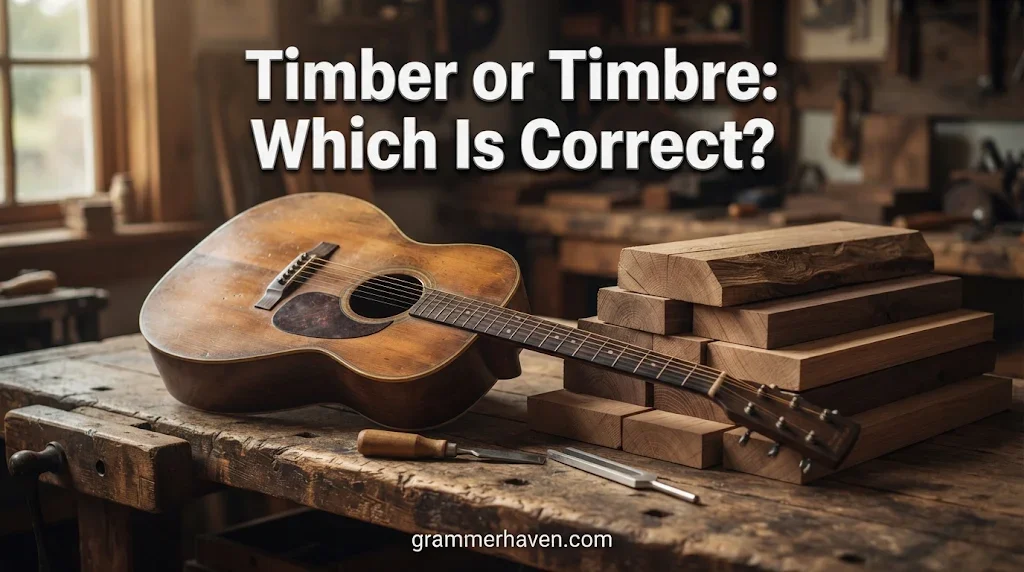
Timber or Timbre explains two similar-sounding English words with different meanings, uses, spellings, and roles in everyday communication. Timber and Timbre are commonly confused words that challenge English learners, language learners, and native speakers because of their similar pronunciation and similar-looking words. Their spelling, definition, and usage have distinct meanings. Timber relates to wood, construction, carpentry, and building. It describes cut wood, lumber, timber products, and building materials used in physical structures, construction materials, and the building process.
A sturdy house may require sturdy timber for physical construction. The expression knock on wood is another phrase associated with wood. Timbre belongs to the world of music and musical terminology. It describes the unique quality of sound that makes one voice or musical instrument different from another. A violin, for instance, can produce a rich sound or a haunting sound. Its sound characteristics, auditory qualities, acoustic quality, tone, sound texture, and sound identity help explain its voice quality and instrument sound. These features contribute to musical expression, musical sound, aural landscapes, and sound landscapes.
The difference between these words involves more than pronunciation because their contextual meaning, semantic differences, and lexical differences affect sentence meaning. Using interchangeable words or incorrect word substitution can create linguistic confusion and affect word choice. Understanding the context helps identify which word belongs in a sentence. Connecting Timber with wood and building and Timbre with sound and music makes correct usage easier. Their variations, word differences, and distinct meanings become clearer through regular English vocabulary practice and attention to the subject being discussed.
Timber or Timbre – Which Is Correct? Understanding the Real Difference
At the core, this confusion happens because English borrowed words from different languages and shaped them over time. “Timber” comes from old Germanic roots tied to building materials. “Timbre” comes from French, tied to music and sound theory.
Even though they look almost identical in spelling, they live in completely different worlds.
Think of it like this:
- Timber belongs to construction sites
- Timbre belongs to music studios
One deals with physical material you can touch. The other deals with sound quality you can only hear.
That difference alone clears up most confusion.
What Does Timber Mean? Clear Definition and Real Usage
Basic meaning of timber
Timber refers to wood that has been prepared for building or carpentry work. It usually comes from trees that are cut, processed, and shaped into usable material.
According to the Cambridge Dictionary, timber means:
“Wood used for building or for making things.”
That definition stays consistent across modern English usage.
How timber is used in real life
Timber shows up everywhere in construction and manufacturing. You’ll find it in:
- House framing and roofing
- Furniture production
- Wooden flooring
- Doors and window frames
- Beams and support structures
In many countries, timber also refers to a commercial industry. For example, “timber exports” or “timber trade” refers to large-scale wood production and distribution.
Common expressions with timber
One interesting phrase often confuses learners:
- “Timber!”
This is shouted when a tree is falling, warning others to move away. It’s not metaphorical. It’s a safety alert used in logging environments.
Example sentences using timber
- The workers stacked the timber beside the construction site.
- The cabin used locally sourced timber for the walls.
- He shouted “timber!” before the tree crashed down.
Notice how every example connects to wood or physical structures.
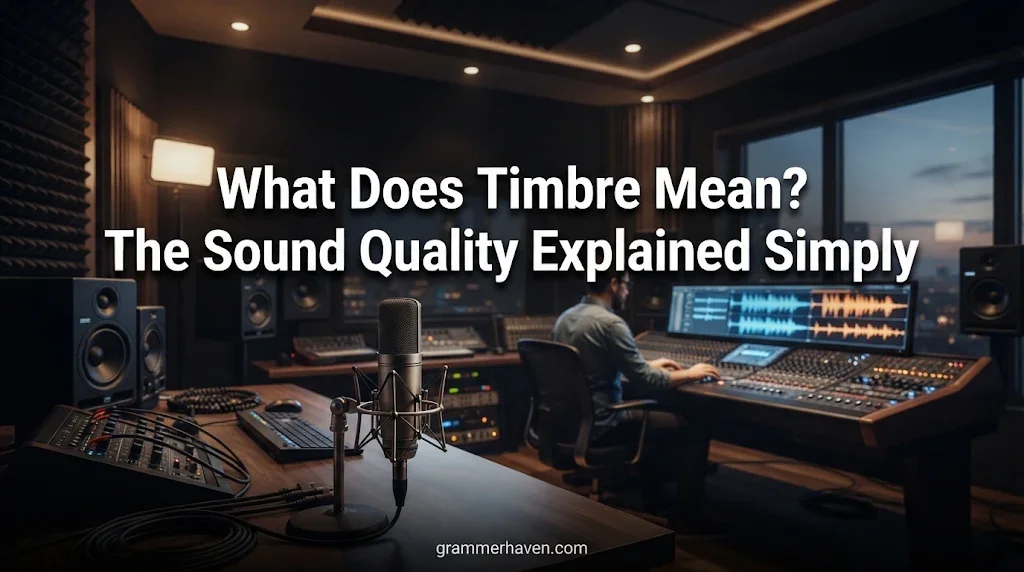
What Does Timbre Mean? The Sound Quality Explained Simply
Basic meaning of timbre
Timbre describes the unique character or “color” of a sound. It helps you distinguish one sound source from another even when they play the same note.
A simple definition comes from Britannica:
“Timbre is the quality of a sound that distinguishes different types of sound production.”
Why timbre matters in music and audio
Imagine two instruments:
- A piano plays middle C
- A violin plays the same middle C
They share the same pitch. They share the same volume. Yet your brain instantly knows which is which.
That difference comes from timbre.
It depends on:
- Harmonics (extra frequencies above the main note)
- Attack (how quickly the sound starts)
- Decay (how it fades)
- Material of the instrument
- Playing technique
Timbre is why music feels rich instead of flat.
Real-world examples of timbre
You experience timbre daily without noticing:
- A soft, breathy voice vs a sharp, nasal voice
- Electric guitar vs acoustic guitar
- A child’s voice vs an adult’s voice
- A cheap speaker vs a studio monitor
Even silence between sounds shapes how you perceive timbre.
Example sentences using timbre
- Her voice has a warm and soothing timbre.
- The trumpet’s timbre cut through the entire orchestra.
- Engineers adjusted the timbre of the recording for clarity.
Pronunciation Guide for Timber vs Timbre
This is where most confusion becomes permanent.
Timber pronunciation
- Pronounced: TIM-ber
- Simple, direct English pronunciation
IPA: /ˈtɪmbər/
Timbre pronunciation
This is where things get tricky because English borrowed it from French.
Common pronunciations:
- TAM-ber
- TAM-bruh
- Sometimes TAM-bər
IPA: /ˈtæmbər/ or /ˈtɪmbreɪ/ (varies by accent)
Why they sound similar
They confuse people because:
- Both have two syllables
- Both start with “tim/tam”
- English speakers adapt “timbre” differently from French
In casual speech, most people say “tam-ber,” which makes the spelling confusion worse.
Timber vs Timbre Comparison Table
| Feature | Timber | Timbre |
| Meaning | Wood used for construction | Quality of sound |
| Field | Construction, carpentry | Music, audio engineering |
| Physical? | Yes | No |
| Pronunciation | TIM-ber | TAM-ber / TAM-bruh |
| Origin | Old Germanic languages | French |
| Example use | Building houses | Distinguishing instruments |
Etymology: Where Timber and Timbre Come From
Origin of timber
The word “timber” traces back to Old English “timber”, meaning building or structure. It shares roots with Germanic languages where similar words referred to construction materials.
Over time, the meaning narrowed to specifically mean wood used for building.
Origin of timbre
“Timbre” entered English from French, which originally borrowed it from Greek and Latin influences tied to musical theory.
In French, “timbre” was associated with sound color and tonal quality, especially in bells and instruments.
That musical heritage is why modern English keeps it in audio and music contexts.
Why People Confuse Timber and Timbre
This confusion isn’t random. It comes from real linguistic overlap.
Here’s what causes it:
- Similar spelling structure
- Same number of letters
- Overlapping pronunciation in English
- Exposure in different contexts (music vs construction)
- Lack of visual meaning difference when written
A student reading both words quickly might assume they are variants of the same term.
They are not.
They behave like linguistic “false twins.”
Memory Tricks to Never Confuse Timber and Timbre Again

Let’s make this stick in your brain.
Simple association method
- Timber = Trees + Building
- Think: “T” for “Tree”
- Timber always involves wood
- Timbre = Tone + Music
- Think: “T” for “Tone”
- Timbre always involves sound
Visual trick
Imagine this:
- Timber = a house frame made of wood
- Timbre = a sound wave moving through air
If you can “see” it, it becomes easier to remember.
Common Mistakes People Make
Even fluent speakers slip up.
Mistake 1: Using timber for sound quality
Incorrect:
- “Her timber is very soft.”
Correct:
- “Her timbre is very soft.”
Mistake 2: Pronouncing timbre like timber
Incorrect:
- “TIM-ber” for timbre
Correct:
- “TAM-ber” or “TAM-bruh”
Mistake 3: Thinking they are variants
They are not spelling variations. They are separate words with separate meanings.
Real-World Case Study: Music Production vs Construction Industry
Case study 1: Music studio usage of timbre
A recording engineer working on a vocal track focuses heavily on timbre.
They adjust:
- EQ to shape tone
- Compression to smooth dynamics
- Microphone choice to capture character
Even small changes affect perceived timbre drastically.
A vocalist may sound “warm” or “sharp” depending on these adjustments.
Case study 2: Construction industry usage of timber
A construction firm building eco-friendly homes chooses timber carefully.
They evaluate:
- Strength grade
- Moisture content
- Durability
- Sustainability certification
Using low-quality timber can lead to structural failure. So precision matters.
These two industries show how completely separate the words are in real life.
Side-by-Side Real-Life Scenarios
Scenario 1: Construction site
Workers unload stacks of timber for building a wooden structure. The foreman checks quality and moisture levels.
Everything here is physical and measurable.
Scenario 2: Recording studio
A producer adjusts the timbre of a singer’s voice using mixing tools. The goal is emotional impact and clarity.
Everything here is auditory and subjective.
Quick Recap: Timber vs Timbre in One Glance
- Timber = wood used in construction
- Timbre = quality of sound in music
- One is physical
- One is sensory
- They never overlap
See also: Your Sincerely or Yours Sincerely? Which Is Correct & How to Use It?
FAQs:
Is timbre just another spelling of timber?
No. They come from different linguistic roots and mean completely different things.
Why is timbre pronounced differently from how it looks?
Because English borrowed it from French. Pronunciation shifted over time while spelling stayed closer to the original form.
Can timber ever relate to sound?
No. Timber only refers to wood or construction material. It has no audio meaning.
What is the easiest way to remember timbre?
Link it to music. Think: “timbre = tone quality.”
Conclusion:
Understanding the difference between Timber and Timbre makes English writing clearer and more accurate. Timber refers to wood used in construction and carpentry, while Timbre describes the unique quality of a sound produced by a voice or musical instrument. Both words have similar pronunciation but completely different meanings and uses. Remembering Timber = Wood and Timbre = Sound is a simple way to avoid confusion. Choosing the correct word helps you improve your vocabulary, spelling, and everyday communication.
Latest Posts:
- Result In or Result To: Which Is Correct? (With Examples)
- A Dime a Dozen: Meaning, Definition, Origin and Real-Life Usage
- Hooplehead Definition, Meaning, Usage and Examples
- Whole vs Hole: What’s the Difference?
- Acumen vs Acuity vs Acuteness: What’s the Difference?