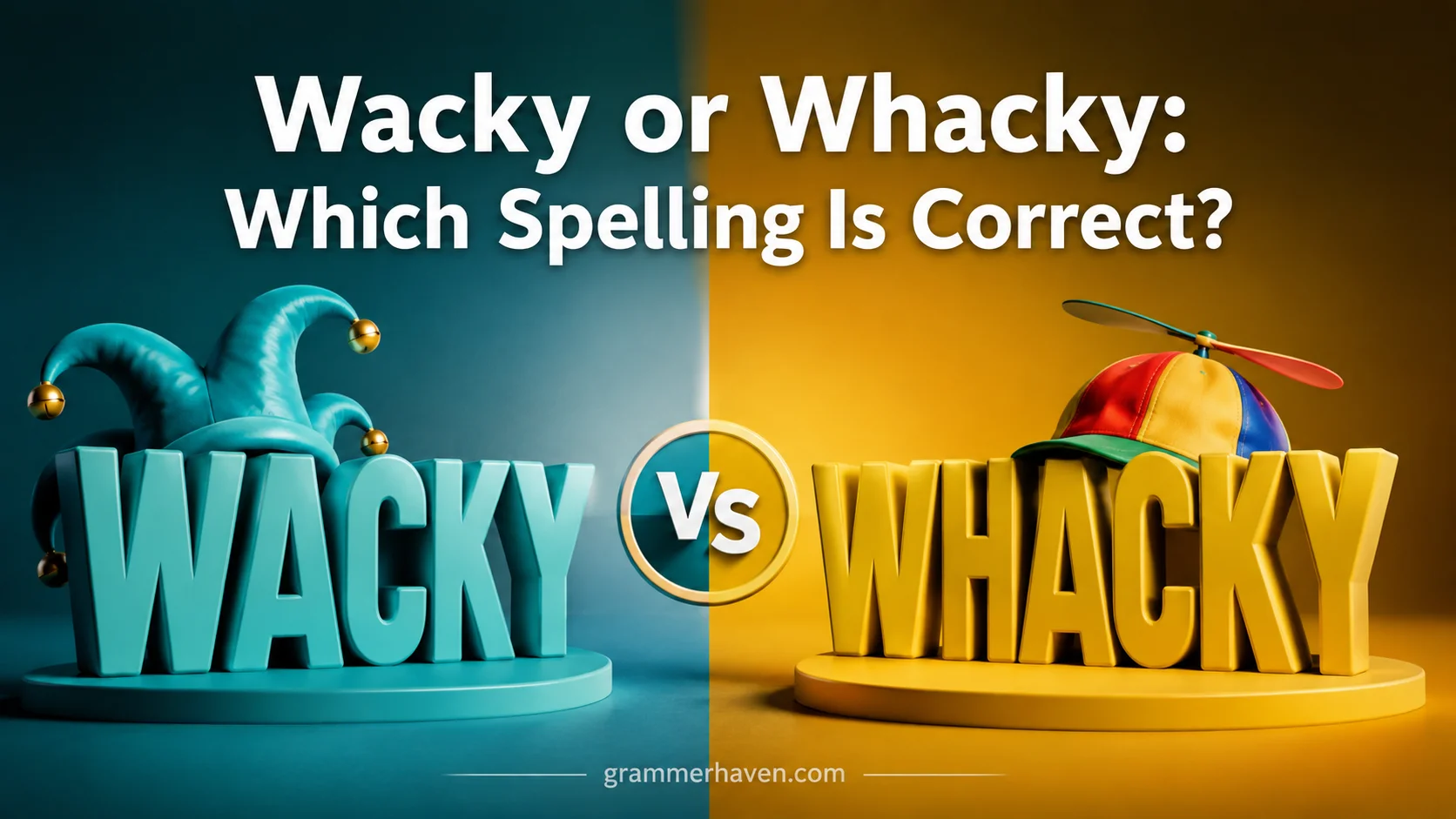
Wacky or Whacky: Which Spelling Is Correct? explains why Wacky is the preferred spelling in modern American English and standard English usage. Wacky is an adjective for something strange, eccentric, silly, funny, quirky, goofy, bizarre, zany, amusingly unusual, informal, or unconventional. Both spellings share the same pronunciation, meaning, and usage, though Whacky is an older form and less common variant spelling. Dictionaries and established language rules support Wacky as the safest choice for writing, helping improve clarity and reader perception.
Writers, students, and native English speakers can experience language confusion when choosing between these forms. My experience in content writing shows that correct spelling supports clearer communication and stronger writing confidence. Wacky works well in blogging, creative writing, online writing, social media posts, and online content. Editorial style, proofreading, and word choice can prevent a spelling error from changing the tone of a brand message, social post, or witty caption. Internet searches, grammar help forums, Reddit-style insights, and real-life examples show how these terms appear in everyday English language use.
A comparison of usage trends, data trends, and internet usage shows that Wacky remains common and is the accepted spelling. Whacky still appears as an outdated spelling or traditional spelling. Your message can look more polished with Wacky and less careless or unprofessional. Developing your English skills includes recognizing commonly confused words and choosing the established form that feels familiar to readers.
Wacky vs Whacky: Quick Comparison
Before exploring the details, here is a quick overview:
| Word | Standard Usage | Meaning | Recommended Use |
| Wacky | Common and widely accepted | Strange, silly, unusual, eccentric | Use this spelling in most situations |
| Whacky | Rare variant spelling | Same meaning as wacky | Acceptable but uncommon |
The two words:
- Have the same pronunciation
- Have the same meaning
- Are used in the same contexts
- Differ mainly in spelling preference
Think of whacky as a cousin of wacky that shows up occasionally but is not the family favorite.
What Does Wacky Mean?
The word wacky describes something unusual, strange, funny, or outside the ordinary.
It often refers to ideas, people, behaviors, designs, or situations that feel surprising or unconventional.
Unlike words such as terrible or wrong, wacky usually carries a playful or positive feeling.
For example:
“She came up with a wacky solution to the problem.”
This sentence does not necessarily mean her idea was bad. It suggests the solution was creative, unexpected, and different from normal approaches.
Common meanings of wacky include:
- Unusual
- Eccentric
- Silly in an entertaining way
- Strange but interesting
- Wildly creative
Examples of wacky things:
- A restaurant serving desserts shaped like everyday objects
- A person wearing a costume to a normal meeting
- A company creating a strange but memorable advertisement
- An inventor designing an unusual machine
The key idea is that wacky often means “different in a fun way.”
What Does Whacky Mean?
Whacky has the same meaning as wacky.
It describes something strange, unusual, or humorous. The extra h does not create a different definition or change the pronunciation.
Examples:
- “The comedian has a whacky sense of humor.”
- “The company launched a whacky marketing campaign.”
These sentences are understandable. However, many editors and professional writers would replace whacky with wacky.
The spelling with the extra h appears occasionally because English spelling often develops variations over time. Some words keep alternative forms even after one version becomes more common.
Wacky vs Whacky: What Is the Actual Difference?
The main difference between wacky and whacky is not meaning. It is popular and standard usage.
| Category | Wacky | Whacky |
| Meaning | Strange or unusual | Strange or unusual |
| Pronunciation | Same | Same |
| Frequency | Very common | Much less common |
| Professional writing | Preferred | Usually avoided |
| Dictionary acceptance | Standard | Listed as a variant in some sources |
If you are writing an article, essay, report, or professional message, wacky is the safer choice.
Why Is Wacky More Common Than Whacky?
English spelling changes naturally over time. Some spellings become dominant because they appear more often in books, newspapers, dictionaries, and popular culture.
The word wacky became the accepted spelling because it matched common English spelling patterns.
Writers generally prefer shorter spellings when the extra letters do not change pronunciation or meaning.
For example:
- Wacky is shorter and cleaner.
- Whacky adds a letter without adding information.
Modern English often favors efficiency.
Consider these examples:
| Older or Alternative Form | Modern Preferred Form |
| Catalogue | Catalog (American English) |
| Dialogue | Dialog (sometimes used in American English contexts) |
| Whacky | Wacky |
This does not mean every longer version is wrong. It simply shows how language evolves.
The Origin and History of Wacky
The exact origin of wacky is not completely certain, but the word became popular in American English during the 20th century.
It developed as informal slang connected with ideas of foolishness, odd behavior, and eccentric personalities.
Over time, popular entertainment helped spread the word.
Wacky became common through:
- Comedy shows
- Cartoons
- Newspapers
- Movies
- Advertising
- Everyday conversation
The word fit perfectly into a culture that valued humor and creativity.
A character in a comedy might be described as wacky because they behaved unpredictably. A strange invention might be called wacky because it looked unusual but imaginative.
The word gained a friendly tone rather than a harsh one.
How Do You Pronounce Wacky and Whacky?
Both spellings sound exactly the same.
Pronunciation:
Wacky: WAK-ee
Whacky: WAK-ee
The extra h in whacky does not create a separate sound.
Examples:
- “That is a wacky idea.”
- “That is a whacky idea.”
When spoken aloud, listeners cannot tell which spelling you used.
This is why the difference only matters in writing.
Examples of Wacky in Sentences
The best way to understand wacky is to see how people actually use it.
Everyday examples
- “My brother has a wacky collection of vintage toys.”
- “The movie follows a wacky group of characters.”
- “They designed a wacky office space with colorful furniture.”
- “Her wacky jokes always make people laugh.”
Business examples
Companies often use the word wacky when describing creative marketing.
Examples:
- A brand creates a strange commercial featuring unusual characters.
- A company launches an unexpected product design.
- A restaurant creates a surprising menu item.
A marketing team might say:
“We need a wacky campaign that people will remember.”
Here, wacky means memorable and unconventional.
Examples of Whacky in Sentences
Although uncommon, whacky appears in informal writing.
Examples:
- “The artist created a whacky sculpture.”
- “His whacky personality made him unforgettable.”
- “The game has a whacky storyline.”
These examples are understandable. However, replacing whacky with wacky would make the writing look more standard.
Compare:
✅ “The comedian has a wacky style.”
⚠️ “The comedian has a whacky style.”
Both communicate the same idea, but most readers expect the first version.
Common Mistakes When Using Wacky and Whacky
Mistake: Thinking They Have Different Meanings
Some people assume:
- Wacky means funny
- Whacky means extremely strange
That difference does not exist.
Both words mean:
- Odd
- Unusual
- Eccentric
- Strange in an entertaining way
Mistake: Using Whacky in Formal Writing
While whacky is understandable, it can distract readers because it looks less familiar.
Professional writing values consistency and clarity.
Use wacky in:
- Blog articles
- Business content
- School assignments
- Reports
- Presentations
- Marketing materials
Mistake: Assuming Wacky Means Bad
The word does not automatically mean negative.
Compare these examples:
Positive use:
“The inventor created a wacky machine that solves everyday problems.”
Meaning:
- Creative
- Unexpected
- Interesting
Negative use:
“That was a terrible idea.”
Meaning:
- Unsuccessful
- Harmful
- Poorly planned
A wacky idea might actually become a brilliant idea.
Many inventions looked strange before people understood their value.
Wacky Synonyms and Similar Words
Several words overlap with wacky, but each has a slightly different feeling.
| Word | Meaning | Example |
| Quirky | Unusual in an appealing way | “She has a quirky personality.” |
| Weird | Strange or unfamiliar | “That movie was weird.” |
| Eccentric | Different from normal behavior | “The artist was eccentric.” |
| Zany | Extremely funny and unconventional | “The comedian has a zany style.” |
| Bizarre | Very strange or shocking | “The story had a bizarre ending.” |
| Odd | Different or unusual | “That is an odd choice.” |
Wacky vs Quirky
These words are close but not identical.
Quirky often sounds charming.
Example:
“He has a quirky habit of collecting old maps.”
Wacky sounds more energetic and extreme.
Example:
“He created a wacky invention that flies using balloons.”
Wacky vs Weird
Weird can be neutral, positive, or negative.
Example:
“That movie was weird.”
The listener may not know whether you enjoyed it.
Wacky usually suggests playful strangeness.
Example:
“That movie was wacky.”
The listener expects humor or creativity.
When Should You Use Wacky Instead of Whacky?
The easiest rule:
Use wacky almost every time.
Choose wacky when writing:
- Articles
- Emails
- Social media posts
- Academic work
- Professional documents
- Advertisements
Use whacky only when:
- A brand uses that spelling
- A title officially contains that spelling
- You are quoting someone
- You intentionally want an unusual style
For normal writing, wacky is the best choice.
Wacky vs Whacky in American English
American English strongly prefers wacky.
Modern dictionaries, publishers, and online publications overwhelmingly use the shorter spelling.
For writers following US English standards:
✅ Write: wacky idea
❌ Avoid: whacky idea
This choice helps your writing look polished and familiar.
Wacky vs Whacky vs Whack: Are They Related?
Although these words look similar, they have different meanings.
| Word | Meaning | Example |
| Wacky | Strange or unusual | “That is a wacky plan.” |
| Whacky | Variant spelling of wacky | “That is a whacky plan.” |
| Whack | A hit or attempt | “Give it a whack.” |
The word whack is unrelated to wacky.
Examples:
- “I will give the puzzle a whack.”
(I will try solving it.) - “The comedian has a wacky personality.”
(The comedian is unusual and funny.)
Similar spelling does not always have a similar meaning.
Real-World Examples of Wacky Usage
The word wacky appears frequently in entertainment, marketing, and creative industries.
Entertainment
Comedy relies heavily on unusual situations and exaggerated characters.
Examples include:
- Cartoon characters with strange personalities
- Absurd movie plots
- Unexpected comedy styles
A reviewer might describe a film as:
“A wacky adventure filled with strange characters.”
Marketing
Brands often use unusual ideas to stand out.
A normal advertisement might be forgotten.
A wacky advertisement might make people stop scrolling.
Companies sometimes use:
- Strange mascots
- Unexpected humor
- Unusual storytelling
- Creative product designs
The goal is not randomness. The goal is attention.
See also: Therefore or Therefor: Which Spelling Is Correct?
FAQs:
1. Is Wacky or Whacky the correct spelling?
Wacky is the preferred spelling in modern English, especially in standard and American English. Whacky is an older and less common variant.
2. What does Wacky mean?
Wacky is an informal adjective that describes something strange, silly, funny, quirky, eccentric, goofy, bizarre, or unconventional.
3. Is Whacky a misspelling of Wacky?
Not exactly. Whacky is an established variant spelling, but Wacky is much more common and generally the safer choice in modern writing.
4. Is Wacky used in American English?
Yes. Wacky is widely used in American English, particularly in informal writing, creative content, blogs, social media, and everyday communication.
5. Can I use Whacky in formal writing?
You can, but Wacky is usually the better choice. Formal writing often favors the more common and established spelling to maintain clarity and consistency.
6. Do Wacky and Whacky have the same meaning?
Yes. Both Wacky and Whacky generally have the same meaning. They describe something unusual, silly, eccentric, or amusing.
7. How do you pronounce Wacky?
Wacky is pronounced WAK-ee. Whacky normally has the same pronunciation, which can make the two spellings easy to confuse.
8. Why is Wacky more common than Whacky?
Wacky has become the standard and widely accepted spelling in modern usage. Whacky continues to appear, but it is less common and often carries an older or traditional spelling pattern.
9. Should writers use Wacky or Whacky?
Writers should generally use Wacky, especially in blogging, online writing, creative writing, social media posts, and content where familiar spelling matters.
10. Is Wacky a formal or informal word?
Wacky is mainly an informal word. You can use it when describing something amusingly strange, silly, or unconventional, but a more precise term may suit highly formal writing.
Conclusion:
Wacky is the best choice when you need the modern, common, and widely accepted spelling. Whacky isn’t necessarily meaningless or impossible to encounter, but it represents an older and less common variant. If you’re writing for students, readers, websites, social media, or general American English audiences, choosing Wacky keeps your writing clear, familiar, and polished.