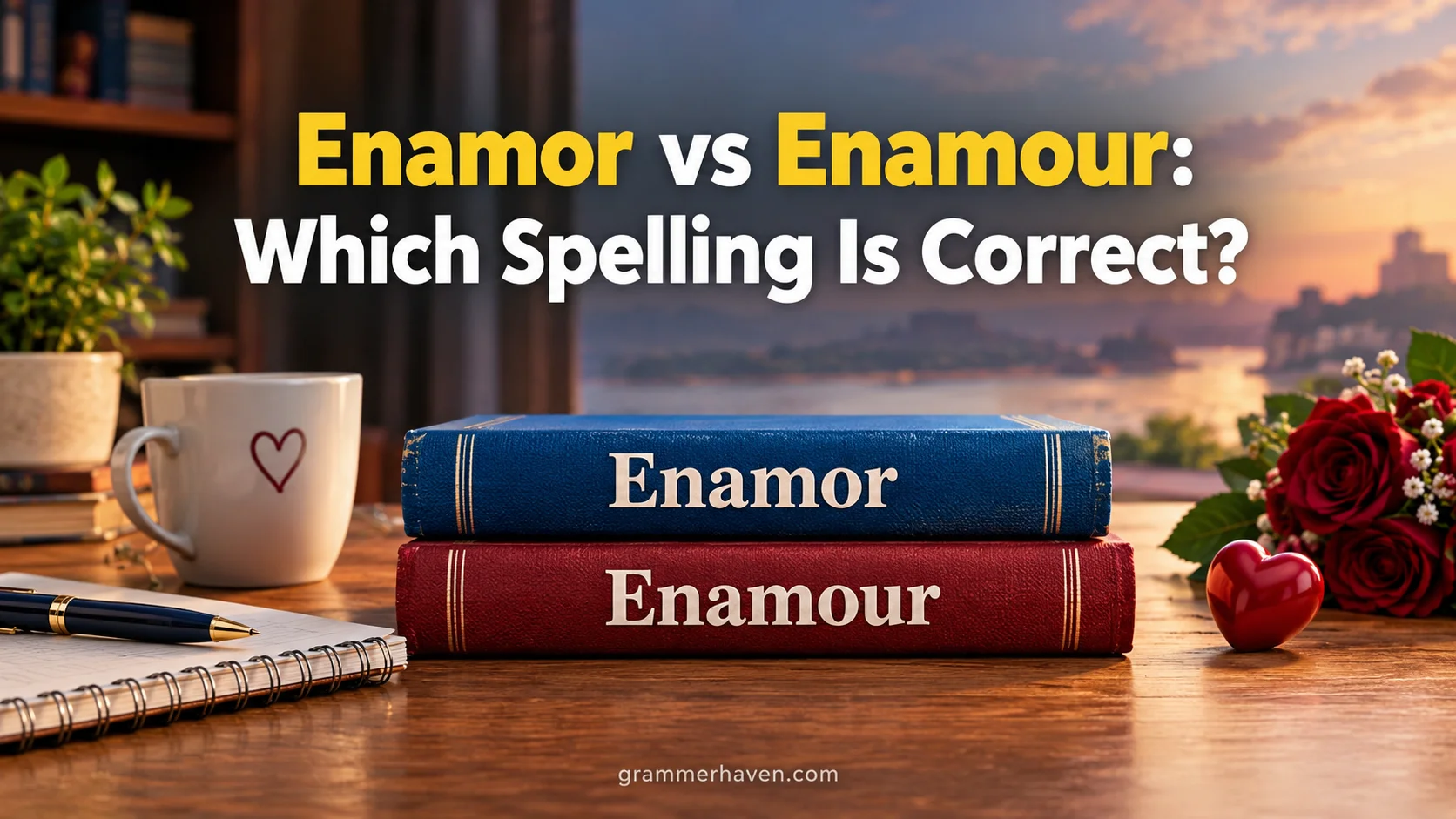
Enamor vs Enamour shows how one verb can have two regional spellings with the same meaning and usage in English.
Enamor and Enamour are spelling pairs of the same verb. Both mean to fill a person with love, strong affection, or admiration. They can describe someone who feels deeply attracted or charmed by someone or something. American English uses enamor as the standard form, while British English uses enamour with an extra u. The spelling difference comes from regional conventions, not a change in meaning. Your specific audience can guide the natural choice when writing in English.
Collins and Cambridge recognize these regional forms and correct spellings. The American English form is primarily common in American writing. The British English form appears in standard British English. The word can be used in sentences to express feeling, affection, attraction, or being filled with love. “The audience was enamored by the magician’s captivating performance” shows how the word can describe people who are greatly attracted to something. The spelling does not cause a different meaning. Both versions express the same idea of feeling of love or charm. The key distinction is regional usage. Both forms can describe someone who feels affection or admiration toward a person or thing. Writers should keep their spelling consistent with their chosen variety of English when an audience expects American or British usage.
Quick Answer: Enamor vs Enamour
Enamor and enamour have the same meaning. The difference is primarily spelling and regional usage.
- Enamor is the standard American English spelling.
- Enamour is the standard British English spelling.
- Both mean to cause someone to love, admire, like, or become strongly attracted to someone or something.
- The related American form is enamored.
- The related British form is enamoured.
- The pronunciation is essentially the same within the corresponding English varieties.
- Neither spelling is inherently wrong.
- Your choice should depend on the English variety and audience you’re writing for.
For example:
American English: The audience was completely enamored with the performance.
British English: The audience was completely enamoured with the performance.
The meaning doesn’t change. Only the regional spelling does.
What Does Enamor Mean?
Enamor is a verb meaning to make someone feel strong affection, love, admiration, or fascination. It can describe romantic attraction, but it isn’t limited to romance.
For instance, someone can become enamored with a person. They can also become enamored with a city, painting, book, idea, style, or experience.
Cambridge defines enamor as a US formal verb meaning to cause someone to like or love someone or something. Collins similarly defines it as filling someone with love and desire or charming and captivating them.
Enamor Examples
Here are several natural examples:
- The young artist became enamored with the city’s old architecture.
- She was immediately enamored of the charming little village.
- He became enamored with the idea of living near the ocean.
- The children were enamored with the colorful illustrations.
- She quickly became enamored of his kindness and patience.
- The travelers were completely enamored with the mountain scenery.
Notice something important: the word often appears in the passive construction be enamored. That pattern is much more common than using enamor as an ordinary active verb.
For example:
The novel enamored her with the beauty of rural life.
However, you’ll more commonly encounter:
She was enamored with the beauty of rural life.
Collins notes that the verb is now mainly used in the passive and commonly followed by of or with.
What Does Enamour Mean?
Enamour has the same meaning as enamor. The only major distinction is its spelling and regional preference.
British English uses enamour, while American English generally uses enamor. Cambridge labels enamour as a UK formal verb and explicitly gives enamor as its US counterpart.
Enamour Examples
You might see sentences such as:
- The visitors were enamoured with the peaceful countryside.
- She became enamoured of the historic building.
- He was deeply enamoured with the idea of traveling abroad.
- The audience seemed enamoured of the young performer.
- They became enamoured with the region’s natural beauty.
The meaning remains exactly the same as in the American spelling.
Enamor vs Enamour: Key Difference
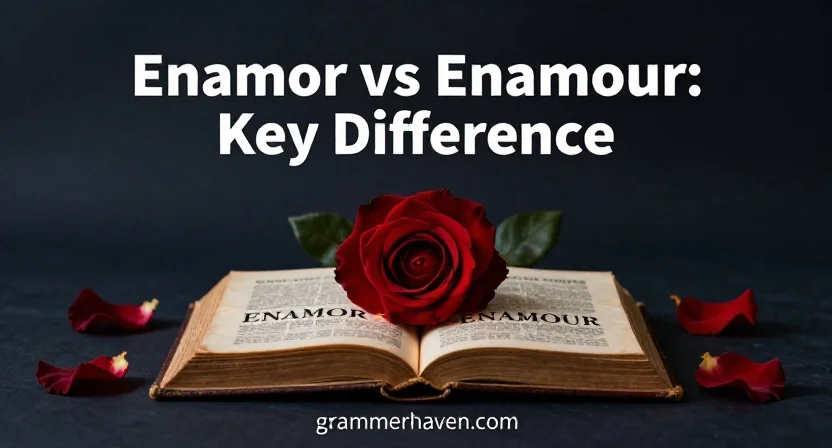
The easiest way to understand enamor vs enamour is to compare them directly.
| Feature | Enamor | Enamour |
| Meaning | To inspire love, affection, admiration, or fascination | Same |
| Part of speech | Verb | Verb |
| Main spelling convention | American English | British English |
| Related adjective | Enamored | Enamoured |
| Pronunciation | Regional pronunciation applies | Regional pronunciation applies |
| Meaning difference | None | None |
| Best choice for US writing | Yes | Usually no |
| Best choice for UK writing | Usually no | Yes |
So, if you’re wondering “Is enamor or enamour correct?”, the answer is simple: both are correct.
The real question is which form suits your audience.
Why Are Enamor and Enamour Spelled Differently?
The difference follows a broader pattern in English spelling.
American and British English often use different spellings for words ending in -or and -our.
Compare:
- color / colour
- favor / favour
- honor / honour
- labor / labour
- neighbor / neighbour
- humor / humour
- enamor / enamour
The distinction isn’t unique to this word.
Historically, enamour came into English through French. Etymonline traces the word to Middle English enamouren and Old French enamourer, ultimately connecting it with amour, meaning “love.” The English word dates back to the medieval period.
American English later developed spelling preferences that removed the u from many -our words. That’s why American readers generally expect enamor, while British readers are more accustomed to enamour.
The spelling difference therefore reflects the history of English rather than a difference in meaning.
Enamor vs Enamour in American English
If you’re writing in American English, use enamor.
The same convention applies to its related forms:
- enamor
- enamored
- enamoring
For example:
The students were enamored with the professor’s unusual teaching style.
She became enamored of the coastal town.
The designer’s work has enamored audiences around the country.
Cambridge identifies enamor as the US form and gives enamour as the UK equivalent.
For an American audience, writing enamour won’t necessarily make your sentence incomprehensible. Most readers will understand it. However, it can look like a British spelling in an otherwise American document.
That matters when you’re trying to maintain a consistent editorial style.
Enamor vs Enamour in British English
For British English, choose enamour.
Its related forms follow the same spelling:
- enamour
- enamoured
- enamouring
For example:
She was completely enamoured with the old castle.
He became enamoured of the quiet village.
The audience seemed enamoured with the actor’s performance.
Cambridge labels enamour as a UK formal verb and lists enamor as the American equivalent.
Collins also identifies enamour as the British form and enamor as the US form.
Enamor vs Enamour Meaning
There is no meaningful difference in definition between the two spellings.
Both can describe:
- Romantic attraction
- Strong affection
- Admiration
- Fascination
- Captivation
- A powerful liking for something
Consider these two sentences:
She was enamored with the musician.
She was enamoured with the musician.
The sentences communicate the same idea. The writer has simply followed a different spelling convention.
The word can also describe non-romantic enthusiasm:
He became enamored with classical architecture.
Here, enamored doesn’t mean that he fell romantically in love with a building. It means he developed a strong admiration or fascination with it.
That’s an important distinction because enamor can express more than romantic love.
Enamor vs Enamour Pronunciation
The spelling difference doesn’t normally create a separate pronunciation.
Cambridge gives the American pronunciation of enamor as /ɪˈnæm.ɚ/ and the British pronunciation as /ɪˈnæm.ər/. It gives corresponding regional pronunciations for enamour.
In practical terms, the American and British forms sound extremely similar. The final sound reflects the speaker’s accent rather than the presence or absence of the written u.
So don’t assume that enamour needs a dramatically different pronunciation simply because it contains an extra letter.
Enamor vs Enamour in a Sentence
A side-by-side comparison makes the difference especially clear.
American English
The travelers were enamored with the peaceful mountain village.
British English
The travelers were enamoured with the peaceful mountain village.
Both sentences mean that the travelers developed a strong liking or admiration for the village.
Here’s another example:
| American English | British English |
| She was enamored with the painting. | She was enamoured with the painting. |
| He became enamored of the city. | He became enamoured of the city. |
| They were enamored with the landscape. | They were enamoured with the landscape. |
| The audience was enamored of the performer. | The audience was enamoured of the performer. |
The grammar and meaning stay essentially unchanged. Only the spelling follows the regional convention.
Enamor, Enamored, Enamour, and Enamoured
One easy mistake is to recognize the difference between enamor and enamour but then mix the related forms.
The spelling should remain consistent.
Enamor
This is the American English verb.
The story enamored readers with its vivid characters.
Enamored
This is the usual American English past participle and adjective.
She was enamored with the old theater.
Enamour
This is the British English verb.
The story enamoured readers with its vivid characters.
Enamoured
This is the British English past participle and adjective.
She was enamoured with the old theater.
Collins explicitly gives enamoured as the British form and enamored as the American form.
A Useful Consistency Rule
If your document uses American English, write:
enamor → enamored
If your document uses British English, write:
enamour → enamoured
Don’t switch between the two systems without a reason.
For example, this combination looks inconsistent in American English:
She was enamoured with the museum, but the new exhibit enamored her.
A consistent American version would use enamored in both places.
A consistent British version would use enamoured in both places.
Common Mistakes With Enamor and Enamour
Mistake: Calling Enamour Incorrect
Some writers assume that enamour is simply a misspelling of enamor.
That’s incorrect.
Both dictionaries and established English usage recognize the two forms. Cambridge directly treats enamour as the UK form and enamor as the US form.
Mistake: Calling Enamor Incorrect in British English
The reverse mistake happens too.
A British writer might encounter enamor and assume the writer made a spelling error. However, enamor is the established American form.
Regional spelling matters.
Mistake: Mixing Enamored and Enamoured
This is more noticeable in edited writing because the two forms belong to different spelling systems.
Choose one convention and stick with it.
Mistake: Assuming Enamor Always Means Romantic Love
The word can certainly describe romantic attraction. However, it also means captivate, charm, or strongly attract.
For example:
The filmmaker became enamored with the desert landscape.
The filmmaker doesn’t necessarily love the desert romantically. The sentence describes fascination or admiration.
Enamor vs Enamour Compared With Similar Words
Several words overlap with enamor and enamour, but they’re not perfect substitutes.
| Word | General meaning | Strength or nuance |
| Enamor | Fill with love, admiration, or fascination | Strong attraction |
| Enamour | Same as enamor | Strong attraction |
| Admire | Regard someone or something with respect or approval | Often less emotional |
| Adore | Love or like intensely | Often stronger and warmer |
| Attract | Draw someone’s interest or attention | Broad and neutral |
| Captivate | Hold someone’s attention through charm or fascination | Strong fascination |
| Fascinate | Create intense interest or curiosity | Often intellectual or emotional |
| Infatuate | Inspire intense but often short-lived passion | Usually romantic |
This distinction helps you choose the right word.
For instance, you might admire a colleague’s discipline without becoming enamored with them. You might also find a documentary fascinating without feeling the deeper emotional attraction suggested by enamored.
Which Should You Use: Enamor or Enamour?
The answer depends on your audience.
Choose Enamor When:
Use enamor when you’re writing:
- For American readers
- In American English
- For a US-based publication
- For an American business or organization
- In content that follows American spelling conventions
- Alongside spellings such as color, favor, and honor
For example:
The new design enamored customers across the United States.
Choose Enamour When:
Use enamour when you’re writing:
- For British readers
- In British English
- For a UK publication
- For an audience that follows British spelling
- Alongside spellings such as colour, favour, and honour
For example:
The new design enamoured customers across the United Kingdom.
The choice isn’t about which word sounds more sophisticated. It’s about following the spelling system your audience expects.
How to Remember Enamor vs Enamour
A simple memory trick can make this distinction easier.
Think of the familiar pair:
color → American English
colour → British English
Now apply the same pattern:
enamor → American English
enamour → British English
You can also remember the broader pattern:
- favor → favour
- honor → honour
- labor → labour
- humor → humour
- neighbor → neighbour
- enamor → enamour
The American forms generally drop the u, while the British forms retain it.
This isn’t an absolute explanation for every English spelling difference, but it works well for this particular group.
Is Enamor or Enamour More Common?
The answer depends heavily on which English variety you’re measuring.
In American English, enamor is the expected spelling. In British English, enamour is the expected spelling. Major dictionaries reflect this regional distinction rather than treating one version as a universal replacement for the other.
There’s also an interesting usage point: the word itself is relatively formal and often appears in constructions such as be enamored of or be enamored with.
That means you may encounter enamored or enamoured much more often than the base verb in everyday writing.
For casual conversation, people often choose simpler words such as love, like, admire, or really enjoy.
For example:
I really love this restaurant.
sounds more conversational than:
I am completely enamored with this restaurant.
The second sentence isn’t wrong. It simply carries a more literary or formal flavor.
Enamor vs Enamour: A Practical Style Guide
If you’re unsure which spelling to use, follow this quick checklist:
- Identify your audience.
- US readers → enamor
- UK readers → enamour
- Check the spelling style of the surrounding article.
- color, favor, honor → likely enamor
- colour, favour, honour → likely enamour
- Keep related forms consistent.
- American → enamor, enamored
- British → enamour, enamoured
- Don’t change the spelling based on meaning.
- Both forms can describe love, admiration, attraction, or fascination.
- Don’t treat the British form as an error.
- Enamour is an established British spelling.
- Don’t treat the American form as an error either.
- Enamor is an established American spelling.
Enamor vs Enamour: Examples at a Glance
| Context | American English | British English |
| Base verb | enamor | enamour |
| Past participle | enamored | enamoured |
| With a person | enamored with her | enamoured with her |
| With a place | enamored of the city | enamoured of the city |
| With an idea | enamored with the concept | enamoured with the concept |
| Meaning | Love, admire, captivate | Love, admire, captivate |
| Correctness | Correct | Correct |
See also: Is It Correct to Say “How Do You Mean?” Meaning, Grammar & Usage
FAQs:
Is Enamor the American spelling?
Yes. Enamor is the standard American English spelling. Cambridge labels it as a US formal verb and lists enamour as the UK form.
Is Enamour the British spelling?
Yes. Enamour is the standard British English spelling. Cambridge labels it as a UK formal verb and identifies enamor as the US equivalent.
Do Enamor and Enamour have the same meaning?
Yes. Both mean to cause someone to feel love, affection, admiration, attraction, or fascination. The spelling changes according to regional English conventions rather than meaning.
Are Enamor and Enamour pronounced the same?
They have essentially the same pronunciation within their respective regional varieties. The written u in enamour doesn’t create a separate meaning or a fundamentally different word. Cambridge provides corresponding US and UK pronunciation forms for the two spellings.
Which spelling should I use in formal writing?
Use the spelling that matches your chosen variety of English. For American English, use enamor and enamored. For British English, use enamour and enamoured. Consistency matters more than choosing one version as universally correct.
Conclusion:
The difference between enamor vs enamour is straightforward once you recognize the regional spelling pattern. Both words have the same meaning. Both are legitimate English forms. The main difference is that enamor belongs to standard American English, while enamour belongs to standard British English.
The same distinction continues in their related forms. American English uses enamored, while British English uses enamoured. Neither version is inherently better.
If you’re writing for a US audience, choose enamor. If you’re writing for a British audience, choose enamour. Most importantly, keep the spelling consistent throughout your writing.
In short, the extra u changes the regional spelling, not the meaning.