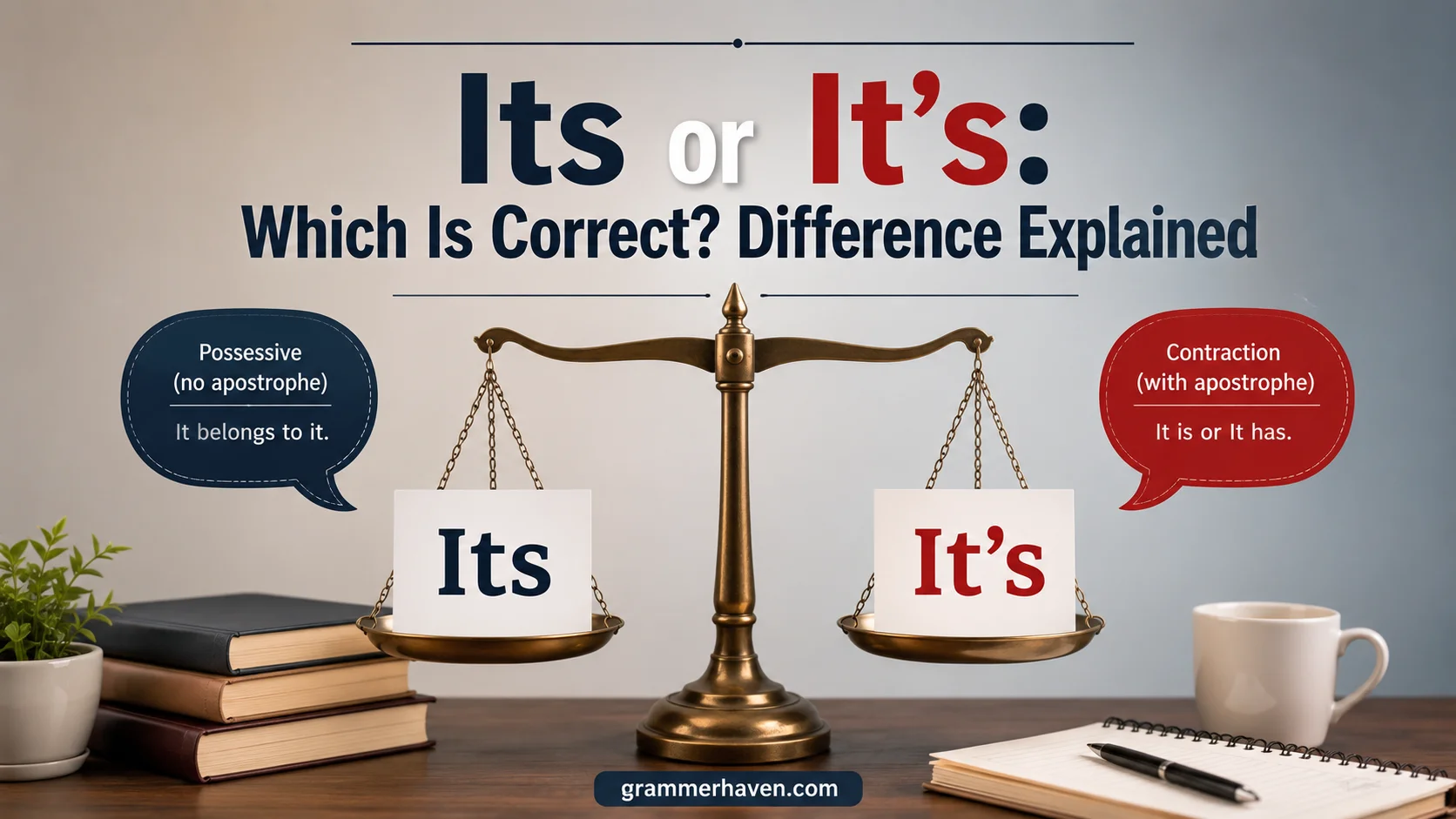
Its or It’s: Which Is Correct? Difference Explained helps you identify the spelling, meaning, grammar, and usage of these two confusing English words. Its and it’s have the same sound in speaking, yet the difference is noticeable in writing. Its works as a possessive pronoun to show possession connected to an object or animal. It’s is a contraction of “it is” or “it has,” with the apostrophe marking the shortened form. This distinction prevents common spelling mistakes and reduces confusion about English grammar.
Both forms are correct, but they have different purposes. Check the meaning before you use either form. In certain situations, it’s means “it is” or “it has,” while its shows possession. A simple way to remember the usage is to replace it’s with “it is” or “it has.” If the sentence still makes sense, it’s fits; if the sentence needs a possessive form, use its.
Its vs It’s: The Quick Difference
The fastest way to understand its vs it’s is to look at what each word does.
| Word | Meaning | Type | Example |
| It’s | It is / It has | Contraction | It’s raining today. |
| Its | Belonging to it | Possessive form | The bird spread its wings. |
Here is the easiest test:
Replace it’s with it is or it has.
If the sentence still makes sense, use it’s.
Example:
It’s a beautiful morning.
Replace it:
It is a beautiful morning.
The sentence still works, so it’s is correct.
Now try:
The company changed it’s logo.
Replace it:
The company changed it is logo.
That sounds wrong.
The correct sentence is:
The company changed its logo.
What Does “It’s” Mean?
It’s Means “It Is”
The most common use of it’s is as a contraction of it is.
A contraction combines two words into one shorter form. English speakers use contractions constantly because they make conversations and writing sound more natural.
Examples:
| Full Form | Contraction |
| It is cold outside. | It’s cold outside. |
| It is important to practice. | It’s important to practice. |
| It is my favorite movie. | It’s my favorite movie. |
Both versions are grammatically correct.
However, it’s sounds more natural in everyday communication.
Examples in Real Conversations
Without contraction:
It is difficult to learn a new language.
With contraction:
It’s difficult to learn a new language.
The second sentence feels smoother and more conversational.
You will commonly see it’s used in:
- Everyday conversations
- Emails
- Articles
- Social media posts
- Informal writing
It’s Can Also Mean “It Has”
Many people remember that it’s = it is, but they forget that it can also mean it has.
This happens when it’s appears before a past participle.
Examples:
It’s been a long week.
Meaning:
It has been a long week.
Another example:
It’s changed dramatically.
Meaning:
It has changed dramatically.
More examples:
| Sentence | Full Meaning |
| It’s already started. | It has already started. |
| It’s improved over time. | It has improved over time. |
| It’s become easier. | It has become easier. |
A simple trick:
If you can replace it’s with it has, then it’s is correct.
What Does “Its” Mean?
Its Shows Possession or Belonging
The word its shows that something belongs to an animal, object, organization, or idea.
Think of its as meaning:
“belonging to it”
Examples:
- The dog wagged its tail.
- The company updated its website.
- The phone lost its connection.
- The tree dropped its leaves.
In each example, something belongs to something else.
Let’s break one down:
The cat cleaned its paws.
Ask:
Whose paws?
The cat’s paws.
Because the paws belong to the cat, we use:
The cat cleaned its paws.
Not:
The cat cleaned it’s paws.
Why Is “Its” Different From Other Possessive Words?
This is where many people get confused.
English often uses apostrophes to show possession:
- John’s car
- Maria’s phone
- The company’s policy
So why don’t we write:
The dog cleaned it’s paws?
The answer comes from the difference between possessive nouns and possessive pronouns.
Possessive Nouns Use Apostrophes
Examples:
| Noun | Possessive Form |
| The boy | The boy’s backpack |
| The teacher | The teacher’s desk |
| The company | The company’s website |
These nouns need apostrophes.
Possessive Pronouns Do Not Use Apostrophes
Examples:
| Pronoun | Possessive Form |
| My | My book |
| Your | Your phone |
| His | His jacket |
| Her | Her shoes |
| Their | Their house |
| It | Its color |
The word its belongs to this second group.
It works like:
- his
- her
- their
- your
Not like:
- John’s
- Sarah’s
- company’s
The Best Trick to Remember Its vs It’s
Use the “Expand the Word” Method
This is the easiest method.
Whenever you see it’s, expand it.
Ask:
Can I replace it with:
- it is
- it has
If yes, keep it’s.
If no, use its.
Example One
Sentence:
It’s raining outside.
Expand:
It is raining outside.
Correct.
Example Two
Sentence:
The computer lost its connection.
Expand:
The computer lost it is connection.
Incorrect.
Therefore:
The computer lost its connection.
Example Three
Sentence:
It’s been an amazing year.
Expand:
It has been an amazing year.
Correct.
Common Its vs It’s Mistakes
Mistake: Using “It’s” for Ownership
Incorrect:
The dog chased it’s tail.
Why is it wrong?
Because the tail belongs to the dog.
You are showing possession.
Correct:
The dog chased its tail.
Mistake: Using “Its” When You Mean “It Is”
Incorrect:
Its going to rain tomorrow.
Test:
It is going to rain tomorrow.
That works.
Correct:
It’s going to rain tomorrow.
Mistake: Thinking Every Apostrophe Shows Ownership
This is the biggest reason people confuse these words.
Many people learn:
Apostrophe = possession
That rule works often, but not always.
Examples:
Possession:
The girl’s backpack.
Contraction:
She’s happy.
Possession:
The company’s office.
Contraction:
It’s open.
The apostrophe in it’s replaces missing letters:
it is → it’s
The apostrophe does not show ownership.
Its vs It’s Examples in Everyday Writing
Animals
Incorrect:
The bird cleaned it’s feathers.
Correct:
The bird cleaned its feathers.
Explanation:
The feathers belong to the bird.
Technology
Incorrect:
The phone lost it’s battery.
Correct:
The phone lost its battery.
Explanation:
The battery belongs to the phone.
Weather
Incorrect:
Its very hot today.
Correct:
It’s very hot today.
Explanation:
You mean:
It is very hot today.
Business
Incorrect:
The company changed it’s strategy.
Correct:
The company changed its strategy.
Explanation:
The strategy belongs to the company.
Its vs It’s in Professional Writing
Small grammar mistakes can affect how readers view your writing.
A single apostrophe may seem insignificant, but repeated errors can make writing appear careless.
This matters in:
- Business emails
- Academic papers
- Reports
- Resumes
- Marketing content
- Professional documents
Compare:
❌ The organization improved it’s customer service.
✅ The organization improved its customer service.
The second version looks cleaner and more professional.
Its vs It’s vs Their vs They’re vs There
People often confuse its and it’s with other similar-looking words.
Here is a quick comparison:
| Word | Meaning | Example |
| Its | Belonging to it | The company changed its logo. |
| It’s | It is / It has | It’s a great idea. |
| Their | Belonging to them | Their house is large. |
| They’re | They are | They’re coming soon. |
| There | Location or existence | The keys are there. |
A useful pattern:
- Apostrophe often creates contractions.
- Possessive pronouns usually do not use apostrophes.
Examples:
- They’re = they are
- It’s = it is
- You’re = you are
But:
- Their = possession
- Its = possession
- Your = possession
Why Doesn’t “Its” Have an Apostrophe?
The history of its is a little unusual.
Early English writers sometimes used apostrophes differently. In older writing, you may find examples where it’s represented possession.
Over time, English grammar changed.
Modern English follows this rule:
- It’s became the contraction for “it is” and “it has.”
- Its became the possessive form.
Today, writing it’s when you mean ownership is considered incorrect.
Case Study: How One Apostrophe Changes Meaning
Consider these two sentences:
Sentence One:
The company changed its policy.
Meaning:
The policy belongs to the company.
Sentence Two:
The company changed it’s policy.
Meaning:
The company changed it is policy.
That does not make grammatical sense.
A tiny apostrophe changes the entire structure of the sentence.
This is why understanding its vs it’s matters.
Practice Exercise: Choose Its or It’s
Fill in the blanks.
- The dog hurt ___ paw.
- ___ been a wonderful experience.
- The machine stopped because ___ battery died.
- ___ important to learn grammar.
- The company improved ___ services.
Answers
- The dog hurt its paw.
- The paw belongs to the dog.
- It’s been a wonderful experience.
- It has been a wonderful experience.
- The machine stopped because its battery died.
- The battery belongs to the machine.
- It’s important to learn grammar.
- It is important to learn grammar.
- The company improved its services.
- The services belong to the company.
Quick Reference: Its vs It’s Cheat Sheet
| Question | Correct Choice |
| Does it mean “it is”? | It’s |
| Does it mean “it has”? | It’s |
| Does something belong to it? | Its |
| Does the sentence show ownership? | Its |
| Can you replace it with “it is”? | It’s |
Remember:
It’s = it is or it has. Its = belongs to it.
That simple rule solves almost every situation.
See also: On to or Onto: How to Use Each Correctly
FAQs:
1. Is “its” or “it’s” correct?
Both its and it’s are correct. They have different meanings and grammatical functions. Its shows possession, while it’s is a contraction of “it is” or “it has.”
2. What does “its” mean?
Its is a possessive pronoun. It shows that something belongs to or relates to an animal, object, organization, or other thing. For example: “The company changed its policy.”
3. What does “it’s” mean?
It’s is a contraction. It can mean “it is” or “it has.” For example, “It’s cold” means “It is cold,” while “It’s been difficult” means “It has been difficult.”
4. Why do people confuse “its” and “it’s”?
People often confuse them because its and it’s have the same sound when spoken. The apostrophe makes the difference visible in writing.
5. How can I remember the difference between “its” and “it’s”?
Try replacing it’s with “it is” or “it has.” If the sentence still makes sense, it’s is probably correct. If you’re showing possession, choose its.
6. Is “its” a possessive pronoun?
Yes. Its is a possessive form used to show ownership or association. For example: “The cat cleaned its paws.”
7. Is “it’s” always short for “it is”?
No. It’s can be short for either “it is” or “it has.” The surrounding sentence tells you which meaning applies.
8. Can “its” ever have an apostrophe?
No. The possessive form is its, without an apostrophe. Writing it’s when you mean possession is a common grammar and spelling mistake.
9. Which is correct: “The dog wagged it’s tail” or “The dog wagged its tail”?
“The dog wagged its tail” is correct because its shows that the tail belongs to the dog. It’s would mean “it is” or “it has,” which doesn’t fit the sentence.
10. What is the easiest rule for using “its” and “it’s”?
Use its for possession. Use it’s when you can expand it to “it is” or “it has.” This simple test works in most everyday writing situations.
Conclusion:
Its and it’s may sound identical, but their jobs in a sentence differ. Use its to show possession, and use it’s as a contraction of “it is” or “it has.” When you’re unsure, expand it’s and check whether the sentence still makes sense. A quick test can save you from an easy-to-miss grammar mistake.