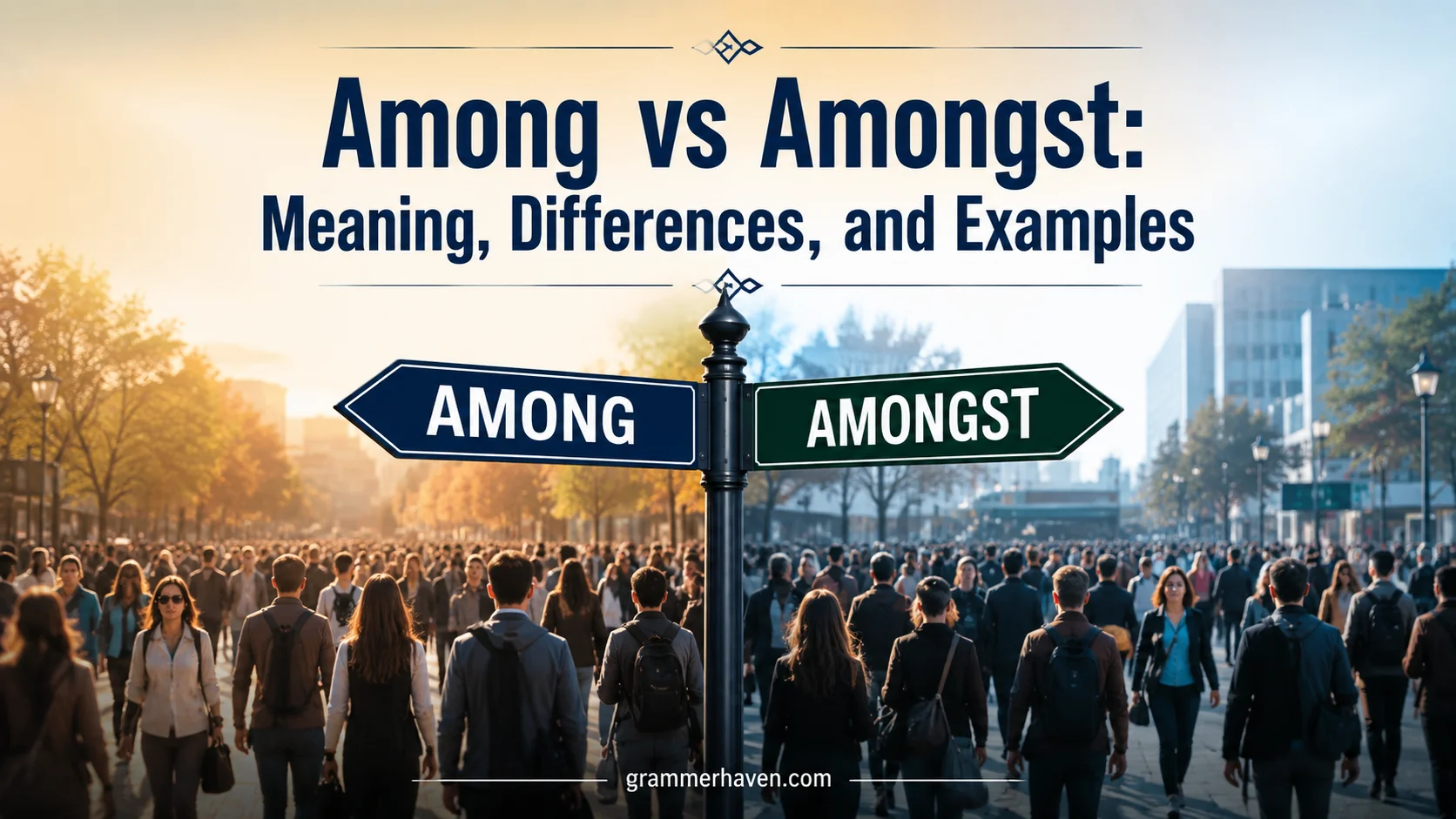
When you compare among vs amongst, you might wonder whether one word is more correct than the other. Many writers hesitate before choosing between them because the words look almost identical.
The good news? Both words are correct.
Among and amongst have the same meaning. They both describe something located within a group, surrounded by several people or things, or shared across members of a collection. The main difference is not grammar. It is style, frequency, and regional preference.
In modern English, especially American English, among is the clear favorite. Amongst appears more often in British English and in writing that aims for a traditional, formal, or literary tone.
This guide explains among vs amongst, including their meanings, differences, history, examples, common mistakes, and when you should use each one.
( =========== Move anywear else during drifting
Among vs Amongst Explained: Meaning, Differences, and Examples shows why these English words create confusion in writing, despite sharing the same meaning and similar usage in a sentence. Among and amongst describe being surrounded by somebody or something, positioned in the middle of a group, company, or association. They can describe something occurring or practiced within a group. For example, “She felt comfortable among her friends” places her in the middle of that group. Today’s post focuses on their choice and everyday use.
Either form is correct, but among is the safer and more widely used option, especially in modern English writing. In my experience reviewing sentences, among usually sounds more natural and clear. The important points are understanding their functions, differences, and examples so you can use each word confidently. Questions often arise when you encounter both forms in different contexts, but neither is automatically wrong.)
Among vs Amongst: Quick Comparison
Before exploring the details, here is a simple overview:
| Feature | Among | Amongst |
| Meaning | Within or surrounded by a group | Within or surrounded by a group |
| Word type | Preposition | Preposition |
| Grammar correctness | Correct | Correct |
| Common usage | Very common | Less common |
| Tone | Modern, neutral | Traditional, formal, literary |
| More common in | American English | British English |
| Everyday writing | Preferred choice | Less common |
The biggest takeaway:
Among is the standard choice for most modern writing. Amongst is an alternative form that adds a slightly old-fashioned or formal feeling.
What Does Among Meaning?
Among is a preposition that means being surrounded by, included in, or part of a group.
You use among when something exists inside a larger collection of people, objects, places, or ideas.
For example:
- “She found her phone among the books.”
- “He was popular among his classmates.”
- “The cabin sits among tall trees.”
In each example, the subject is connected to a group.
The phone is mixed in with books.
The person belongs to a group of classmates.
The cabin is surrounded by trees.
Common Uses of Among
The word among appears in many different situations. Here are the most common ones.
1. Among for Physical Location
Use among when something exists inside a group of physical objects.
Examples:
- “The small house was hidden among the mountains.”
- “A red flower grew among the white roses.”
- “The child disappeared among the crowd.”
The word creates a picture of something surrounded by many similar things.
Think of a single tree standing in a forest. The tree is not simply next to the forest. It is among the forest.
2. Among for Groups of People
You can use among when talking about relationships, opinions, or positions within a group.
Examples:
- “The scientist became respected among researchers.”
- “There was excitement among the fans.”
- “The new policy caused disagreement among employees.”
Here, among shows how something exists inside a community or group.
3. Among for Sharing or Distribution
Another common use involves dividing something between members of a group.
Examples:
- “The teacher distributed the papers among the students.”
- “They shared the responsibilities among team members.”
- “The charity divided donations among several organizations.”
The word highlights that multiple people receive or participate in something.
What Does Amongst Mean?
Amongst has the same meaning as among.
There is no major difference in definition.
Examples:
- “She walked amongst the trees.”
- “The message spread amongst employees.”
- “The treasure was hidden amongst old documents.”
These sentences mean the same thing if you replace amongst with among.
Compare:
“The village was located among the hills.”
and:
“The village was located amongst the hills.”
Both sentences are correct.
However, the second sentence sounds slightly more poetic or traditional.
Among vs Amongst: What Is the Actual Difference?
The difference between among and amongst comes from how people use them, not what they mean.
Meaning Difference
There is almost no meaning difference.
| Sentence | Meaning |
| “She sat among friends.” | She sat within a group of friends. |
| “She sat amongst friends.” | She sat within a group of friends. |
The message stays the same.
Style Difference
The main difference is tone.
Among
Sounds:
- Natural
- Modern
- Simple
- Common
Example:
“The company ranked among the industry leaders.”
This sounds normal in business writing.
Amongst
Sounds:
- More formal
- More traditional
- Slightly poetic
Example:
“The traveler wandered amongst the ancient ruins.”
This creates a more literary atmosphere.
Is Amongst More Correct Than Among?
A common misconception is that amongst is a more sophisticated or grammatically superior version of among.
That is not true.
Both words are grammatically correct.
Choosing amongst does not automatically improve your writing. Sometimes it can make a sentence feel unnecessarily formal.
Compare:
Natural:
“The report was shared among employees.”
More formal sounding:
“The report was shared amongst employees.”
Both work, but the first sentence fits most professional situations better.
Clear writing usually beats complicated writing.
Why Does Amongst Exist? A Short History
English has changed dramatically over hundreds of years. Many words developed alternative forms because speakers added endings to create different sounds.
Among comes from Old English roots connected to the idea of being mixed or included within something.
Later, amongst developed as an extended form.
This pattern appears in other English words:
| Common Form | Alternative Form |
| While | Whilst |
| Among | Amongst |
| Amid | Amidst |
Historically, these extra endings were more common. Over time, some survived in certain regions while others became less frequent.
Today, among dominates everyday English.
Among vs Amongst in American English
In the United States, among is overwhelmingly more common.
American writers usually choose among because it sounds direct and natural.
Examples:
- “The results showed differences among participants.”
- “She was among the first people to arrive.”
- “The decision created debate among voters.”
Using amongst in American English is not wrong, but it often creates a more formal or old-fashioned tone.
For example:
“The eagle flew amongst the clouds.”
This sounds like a line from a poem rather than everyday conversation.
Among vs Amongst in British English
British English uses both forms.
However, British speakers are generally more comfortable with amongst than American speakers.
Examples:
- “The issue caused concern among residents.”
- “The flowers grew amongst the grass.”
Both sound acceptable in Britain.
Still, among remains common in British writing, especially in journalism, academic writing, and business communication.
Common Mistakes With Among and Amongst
Understanding the rules helps you avoid awkward sentences.
Mistake 1: Using Among for Only Two Things
Traditionally, among refers to groups of three or more.
Incorrect:
“The agreement was among Sarah and John.”
Better:
“The agreement was between Sarah and John.”
Use between when you are talking about two clearly separate people or things.
Mistake 2: Thinking Amongst Means Something Different
Some writers believe amongst means something more specific.
It does not.
These sentences mean the same:
- “The secret spread among the villagers.”
- “The secret spread amongst the villagers.”
Mistake 3: Using Amongst to Sound More Intelligent
A longer word is not always a better word.
Example:
“The manager explained the changes amongst the employees.”
This is correct, but:
“The manager explained the changes among the employees.”
sounds more natural.
Good writing focuses on clarity, not decoration.
Among vs Between: The Difference Explained
Many people confuse among and between.
The traditional rule is:
- Between = relationships involving separate individuals or groups.
- Among = something within a larger group.
Examples:
Between
“The conversation was between the two managers.”
There are two clearly identified people.
Among
“The conversation spread among the managers.”
The information moved through a group.
However, modern English allows between with more than two clearly separate items.
Example:
“The treaty was negotiated between five countries.”
Each country is an individual participant, so between works.
Among vs Amongst Examples in Real Sentences
Seeing examples in context makes the difference easier to understand.
Everyday Examples
| Sentence | Why It Works |
| “She felt comfortable among friends.” | She was part of a group. |
| “The dog ran among the children.” | The dog moved within a group. |
| “I found my wallet among the papers.” | The wallet was mixed with other objects. |
Workplace Examples
| Sentence | Usage |
| “The manager shared the update among employees.” | Distribution within a group |
| “Trust among coworkers improves teamwork.” | Relationship inside a group |
| “The decision created discussion among leaders.” | Opinions within a group |
Academic Writing Examples
Academic writing usually favors among because it sounds neutral.
Examples:
- “The researchers compared differences among participants.”
- “The study identified patterns among age groups.”
- “The results varied among different regions.”
Creative Writing Examples
Creative writing may use amongst for atmosphere.
Examples:
- “The castle stood amongst the mist-covered hills.”
- “She searched amongst forgotten memories.”
- “The warrior disappeared amongst the shadows.”
The extra syllable can make the sentence feel slower and more dramatic.
When Should You Use Among Instead of Amongst?
For most situations, choose among.
Use among when you are:
- Writing an article.
- Creating business content.
- Writing an email.
- Preparing academic work.
- Communicating with a broad audience.
Examples:
✅ “The survey was conducted among customers.”
✅ “The company is among the market leaders.”
When Should You Use Amongst?
Choose amongst when you want a specific style.
Use it when:
- Writing poetry.
- Creating historical fiction.
- Following British style preferences.
- Trying to create a traditional tone.
Examples:
“The knight walked amongst the ruins.”
“A quiet voice echoed amongst the trees.”
A Simple Rule to Remember Among vs Amongst
If you are unsure, use this rule:
Use “among” for everyday writing. Use “amongst” when you intentionally want a more formal or literary sound.
A quick memory trick:
“Among is the everyday shirt. Amongst is the jacket you wear for a special occasion.”
Both work. The choice depends on the setting.
See also: Jist or Gist: Which Is Correct in 2026?
FAQs:
1. Are among and amongst the same word?
No. Among and amongst are different forms of the same word, but they generally have the same meaning and functions.
2. What does among mean?
Among means being surrounded by or included within a group of people or things. It can also describe a division or choice involving three or more parties.
3. What does amongst mean?
Amongst has essentially the same meaning as among. It can mean being in the middle of or surrounded by people or things.
4. Is among more common than amongst?
Yes. Among is generally the more widely used and favored form, especially in modern American English.
5. Is amongst grammatically correct?
Yes. Amongst is a grammatically correct English word. It may sound more traditional or formal in some contexts.
6. Should I use among or amongst in American English?
Among is usually the better choice in American writing because it sounds more natural and is more common.
7. Is amongst more common in British English?
Amongst appears more often in British English than in American English, although among remains common and completely correct in British usage.
8. Can among be used for three or more people?
Yes. Among can indicate a division, relationship, or choice involving three or more people or things.
9. Does amongst have a different meaning from among?
Usually, no. The two forms generally don’t have different meanings. The main difference is their style, frequency, and regional preference.
10. Which is correct: among or amongst?
Either is correct. Choose among when you want the more common and straightforward option. Choose amongst when its slightly traditional or formal tone fits your sentence.
Conclusion:
Among and amongst share almost the same meaning and can perform the same functions in a sentence. Both can describe being surrounded by people or things, existing within a group, or making a division or choice among several parties.
The practical difference is mainly usage and style. Among is the safer and more common choice, particularly in American English, while amongst can give writing a more traditional or formal feel. If you’re unsure which one to use, among will usually be the natural choice.