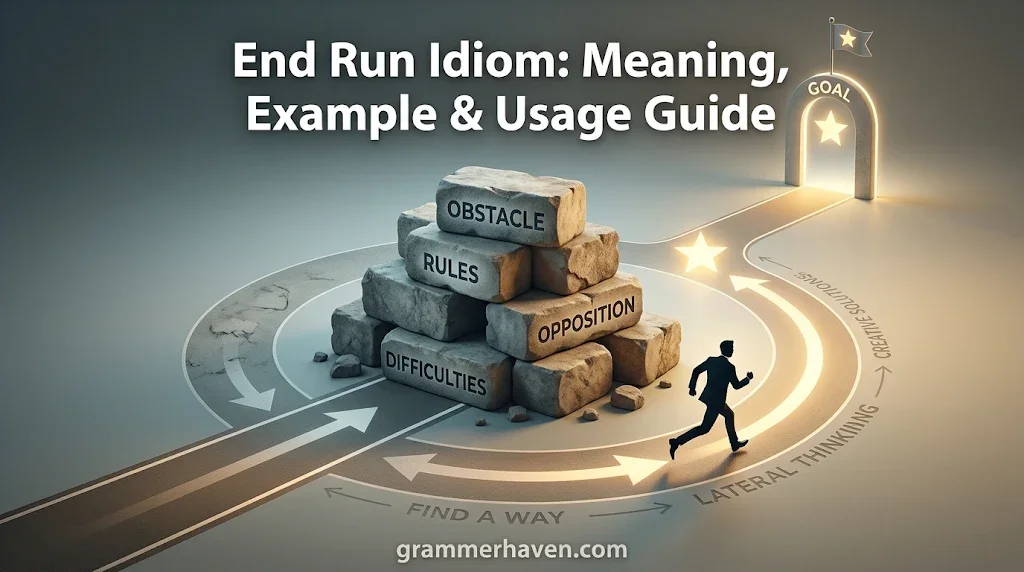
The End Run Idiom Meaning, Example & Usage Guide explains how this football phrase helps people understand a shortcut strategy in daily communication. The end run idiom has an interesting meaning because this football move became a phrase used in everyday conversation, chats, meetings, and workplace discussions. The term can make people feel puzzled as they wonder what it really mean and why this popular idiom appears outside sports arenas. The origins show a clear contrast between a sports strategy and a communication strategy. In real conversations, people may make an end run to explain a different way to reach a goal because the core idea is a strategy that avoids the usual way and helps someone achieve results more quickly and easily.
In real-life situations, an end run often means bypassing rules or accepted procedures without breaking rules. It does not always involve trying to challenge authority; instead, it can be a shortcut or alternative route to solve problems. In an office setting, a project may need approval, but lengthy meetings with middle managers can slow the approval process. In one case, a team faced delays and chose directly speaking with the top boss for a quicker decision. They did not break policy; they simply skip over delays, speed up progress, and continue following accepted procedures.
This idiom also shows how language changes and how a simple football move can shape modern language and workplace communication. People use this phrase in sentences to discuss decision making, management, and ways to tackle challenges while planning their next moves. The tips to remember the usage are simple: think about taking a different path instead of the normal route. Although the phrase sounds strange at first, it becomes clear when you see how it connects with goal achievement, workplace situations, and everyday problem-solving.
End Run Idiom Meaning Explained in Simple English
At its core, the end run idiom means:
To avoid a barrier or authority by going around it instead of through it.
Think of it like this:
Instead of walking through a locked door, you walk around the building.
That’s the mental image behind the phrase.
Simple breakdown:
- End = the outer edge or side
- Run = movement or action
- End run = going around the edge to avoid the center obstacle
So when someone “makes an end run,” they don’t follow the expected path. They take a side route.
Real meaning in everyday use:
People usually use it when someone:
- Bypasses a manager or boss
- Avoids rules or procedures
- Skips authority levels
- Finds an indirect way to get what they want
It often carries a slightly strategic or mildly negative tone, depending on context.
Origin of the End Run Idiom (From Football to Boardrooms)
The end run idiom origin comes directly from American football.
In football, an end run happens when a player:
- Runs toward the edge of the field
- Avoids the defensive line in the center
- Tries to gain yards by going around defenders
Instead of crashing through the middle, the player uses speed and positioning to sneak around the defense.
How it entered everyday language
Over time, people noticed how similar this was to real-life situations:
- Employees bypassing managers
- Politicians avoiding bureaucracy
- Companies working around regulations
So the phrase moved from sports commentary into everyday English.
Why this idiom survived so well
It stuck because it:
- Creates a strong visual image
- Feels strategic and smart
- Works in business, politics, and casual talk
Just like other sports idioms such as “ballpark figure” or “step up to the plate,” it crossed into normal language naturally.
How the End Run Idiom Works in Modern English
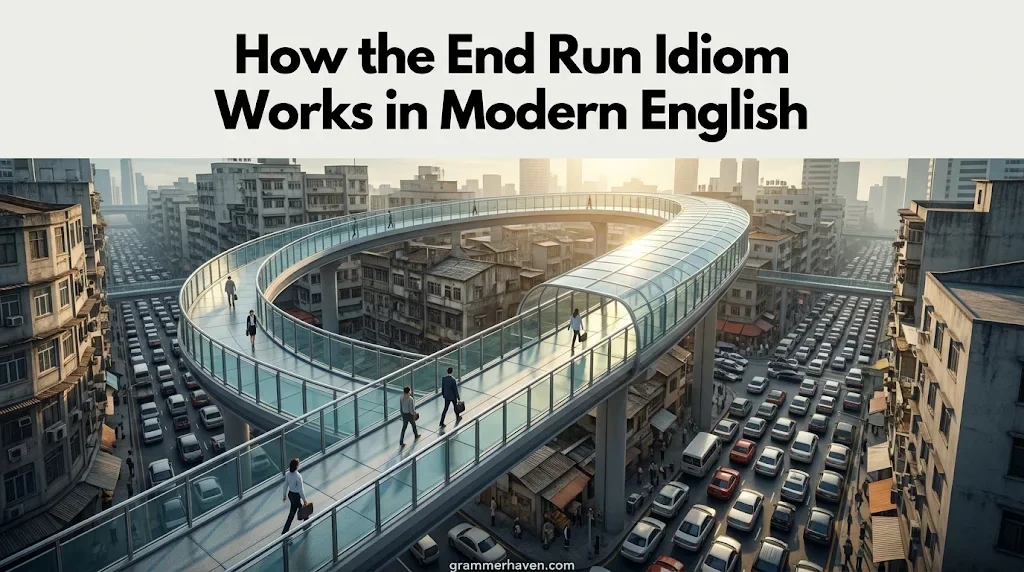
Today, people use end run idiom meaning example usage in several real-world contexts. Let’s explore how it shows up in daily life.
End Run in Business Context
This is where you’ll hear it most often.
Typical meaning:
An employee or department bypasses the normal chain of command.
Example scenario:
Imagine a marketing executive disagrees with their manager’s decision. Instead of debating it internally, they go straight to the CEO.
Someone might say:
“She made an end run around her manager and pitched the idea directly to the CEO.”
Why it matters in workplaces:
- It can speed up decisions
- It can create conflict
- It can undermine authority structures
Business example in dialogue:
“Don’t make an end run around the project lead. Follow the process first.”
End Run in Politics and Government
Politics uses this idiom heavily because systems often involve layers of authority.
Meaning in politics:
A politician or group avoids formal procedures to achieve a goal.
Example:
A lawmaker introduces a policy through indirect channels instead of going through standard committees.
People might say:
“The administration tried an end run around Congress.”
Why politicians use end runs:
- To bypass opposition
- To speed up legislation
- To avoid political gridlock
But it often leads to controversy because it can feel like a shortcut around democratic process.
End Run in Everyday Conversations
You don’t need to work in business or politics to hear this idiom.
Everyday meaning:
Someone avoids a direct conflict by going around a person or rule.
Example:
Your roommate refuses your request, so you ask your landlord instead.
Someone might say:
“He made an end run around me and asked my parents instead.”
Everyday situations:
- Family decisions
- Group projects
- Friend disagreements
It often carries a tone of mild frustration or surprise.
Real-Life Examples of End Run Idiom Usage
Let’s look at practical, relatable examples so you can feel how it works.
Example 1: Workplace politics
Sarah didn’t agree with her supervisor’s decision. Instead of arguing, she made an end run and contacted upper management directly.
Example 2: School project
The student made an end run around the group leader and submitted the work to the teacher alone.
Example 3: Family situation
He made an end run around his parents and asked his older brother for permission.
Example 4: Business negotiation
The company tried an end run around regulators by restructuring the deal.
Grammar and Sentence Structure of “End Run”
The phrase “end run” works as a noun in sentences.
Common patterns:
“Make an end run around + person/system”
- He made an end run around his boss.
- They made an end run around the rules.
“Attempt an end run against + authority”
- The company attempted an end run against regulators.
“An end run on + organization”
- The team executed an end run on the committee process.
Placement in sentences:
You can use it:
- At the start: “An end run around the system caused tension.”
- In the middle: “She made an end run around her manager.”
Synonyms and Related Expressions
You don’t always need to use “end run.” English gives you plenty of alternatives.
| Expression | Meaning | Tone |
| Circumvent | Avoid rules or obstacles | Formal |
| Bypass | Go around something | Neutral |
| Go over someone’s head | Escalate authority | Neutral |
| Skirt the rules | Avoid rules indirectly | Slightly negative |
| Work around | Find an alternative method | Neutral |
Key difference:
“End run” often feels more strategic and deliberate, while “bypass” sounds more neutral.
Idioms Similar to End Run
English has several related idioms that express similar ideas.
Go over someone’s head
You escalate beyond a direct authority figure.
“She went over her manager’s head to HR.”
Jump the chain of command
You skip levels in an organization.
“He jumped the chain of command and contacted executives.”
Cut corners
You take shortcuts, often reducing quality.
“They cut corners to finish faster.”
Work around something
You avoid a problem creatively.
“We worked around the system limitations.”
Each one carries a slightly different emotional tone, even if the logic overlaps.
Common Mistakes When Using “End Run”
Even fluent speakers misuse this idiom sometimes.
Mistake 1: Using it too literally
People sometimes think it only applies to sports. It doesn’t.
Mistake 2: Using it in formal academic writing
It sounds too conversational for research papers or legal documents.
Mistake 3: Confusing it with cheating
An end run doesn’t always mean wrongdoing. It can simply mean indirect action.
Mistake 4: Overusing it
If you say it too often, it loses impact.
Tone and Connotation of End Run
This idiom sits in a unique emotional space.
Neutral use:
- “He made an end run to speed up approval.”
Slightly negative use:
- “She made an end run behind his back.”
Strategic or positive use:
- “They made an end run to avoid bureaucracy.”
What native speakers feel:
They usually sense strategy, indirect action, and authority bypassing.
It rarely feels neutral-neutral. There’s always a hint of maneuvering involved.
Quick Comparison Table: End Run vs Similar Idioms
| Phrase | Meaning | Strength of “bypass” idea | Formality |
| End run | Indirectly bypass authority | Strong | Informal |
| Go over someone’s head | Skip authority levels | Medium | Neutral |
| Circumvent | Avoid system/rules | Strong | Formal |
| Work around | Find alternative path | Weak | Neutral |
Case Study: End Run in a Corporate Environment
Let’s walk through a realistic scenario.
Situation:
A tech company plans a major product update. The product manager disagrees with engineering leadership.
What happens:
Instead of debating internally, the product manager contacts the CEO directly and pitches the idea.
Result:
- The CEO approves the change
- Engineering feels undermined
- Internal conflict increases
Analysis:
This is a classic end run maneuver.
Key takeaway:
End runs can:
- Speed up decisions
- Create internal tension
- Shift power dynamics
They work best when timing matters more than hierarchy—but they can damage trust if overused.
See also: Is It Correct “To Inquire About Something”?
FAQs:
1. What does the end run idiom mean?
The end run idiom means finding a different or indirect way to achieve a goal by avoiding the usual process. It often describes a shortcut or alternative approach that helps someone move forward faster.
2. Where does the phrase end run come from?
The phrase end run comes from football, where a player runs around the end of the defensive line instead of moving directly through it. Over time, the term became a common expression for avoiding obstacles.
3. Does making an end run mean breaking rules?
No, making an end run does not always mean breaking rules. It usually means finding another way to complete a task while still respecting important policies or requirements.
4. How can I use end run in a sentence?
You can use it when someone avoids a slow process to reach a goal. For example: “The team made an end run around unnecessary delays by speaking directly with the decision-maker.”
5. Is end run commonly used in everyday conversation?
Yes, people use end run in workplaces, business discussions, and casual conversations. It is especially common when talking about strategies, problem-solving, and finding alternative solutions.
Conclusion:
The end run idiom is more than just a phrase borrowed from a football move. It represents a smart strategy where someone finds a different path to achieve a goal without completely ignoring rules or responsibilities. Whether it appears in workplace discussions, meetings, or everyday conversations, the phrase helps explain situations where people avoid unnecessary delays and choose a more direct approach. Understanding its meaning, examples, and usage makes it easier to recognize how this idiom connects sports, communication, and real-life problem-solving.
Latest Post:
- Is It Correct to Say “A Big Congratulations”? The Complete Grammar Guide
- Two Crows Being an Attempted Murder: Meaning, Origins & Real Behavior
- Farther vs. Further: What’s the Difference?
- Result In or Result To: Which Is Correct? (With Examples)
- A Dime a Dozen: Meaning, Definition, Origin and Real-Life Usage