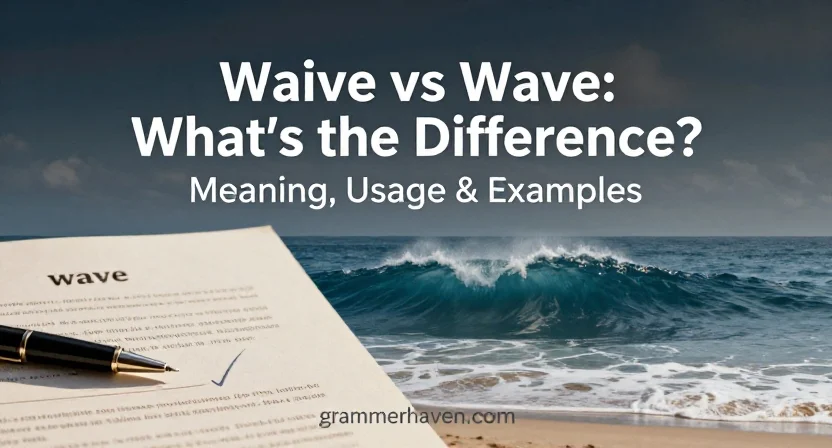
Waive vs Wave explains why these words cause confusion: they sound alike, yet their spelling, meaning, and context make their uses different. These distant cousins have different meanings, which creates a common snag when learning English. Waive refers to giving up something, such as rights or claims, often voluntarily. A person may waive the fee, give up legal representation, or represent yourself in court. A company may remove a fee, payment, or charge. Wave describes an action where you move your hand or another object back and forth for a greeting or signaling. You can wave to a friend across the street to get their attention or send a signal.
Diligent students can avoid this mix-up by keeping the distinction clear in a simple mental loop. Writing and conversations require attention to the spelling difference, even when the sound seems exactly alike in standard American English. An example is “She chose to waive the fee,” while “She waved at me” describes someone who moved a hand as a greeting. The meaning becomes completely different when the spelling changes. Check the entire sentence, main idea, and context before choosing the word. This approach helps students and people use each term accurately.
To remember this classic pair, connect spelling, pronunciation, and American English usage with the meaning of each word. Waive fits when someone chooses to give up a right, claim, fee, or obligation. Wave fits when a person uses a hand or object for signaling, greeting, or another physical gesture. The action tells you which word belongs in the sentence. The written form can guide you when pronunciation does not. This method makes it easier to use each word correctly and avoid another round of confusion.
Quick Answer: Waive vs Wave
Waive is a verb that means to voluntarily give up something, such as a right, fee, requirement, rule, or claim. It can also mean removing a player from a sports team’s roster in U.S. usage.
Wave can be a noun or a verb. It can describe a hand gesture, moving something from side to side, a swell of water, a sudden increase, or a repeating pattern of energy.
| Word | Part of Speech | Main Meaning | Example |
| Waive | Verb | Give up, remove, or not enforce something | “The bank agreed to waive the fee.” |
| Wave | Noun / Verb | Move, gesture, swell, or rise | “She gave me a wave.” |
The easiest rule is:
Waive = give up. Wave = move.
If you’re talking about a fee, right, requirement, claim, or penalty, you probably need waive. If you’re talking about a hand, ocean, flag, gesture, movement, or surge, you probably need wave.
What Does Waive Mean?
Waive means to voluntarily give up something that you have a right to, or to decide that a rule or requirement doesn’t need to be followed. Cambridge defines it as not demanding something you have a right to or not causing a rule to be obeyed.
The word often appears in formal situations. You’ll see it frequently in legal documents, business policies, financial agreements, applications, contracts, and official notices.
For example:
- “The bank agreed to waive the service fee.”
- “The university may waive the application fee.”
- “He decided to waive his right to appeal.”
- “The company agreed to waive the penalty.”
- “The school can waive the requirement under certain conditions.”
The central idea stays the same: something that could normally be demanded is no longer being demanded.
Waive Definition in Simple English
Think of waive as saying:
“You don’t have to do this or pay this anymore.”
Suppose a hotel normally charges a $50 cancellation fee. Your flight gets canceled because of a major storm. The hotel decides not to charge you.
The hotel waived the cancellation fee.
The fee existed. The hotel had a reason to charge it. However, the hotel chose not to demand it.
That’s the heart of waive.
Common Things You Can Waive
You can waive many different kinds of obligations or rights.
Common combinations include:
- waive a fee
- waive a charge
- waive a penalty
- waive a requirement
- waive a right
- waive a claim
- waive a condition
- waive a deadline
- waive an objection
- waive a rule
For example, “The lender waived the late fee” means the lender decided not to require payment of that fee.
Similarly, “She waived her right to appeal” means she voluntarily gave up that right.
Waive in Legal and Formal Writing
Waive has an especially important role in legal language.
A person can waive a legal right, meaning they voluntarily give up the ability to exercise that right in a particular situation. The exact legal effect depends on the relevant law and document, so ordinary dictionary meaning shouldn’t be treated as legal advice.
For example:
“The defendant waived his right to a hearing.”
Here, waived doesn’t mean moved a hand. It means the person gave up or declined a right.
This distinction matters because replacing waived with waved can make a sentence nonsensical.
What Does Wave Mean?
Wave has several meanings, and unlike waive, it works as both a noun and a verb.
As a verb, wave commonly means moving your hand from side to side as a greeting, farewell, signal, or way of getting someone’s attention. It can also mean moving an object from side to side.
As a noun, wave can refer to moving water, a hand gesture, a sudden increase, or a repeating pattern involving energy.
For example:
- “She waved at her neighbor.”
- “He waved goodbye.”
- “A large wave hit the boat.”
- “The flag waved in the wind.”
- “A wave of excitement swept through the crowd.”
So, unlike waive, which has a relatively focused core meaning, wave covers several related ideas involving movement, signals, and rising or repeating patterns.
Wave as a Noun
One common meaning of wave describes moving water.
“A huge wave crashed against the rocks.”
Here, wave refers to the raised movement of water.
The word also appears in expressions such as:
- ocean wave
- tidal wave
- breaking wave
- wave height
- wave energy
However, wave isn’t limited to water.
Wave as a Hand Gesture
A wave can also be a movement of the hand used to greet someone, say goodbye, attract attention, or communicate a signal.
For example:
- “She gave me a wave from the window.”
- “He gave us a quick wave before leaving.”
- “I saw her wave across the room.”
As a verb, you might say:
- “She waved at me.”
- “He waved goodbye.”
- “They waved to the crowd.”
This is one of the most common everyday uses of wave.
Wave as a Sudden Increase
English also uses wave figuratively to describe something that spreads or increases in a noticeable way.
For example:
- a wave of excitement
- a wave of fear
- a wave of protests
- a wave of visitors
- a wave of new technology
In these examples, nothing necessarily moves like ocean water. Instead, the word creates an image of something arriving, spreading, or building in succession.
Cambridge also lists this meaning for a sudden increase in an activity, condition, or feeling.
Waive vs Wave: The Key Difference
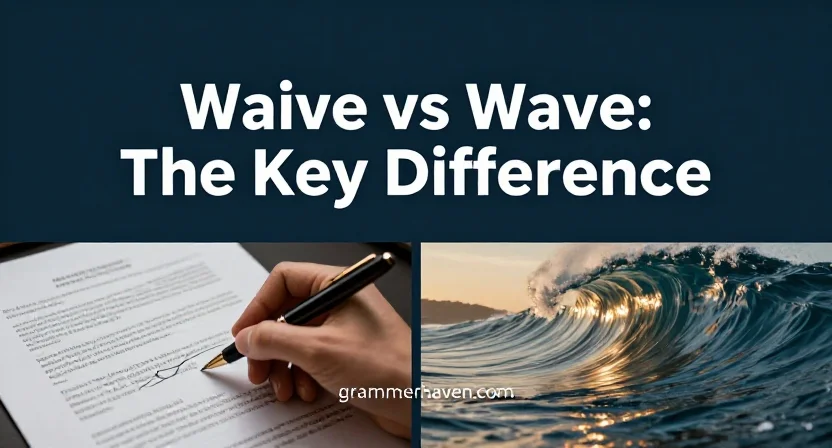
The simplest way to separate waive vs wave is to focus on the action involved.
Waive involves giving something up or choosing not to require it.
Wave involves movement, a gesture, a swell, or a rising pattern.
Consider these two sentences:
“The airline agreed to waive the change fee.”
“The passenger gave the employee a wave.”
The first sentence involves a fee being removed. The second involves a physical gesture.
Here’s another useful comparison:
| Meaning | Correct Word | Example |
| Give up a right | waive | “He waived his right to appeal.” |
| Remove a fee | waive | “The bank waived the fee.” |
| Ignore a requirement | waive | “The school waived the requirement.” |
| Move your hand | wave | “She waved at me.” |
| Moving water | wave | “A wave hit the shore.” |
| Move a flag | wave | “He waved the flag.” |
| Sudden increase | wave | “A wave of excitement followed.” |
The context usually gives you the answer.
Waive vs Wave Pronunciation
One reason waive vs wave causes so many mistakes is pronunciation.
In standard American English, both words are pronounced /weɪv/. Cambridge lists the same pronunciation for both words.
That makes them homophones: words that sound alike but have different meanings and spellings.
You can’t reliably distinguish them by listening alone.
Instead, you need to understand the sentence.
Compare:
- “They will waive the fee.”
- “They will wave from the balcony.”
If you hear only the sound, both words could fit phonetically. Once you understand the meaning, the correct spelling becomes obvious.
This is why spelling practice matters with homophones. Your ears hear the same sound, while your brain must use context to select the correct word.
Waive vs Wave Examples
Seeing the words in real sentences makes the distinction much clearer.
Examples With Waive
- “The company agreed to waive the delivery fee.”
- “The school may waive the application requirement.”
- “The bank decided to waive the overdraft charge.”
- “She chose to waive her right to appeal.”
- “The landlord agreed to waive the late-payment penalty.”
- “The organization can waive the membership fee in special circumstances.”
In each case, something is being given up, removed, or not required.
Examples With Wave
- “She waved at her parents.”
- “He waved goodbye from the train.”
- “The children watched the waves from the beach.”
- “A strong wave knocked the surfer off balance.”
- “The flag waved in the breeze.”
- “A new wave of customers arrived after lunch.”
Each sentence involves movement, a gesture, water, or a figurative surge.
Waive vs Wave in Different Contexts
Context provides a powerful shortcut when you’re unsure.
Legal Context
Legal and formal writing often uses waive.
Common expressions include:
- waive a right
- waive a claim
- waive an objection
- waive a requirement
- waive a condition
For example:
“The applicant waived the right to appeal.”
Using wave here would change the sentence into something that doesn’t make sense.
Business and Financial Context
Businesses frequently use waive when they remove charges or requirements.
For example:
“The bank waived the annual fee.”
“The company waived the cancellation charge.”
“The provider waived the installation fee.”
These sentences all involve an obligation that someone chose not to enforce.
Everyday Social Context
When you’re talking about greeting someone, wave is the correct word.
For example:
“I waved at my friend across the street.”
“She waved goodbye before getting into the car.”
The action involves a hand gesture. Therefore, wave fits naturally.
Nature and Weather
Use wave when discussing physical waves.
Examples include:
- ocean waves
- sound waves
- light waves
- electromagnetic waves
- heat waves
Cambridge specifically includes water movement and repeating energy patterns among the noun’s meanings.
Common Phrases With Waive
Some word combinations make the correct spelling almost automatic.
Waive a Fee
Waive a fee means to remove a fee that would normally apply.
“The company agreed to waive the $25 processing fee.”
This is one of the most common uses of the word.
Waive a Right
Waive a right means voluntarily giving up a right.
“She waived her right to appeal.”
This phrase frequently appears in legal and formal contexts.
Waive a Requirement
Waive a requirement means deciding that someone doesn’t have to meet a normally required condition.
“The university waived the prerequisite for experienced applicants.”
The exact rules depend on the institution involved, but the grammatical meaning remains straightforward.
Waive a Penalty
Waive a penalty means choosing not to impose or collect a penalty.
“The utility company waived the late-payment penalty.”
The penalty may normally apply, but the organization chooses not to enforce it.
Common Phrases With Wave
Wave Goodbye
Wave goodbye means using a hand gesture to say goodbye.
“She waved goodbye as the bus pulled away.”
Wave Hello
Wave hello means using a wave as a greeting.
“He waved hello from across the parking lot.”
Wave at Someone
The phrase wave at commonly identifies the person receiving the gesture.
“I waved at my neighbor.”
You can also use wave to:
“She waved to her brother.”
Wave a Flag
This means moving a flag from side to side.
“The fans waved flags during the celebration.”
The object being moved can vary:
- wave a flag
- wave a hand
- wave a piece of paper
- wave a sign
Waived vs Waved
The past forms create another common spelling trap.
Waived is the past tense and past participle of waive. Waved is the past tense of wave.
| Word | Meaning | Example |
| waived | Gave up, removed, or didn’t enforce something | “The fee was waived.” |
| waved | Moved back and forth or made a gesture | “She waved at me.” |
Consider this pair:
“The bank waived the fee.”
“The customer waved at the teller.”
The words sound nearly identical except for the grammatical ending, but their meanings remain completely separate.
Waive vs Wave vs Waver
Another word sometimes enters this confusion: waver.
These three words have different meanings.
| Word | Meaning | Example |
| waive | Give up or remove something | “They waived the fee.” |
| wave | Move back and forth or describe a swell | “She waved at us.” |
| waver | Hesitate or become uncertain | “His confidence began to waver.” |
Waver doesn’t mean to wave your hand.
If someone is uncertain about a decision, their resolve may waver.
For example:
“She didn’t waver in her decision.”
That means she didn’t become uncertain or hesitant.
Common Mistakes With Waive and Wave
“The Company Will Wave the Fee.”
Incorrect: “The company will wave the fee.”
Correct: “The company will waive the fee.”
A fee isn’t something you physically move from side to side. You’re giving up the right to collect it.
“She Waived at Me.”
Incorrect: “She waived at me.”
Correct: “She waved at me.”
A hand gesture requires wave.
“He Waved His Right to Appeal.”
Incorrect: “He waved his right to appeal.”
Correct: “He waived his right to appeal.”
A right can be voluntarily given up. It isn’t physically moved.
“A Huge Waive Hit the Shore.”
Incorrect: “A huge waive hit the shore.”
Correct: “A huge wave hit the shore.”
Water produces waves, not waives.
A Practical Way to Remember Waive vs Wave
Memory tricks work best when they’re short.
Remember: Waive = Give Up
Think about things that can be removed or surrendered:
- waive a fee
- waive a right
- waive a requirement
- waive a penalty
- waive a claim
Whenever the sentence involves giving something up, think waive.
Remember: Wave = Move
Think about physical movement:
- wave your hand
- wave goodbye
- wave a flag
- ocean wave
- sound wave
Whenever you see movement or a gesture, think wave.
A useful mnemonic is:
Waive means give up. Wave means move.
It’s short enough to stick.
Waive vs Wave in Sports
There’s one additional meaning of waive worth knowing, especially for American readers.
In U.S. sports terminology, a team can waive a player. This means the team removes the player from its roster and makes that player available to other teams under the applicable league rules. Cambridge records this as a U.S. usage.
For example:
“The team waived the player during the offseason.”
This doesn’t mean the team made a waving gesture toward the player.
The noun waiver also appears in sports:
“The player was placed on waivers.”
The term has a specific technical meaning within professional sports systems, so its exact consequences depend on the league’s rules.
Waiver vs Waive
Don’t confuse waive with waiver.
Waive is a verb.
Waiver is a noun referring to an agreement or official decision involving the giving up of a right, requirement, or obligation. Cambridge gives examples involving documents and fee waivers.
Compare:
- “The university may waive the fee.”
- “The university granted a fee waiver.”
In the first sentence, waive describes an action.
In the second, waiver names the arrangement or document.
You may encounter phrases such as:
- fee waiver
- liability waiver
- application fee waiver
- waiver form
- waiver agreement
A Real-World Case Study: A Fee Waiver
Imagine you’re applying for a course that normally charges a $100 application fee.
The institution has a policy allowing eligible applicants to avoid that fee.
You submit the required documentation. The institution approves your request.
The correct sentence is:
“The institution waived the application fee.”
Why?
Because the institution decided that you didn’t have to pay something that normally applied.
Now imagine you see the admissions officer from across the hallway. You raise your hand and move it from side to side.
The correct sentence is:
“You waved at the admissions officer.”
Same pronunciation. Completely different meaning.
That’s the entire waive vs wave problem in miniature.
Waive vs Wave: Quick Comparison
| Feature | Waive | Wave |
| Pronunciation | /weɪv/ | /weɪv/ |
| Main word class | Verb | Noun and verb |
| Core idea | Give up or not enforce | Move, gesture, swell, or surge |
| Common object | Fee, right, claim, requirement | Hand, flag, water, signal |
| Formal use | Very common | Less restricted |
| Legal use | Common | Usually unrelated |
| Example | “They waived the fee.” | “She waved at me.” |
| Past form | waived | waved |
How to Choose Between Waive and Wave
When you’re proofreading a sentence, ask one simple question:
What is happening in the sentence?
If someone is giving up, removing, forgiving, or not enforcing something, use waive.
If something is moving, gesturing, swelling, or rising, use wave.
Use Waive When:
- A fee disappears.
- A penalty isn’t collected.
- A requirement isn’t enforced.
- Someone gives up a right.
- Someone gives up a claim.
- A condition isn’t demanded.
- A sports team removes a player from its roster.
Use Wave When:
- Someone moves a hand.
- Someone says hello or goodbye with a gesture.
- Water rises and falls.
- A flag moves in the breeze.
- Something spreads in a surge.
- You describe a physical or energy wave.
See also: Have You Seen vs. Did You See: What’s the Difference?
FAQs:
Is it waive or wave a fee?
The correct phrase is waive a fee.
For example:
“The bank agreed to waive the annual fee.”
Waive means the bank decided not to require payment.
Is it waive or wave goodbye?
The correct phrase is wave goodbye.
For example:
“She waved goodbye before leaving.”
Here, wave describes the hand gesture used to say goodbye.
Are waive and wave pronounced the same?
Yes. In standard American English, both are pronounced /weɪv/.
They are therefore homophones.
Their meanings and spellings differ even though their pronunciation is the same.
Is “waived” the same as “waved”?
No.
Waived means someone gave up, removed, or chose not to enforce something.
Waved means someone moved something from side to side or made a waving gesture.
For example:
- “The fee was waived.”
- “She waved at her friend.”
What is an easy way to remember waive vs wave?
Use this simple rule:
Waive = give up.
Wave = move.
If you’re talking about a fee, right, requirement, claim, or penalty, waive is usually the word you need.
If you’re talking about a hand, flag, ocean, gesture, or physical movement, choose wave.
Conclusion:
The difference between waive vs wave is easy to remember once you know what each word means. Waive means to give up, remove, or not enforce something, such as a fee, right, or requirement. Wave refers to a hand gesture, movement, ocean swell, or sudden increase.
Remember this simple rule: waive = give up, wave = move. Since both words sound the same, always use the meaning of the sentence to choose the correct spelling.