It’s vs. Its: Meaning, Difference, Rules, and Examples
It’s vs. Its explains a common English word pair: it’s means it is or it has, while its shows possession, ownership, or association in writing. These forms look almost identical and can have the same sound in everyday speech, but their grammatical jobs are different in standard English. The apostrophe in it’s marks a contraction, ...
Read more
Disoriented or Disorientated: Which Is Correct?
“Disoriented or Disorientated” refers to the same state of confusion, with regional usage shaping which form sounds natural in English writing. Disoriented and disorientated have the same meaning and describe someone who feels confused, loses their sense of direction, or has trouble understanding their surroundings and think clearly. Both are correct English forms, and major ...
Read more
“Learned” or “Learnt”? Which Spelling Is Correct?
“Learned” or “Learnt”? are two forms of the same verb, with the same meaning: to gain knowledge or a skill. “I learned something new” and “I learnt something new” are both correct. American English strongly favors learned, while British English commonly accepts learnt as the standard past form and UK alternative. The important difference is ...
Read more
Don’t Rain on My Parade: Meaning, Origin & How to Use This Idiom
Don’t Rain on My Parade is a colorful English idiom for protecting your happiness, excitement, and plans from someone’s negativity or criticism. Its meaning comes from the image of rain spoiling a parade, a joyful event. The phrase is especially common in American English, conversational speech, and everyday conversation. A friend might use it after ...
Read more
‘Prove’ vs. ‘Proof’: Meaning, Differences and Correct Usage
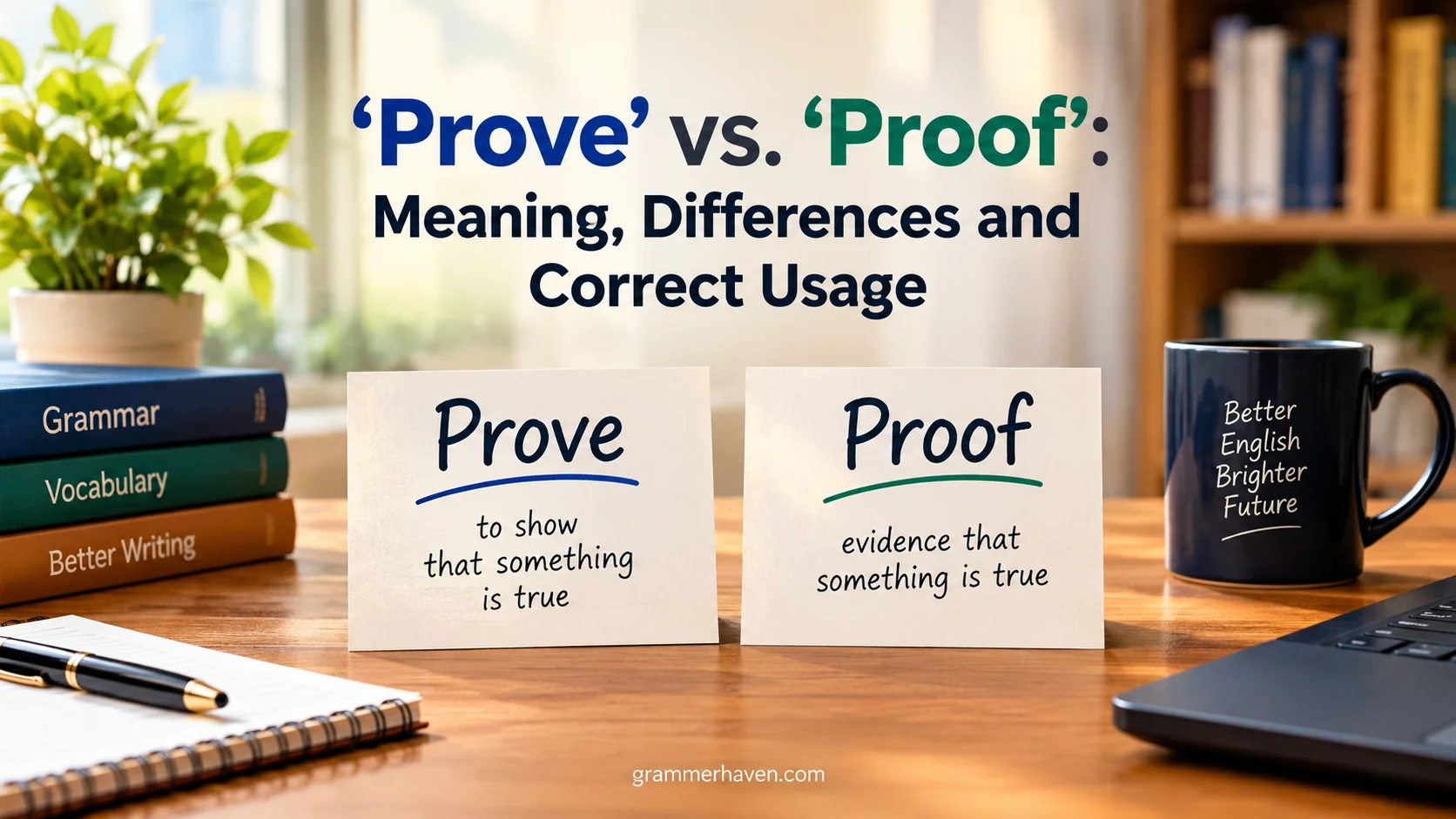
‘Prove’ vs. ‘Proof’: These words are closely related, but prove is a verb for an action while proof is a noun for evidence. Prove and proof can sound pretty much the same, yet their meanings are not interchangeable. Think of them as twins with different personalities and a common root. In learning English, knowing how ...
Read more
Dialog vs. Dialogue: Which Spelling Is Correct?
Dialog vs. Dialogue can catch us off guard because both are legitimate spelling forms in English, but their difference becomes clear through context. In everyday writing, conversations, discussions, and fictional speech, dialogue is the standard choice for exchanges of ideas between characters. You may have seen it in books, floating around on your screen, or ...
Read more
Deadbeat Dad or Deadbeat Mom: Meaning, Signs, Causes & What to Do
Deadbeat Dad or Deadbeat Mom describes a parent who avoids parental responsibilities, financial support, child support, and family obligations. A deadbeat dad or deadbeat mom may be an unreliable or lazy person who fails to fulfill basic responsibilities, including paying bills, making a payment, offering emotional support, and providing family support. The meaning usually depends ...
Read more
When All Is Said and Done: Meaning, Examples, and How to Use It
When All Is Said and Done is a useful phrase for summing up facts, ideas, or events when everything has been discussed and dealt with. The deeper meaning of this expression points to the overall result of a complicated situation. In everyday conversations, talking through each detail can help a speaker identify the most important ...
Read more
“If So” vs. “If Yes”: What’s the Difference?
“If So” vs. “If Yes” helps clarify English language, language nuances, and effective communication when conditional phrases appear after a question. “If so” is more flexible because the phrase can refer back to a previous question, statement, or situation. It means “if that is the case” or “if that is true.” “If yes” is more ...
Read more
Sounds Like a Plan, Stan: Meaning, Origin, Usage and Examples

Sounds Like a Plan, Stan is a playful expression that shows agreement with an idea or suggestion in a cheerful, catchy, casual way in conversation. The phrase works as a reply when you agree with an idea, suggestion, or proposal. Its playful expression, slightly silly tone, and catchy rhyming pattern give an ordinary response more ...
Read more












